







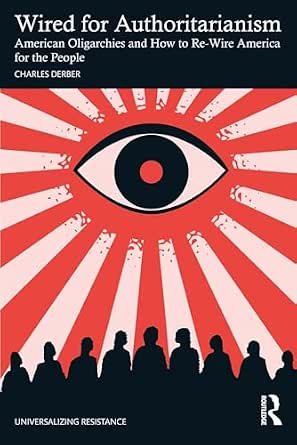
 Adapted from Wired for Authoritarianism: American Oligarchies and How to Re-Wire America for the People
The reigning narrative of US democracy is based on two widely shared beliefs. The first is that the capitalist system and its free markets ensure freedom and pluralism throughout society. The second is that our constitution and electoral system are forms of political wiring designed to ensure a democratic state. While an important veneer of democracy perpetuates this story, and it sounds intuitively plausible, theoretical, historical and empirical studies suggest that it is wrong in both theory and practice.
The reigning myth asserts that free markets tend to create, nourish and guarantee personal and political freedom. It is based on the neo‑classical thesis, advocated by Nobel economist Milton Friedman and other leading neo‑classical economists, that “free markets” ensure political liberty; the freedom to buy and sell in the market undergirds freedom throughout society. Moreover, free markets ensure pluralism, since the competition of the market prevents any individual or company from gaining dominant authority or control. Milton Friedman wrote that freedom is exceptional in human history and has historically come only with capitalist markets:
Because we live in a largely free society, we tend to forget how limited is the span of time and the part of the globe for which there has ever been anything like political freedom: the typical state of mankind is tyranny, servitude, and misery. The nineteenth century and early twentieth century in the Western world stand out as striking exceptions to the general trend of historical development. Political freedom… clearly came along with the free market and the development of capitalist institutions.
The reigning myth of capitalism as the bulwark of freedom suggests that the US Constitution and free elections modeled on liberty and free choice in the markets ensure and reinforce the American democracy which is built on the free markets themselves. The constitution is construed as fundamentally democratic. It has long been seen as creating basic rights and civil liberties, ensuring democratic pluralism in the electorate and crucial checks and balances in the state.
The Bill of Rights and subsequent constitutional amendments expanding voting rights and ensuring due process are, in fact, crucial wiring that has helped sustain both the idea of capitalist democracy and the reality of a credible democratic veneer. They have always provided an American creed that enables resistance and movement from a veneer toward a deeper democracy.
But the celebration of constitutional rights and elections has functioned in large measure to obscure the authoritarian wiring built into both capitalism and American constitutionalism. Much as the Magna Carta did provide limited rights to the barons, curbing the king, it never offered meaningful control to ordinary people not part of the nobility. Through a very different system of wiring, American capitalism provides limited rights to ordinary people but fundamentally requires and ensures the wiring of shared governance by our modern corporate barons and the president, taking control behind the veneer of democracy.
Both markets and constitutional rights do offer liberties central to a credible American democratic veneer. But the reality of capitalist democracy ruled by the people has been decisively refuted by many leading scholars and analysts focusing on power and democracy in the US. American sociologists such as C. Wright Mills and G. William Domhoff, as well as political economists such as Harry Magdoff, Paul Sweezy and David Harvey, have advanced influential studies of the control of America by power elites.
Along with many other scholars, each has elaborated variants of “power elite” theories showing that the capitalist class increasingly controls the US government and society, in partnership with the President and military elites. This vision of American authoritarianism was developed most famously in the mid‑20th century by Mills in his book, The Power Elite. The power elite was made up of corporate oligarchs in a small number of giant corporations uniting with the President and the top brass in the military. Mills wrote that:
These hierarchies of state and corporation and army constitute the means of power; as such they are now of a consequence not before equaled in human history—and at their summits, there are now those command posts of modern society which offer us the sociological key to an understanding of the role of the higher circles in America…. Families and churches and schools adapt to modern life; governments and armies and corporations shape it; and, as they do so, they turn these lesser institutions into means for their ends…. The economic, governmental, and military realms drive events and make history. Other institutions are transformed by decisions made in these realms. Schools, for example, appease corporate interests by changing their curricula to train individuals for business careers.
Inequality studies by eminent economists such as Thomas Piketty, Joseph Stiglitz and John Kenneth Galbraith, have added empirical weight to the evidence that concentration of capital and wealth is moving US society toward a corporate oligarchy with unprecedented concentrated wealth. Historical studies have shown that the rise of large oligopolistic and monopolistic global corporations as well as a new class of billionaires—tied to the shift from competitive to monopoly capitalism and the rewiring of the constitution and the state—increasingly limits democratic rule despite the perpetuation of the veneer of democracy.
The shift from competitive to monopoly capitalism was a major development. The idea of capitalist freedom assumes that thousands of firms compete freely with each other, with none having the power to control the whole economy or society. As Paul Baran and Paul Sweezy wrote in their influential book, Monopoly Capital, competitive capitalism died more than a century ago.
We must recognize that competition, which was the dominant form of market relations in 19th century Britain, has ceased to occupy that position, not only in Britain but everywhere else in the capitalist world. Today, the typical economic unit in the capitalist world is not the small firm producing a negligible fraction of a homogeneous output for an anonymous market but a large‑scale enterprise producing a significant share of the output of an industry, or even several industries, and able to control its prices.
The myth of capitalist democracy perpetuated and ignored the shift to monopoly capitalism, which undercut the intuitive idea of the market creating freedom. When most economic sectors are run by one or two monopoly firms, what happens to freedom, both in the market and in society? The plausibility of competition as a form of capitalist freedom begins to shatter as giant monopoly corporations gain the means to shape both the economy and political world, including investing the dark money where billionaires like Elon Musk funded Trump’s 2024 re-election with about $275 million in campaign donations.
Moreover, theories of the capitalist order have shown that the system, even in its competitive form, always led toward authoritarian rule. Neo‑Marxists have examined Marx’s own theory that government in capitalist societies is inherently authoritarian, with ownership of capital a central tool for gaining and wielding political power. In some of his most famous words, Marx wrote that the capitalist class:
…since the establishment of Modern Industry and of the world‑ market, conquered for itself, in the modern representative State, exclusive political sway. The executive of the modern State is but a committee for managing the common affairs of the whole bourgoisie.
Note that Marx recognizes the “representative” veneer of the state, disguising the underlying authoritarianism and the element of what I call covert control or wiring. Nonetheless, Marx does not mince words about inexorable, essential oligarchic control. Control of the state and predominant political power is essential to the pursuit of profit and the perpetuation of capitalism itself.
Marx argued that capitalism is based on a class system in which the dominant class owns the means of production. Everyone else is part of the working class, dependent for their survival on employment by the ownership class.
Such institutionalized class‑based dependency grows out of the reality that working people lack the land or capital to support themselves. To survive, they need to work for the owners of factories and other modern corporations; they have little choice but to accept the conditions of work, culture and life imposed on them by their bosses, who, in memorable words, have:
…left remaining no other nexus between man and man than naked self‑interest, than callous “cash payment.” It has drowned the most heavenly ecstasies of religious fervour, of chivalrous enthusiasm, of philistine sentimentalism, in the icy water of egotistical calculation… (its) single, unconscionable freedom‑Free Trade. In one word, exploitation, veiled by religious and political illusions, it has substituted naked, shameless, direct, brutal exploitation.
Here, Marx made explicit his critique of capitalism as freedom. The free market ensures mainly that individuals will be reduced to freedom for “egotistical calculation,” losing all liberty other than to pursue the desperate pursuit for survival. You are free, as many of my students say, to devote yourself to the essential “rat race” to make it on Wall Street.
To ensure the very existence of capitalism, capitalists need to have decisive control of the state. This ensures that laws and state policies create and sustain a system of private ownership and broader conditions laser‑focused on profitability and accumulation of wealth. Class politics are central in capitalist economies, and the corporate class needs to wire political institutions and the electoral system to ensure their own dominant influence.
In the Trump era, we have a new political wiring concentrating enormous political control in a tiny elite of slightly more than a thousand billionaires, including the president. Less than one‑tenth of 1% of the American people—super‑wealthy corporate oligarchs closely aligned with the President—rule together with Trump in his second term’s overt authoritarianism.
The empirical data on power elites and wealth point to the ways the corporate aristocracy has long aimed to control the state in search of higher profits. Democracy risks that the government will seek to regulate and tax corporations to fund labor and social welfare. It also risks a state that refuses to subsidize corporations and provide generous “corporate welfare.” Corporations are always dependent on state investment to build physical and social infrastructure, to fund their huge oligopolistic companies—such as Lockheed Martin and Boeing—in the military‑industrial complex, to fund military intervention and wars that protect their foreign markets and investments and to maximize corporate and private over public goods. Right from the very beginning, the infrastructure on which the vast fortunes depended was built with government subsidies for canals and railroads. To lose predominant influence over the state would mean loss of crucial ways that corporations maximize profit.
Oligarchic corporate control of the state, in concert with the president, inheres in American capitalism. But its secret is that it is not absolutist and sustains a credible veneer of electoral democracy and constitutional rights. The degree of and wiring of authoritarianism in capitalist societies significantly vary historically and in different nations. This book shows how evolving forms of authoritarianism—melding the power of the corporate oligarchy and the presidency in different ways—have grown and changed the unique wiring of power in America.
The myth of capitalist democracy—which conceals the intertwined ideas that capitalism is incompatible with democracy and, indeed, depends on a measure of disguised authoritarianism—not only fails to acknowledge these contradictions between capitalism and democracy but also ignores history.