








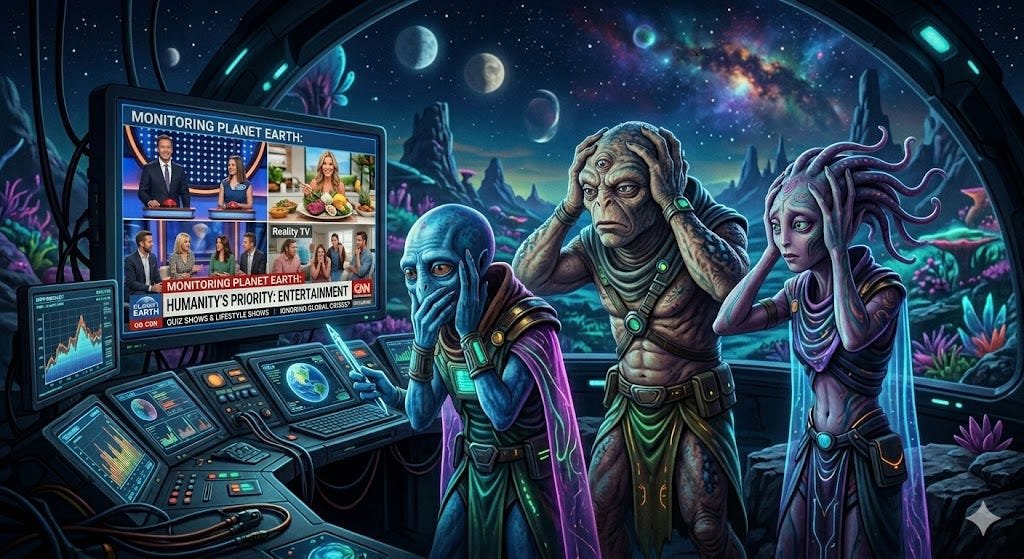
Any aliens who have been monitoring radio and television transmissions streaming outwards into space from Planet Earth over the past few decades will likely be intrigued, bemused, or simply horrified at humanity’s headlong drive towards climate catastrophe. No matter the urgent warnings from climate scientists, the power of billionaires, financial speculators, and corporations maintains a death-like grip on governments around the world. Amid the occasional flurry of big business greenwashing and government rhetoric about ‘climate protection’ and ‘eco-friendly’ initiatives, billions of people are being held hostage by the forces that are dragging everyone to the edge of the climate abyss.
New warnings about climate change do, of course, occasionally appear in the press. But rarely, if ever, are there prominent and sustained front-page headlines and news-leading television coverage. Rarer still are impassioned editorials, high-profile presenters and commentators demanding the substantive, radical changes that are needed to avoid the most damaging predicted impacts of business as usual.
Earlier this month, the Royal Albert Hall hosted a 100th birthday party for naturalist David Attenborough, Britain’s most beloved broadcaster. Celebrities showered him with love and praise: Leonardo DiCaprio, Judi Dench, Olivia Colman, Emily Eavis, Chris Martin, Ben Fogle, Raye, and Kate Winslet. And Paddington Bear. Attenborough sat in the royal box, alongside Prince William. King Charles delivered a handwritten message from Balmoral Castle via a ‘cavalcade of creature couriers’, including eagles, a red squirrel, a hedgehog, otters, ducks, a fox, and deer, thanks to the wonders of CGI. All very nice; all very Disneyfied.
For many years now, Attenborough has been warning about the dangers of mass consumption, pollution, worldwide species loss, and global warming. These subjects are clearly of great concern to him, although he started ringing the alarm bell very late.
But the evening gave a wide berth to such uncomfortable topics. ‘Life on Earth’? The climate crisis must be happening on a different planet entirely.
As Jonathan Liew, a Guardian sports journalist and columnist, pointed out:
‘This is, of course, the Attenborough with which our public discourse is most comfortable: depoliticized, universally adored, a man-sized Paddington Bear fit only for our veneration. Who teaches us about tree frogs and seal cubs and stick insects and asks for nothing in return.’
Of course, what Liew called ‘public discourse’ is the tightly constrained media space permitted by state and corporate power.
Liew continued:
‘And perhaps there are more difficult questions to negotiate here: the extent to which he has been a force for the meaningful and revolutionary change he seeks, and the extent to which his broad, inoffensive appeal has been more hindrance than help, allowing the powerful to feign concern for the planet while shirking the tough and bloody compromises required to secure it.’
To his credit, Attenborough has been eloquent and impassioned in recent years about the climate crisis. He addressed the COP26 climate summit in Glasgow in 2021, saying that:
‘We are already in trouble. The stability we all depend on is breaking. This story is one of inequality, as well as instability. Today, those who’ve done the least to cause this problem are being the hardest hit. Ultimately, all of us will feel the impact, some of which are now unavoidable.’
But, even five years on, as the climate crisis worsens, the topic was deemed unmentionable by the organizers of Attenborough’s 100th birthday party.
‘Hothouse Earth’ And Collapsing Currents
In February, a new scientific report warned that runaway global warming is closer than had previously been thought. We are heading for the ‘point of no return’ after which we would be locked into a hellish ‘hothouse Earth’. Climate ‘tipping points’ would be triggered, producing rapid heating that would lead to a domino effect of further tipping points and feedback loops. These include the melting of the Greenland and Antarctic ice sheets, the drastic dieback of the Amazon rainforest, and the weakening and possible shutdown of the Atlantic Ocean conveyor belt known as the Atlantic Meridional Overturning Circulation (AMOC).
The scientists stated that:
‘Earth’s climate is now departing from the stable conditions that supported human civilization for millennia.’
The world has already experienced a global average temperature rise of over 1.3 °C since pre-industrial times and is likely to surpass the Paris Agreement ‘limit’ of a long-term average temperature rise of 1.5 °C in the next few years. Current government and business policies are pushing us towards 2-3 °C of global warming, if not more, by 2100.
But if trigger points are breached and runaway global warming occurs, we are talking about much higher temperature rises, perhaps 10 °C or more. This would mean almost unimaginable catastrophic effects on the climate system, global agriculture, and societal infrastructure, not to mention the extinction of humans. Scientists have warned that even a rise of 3-4 °C means that ‘the economy and society will cease to function as we know it’.
Bill McGuire, Professor Emeritus of Geophysical and Climate Hazards at University College London, put things in grim perspective via X:
‘We are already locked-in to a return to Pliocene [around 2.6 to 5.3 million years ago] conditions (3C hotter and (eventually) ~ 20m sea-level rise)
‘Keep going as we are, and hotter Miocene [5.3 to 23 million years ago] conditions will result
‘Beyond this, a return to early Eocene [around 48 to 56 million years ago] hothouse beckons – and potential oblivion’
During the Eocene, the global average temperature was well over 10 °C higher than present. Oblivion would hit humanity long before such a rise in temperature occurred.
Earlier this month, yet another deeply disturbing scientific study revealed that the risk of AMOC reaching a tipping point by 2100, after which its shutdown would be inevitable, is as high as 50 percent. Previously, this was considered ‘a low likelihood event’ of around five percent. But even this should be held in perspective. How many of us would board a plane knowing that there was a five percent chance that it would crash?
AMOC, of which the Gulf Stream is the best-known component, is a vital carrier of warm water from the tropics to high latitudes in the North Atlantic, returning cold water southwards. It is a primary source of heat for western and northern Europe, leading to the temperate climate here. AMOC connects with other ocean current systems in a global network that transports heat, water, nutrients, and carbon around the planet. Any disturbance to AMOC, far less its collapse, would have devastating global consequences for climate, agriculture, infrastructure, and even for the habitability of Earth.
Professor Stefan Rahmstorf of the Potsdam Institute for Climate Impact Research in Germany, who has studied AMOC for 35 years, said:
‘This is an important and very concerning result. It shows that the “pessimistic” models, which show a strong weakening of the AMOC by 2100, are, unfortunately, the realistic ones, in that they agree better with observational data.’
He added:
‘I now am increasingly worried that we may well pass that AMOC shutdown tipping point, where it becomes inevitable, in the middle of this century, which is quite close.’
To emphasize: the tipping point may be much earlier than 2100; it could happen by 2050, or even sooner. The vital point here is that scientists increasingly agree that the ‘safe window’ to stabilize the current by halting emissions is closing far faster than previously thought. And the public likely does not even realize it.
Rahmstorf had previously said that a collapse must be avoided ‘at all costs’. Now he added:
‘I argued this when we thought the chance of an AMOC shutdown was maybe 5%, and even then we were saying that risk is too high, given the massive impacts. Now it looks like it’s more than 50%. The most dramatic and drastic climate changes we see in the last 100,000 years of Earth history have been when the AMOC switched to a different state.’
In an English-language video for the German DW news channel, Rahmstorf explained the importance of AMOC for European and global climate, and the significance of the latest alarming results. He warned that we should expect more climate extremes in heat, cold, drought, floods, and storms.
If and when the AMOC collapses, the impact on agriculture in the northern hemisphere will be devastating. The drop in harvest yields for key crops could be as high as 50 percent. Mass starvation is a very real possibility.
Climate Shocks
A few days after the disturbing new AMOC report came out, Guardian columnist George Monbiot noted:
‘Last week delivered the biggest news of the year so far, perhaps the biggest news of the century. But partly because billionaires own most of the media, most people never heard it. We might find ourselves committed to a civilisation-ending event before we even learn that such a thing is possible.’
Prior to Monbiot’s column in the Guardian, the paper had published a piece on the report by Damian Carrington, its environment editor. Two other UK national papers covered the study: the Daily Mail and the Independent. Channel 4 News covered the topic in a news broadcast. Amazingly, that was about it for the entirety of the establishment media. The fact that deeply disturbing findings about a likely collapse of a vital component of the climate system were not given wider, extensive, and sustained coverage is a devastating indictment of ‘mainstream’ journalism.
Even worse, when the report came out, the BBC preferred to push Reform-style propaganda about ‘migrants making false claims to stay in the UK’. This was given a prominent placement on the front page of the BBC News website. We could not find a single report on the BBC News website (although there was an article about it in the BBC Science Focus Magazine). That is simply appalling, particularly for a supposed ‘public service’ national broadcaster.
Scientists are warning, as loudly as they possibly can, that the present economic system of rampant capitalism is destroying the very life-support systems that made Planet Earth a habitable environment for humans to evolve and flourish.
Professor Bill McGuire, whose new book, ‘The Fate of the World: A History and Future of the Climate Crisis’, is published this month, writes:
‘In our current predicament, [global warming] is set to bring about nasty and unwanted shocks and surprises, which are the last things we need right now, and the signs are already there. The ramped-up heat is acting to accelerate melting of the polar sea ice and land-based ice sheets, increase methane degassing from northern hemisphere permafrost and significantly slow the AMOC. Via positive feedback loops and the crossing of tipping points, such domino effects can and do magnify abrupt climate change and its ramifications.’ (Bill McGuire, ‘The Fate of the World: A History and Future of the Climate Crisis’, HarperNorth, 2026, pp. 102-103)
McGuire also points to the devastating effects of climate change on the human body. It is not just rising temperatures that should concern us, he says, but the lethal combination of heat and humidity:
‘If you can’t sweat, you die – and quickly. A combination of heat and humidity is measured on what’s called a wet-bulb thermometer, which provides a far better estimate of the heat we actually feel than a normal, dry-bulb instrument. The critical value on a wet-bulb thermometer is 35°C, because at this level of heat and humidity the human body cannot lose heat by sweating as the surrounding air is already saturated with water. Anyone exposed to such conditions, super-fit or not, resting by the pool in the shade or working in the fields, will start to experience their internal body temperature climbing rapidly, ultimately leading to organ failure and death in 6 hours or so.’ (Ibid., p. 189)
He adds:
‘All of the threats and problems of the modern world will be multiplied and magnified, from physical and mental health to poverty and inequality, to mass migration, civil strife, conflict and war. Global heating is not only tearing apart our climate but shattering the social and economic constructs that keep our world functioning, albeit in a sort of mad-cap way, and stop everything falling apart.’ (Ibid., p. 195)
McGuire relates that he knows from conversations with fellow scientists that:
‘many feel desperately sad and frustrated about where our world is headed and the bleak future we are bequeathing our children and their children, and I am no different. Knowing what I know, it is no longer possible to see my kids without wondering just what incarnation of hell they will have to face in later life.’ (Ibid., p. 199)
Look at the daily, hour-by-hour obsessing over the endless maneuvering within the Labor government; every single statement from ministers and their allies scrutinized by the Westminster bubble of political correspondents.
Imagine that, instead of focusing on short-term melodramas, leading news organizations rigorously probed politicians, day in and day out, about the climate crisis.
Imagine news editors and journalists relentlessly challenging the government over current policies that are bringing us closer to the brink of climate chaos.
Imagine that reporters investigated and exposed the deep reluctance and state-corporate obstacles, including the establishment media, that are blocking alternatives to climate Armageddon.
Imagine, in other words, that we had a sane media system. That could just mean the difference between human survival and human erasure.