

The evil of capitalism is impersonal and built into the workings of the system, its logical need of perpetual capital accumulation, which consumes all in its cancerous growth.
— Chris Kaspar de Ploeg, The Exterminating Empire, 2026, p 115
We only need about 30 percent of our existing productive capacity to ensure decent living standards for 8.5 billion people across the globe.
— Jason Hickel and Dylan Sullivan quoted in Chris Kaspar de Ploeg, The Exterminating Empire, 2026, p 15
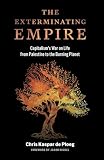
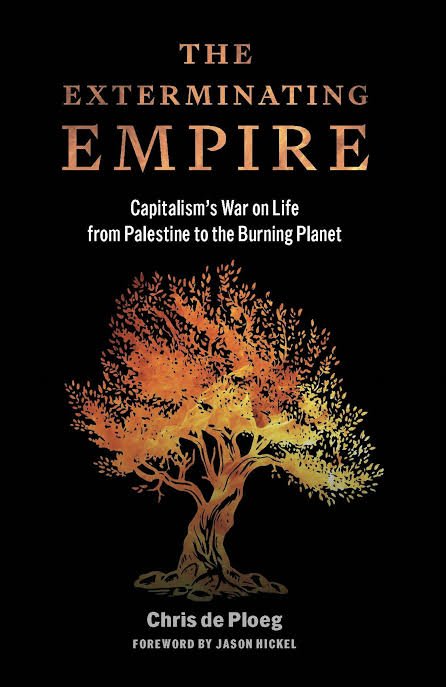 The Hickel and Sullivan quotation lays bare what ails the world. Capitalism has transferred profits generated by the working class to a monopolizing few. Chris Kaspar de Ploeg, in his latest book, The Exterminating Empire: Capitalism’s War on Life from Palestine to the Burning Planet, (Monthly Review Press, 2026), compellingly relates how capitalism is genocidal to people, culture, knowledge and the environment worldwide. De Ploeg has produced a work monumental in scope.
The Exterminating Empire begins in the war waged against Palestine by Israel, a genocide that many of the so-called leaders in the Western-aligned countries — “the capitalist core”/the Global North — support, much to the consternation of their own populaces and the populaces of the Global South who suffer the ravages and pillaging of the Global North. (p 11)
De Ploeg does not hold back; he staunchly substantiates and describes an omnicide motivated by capitalism — its profit-accumulation, power accumulation, land accumulation, imperialism, colonialism — that blithely overrides economic equality, human rights, state sovereignty, and a salubrious environment. Capitalism is the anti-humanism, the anti-humanitarianism that generates wars and negatively impacts large swaths of humanity. Capitalism is what must be dismantled and superseded by humanitarianism.
*****
Capitalists crave land, as it is crucial to generating profit.
The western hemisphere is a stark irrefutable example of capitalists’ destruction of Indigenous peoples — a genocide that enabled Europeans and their progeny to dispossess Original Peoples of the land they had lived on since time immemorial. As a historical starting point, The Exterminating Empire tells of the destruction of bison herds on Turtle Island, a keystone species that was crucial to many Indigenous nations. De Ploeg identified “what is perhaps the most concentrated extermination program in history, colonial capitalism wiped out” nearly every one of the 30 to 100 million bison on Turtle Island between 1870 and 1890. (p 36) Starvation would consequently be faced by many Indigenous peoples.1University of Regina professor James Daschuk in Clearing the Plains: Disease, Politics of Starvation, and the Loss of Aboriginal Life chronicled how the destruction of the bison massively affected the Plains people in Canada.
Removing native species clears the way for the introduction of invasive species to new lands — an ecocide. The decision to introduce new species was largely calculated on the generation of profit. (p 118) The profligate use of chemicals and fossil fuels, the unbridled extraction of resources along with the concomitant pollution of the land, water, and air — much of it said to be connected with weather extremes and climate change — are a part of the ecocide. Humans are, of course, also affected by the ecocide.
Starvation as a weapon by invaders to the “New World” is also a current genocidal weapon used by Zionist Jews to wipe out Palestinians, thereby clearing the land for a Eretz Yisrael. “It is well known that the Zionist entity steals land from Palestinian farmers, in an extraordinarily blatant and open practice of apartheid…” (p 75) — and it is not just farmers.
The omnicides are wreaked by capitalists and corporatists who inflict the law of the jungle on others. The Exterminating Empire tackles the car industry, tobacco, sugar addiction, unbridled consumerism, Big Tech, military contractors, etc. De Ploeg writes, “Ideologies of extermination are logical extensions of capitalism…” (p 94) This is true from the invasive settler-colonialism of Turtle island, Nazism in Europe, Zionist genocides in the Middle East, and the ravaging of much of the rest of the western hemisphere and Global South.
Even the Global North does not escape unscathed. Ukrainians are the current sacrificial lambs to slaughter for imperialism. (p 119)
Nonetheless, it is argued that the negative traits of being greedy, aggressive, warring humans are not intrinsic to the human condition. The Exterminating Empire notes that many Indigenous peoples and early humans were peaceful and shared what they had. (p 152)
The warring and killing in Eastern Europe, the Middle East, Sudan, Myanmar, etc along with the burgeoning economic gap between the Global North and Global South is widening in absolute terms, a significant rise in recorded climate-related calamities,2See EM-DAT International Disasters Database. adumbrate some of the challenges facing the Earth, its flora and fauna, as well as humans.
*****
Can the masses of humanity bring about a return to the primordial paradise?
De Ploeg’s final chapter — “What Is to Be Done? Strategizing in Defense of Life” — is consequential in answering this question. De Ploeg injects a realistic optimism of a different and better world that is attainable through solidarity: “A good life for all is within or reach if we seize the means of production and use them for human and ecological needs.” (p 174)
Among the changes is embracing central planning that is democratic and multilevel (as opposed to top-down), ecosocialism, and ending the concentration of land ownership in a few hands. This means ending capitalism, as such it will be anti-imperialist and revolutionary.
De Ploeg points to China, albeit imperfect,3De Ploeg notes, “At the same time, China also trades with and invests in reactionary regimes, which often puts it at odds with the liberation movements in these countries. Essentially, there is no clear image of Chinese foreign trade and investment and its impact, which is determined more by the local conditions than by China.” (p 196) For more on this topic see the two-part interview between Ron Ridenour and myself at “Communism in China” and “Communism and Morality in China.” playing a crucial role in leading the way to an antiwar, anti-imperialist, anti-poverty world. While acknowledging legitimate criticisms of China, de Ploeg cautions: “Criticism of China, especially coming from the Global North, should be voiced with a level of humility and respect.” (p 196-197)
The Exterminating Empire is packed with historical and background information and analysis, well supported with a plethora of endnotes (p 208-298). However, since this is a book review, sufficient coverage of the essence of The Exterminating Empire is lacking. Therefore, get the book and read it; consider how The Exterminating Empire addresses, in plain language, the topic of good versus evil. And, consider the book’s blueprint for the creation of a good world for all.
ENDNOTE: