








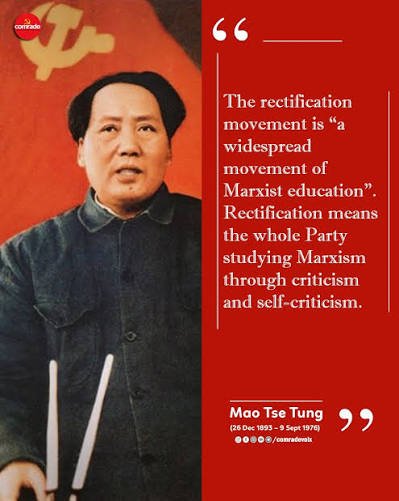
The Communist Party does not fear criticism because we are Marxists, the truth is on our side, and the basic masses, the workers and peasants, are on our side.
— Mao Zedong, “Speech at the Chinese Communist Party’s National Conference on Propaganda Work” (March 12, 1957), 1st pocket ed., p. 14.
Thoroughgoing materialists are fearless; we hope that all our fellow fighters will courageously shoulder their responsibilities and overcome all difficulties, fearing no setbacks or gibes, nor hesitating to criticize us Communists and give us their suggestions. “He who is not afraid of death by a thousand cuts dares to unhorse the emperor” – this is the indomitable spirit needed in our struggle to build socialism and communism.
— Mao Zedong, Ibid., p. 16.
We have the Marxist-Leninist weapon of criticism and self-criticism. We can get rid of a bad style and keep the good.
— Mao Zedong, “Report to the Second Plenary Session of the Seventh Central Committee of the Communist Party of China” (March 5, 1949), Selected Works, Vol. IV, p. 374.1The source of Mao Zedong quotations: Quotations from Mao Tse Tung, “27. Critism and Self-Critism [sic],” Marxists Internet Archive.
Most people would agree that, if not the country, then at least its government must be open to criticism. In fact, criticism and self-criticism is a central ideological foundation of the Communist Party of China (CPC) designed to maintain party discipline, correct political or organizational errors, and keep a revolution from deviating from its ideological precepts.
Ron Ridenour takes seriously, as he should, that the rising economic powerhouse of China must be open to criticism. As such, he wrote a three-part series on how China fails to live up to Marxist-Leninism. [Part 1 – “China Officially Stands for World Peace,” Part 2 – “China Invests in U.S./Israel Wars and Supported Pol Pot’s Genocide and South African Apartheid,” Part 3 – “Artificial Intelligence = Alienation Instructors.”]
Ridenour does not just criticize, he also recognizes that the People’s Republic of China is peaceful and that it has eliminated extreme poverty, whereas the “democratic” United States has not.
Media has a vital role. It must be respectful of its readership. It must avoid censorship and be open to publishing reasoned and substantiated pieces that facilitate its readers to reach their own conclusions.
Nonetheless, I found that Ridenour was focused to0 much on “past mistakes” of a massively impoverished China escaping a Western-aligned capitalist class stranglehold that inflicted a Century of Humiliation on China. Achieving the freedom to implement socialism against the infringing malevolence of the capitalist and imperialist Western-aligned world does not lend itself to instantaneous economic development with fully fledged socialism.
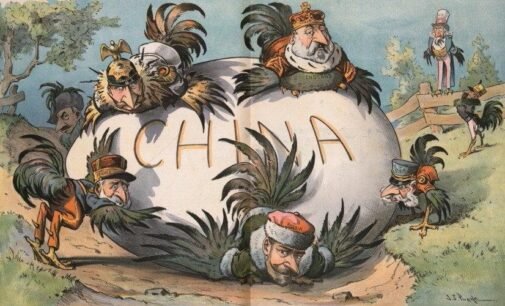
“A Troublesome Egg to Hatch,” LOC’s Public Domain Archive Media
Moreover, some of the criticisms were, in this writer’s opinion, pin prick, and used dubious sourcing such as Wikipedia (which can, at best, be a secondary source, and when used it should be considered with requisite skepticism).2A brief check of independent websites, some of the leftist variety revealed criticism of Wikipedia:
Paul Craig Roberts, “Wikipedia: The Unintended Consequences of the Digital Revolution Await Us.”
Rima Najjar, “Provisional Bondi Beach Truths: Containment, Power, and the Struggle to Name Palestine on Wikipedia,” writes that “Wikipedia manages the Israel/Palestine conflict by constricting the boundaries of permissible speech.”
Media Lens, “Caught in the Cross Hairs: Media Lens and the Mystery of the Wikipedia Editor.”
Martin Iqbal, “Lies, Damned Lies, and Wikipedia,” calls “Wikipedia: [a] Zionist Lie Factory”
C.J. Hopkins, “The Ministry of Wiki-Truth.”
Thorsten J. Pattberg, “Wikipedia is a PsyOp: Co-Founder” charges that “Google began cooperating with Wikipedia, making it the top search result for all queries, under the condition that Wikipedia, like Google, adhered to the world rulers, the Jews, and the Left. (SIC)”
Nation states are not paragons of governance. This is recognized in Marxist Leninism and, therefore, the acceptance of criticism and self-criticism that serve to facilitate course correction when the governmental direction has gone awry.
In Part 1 of the interview with Ron Ridenour, it was much more than criticism, as Ridenour accuses China of being capitalist and immoral.
*****
Kim Petersen: You wrote, “China seeks to be the world’s richest country.”
I wrote, “I have never heard of a Chinese official stating this.” If you were familiar with Chinese culture, then you’d be aware that boasting is a much frowned-upon behavior. China does not seek to be richer than other states, only that they can all profit together. On numerous occasions China states its intention to form win-win relationships.
You write, “It already has the world’s second most millionaires/billionaires after US-ARME (United States of America Racist Military Empire).
Given that China has 1.4 billion people and that China has the largest economy measured by PPP, it is not unusual that there would be billionaires. But do Chinese billionaires have free rein as in the capitalist West? Could an Epstein class arise and escape consequences for sex trafficking and sexual misconduct with young girls in China? Under Xi’s chairmanship, China has waged an unrelenting battle against corruption and inequality, and even the richest persons have been handed severe jail sentences. And wealthy individuals who seek to monopolize wealth will be penalized by the government. Excessive greed is frowned upon.
Furthermore, you write, “China aims to be the world’s strongest technological power within 15 years.”
I wonder about the framing of your statement. China aims to be the best at what it does. That is, for most people, an admirable trait. Is China doing this for its own aggrandizement? Take Chinese AI, China has made it open source. Anyone can take it and adapt it to their own needs. All nations are invited to participate in its space station Tiangong and China invites international cooperation in developing a moon base.
Ron Ridenour: I stand corrected. I improperly mixed “richest” with becoming the “world’s dominant technological power” as written in its 15th Five-Year Plan, and should occur within the forthcoming five-year plan.
In the last twenty years, China has achieved the feat of turning an economy with approximately $2,000 GDP per capita into one of the world’s leading innovation hubs, with close to $14,000 today. The Chinese government plans to take this further. Its next goal, announced in the Central Committee of the Communist Party of China’s 15th. Five-Year Plan, released on 13 March, is to establish China as the world’s dominant technological power. [emphasis added]
KP: I wrote, “I have never heard of a Chinese official stating this.” If you are familiar with Chinese culture, the you’d be aware that boasting is a frowned-upon behavior. You did not quote a Chinese official. You quoted Bruegel, a European think tank. As for the quotation that you emphasized — “to establish China as the world’s dominant technological power” –, upon reading, it states:
抓住新一轮科技革命和产业变革历史机遇,统筹教育强国、科技强国 (Seize the historic opportunities presented by the new round of technological revolution and industrial transformation, and coordinate the development of a leading nation in education and a leading nation in science and technology.) [emphasis added]
There is a distinct difference between stating a desire to be “a leading nation in science and technology” from a desire to be “the world’s dominant technological power.”
RR: Yes, China’s win-win capitalism, especially within BRICS, is a better approach, more socially acceptable to conducting capitalist economies than is the top-down US-Europe-Common Wealth system. It is true that China is way behind US’s per capita income, in part because it has four times the population, but its economic growth rate plan is for 4.5% growth by 2026 end, double U.S. expectations.
The 15th Five-Year Plan shows that China’s drive to be first in technology also includes excruciatingly alienating AI and robotics. I must admit that my perhaps “phobia” for ever-advancing technology is certainly out of step with, perhaps, every society’s goal that is not deep in the bushes.
KP: You criticize China for not working to end alienation given that it works with capitalist economies and war-making, genocidal nations in the world, e.g., the US and Israel.
You argue, “Alienation is the consequence of ‘China’s Path’ to achieve the biggest economy in the world.” Again, I am unaware of any official evidence to support the contention that this is China’s desired achievement. Nonetheless, since China is the world’s most populous country, after capitalist India, it would only be unsurprising if it had the biggest economy (which it already does), and what also needs to be considered is per capita statistics. Also there is a strategic argument to be made for China owning a small percentage of the US economy. Should the US threaten Chinese security, a sell off the US economy would provide some leverage.
RR: Despite China’s real interests and diplomacy to convince the US that China is not an enemy or a threat to the US, the governments with the US-Army, especially with and since Obama-Biden’s regime and even escalating under Trump, move closer to China and its near waters.
KP: In “From Artificial Intelligence to Robots Replacing Humans” you write of robotics, “all powered by Alienation Instructors” “Worst of all is that the propaganda-drugged Chinese population apparently applaud such anti-human development.”
The development of robot technology is a human-created achievement. Like with AI, the technology only becomes anti-human depending on how it is used. And it would be humans that would be making this decision. Would it be preferable if the capitalist-aligned West developed AI and robotics alone?
RR: My obstinacy to unending technology can be compared with the Luddites, and Chaplin’s Modern Times, and could be considered misanthropic. Regardless, I am certain that the way that automation/digitalization is skyrocketing is not sane for us mere homo sapiens. Already, soon-to-be-trillionaire Elon Musk is speaking of a post Homo sapiens species that his technological expertise is promoting. That is especially scary given that his politics/ideology is fascist and racist.
Scarier still is what we have recently been hearing from some AI corporate leaders and even US politicians from both parties: AI could kill off the entire human species within a decade.
Jeffrey Sachs wrote in the same week that the AI genocidaire made world news:
“On Sunday the President of the United States stood on a golf course in County Clare, Ireland and was asked what he intended to do about the most serious technological warning of our lifetime.” His answer, in full, was that America is beating China. “We’re leading China in AI. We’re the most sophisticated country in the world, and frankly, I want to keep it that way, because whoever wins AI wins.”
What is there to win after AI, Mr. Trump?
You ask would it be preferable had China not develop robotics and AI? In this real world, probably 99.99% would answer no. I never thought of being a communist leader but just for myself, I’d say yes. Let us not compete with such idiots and warmongers.
KP: You write, “China Still Practices Inequality between the Genders.”
When the People’s Republic of China was established in 1949, the CPC implemented legislation to advance equality between men and women. Mao is credited with saying the oft quoted truism, “Women hold up half the sky.”
You write, “Three fourths of all marriages still entail buying a woman.” You phrase this in a negative way. Hmmm, “buying a woman” or bending to some wrongly continued tradition? And what must be considered is that there is a difference between urban and rural China. Despite successful efforts by the CPC to economically develop the hinterlands of China, this gender disparity is an outdated, traditional mode of considering male-female relations that requires time to make a dent in unequal marriage practices. Actually, the inequality in China favors the woman over the man. The man is asked to provide in essence a male dowry. Also males are at a disadvantage because of the current gender population dynamic that leaves many males without a wife in a monogamy-practicing society.
I remember a diving co-worker in Thailand that paid for female services, as do so many Westerners who spend time in Thailand. He reasoned that in the West men are buying women as well: paying for dinners, flowers, gifts. Lastly, it is a tu quoque argument, but it is a truism that gender inequality exists in most countries in the Western-aligned world.
RR: A Communist Party-led government for nearly eight decades ought to be better than Capitalist Parties-led governments. If women were allowed to hold up half the sky from the time Mao advocated such, there might be full equality today. Men should not need to buy sex dolls in order to fulfill nature’s sexual calling.
KP: You write that the US Pivot to Asia is recognized by “China’s own media show how much the U.S. is surrounding it with billions of dollars-worth of military might to intimidate and corral China’s one and half billion people.”
Is China fearful of the US? Has China not seen how Iran has defeated the US and Israel? Has China not seen how the mighty US was pinned down in Afghanistan for 20 years and had to leave with its tail between its legs and before that in Viet Nam? Some argue that China’s military technology is equal to or more advanced than US military technology.
You quote, David Pine: “China has about eight foreign military bases — one in Djibouti and some on human-made islands in the South China Sea.”
I dispute the number and the framing — “foreign military bases.” [emphasis added]
Nonetheless, what this would seem to demonstrate is that China is not an offensive threat — that its military is defensive. And Chinese military expenditure has been forced upon China by the capitalist US and its allies, as has the militarization of the South China Sea islands, which according to China are not foreign bases but Chinese bases.
The same goes for Taiwan, internationally recognized as a province of the PRC. The US, as well as other Western-aligned nations, however, hypocritically seek to undermine full-fledged reintegration.
RR: I find nothing to argue with here. As a communist myself, depending on how one defines this much maligned term, I think it is positive that China does not act or threaten to invade other countries, and that it uses what resources are necessary to defend itself if the US does invade.
KP: You criticize that “China copies Western surveillance of its citizenry.”
It is very important to mention that China has had a terrorism threat within the state. The East Turkestan Islamic Movement (ETIM), delisted from the US terrorism list, has carried out lethal terrorist attacks. Is China not permitted to put CCTV to good use, to protect the security of Chinese citizens? And is it not important to consider how Chinese feel about the surveillance? The Asia Pacific Journal of Public Administration reported “citizens in China are generally very willing to accept facial-recognition cameras built by governments, and this acceptance increases when citizens’ trust in companies and government institutions is greater” concurred by the Princeton School of Public and International Affairs found “based on a 2018 survey of a nationally representative sample, … that a large majority of Chinese citizens support various forms of state surveillance. CCTV surveillance receives the highest support (82.2%), followed by e-mail and Internet monitoring (61.1%).”
RR: The extensiveness of near total surveillance, greater than anywhere in the world, gets details of where and how people shop, where they buy gasoline…..I doubt that all this information is just to find and prevent terrorist actions.
If the majority of people feel this is worthwhile, still a minority do not. The same sort of statistics could probably be found in Western capitalist developed countries. Majorities can also be brain washed, as well.
KP: In your series conclusion, you write, “If the founders of Marxism, and subsequent leaders of Communist parties—such as Lenin and Trotsky, Fidel and Raul Castro, Camilo Cienfuegos and Che Guevara—could see what the so-called Communist Party of China is doing to enhance capitalist alienation, they would lead a revolutionary communist revolution.”
First, it must be firmly recognized that China states that it is only in the earliest stages of Socialism with Chinese Characteristics. One does not press a button and, voila, the not-so-long-ago dirt-poor China is transformed into a Communist paragon. Yet on 1 July, the CPC announced achieving a “xiaokang society” or “moderately prosperous society.” Currently, China current plan puts a “focus on people’s livelihoods, sending a clear signal that development is ultimately meant to benefit the people by 2030.” China does not trumpet spending 1.5 trillion dollars on the military. Next up for China: “From 2035 to the middle of this century, with another three five-year plans, the country will strive to build itself into a great modern socialist country that is prosperous, strong, democratic, culturally advanced, harmonious and beautiful.” Seems like something genuine Communists could and should get on board with.
RR: I browsed over my two score of articles and interviews I have written for DV since 2008, and found something quite appropriate for this discussion. I wrote this in 2014 about alienation in China.
Alienation is skyrocketing in Communist Party-led capitalist China, as well. While poverty still overwhelms hundreds of millions of people, China now has the world’s second greatest number of billionaires, 190. Yet a new trend among many teenagers in Beijing and other large cities indicates that contradictions between communist egalitarian rhetoric and profit greed reality have reached a pinnacle.
The media reports that instead of keeping pets, an expensive enterprise, loneliness is being combated by taking an iceberg lettuce head for a walk. According to [Denmark wire service] Ritzau, May 8, 2014, The Austrian Times interviewed a Beijing University psychologist who said that it helps to have something to talk to, even a lettuce. One lonely girl, Luis Ja Chen, is quoted to say:
I feel that I can transfer my negative thoughts to the lettuce when we take a walk. I feel better afterwards.
OK, the lettuce-as-comforter was written in 2014 but probably is still relevant for some people, just as buying sex dolls is still relevant for a lot of men; maybe women too.
I watched what Ben Norton has to say about Xi cracking down on billionaires’ corruption; and about the current stage of building “common prosperity to reduce inequality.” All positive. It might well be that China needed to go through a harsh capitalist period before beginning to develop socialism. After all Marx-Engels meant that socialism could not be started before capitalism was well advanced. Nevertheless, I mean that developing common prosperity should have been a priority long ago even as capitalism was the basic economy, if the communist leaders were more morally oriented than capitalist leaders.
The trial and sentencing of Xu Jiayin—Bill Gates equivalent in China—is also a positive sign. Yet what Xu and many of the richest have been doing to cheat and gain illegal profits from the socialism-in-development system should not have been allowed all these decades. It certainly was not allowed when Cuba was on the road to socialism, and that is why I could say that Che would not have tolerated such immoral and criminal behavior. I also wonder what he and Fidel would think of where Cuba is heading since near total capitalism has been reinstituted recently?
- See Part 1 of the interview with Ron Ridenour.
ENDNOTES: