






Orientation
Competing parameters for consciousness
Where is consciousness rooted? Is consciousness housed inside the body of a biological being, simply the creature of an organized brain? Or is consciousness just a complexification of sensory life? Or is consciousness rooted in the social life of animals? If the latter is the case, is it fair to say that animals that do not have a social life are not conscious? That seems unfair. We will come back to this.
For now let’s take the path of social animals and consciousness. We know many creatures are social. The closest primates to the human species are chimps and bonobos. While the latter are social, they are not cultural as we saw in my last article. What does is it do to consciousness when social animals became socio-cultural animals? Hominids such as Homo erectus and Homo neanderthalensis have a culture of sorts because they made tools, but as far as we know they did not have verbal language. What happens to consciousness when a culture develops a language?
Lastly what does the emergence of writing systems do to consciousness? In other words, what does a memory system that is external to the brain do to the structure of consciousness? What do the presence of verbal language and writing systems do to the synapses of the brain?
How centralized is the brain? Some evolutionary psychologists picture the brain as having independent cognitive modules that are responsible for each associative or isolatable aspect of higher functions. This is a kind decentralized mind. Theorists such as Merlin Donald argue that at least the higher levels of cognition the brain are centralized and organized achieved by a single unitary structure. In his books Origins of the Modern Mind and A Mind So Rare Donald will not only define what consciousness is and isn’t but when, where and how it started as well as what function in evolution it served.
Humble origins: the tunnel of consciousness
Consciousness has narrow beginnings. Far from being a brilliant searchlight, it is more like a tunnel through which everything must pass. For example:
- without habit to carry us along, consciousness can become disconnected, vague and lacking in focus;
- without sense data people hallucinate and no one could sleep normally;
- left to our senses, we can only hold about 7 pieces of information at a time;
- we have a short-attention span and
- we have a strong startle response for evolutionary reasons, but it interrupts our awareness.
How could such a limited mental instrument later create such a subtle, complex fabric of knowledge? Donald points out the cathedrals of medieval Europe were an architectural means for achieving a simultaneous conscious experience of light, beauty, infinity and illumination. Let us try to track this long trajectory.
I. Competing Theories of Consciousness
Materialists out of the closet
Neo-Darwinian hardliners like Steven Pinker argue that the conscious mind is irrelevant to Darwinian evolution and the “free will” that we usually associate with consciousness is illusionary. For hardline Neo-Darwinists, in the socio-cultural sphere, “memes” are supposed to be the cultural equivalent of genes which they claim are the elementary reproducers of culture. Consciousness is captured and enslaved by these parasitizing memes which are reduced to genetic and environmental constraints.
The claims of materialist hardliners are:
- Most of what we achieve takes place unconsciously. We act, think, speak and imagine mostly in the unconscious. Daniel Dennett writes that all the real cognitive action takes place below the conscious surface.
- The hardest of the hardliners define consciousness as the direct awareness of sensation and nothing else. There are no non-sensory conscious states.
- For hardliners cognition is basically running on a brain that is organized like an enormous parallel computer. That means that the brain is organized in separate modules with no central governor. According to Canadian professor and psychologist Merlin Donald, “hardliners” reject the pragmatic, fuzzy definitions of consciousness that are commonly used in cognitive science.
- Consciousness is no more than a mirror of the external world. Our awareness can have no significant independence from the external world.
- Consciousness is limited to short-term, working memory.
- Selves are cultural inventions. The Cartesian self is merely an illusion produced in our brains by representational feedback originating in culture. There is no little man in the head, that is organizing information in the service of a central-self-identity. This image should be replaced by a “conceptual pandemonium” in which my anarchic inner world is teeming with ideas and images, all of which are fighting for supremacy. The initiation and execution of mental activity are always outside conscious control. (Dennett).
- Hardliners are determined to assign consciousness a passive role and end the dualism between mind and matter in favor of matter.
- The less materialist hardliners like Nicholas Humphrey think that consciousness is inseparable from symbolic thought (verbal language) and hence unique to humans.
- Lastly, Hardliners are interested in perception, attention, voluntary movement and short-term working memory. They lose interest in states of consciousness that last longer and might not be directly connected to decisions about survival.
Merlin Donald’s Qualitative Theory of Consciousness
Merlin Donald has identified six ways in which consciousness cannot be reduced to materialist explanations.
- Consciousness precedes culture and language
 Donald disagrees with all materialist claims, arguing that consciousness is very important to evolution. Not surprisingly, he also claims that the human mind is a hybrid product of biology and culture and the human mind cannot come into existence on its own but is wedded to a collective process. It might be tempting to think of that as non-reductionist. Donald might champion the institutions of a more complex life such as sociality, culture and verbal language as the foundation for consciousness rather than sensory inputs and natural selection. But surprisingly, Donald says that consciousness is active and emergent over Darwinian biology but not because sociality, culture and verbal language have given it a start. Rather, he suggests that sociality, culture and language are consequences and products of a radical change in consciousness. This includes the fields of art, mathematics, religion and musical theory. In the case of language, our consciousness span is deeper than just language and equally important in nonverbal domains:
For example, dance and music demand qualitatively intermediated conscious capacities. Live jazz performers hear not only their own performances but those of every member of the group and estimate the overall sound that results.
How might have this taken place? We shall soon see.
- Consciousness is an active adaptation of a central governor to either novel or fast-moving situations
Why is there consciousness at all? Donald argues that consciousness is a reaction to novel, unusually complex or fast moving situations in evolution. In the light of these events:
Consciousness does not receive sensory input passively. It explores, actively surveys the environment, organizes its perceptions into coherent chunks or episodes, remembers them selectively and anticipates the immediate future. It is about building and sustaining mental models of reality, constructing meaning and exerting autonomous intermediate control over one’s thought process. Consciousness involves self-evaluation, prioritizing and planning, place, time, purpose of projects.” (A Mind So Rare)
It would be inefficient to evolve extra capacity only in specialized mental modules for space, hearing or speech. The environmental challenges are too immediate and demanding for anything less than are cross-modal brain organization.
We now realize that awareness engages many brain regions simultaneously and that most of the networks of conscious regulation are distributed widely across several brain areas.
- Most automatic behavior is a product of conscious learning
Donald seems to suggest that hardliners slur over the differences between what is automatic and based on short-term unconscious learning and what is automatic based on long-term learning. It is unfair to use evidence for automatic cognitive processing as leverage against the efficiency of consciousness. Why? Because the automatic tendency of learned motor skills was once the product of long-term cognitive processing. Things which appear to be “natural” are the end result of a process of repeated rehearsals and evaluation which rely heavily on conscious supervision.
For example, I have been told that when I drive a stick shift I do it “naturally” “effortlessly” and automatically. However, for those of you who learned to drive a stick shift, you know that it hasn’t always been that way. When I first learned to drive, I had to coordinated my body so that the clutch, accelerator and gear shift all worked together. When they didn’t the result was a stalled engine or a car that lurched forward or backward. In order to minimize these occurrences my mind had to be guiding my body all the way through each of the processes. I had to “talk my way through the problem”. Eventually, like learning a new dance, my body “got it”. Then my mind was able to withdraw from the activity of driving and focus on other problems or just dig the music on the radio. The automatic achievement of driving the stick shift was earned, it wasn’t there from the beginning, unconsciously processing information. Furthermore, it took far longer than fifteen seconds before it became an automatic process.
- Extended time frame of awareness
Consciousness is far more extensive in time and space than most hardliners believe. As we’ve said, hardliners are interested in perception, attention, voluntary movement and short-term working memory. Donald argues that these frameworks are obsessed with the here-and-now 15 seconds or less judgments. This is too short a time period to give it an adequate image of the full range of human consciousness to satisfy our very basic need to try to grasp the events in our lives consciously and assert some degree of control over what we are and what we do.
Donald reports that clinical observations of disordered consciousness are often focused on the intermediate time range of experience. This is the time scale that matters in adjusting to the real world and the zone within which many disorders of consciousness reveal themselves. Many patients who have apparently normal conscious self-regulation on the micro-scale fail miserably on the larger timescale, especially in self-monitoring. In a mentally healthy person, self-image combines a concrete, detailed, up-to-date image of the body with autobiographical memory records within the intermediate time zone.
Human consciousness casts a shadow far beyond the narrow time corridor set up by hardliners in their lab experiments. Let’s take some examples:
When 4 people have serious conversations about a movie we must:
- keep the ideas of various participants in separate areas of memory, properly labeled and updated.
- we must keep track of where the larger conversation is heading and how one another’s opinions are changing
- at the same time, we must maintain normal contact with the surrounding waiters, other dinner guests and the changing outdoor climate.
Other occupations which require long-range consciousness include chess players, mathematicians, military strategists which can last for hours. The width and depth of working memory is much wider than those suggested by traditional laboratory techniques.
- Consciousness is more social than sensory
Unconscious cognitive processes could not be used to deal with most social situations because they lack updating functions. Nicholas Humphreys, one of softer hardliners, acknowledged this vital negotiating role of consciousness. He maintained both the sensory nature of awareness and the social function of consciousness. People interact too fast, he writes. They change their evaluations of one another too rapidly and they perceive the subtleties of social life too quickly for anything but a fully attuned conscious mind to track.
Donald points out that 19th century novelists like Balzac put that into practice. Balzac constructed a vast sociogram of every stratum of French society and created around 400 characters. Writers clearly agree on the predominance of socialconsciousness over sensory awareness. Our normal focus is social. While James Joyce did portray a fragmentary evanescent awareness in his stream of consciousness novels, this was the exception rather than the rule.
- Consciousness involves mind-reading
The evolution of a “theory of mind” allows the individual to imagine what the minds of others might be thinking. Most all the strategies of higher level organized games involve levels of mind-reading. Other people’s intentions are much too intricate, unpredictable, mutually changing and dangerous to be left to an automatic pilot. Children begin to acquire a theory of mind at around the age of two or three and are now equipped to engage in games of deception whether in earnest or in play. Below is a summary of how hardline reductionists differ from Donald’s qualitative theory of consciousness.
Table I Theories of Consciousness
| Hard liner Reductionists (Pinker, Dennett, Humphreys to a lesser extent) |
Theory of consciousness | Merlin Donald—qualitative theory of consciousness
(Cross between biology and culture) |
| Unconscious | What part of the mind is operating to insure survival | Conscious |
| Sensation, (there are no non-sensory conscious states) |
In what is consciousness rooted | Social life There are non-sensory conscious states |
| Short, no more than 15 seconds Short-term working memory Perception, attention, voluntary movement |
How quickly are decisions processed | Intermediate and long-term minutes, hours Autobiographical memory operating |
| Decentralized with specialized domains Parallel processing of computer |
How is the brain organized | Centralized governor Consciousness involves self-evaluation, prioritizing and planning, place, time, purpose of projects |
| A product of natural selection with little learning | What is automaticity | A product of natural selection that indicates higher forms of learning Learning and repeated rehearsal which first involves mind |
| It is proof that Darwinian mechanisms for survival do not need consciousness | What does automaticity prove | Darwinian mechanisms for survival need consciousness for some functions |
| Passive mirror | What is the relationship between the mind and the external world | Superimposes plans and schemes on the world |
| Later Consciousness begins with symbolic thought before then consciousness was not needed |
When does consciousness begin | Earlier Consciousness begins with social life and is active before culture, language or symbols |
II. Levels of Consciousness
- Level I Awareness: raw sensation—selective binding
A slug is sensitive only to the pull of gravity and the push of light. It does not have the neural means to discriminate complex objects such as trees and people. Slugs can’t perceive flowers, walls or rocks or even other slugs. This is the boat most living creatures are in. Objects and events are not given directly to the eyes and ears as are color, loudness and brightness. They must be sought out and derived from a very noisy barrage of physical energy. Before any species can do this, it must evolve the brainpower to detect the existence of events that hide behind raw sensation. According to Donald, binding is the theoretical basis of object perception, or the neural means of attaining perceptual unity: our ability to perceive complex things. Objects could not be perceived as coherent entities without binding. Binding is what holds objects constant under constantly changing conditions.
- Level Two Awareness: short-term control – working memory
The emergence of short-term working memory grants a species autonomy from the immediate environment. It is able to generate extended perception into simple events that can hold an image in consciousness independently of what is going on around them. This can be seen in the emergence of the capacity for delayed response. It enables the brain to extend its perceptual framework over several seconds. In human beings these are the kinds of perceptual problems in which pieces of a puzzle must be kept in mind while the solution is sought. Working memory is active storage involving evaluations and problem solving: sustaining the perceptual image in the absence of the stimulus. Working memory would allow for longer term relationship between people as they work.
- Level three: awareness-episodic memory: primates
This third level of the hierarchy is complete only in primates and fully developed in humans. This memory for specific, coherent detailed events is the essence of episodic cognition. At this stage there is social organization and awareness but without an enduring culture. Behavior is controlled by signs, indicators read by actions. Behavioral is routine and gestures are involuntary, emotional and stereotypic. Typical mammalian episodes might be eating food in a certain place, knowing one’s place in the hierarchy, being groomed by a particular individual or engaging in ritualized aggression or mating.
III. Evolution of Consciousness from Primates to Hominids
Two types of mind: isolated mind and social mind
Cognitive science, dominate by hardline materialists, studies the mind as if it were confined within a single brain of an isolated individual. Donald acknowledges that this is a good model for apes in the wild because they cannot share ideas and thoughts in any detail. Every generation starts afresh because the old die with their wisdom forever sealed in their brains. An older ape cannot tell the younger “there is an orchard beyond that ridge”. Donald informs us that isolated brains can formulate categories and concepts and think in an analogue manner without enculturation. But they cannot create languages or explicit symbols. He calls human evolution “the Great Hominid Escape from the Nervous System”. Why? Because symbols evolved to mediate transactions between brains, rather than to serve an internal thought code for individual brains. Symbols by themselves do not have of any inherent meaning. The meaning has to be built up by culturally process of understanding.
Hybrid Minds: analogue and symbolic
Humans bridge two worlds. We are half-analogizers with direct experience of the world and we are half symbolizer, embedded in a cultural web. We are simulated by both neural nets and culture. Humans are unique in having both modes available to us and we play them off one against the other. We have hybrid minds. We are capable of operating entirely within that same fuzzy analogue mode that constituted the whole of the cognitive universe for our ancestors, while another part of the US operates like the symbolic machines we have made.
Table 2 The Great Computational Divide
| Analogue mind Ancient neural net mind |
Category of comparison | Symbolic computation Cultural Minds |
| Ape troupes, human groups | Example of species | Human groups |
| No. | Can ideas be shared within a single generation? | Yes – can be shared with detail |
| No | Can tools be shared across generations? | Yes- technology can be improved |
| Little. Cultural differences due more to habitus, not culture itself | Degree of cultural variation | Greater cultural variation. Differences due less to habitat and more to culture itself |
| Classifies the world without preconceptions about what the major classes ought to be | How is the world classified? | Takes in the world in prepackaged categories. It is given the major classes of experience in advance |
Domain clusters of proximal evolution
Applying Vygotsky’s theory of the zone of proximal development to primate evolution, Donald argues that the best way to understand the overlap between the cognition of humans as compared to our closest relatives are to identify those characteristics which are right at the edge (Vygotsky’s zone) of what primates can achieve. The domains most sensitive to selective pressure are those operating just outside the capacity of a species. Sometimes Donald says a cluster of traits evolves at the same time. Please see Table 3 below:.
- Reading across we can see how humans can be compared to our closest relatives across twelve domains. This is like watching a movie.
- Reading down we can see how clusters of traits might have evolved at relatively the same time (give or take a few thousand years!) and how they might have influenced each other. This is like a snapshot of each primate.
Table 3 Domain Skill Clusters of the Primate Realm of Proximal Evolution
| Domain general skill clusters | Monkeys | Wild Apes | Enculturated Apes | Humans |
| 1) Self-monitoring of success and failure | Yes | Yes | Yes | Yes |
| 2) Divided attention
Multi-tasking |
No | Maybe | Some | Yes |
| 3) Self reminding A mimetic use of action to keep a longer sequence of action going |
No | Maybe | Maybe | Yes |
| 4) Auto-cuing Basis of recall which is achieved entirely from internal cues |
No | No | Yes | Yes |
| 5) Self-recognition in the mirror Most other animals think the image in the mirror are another animal |
No | Yes | Yes | Yes |
| 6) Rehearsal and review of action
In the service of improvement of skills |
No | Maybe | Yes but limited | Yes |
| 7) Whole body imitation | No | Partial | Yes but limited | Yes |
| 8) Mind-reading | Minimal deception |
Minimal deception | Yes | Yes |
| 9)Teaching Consciously regulating the learning process of another |
No | Maybe | Yes | Yes |
| 10) Gesture Iconicity in expression It usually creates a visual metaphor of something else, usually another action |
No | Doubtful | Some | Yes |
| 11) Symbolic invention (verbal language, art) |
No | No | Proto-gestural | Yes |
| 12) Complex skill hierarchies Driving, piano playing Verbal language is a product of this |
No | No | Some | Yes |
IV. Episodic Consciousness—Primates
In episodic consciousness time is experienced overwhelmingly in the present as a series of concrete episodes which are situation-bound and not compared to other situations. Specifics of particular events are remembered but generalities across actions are not made. Further, these situations are not represented in the mind so that reflection is possible. In episodic consciousness, event space is not subordinate to the representation of both the external world and the self. Episodic consciousness is bad at vocalizing and is limited to calls. Furthermore, the facial muscle of primates are fairly rigid so that reading of emotions is limited. Learning takes place through imitation. However, by itself, this capacity cannot explain language or symbolizing capacity
V. Mimetic Consciousness: Hominids—Proto-humans
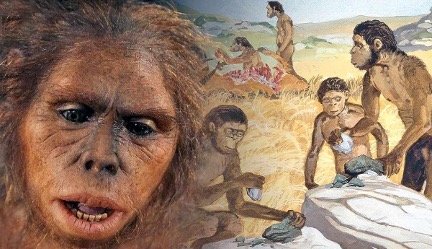
Donald informs us that mimetic culture is the murky realm of eye contact, facial expressions, body language, self-decoration, gesticulation and tones of voice. In mimetic consciousness facial expressions are softer and reading emotions is easier. In addition, because Homo-erectus and Neanderthals can stand up, a much broader range of analogical messages is possible. For over two million years, hominids shared food, disseminated skills such as tool manufacture. Group behavior was very stable and there were long-term patterns such as the continuous habitation of a site and the maintenance of fire and communal style living. They used home bases as a fixed point of departure. They left behind tool making sites and seasonal hunting camps.
Mimesis is an analogue style of communication that employs the whole body as an expressive devise including pantomime, gesturing, sharing attention in rituals, songs, dances and games which allow proto-humans to receive comfort, continuity and inspiration in the face of the unknown. Mimetic skill is the extension of conscious control into the domain of action. It epitomized four uniquely human abilities.
- mime—episodic consciousness experiences events. Mime uses an imaginative reenactment of an event. As Donald writes, it is an event about an event. Unlike episodic consciousness mime is not limited to the present since it can be an enactment of the past and the future. It moves beyond episodic awareness by re-presenting events. Along with physical movement, vocalization probably developed beyond simple cries to some form of voluntary voice modulation including pitch, tone and volume what is called prosody.
- imitation – it requires more discipline than mime. Whereas mime is initiated from within, imitation requires careful watching of someone or something else, copying their motions while suppressing behavior that might violate what one is copying. It is one thing to pretend to be the animal one is hunting. It is another thing to craft the costume and prepare a hunting ritual in order to imitate the animal. Imitation, unlike mime, would involve teaching on the part of an adult.
- Skill – is a combination of mime and imitation but it is practiced over time. This results in improvements in performance through rehearsal.
- Gesture – calls on all three skills in the service of group communication. Controlled gestures, shared attention and rhythm are the foundation of group rituals. This shows up phylogenetically in improvement with the appearance of Acheulean hand axes. Gestural and voice control are now voluntary and not stereotypic. Mimetic consciousness lies in between Robin Dunbar’s “grooming” stage of chimps which averaged bands of about 50 (this is Donald’s episodic consciousness for chimps) and the evolution of verbal language with 150 people (Donald’s mythic consciousness which we shall get to next). This would mean that mimetic consciousness would involve Homo Erectus and Neanderthals living in groups from 50-150 people.
VI. Mythic Consciousness
Mythic consciousness involves a qualitative change in consciousness. If mimetic consciousness is an event about an event, mythic consciousness strings together a story that connects events. On a cultural level, language is not primarily about inventing words. It is about telling stories in groups. Language is invented on the level of narrative. Categories such as nouns, verbs and adjectives emerged only after episodic representation had been specified first in mime and gesture.
Donald informs us that the ultimate complex structure of language was implicit even in pantomime and gesture. Language does not devalue or displace mimesis. It serves a different function in society. The mimetic body language, prosody and ritual of life continue but under the control of a new mythic mantle. Yet validating myths nevertheless had to rely on performances, coronations elaborate weddings, and customs such as bowing and curtsying to consolidate and implement power in daily life. We still have craft, custom, skill and ritual which are all mimetic in their roots. However, myth has come to dominate ritual.
Mime, imitation, skills and gestures are reorganized on a higher level
Mime, imitation, skills and gestures continue to exist but are subordinate, complimenting verbal language. Rituals and stories are verbalized, enacted and hammered into significance and meaning. Analogy is used for the first time to build bridges between the known and the unknown.
The zooming power of verbal language
As Donald points out, language gives us a cognitive zooming facility with which we can voluntarily alter the scale of experience, plunging into microscopic detail or pulling back for the big picture. In mythic consciousness stories, songs, and music are not simply repeated, but are suppressed, exaggerated into a new temporal organization of a dramatic story. Vocalizing streams are longer and grammar and syntax are used. For the first time, words and phrases stand out from common sounds.
The development of language allows consciousness to open up the past and the future by allowing people to talk about what happened before and what they intend to do in the future. Behavior is not just regulated through signs but predominately through symbols such as status objects which regulate inclusion and exclusion in groups. As a result of verbal language Homo sapiens develop cultural artifacts and knowledge systems which are passed on over time. In terms of social organization, verbal language helped to develop an ability to integrate a large number of groups (up to 150) as well as to create a division of labor between not only hunting and gathering, but also between making tools and weaving baskets.
VII Theoretic Consciousness
Writing invites metacognition: thinking about thinking
The development of writing systems first in Bronze Age, picture writing and then the Iron Age alphabet makes possible another qualitative revolution in consciousness. Writing freezes thinking and objectifies it. This allows people not only to see their thinking but it allows them to think about their thinking. Writing makes it possible to:
- categorize and correct thinking mistakes;
- organize knowledge into frozen frames which can be improved on;
- organize symbol systems into theories which can take on a life of their own independently of solving concrete problems. Examples include mathematical theory, religious theory, deductive logic, scientific theory, (inductive logic, formal systems of measurement, taxonomic classification) systems of law, systems of art -painting, musical theory and
- allow for analysis and the discovery of laws which would be impossible if limited to the spoken word.
Literary skills change the functional organization of the brain
Literacy affects the relative growth and synaptic richness of certain regions and structures of the brain. There is no equivalent in a preliterate mind to the circuits that hold the complex neural components of a reading vocabulary or the elaborate procedural habits of formal thinking. These skills are unnatural. They are grounded in deep drilling by decades of intensive schooling in technical, mathematical, scientific and musical fields. Literary skills also deeply influence how individuals and communities of literate individuals perform their cognitive work.
Biological vs external memory systems
The external memory stores books, calendars, musical notations, math notations, impressionist light and maps which liberate consciousness from the limitations of the brain’s biological memory systems. Our external memory is a kind of Trojan horse in the brain. It translates all the advantages of external storage media directly to the brain. This makes the mind externally programmable. Ideas, theories, strategic plans and imaginary events can be processed according to the dictates of cultural cognitive engineers.
External storage systems are revolutionary because they transform the architecture of conscious mental activity. Externally displayed thoughts can be classified, compared, experimented with just as can physical objects in a lab. They can be assembled into complex arguments much more easily than any biological memory. Here is a summary of the advantages of an external memory system over the brain.
Table 4 Biological vs External Memory Compared
| Biological Memory | Category of Comparison | External Memory |
| Engrams | Memory records | Exogram |
| Impermanent | How long do they last? | Permanent |
| Small | Volume | Unlimited |
| Hard to refine | Refinability | Infinitely reformable |
| Vague – lacks definition, detail | Clarity
|
Sharper |
| Impossible to display in awareness for any length of time | Display | Stable
More easily displayed |
| Difficulty in locating and recall | Accessibility to recall | Easy to search |
| Rely on ancient associative principles such as similarity and continuity | Methods of recall | Dewey Decimal system at libraries |
| Unreliable | Sound | More reliable |
| Standards are vague | Standards | Stricter standards of revision |
| It improves but difficult to see how | Rates of improvement | Improves over time |
| Natural experience is less intense and has less variety because you have access to the people you know | Experience/ vicarious reality | Vicarious reality—tv, movies, books
Go beyond personal experience and have more intensity (for better or worse) and more variety |
| Cultural memories More limited over time Rely on storytelling which slowly changes over generations in spite of cultures wishing to keep them the same |
Memory depth | Cultural memories over generations
locked into external storage |
Finally, let’s turn to Donald’s overview of the four kinds of consciousness from apes to pre-human hominids to human beings. They include episodic, mimetic, mythic and theoretical consciousness. Categories that are compared include the degree of culture, communication systems including gestures, body language, vocalizing, hearing, how time is perceived and memory.
Table 5 Forms of Self Awareness: Apes, Proto-humans, Humans
| Category of Comparison
Types of Consciousness |
Episodic streams of discrete events—other directed, observes the world from unselfconscious perspective |
Mimetic theatricalgestures, postures, self-conscious, subjected to relentless review-ritual |
Mythic 100,000 to 5,000 BCE Linguistic representationNarrativemyth |
Theoretic External representation
Writing systems |
| Species and Time | Primate (Chimps, Bonobos) | Proto-human Homo-Erectus, Neanderthals Generative, recursive capacity for mime |
Homo Sapiens | Homo Sapiens |
| Time Period | 5 million BCE | 2 million BCE
Beginning of Pleistocene |
150,000 BCE Upper Paleolithic/ Neolithic |
5,000 BCE Bronze and Iron Ages |
| Social/Culture | Social but Pre-symbolic: signs No enduring culture |
Social but pre-symbolic no enduring culture |
Social and Symbolic CultureComplexity of roleincreased bands of 50-100Size increases to100’s in response to Ice Age crisis to better coordinate hunting big game Bands, Tribes 100—1000 |
Social and Symbolic Culture Division between mental and manual laborCities, States 10, 000-100,000 |
| Conscious conduct | Imitation
not as literal as mimicry routine, instinctual |
Mimicry: addsrepresentational dimension to imitation for purposes of reenactment of a relationship or an event
Conscious, self-initiated representational acts but not linguistic |
Speech and verbal language | Writing
sign language closer to ideographic reading and writing than speech |
| Communication systems | Grooming Recalling a single event |
Ritual, song, dance, games | Stories | Study of rhetoric Scientific theories |
| Gestures: Involuntary or voluntary | Gestures are involuntary, stereotyped | Gestures are voluntary, not stereotyped | Gestures are subordinate and reinforcing of speech | |
| Gestures:
Concrete or abstract |
Unreflective, concrete and situational | Unreflective Concrete and situational |
Reflective Concrete and situational |
Reflective Abstract universal |
| Body language | Possess less complex superficial facial muscles needed to express emotions | More complex facial muscles to express emotions | Most complex facial muscles to express emotions
Body more vertical to express fuller range of analogical messages |
Same as mythic |
| Vocalizing | Poor at vocalizing, whining, begging | Cannot sustain vocalization for many minutes No notations, no grammar |
Can sustain vocalization for minutes Notations, grammar using vocalizing to clarify thinking |
Uses vocalizing the writing to clarify thinking |
| Hearing | Low differentiation of vocalizing from external sounds | Perceives words and phrases as a sequence of sounds A word sentence does not stand out from common sounds |
Perceives words and phrases as objects and events A word or sentence stands out from common sounds |
|
| Duration (How is time perceived?) |
Lives lived entirely in present as a series of concrete episodes which are situation-bound | Lives with short pasts and futures | Oral storytelling lengthens the past and the future | Writing systems open up the deep past and deep future |
| Events and situations | Specifics of events but not generalities of action across situations | Concrete episodes represented and comparison between episodes Can generalize actions across situations |
Organizes variety of events suppresses some exaggerations of others into a temporal and dramatic story
Significance, meaning, analogy |
Theories reorganize the real past in the service of causal explanations
Theories of mathematics, science, religion, law, music
Dissection. Analysis, laws |
| Formal argumentssystematic taxonomies induction, deduction formal methods of measurement |
||||
| Memory | Episodic memory of single events
Recall but cannot represent a situation and reflect on it |
Procedural memory preserves generalities of action across events: tools manufacture | External Memory Storage
Working memory |