







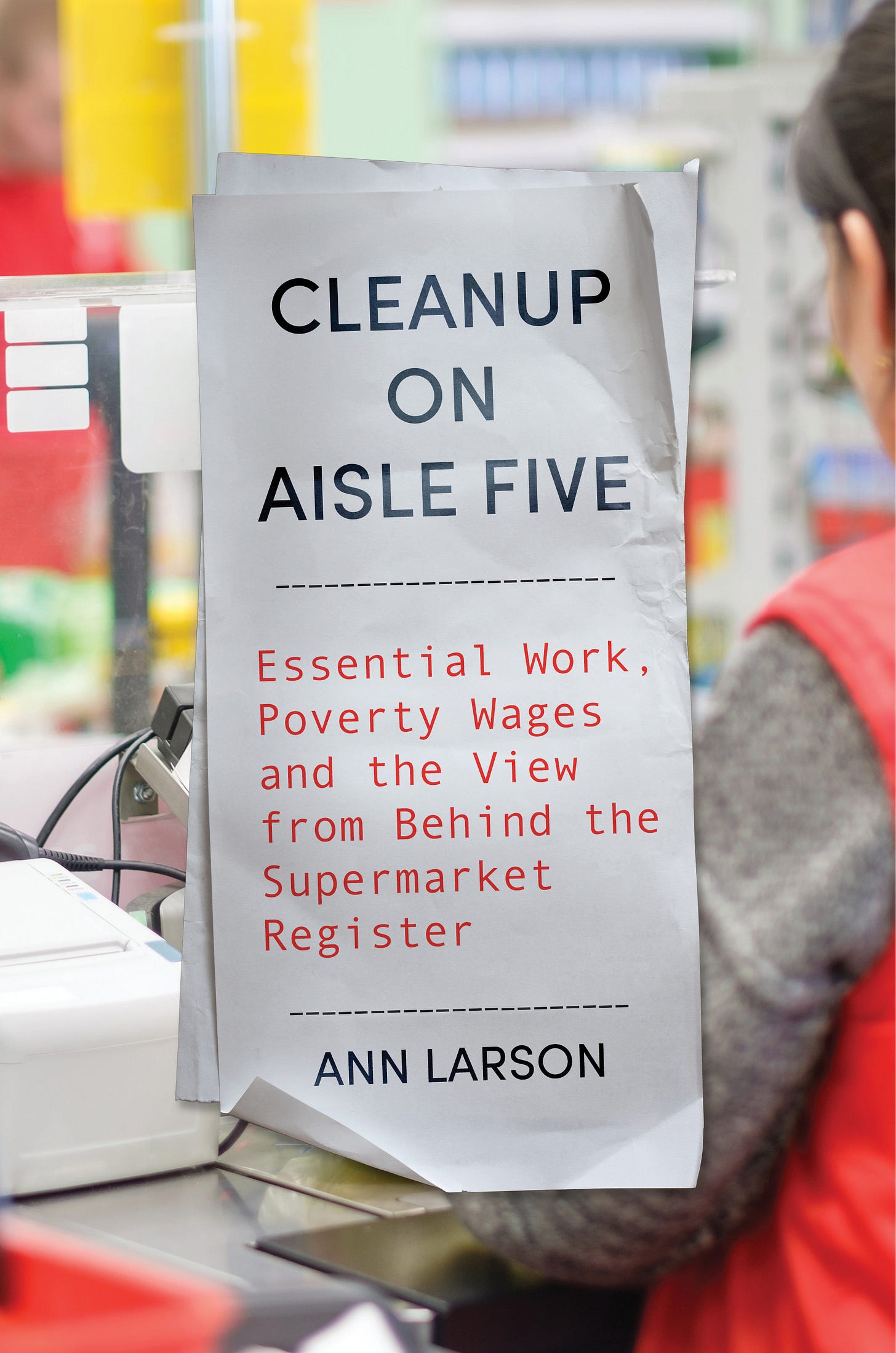
It was a quick 60 minutes, squeezing in:
- her book, Cleanup on Aisle Five: Essential Work, Poverty Wages and the View from Behind the Supermarket Register
- her small-town upbringing and expectations of success
- professional managerial class aspirations
- Shop Class as Soul Craft
- we don’t need no sinkin badges for your goddamn bias against SKILLED workers far and wide
- Nickel and Dimed and pushed out of the health care and secure food market
- The bloody venture capitalist leeches or vultures (two admirable animals in my book, but let’s go with it)
- Koch Brothers Stand Together app for exploiting houseless folk — PadSplit
- just in time, freeway flyer, adjunct disposable faculty
- these muckrakers — Main Street by Sinclair Lewis; A Month of Sundays: Searching for the Spirit and My Sister by Julie Mars; Twenty Years at Hull-House by Jane Addams; Jack London: Explored harsh social conditions, poverty, and socialist themes in works like [The People of the Abyss] and [Martin Eden]; Theodore Dreiser: Wrote naturalistic novels like [Sister Carrie] that focused on the unforgiving economic realities of urban American life; Frank Norris: Authored gritty naturalist works like [McTeague] that examined greed, poverty, and human decay; John Steinbeck: Captured the devastating plight of migrant workers and economic inequality in The Grapes of Wrath ; George Orwell: Combined political sharp commentary and socialist ideals in fictional and documentary works like [Animal Farm] and [Down and Out in Paris and London];Barbara Ehrenreich: Wrote investigative non-fiction like Nickel and Dimed, which mirrors muckraking traditions by going undercover in low-wage American jobs.
Here, some of her articles:
What was it like to work at a grocery store during peak COVID? (Marketplace) 2025
To the Corporate Media, Workers May as Well not Exist
There’s No Such Thing as Unskilled Labor (Wort Radio)
Composition’s Dead (2016), From the book, Composition in the Age of Austerity
Higher Education’s Big Lie (2010)


And so this Koch Industries-invested company was on Ann’s radar.
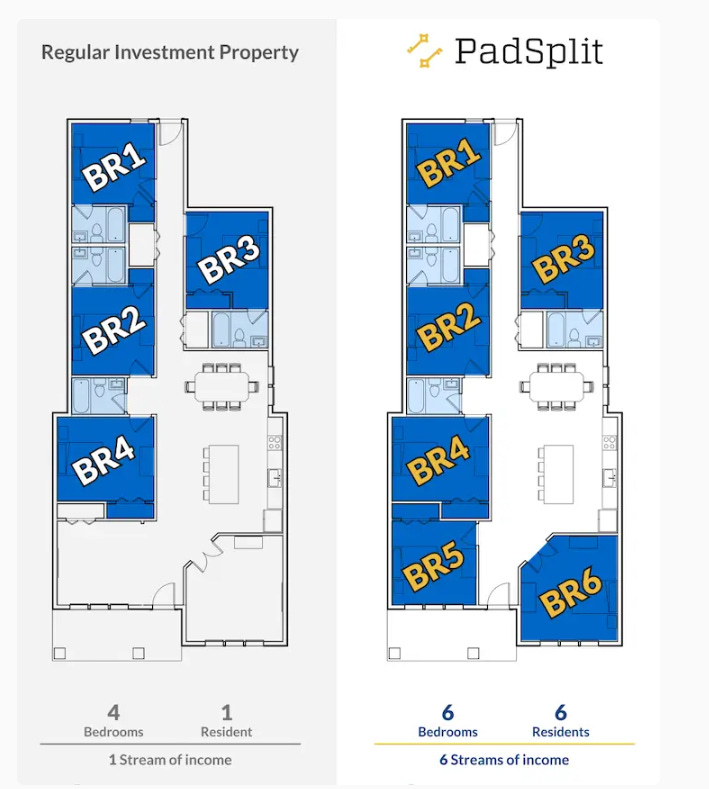
Ann — Tenants aren’t the only ones with concerns. In Houston, after two people died in a boarding house fire, the city issued new rules for operators, including requiring permits. In a suburb of Atlanta, neighbors complained about trash, noise, and numerous cars parked in front of PadSplit properties. Last year, affordable-housing activists in Salt Lake City protested to stop a (non-PadSplit) rooming house development. They argued the model turns basics—such as private bathrooms—into luxuries, which exerts upward pressure on rent prices for everyone.
Those problems haven’t stalled the company’s growth. Founded in 2017 in Atlanta, PadSplit has grown to encompass 6,500 rental units across the U.S. and 5,300 renters. PadSplit has received $35.2 million in venture capital funding, and in 2022 Inc. listed it as one of the fastest-growing real estate firms in the country.
It’s easy to see why landlords gravitate toward this model. Heather Wren, an Atlanta-based landlord, partnered with PadSplit in 2018. She started with one property that had formerly been occupied by a woman with three children who was using a housing choice voucher via a program run by the Department of Housing and Urban Development (HUD) that pays a portion of low-income tenants’ rent. Wren converted the home to a PadSplit that housed six individuals who weren’t receiving the government subsidy. She quickly discovered what studies have long shown: Renting to poor people is good for business.
“PadSplit has been the key to higher profits,” Wren told me. She now owns 10 properties with a total of 65 rooms and plans to keep growing.
When I interviewed LeBlanc in March, he contended that the real problem is not with his company but with government inefficiency. PadSplit’s roots go back to 2008 when LeBlanc saw signs of the impending foreclosure crisis in Atlanta.
“It was disturbing to see what was going on in some of these neighborhoods,” he said. “And I knew that housing projects were also shutting down.”
The relationship between PadSplit and the Koch family (often historically referenced as the Koch Brothers) centers primarily on financial backing through philanthropic and venture investment arms, alongside a coincidental executive name connection.
1. Venture Backing via Stand Together
PadSplit, an affordable marketplace platform that allows property owners to rent out single-family homes room-by-room, is financially backed by Stand Together Ventures Lab. Stand Together is a philanthropic and venture organization founded and heavily funded by billionaire Charles Koch to support market-based solutions to social problems, including the affordable housing deficit.
2. Strategic Alignment on Workforce Housing
The Koch network’s investment in PadSplit aligns with their broader, multi-million dollar venture into single-family and workforce rental real estate. For instance, Koch Real Estate Investments—a subsidiary of Koch Industries—previously made a massive $200 million equity investment in Amherst Holdings, one of the nation’s largest single-family rental operators. The network favors companies like PadSplit that utilize private-sector innovation and existing housing infrastructure rather than government-subsidized programs to decrease rent burdens.
3. Executive Team Overlap
Adding to the association, PadSplit’s current Chief Growth Officer is Adam Kolojejchick-Koch. He leads the company’s sales, marketing, and expansion efforts to recruit real estate investors to the platform.

I met Ana through the non-profit program I am heading up, both in Lincoln County and Jefferson County. Family Independence Initiative of Oregon is a pilot project collecting valuable stories from working families in exchange for $840 for one-year participation.
The quarterly deposit of $175 I had just put into her account prompted Ana to contact me. She told me the money helped her make a car payment. She also is attempting to get more people in Jefferson County to sign up, or at least to email me.
Love Thy Neighbor — One Woman’s Fight for Her Husband
“Program aim: enrolling families to end poverty”
By Paul Haeder, 2019!
“Sometimes having people in your circle to support you can mean the world of difference,” said Joann, who talked with me in Madras at the United Methodist Church, while discussing the new initiative Jefferson and Lincoln counties are rolling out. “I think my circle of support has given me invaluable emotional and material support not found anywhere else.”
The new gig for me is with Family Independence Initiative, a nonprofit started 18 years ago through the research tools and impetus of the founder, Mauricio L. Miller (author of the book, “The Alternative: Most of What You Believe About Poverty Is Wrong”).
For 450 households in Jefferson County, the chance to be part of a networking and peer support pilot could change the face of how social services staffing and funding are delivered in Oregon. The project is jointly supported by the Oregon Department of Human Services, and the goal is to engage with people who go in and out of poverty and give them networking tools to end that cycle.
FII is a successful model in other cities — Oakland, Austin, Cincinnati, Boston, Albuquerque and a half dozen other cities. What has occurred in those cities is nothing short of miraculous.
Jorge Blandon, executive vice president of Family Independence Initiative, was out here in Newport at the end of May and talked with a dozen households about the project — basically getting a household to form a cohort web of five or six other households to learn and share the value of social networking.
The 12-month participation process is pretty simple: register the family through a website, Up Together, and then each month, the household records progress and goals and challenges.
“For me, this sounds like a win-win,” said Jewel, a secretary for an antipoverty program in Lincoln County. “It makes sense that people are their best supports, their best avenues for networking.”
My job is to get in front of households and present the steps of joining this Lincoln County pilot, which is ultimately about learning directly from the community. Members receive $100 for signing up, and then $700 is paid out quarterly.
I presented the project to groups in Madras last month, and we will be at the Latin Festival Sept. 14, at Sahalee Park. Individuals at the community event in the park were able to ask the questions most people are concerned with: “Where does this information go? Is my private journaling and family budget kept private?”
We are in the process of hiring an on-the-ground site director for Jefferson County.
“Building networks for struggling families is really the key to their self-sufficiency,” said Pastor Nancy Slabaugh Hart of the Madras United Methodist Church.
Family Independence Initiative uses sophisticated language learning tools. The information people put on the Up Together site is looked at as aggregate data, meaning those data points from individuals are put into algorithms that help FII determine what families are doing to get out of poverty. All information is anonymous and secure. Then FII reports back to DHS about the findings.
Part of the attraction for me to undertake this half-time job is that I have been working in and around communities living through many forms of poverty and life challenges. From educator in gang-prevention programs in El Paso and Spokane, to social worker for Portland homeless and within a transition facility for veterans and their families facing homelessness in Beaverton, I have had years working with courageous and resourceful individuals and families.
My role is to introduce the project, get people enrolled, and let the families (this could be a single parent, a couple with no children, single individuals, married or not) develop the web of communication and support. I have a complete hands-off role in terms of assisting families with their goals and needs, or locating resources. I do offer up support for the online journal writing over the 12 months of networking.
We all know about American communities which participated in so-called barn-raising events. Those events were people-powered, community-based, with no government or nonprofit involvement.
How Chinatowns across this country were founded is illustrative of peer support, peer networking and social capital: families, friends, businesses and churches came together to provide jobs, micro-loans, community space, spiritual and educational support. Again, no government or social services agencies were called upon.
In 2019, families in Jefferson County had multiple challenges — single-parent households with that parent working two jobs, but still not getting ahead; families that get some form of support (food stamps, Temporary Assistance for Needy Families, housing vouchers) but want to get out of the cycle of multigenerational poverty; seasonal work; expensive housing.
The FII web page states, “As a nation, we have missed an opportunity to invest directly in the initiative and strength of low-income families working toward economic mobility. Seventy-five percent of low-income families move above the federal poverty line within four years. Yet, 50% slip back under within five years. Under the current approach, families struggle to build the necessary assets to weather the next crisis and aren’t rewarded for their initiative in doing so. FII is changing this resource gap for low-income families by partnering with, learning from, and investing directly in families.”
What FII wants is data and stories from the enrolled families or households. From there, a hundred data points are recorded and then mapped in graphs and charts so the heads of DHS can see what social services are missing and what families are really doing to rise out of poverty.
For Blandon, the mission at FII and for any family living in poverty is clear.
“At its core, what FII is doing is trying to bring (connections, choice, and capital) back to families,” he said. “We know that families are the experts. How else would they survive certain conditions? They’re coming up with creative ways to support each other.”
“FII is trying to push for a new system — a system that looks at working poor communities in a different light. They are not moochers or takers. They are not poor because they’re lazy; quite the opposite,” said Blandon. “We’re trying to shed that light by leveraging technology and data.”
For more information, or for hosting orientations, contact Paul Haeder at gro.iifnull@luap, or call 509-8—-9—7. Any household is eligible, with two caveats — there must be an active email and a banking account or debit card for the $800 stipend payment.
*****

Ann and I talked about surveillance capitalism as it is not only played out in the grocery store, but EVERYWHERE:

Through the lens of Wrench in the Gears, this pivot to “bipartisan social innovation” is not benign charity. Rather, it is viewed as a calculated long game to dismantle the public safety net and replace it with a privatized “human capital” stock market. McDowell’s research outlines several mechanisms of this strategy.
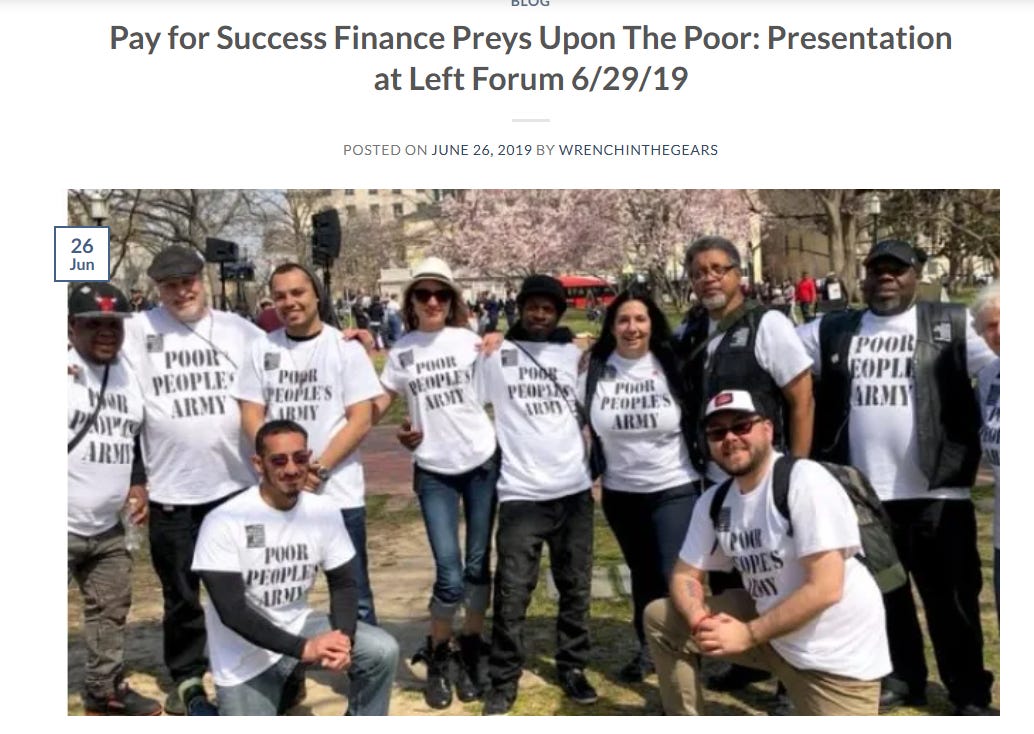
This talk with Ann Larson opened up so many Pandora boxes. Here, Wrench in the Gears:
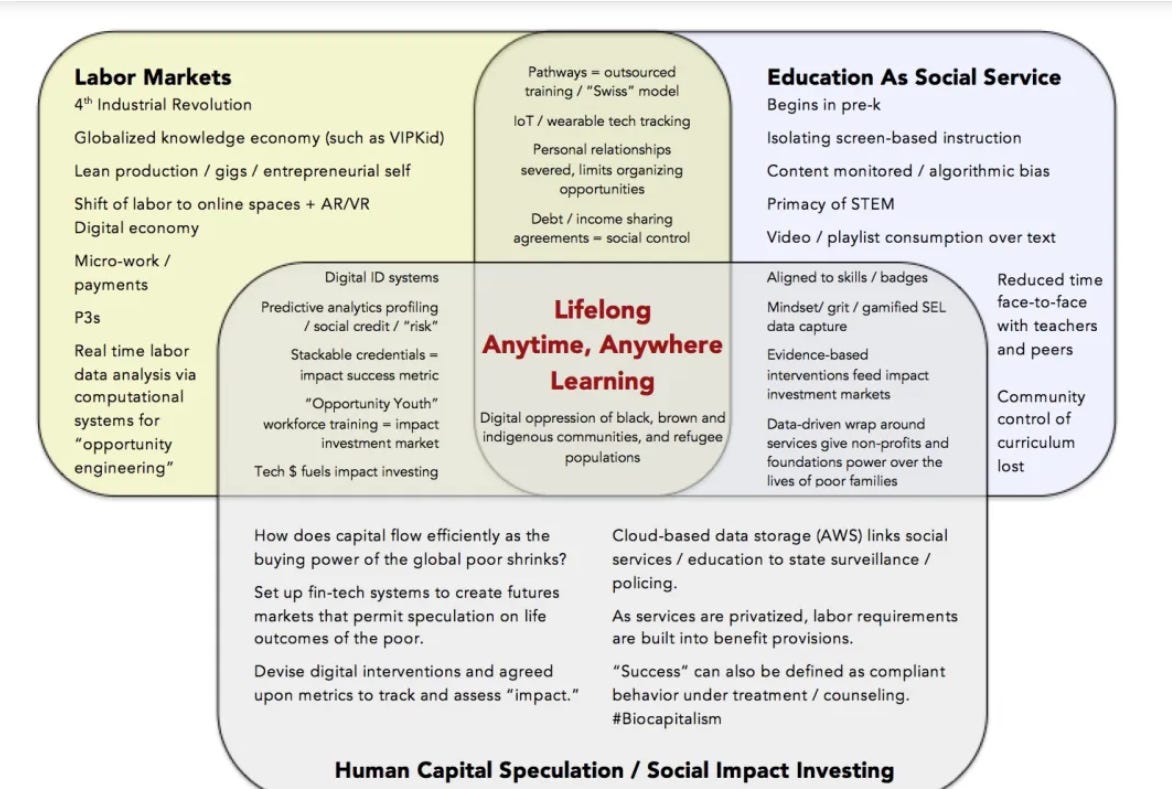
How Pay For Success Finance Will Prey Upon The Poor
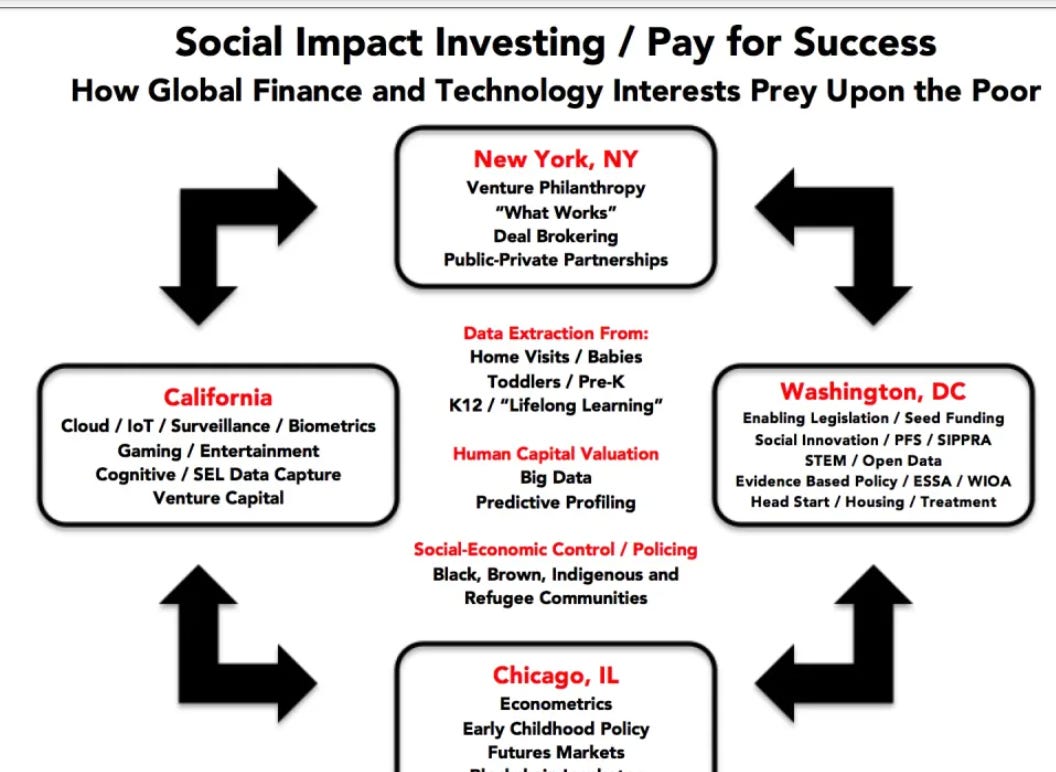
One of the biggest things we’re up against, and something few people are talking about, is social impact investing and pay for success finance. Within the hollowed-out shell of the welfare state, which admittedly was always inadequate and used for purposes of racialized social control, global finance has built a new machine that will use predictive analytics, artificial intelligence, and wearable and screen-based technologies to monitor the global poor and profit from their misery.
This effort is being carried out in partnership with the non-profit sector, higher education, think tanks, and global foundations. Many involved identify as liberal, even progressive. Successful resistance will require stopping Trump, the Koch brothers, and ALEC, as well as a corporate, militarized Blue Wave that has every intention of stabilizing late-stage capitalism with technocratic “evidence-based” solutions. Make no mistake; this is a fully bipartisan enterprise.
Outcomes-based contracts are this machine’s operating system. Contracts employ pay-for-performance agreements that reimburse service providers IF they produce specified success metrics. These metrics are narrowly defined and chosen for their ability to be gamed. Contrived solutions offer up fake “success” to enrich investors at the expense of vulnerable populations. Think standardized test scores as success metrics for education or Fitbit step counts for preventative health.
This machine requires a steady supply of people labeled deficient by those in power. Like batteries in the Matrix, the poor are meant to be the fuel. The machine does not care for their actual well-being; its sole purpose is to maximize profit. In that it is similar to the capitalist Western medical model where Big Pharma opts for chronic disease management over research leading to cures. Pay for success will not empower the poor, but instead manage them and harvest their data indefinitely.
The infrastructure for this system was put in place in the years leading up to the financial crisis of 2008. After toxic mortgages imploded, financiers needed another way to keep global capital circulating. It had to be even bigger than real estate debt, since global wealth continues to become more and more concentrated. The next BIG target would be financialized public benefit systems. Through financialization, resources are siphoned from the real economy into the financial sector, where demands for short-term profit lead to instability, overwhelming debt, income inequality, and wage stagnation.
To justify this shift, proponents of pay for success insist governments will never have sufficient resources to care for their people. Services MUST be outsourced. This in turn opens up vast global markets for speculative investment in human capital. The big money isn’t to be had running human services, which are admittedly hard to turn a profit on, but rather in the trade of debt associated with providing those services. Such a development isn’t surprising, given the power finance and technology interests like Alphabet and Goldman Sachs hold over elected officials. Governments have been captured, and as hostages of transnational capital, they’re compelled to go along with this brutal scheme.
After its fin-tech makeover, the new welfare state will essentially function as a maze into which poor people are forced by social work navigators. Technologies will track, predict, and influence behavior. The digital dust the poor generate as they attempt to negotiate punitive bureaucracies will flow to social sector dashboards, informing hedge fund bets in real time. With their varied portfolios of trauma, vulnerable populations will replace real estate in the lead-up to the next Big Short.
Investors don’t put money in markets they expect to dry up. Thus, logic dictates that turning poverty into a global investment market will only increase poverty. Social impact markets require an ever-expanding supply of people deemed cheaply fixable according to the terms investors set. The fixes offered aren’t meant to materially improve lives long-term. That would require redistribution of resources, something unthinkable for the likes of Bill Gates, Jeff Bezos, and Mark Zuckerberg. While poverty may be reduced somewhat, it is an essential feature of the design. For pay for success to thrive, homelessness, addiction, mental illness, hunger, violence, unemployment, broken families, and uncertainty must remain the norm. Hedge funds hate stability, and they’re the ones driving social impact investing. If everyone had enough to live a stable life, the gambling would have to come to an end.
Vulture philanthropies seeded this market. After many grant cycles, the non-profit sector has been conditioned to impose toxic solutions without question, collecting the data needed to justify venture capital’s profit-taking. Having been integrated into the machine, these partners in crime are tasked with managing populations that black box algorithms have identified as “at risk.” These artificial labels will, of course, be disproportionately applied to Black and Brown communities. The system demands broken people. Broken people are the raw material. As a result, the system is incentivized to manufacture data and create as many broken people as hedge funds require to keep global capital in optimal circulation.
Social sector workers are also part of the human capital pipeline, caught in this web along with the poor. The system intends to extract as much data and impose as much surveillance as it possibly can, which is why those administering harmful solutions must get creative in identifying others with whom they can organize. This shift will be catastrophic for educators, healthcare providers, therapists, and social workers across the globe. Effective resistance will need to unite people across diverse workplaces.
The United Way is a partner in these efforts, as is Strive Together out of Ohio. They’ve identified a permanent underclass for “collective impact” processing called ALICE: Assets Limited, Income Constrained, Employed. These are the households of the working poor: children with unstable housing, indebted college graduates, workers living paycheck to paycheck, patients with chronic illness, disabled veterans, the elderly. Pay-for-success “solutions” will process them as commodities via ed-tech, tele-health, tele-therapy, and “smart” housing.
Soon, large segments of the population will find their life choices subject to digital engineering, forced onto prescriptive pathways, jumping through hoops into which structural racism has been embedded in computer code. Smartphones will play a major role as benefits are moved to online platforms and linked to digital identity. It is the phones with their biometric capacity that facilitate transfers of value and data and enable tracking and analysis of impact. Phones will be the minders of the poor. Those with phones can have no expectation of privacy.
Such systems are being piloted on unhoused people in Austin now with backing from Bloomberg Philanthropies, a major impact investor. The state of Illinois also has a working group setting up Blockchain birth certificates and is looking to digitize SNAP benefits so coded nudges can be used to push “good” food choices. As the poor have their welfare inputs evaluated against their economic and behavioral outputs, the rich will sit on the sidelines placing bets. Either way the rich win, because there’s always someone willing to take the short position.
Beyond financialization of human life, these data-driven systems also legitimize increased surveillance of large segments of the population, especially Black and Brown communities already subject to militarized policing. Resisters will be viewed as insurgents and subject to violent counterinsurgent interventions as we saw in Ferguson and at Standing Rock. Wearable and screen-based technologies and interoperable data systems, like Project Unicorn headquartered a few blocks from here, will feed a vast network of signals intelligence to monitor the behavior of the poor, predicting the likelihood of pushback. The Minerva Research Initiative was set up by DARPA (the Defense Advanced Research Projects Agency) for exactly this purpose. It’s not hard to imagine the impact such intelligence will have on resistance movements.
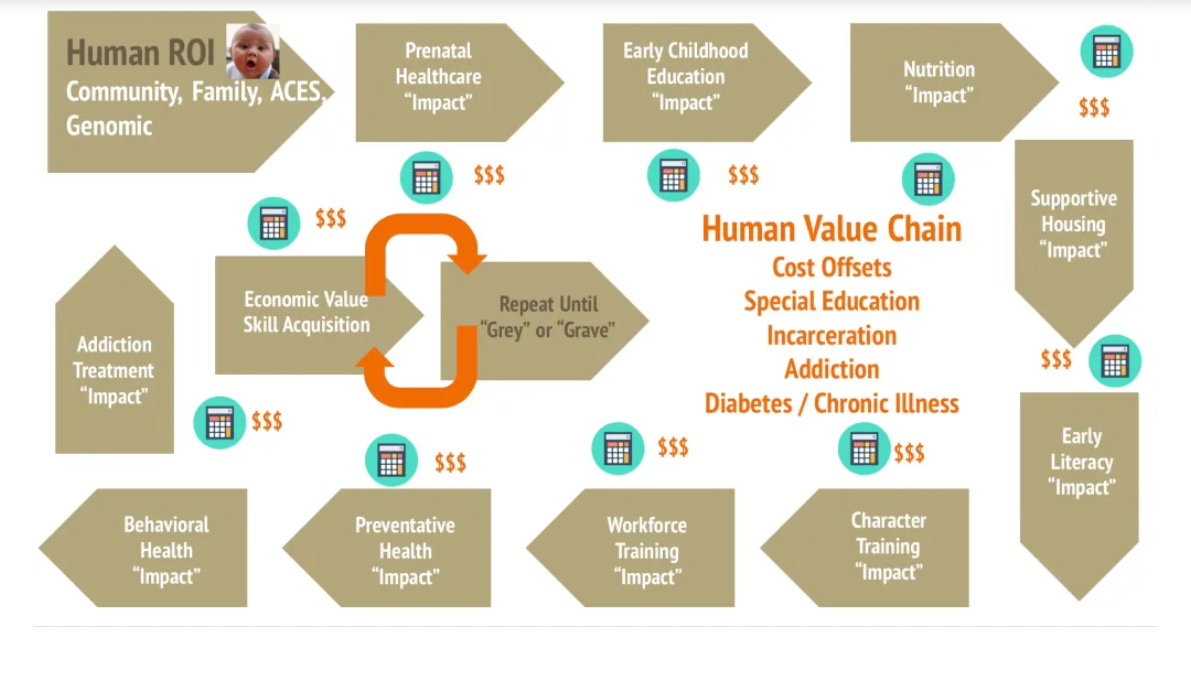
So, what does social impact digital surveillance look like?
It looks like behavior tracking apps for low-income mothers.
It looks like play tables that video record toddlers and score their social behaviors.
It looks like online preschool.
It looks like brain wave monitoring headbands and executive function-enhancing video games for students.
It looks like wearable tech that tracks vital signs for substance users.
It looks like online cognitive behavioral therapy for prisoners.
It looks like Fitbits and Internet of Things pill caps for Medicaid patients.
It looks like “smart” supportive housing with integrated IoT monitoring.
It looks like tablet-based overseas monitoring of seniors.
It looks like virtual reality death simulation training for hospice workers.
Once you peek under the hood, you realize what a grotesque business social impact investing actually is. These tools are built on 400 years of racial capitalism. It is the Doctrine of Discovery with Blockchain replacing double-entry bookkeeping and smartphones and digital identity systems replacing shackles. It is a system that arose in tandem with cloud-based computing, broadband, 5G, and the Internet of Things. These advancements are inextricably linked to the interests of the US military and intelligence community, which is why we must recognize that as much as we have come to rely on our devices, true liberation will never come through digital channels. It can’t; our opponents run the cloud.
We’re living through a period of orchestrated mass confusion and distraction. Some are sitting like frogs in simmering pots, distracted on their phones as the steam billows around them. Others are forced to play real-life games of Frogger, heads down, crossing dangerous highways, dodging crises right and left with little opportunity to see, let alone plan for, what is coming.
South Africa and Australia have piloted public benefits on Blockchain linked to digital identity. The state of Illinois is looking into it as well. We need to stop them politically, and we must develop alternative networks of support outside existing government and non-profit structures. We need to get out of our simmering pots and look up to the horizon. We need to do it soon. — Alison McDowell
What Ann Larson and I touched upon was the monopolization of food, and the “insecurity” of grocery workers is tied to the slave wages and long hours. I have first-hand experience with cashiers and other retail service folk living in vans. I was both a social services worker getting the houseless and just released from prison and those with substance abuse histories JOBS, sometimes felony friendly, and some that needed jobs like warehouse work, and service work, including chopping fruit and frying chickens. Corporate America on down the line, to the very same struggling managers of these places are hell on wheels, retribution focused, and wannabe drill fucking sargeants.
We talked about the infantilization of the training modules for these jobs, and the fact that cashiers have to scan a certain number of items a day or else. At the local Kroger’s Fred Meyer, read all about it: Ground-Truthing at 69 in a time of Genocide, Scholasticide, and “Devolution of the Soul”, There are no exits anymore from the MADD — Mutually Assured Destruction of Decency

Ann — “In 2020, at the height of the pandemic, I got a job in a supermarket where my colleagues and I were paid poverty wages to do essential work. I came away from the experience humbled and determined to share what I had learned. In the tradition of bestselling behind-the-scenes classics such as Barbara Ehrenreich’s Nickel and Dimed and George Orwell’s The Road to Wigan Pier, Cleanup on Aisle Five is a character-driven look at the modern supermarket. It unpacks what works and what doesn’t and unveils the corporate interests that control everything from labor conditions in stores to how we shop for food.”
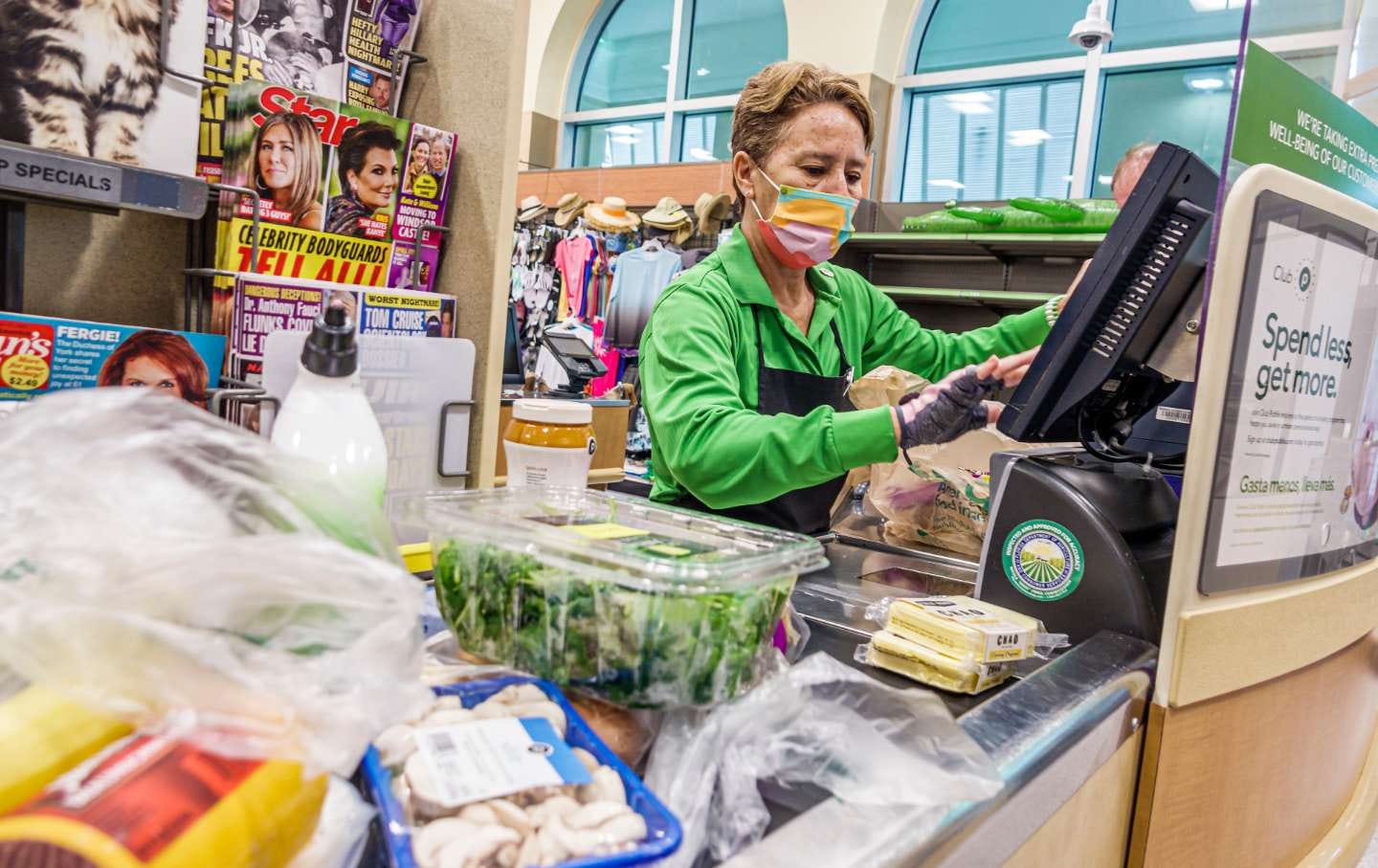
So says Ann: “In the small Idaho town where I grew up, you might aspire to be a schoolteacher, a nurse, or a small business owner, but there was nothing demeaning about working in a supermarket. In middle school, my best friend’s mom was a cashier. I never once considered that I ought to judge her, much less feel sorry for her. Almost everyone I knew did hardscrabble work that kept the community afloat. My grandfather installed tile roofs on houses, my mom taught junior high school English, and my dad had mopped floors in a grocery store before cashing in his GI Bill, getting a degree, and becoming a school librarian. There was no way I was going to feel sorry for myself for working in a supermarket.”

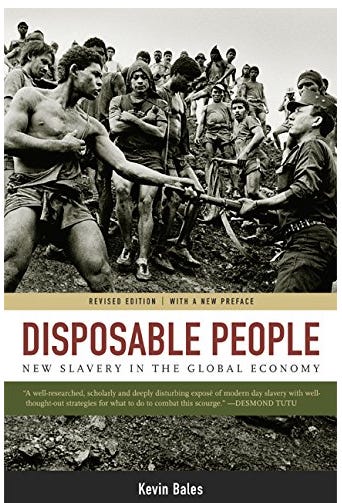
- The “New Slavery”: Unlike historical chattel slavery where owners made large financial investments in legally owned slaves and cared for them as long-term property, modern slaves are extremely cheap to acquire.
- Disposability: Because human life is cheap, slaveholders work individuals to the limit and discard them when they fall ill, get injured, or become unprofitable, replacing them easily with other desperate people.
- Root Causes: The global population explosion, economic globalization that displaces small farmers, and severe government corruption in developing regions drive millions into this system.
The Book of Embraces by the Uruguayan writer Eduardo Galeano (whose “Memory of Fire,” a trilogy poetically chronicling the history of Latin America, I earlier swallowed in great, swift gulps). Here is a video by Caleb González of a poem from “The Book of Embraces,” with music by the great Spanish guitarist Paco de Lucia. Below is the English translation by Galeano’s longtime translator, Cedric Belfrage, followed by the original Spanish.
The Nobodies
The nobodies: nobody’s children, owners of nothing. The nobodies: the no ones, the nobodied, running like rabbits, dying through life, screwed every which way.
Who are not, but could be.
Who don’t speak languages, but dialects.
Who don’t have religions, but superstitions.
Who don’t create art, but handicrafts.
Who don’t have culture, but folklore.
Who are not human beings, but human resources.
Who do not have faces, but arms.
Who do not have names, but numbers.
Who do not appear in the history of the world, but in the police blotter of the local paper.
The nobodies, who are not worth the bullet that kills them.
“Who are my contemporaries?” Juan Gelman asks himself. Juan says that sometimes he comes across men who smell of fear, in Buenos Aires, Paris, or anywhere in the world, and feels that these men are not his contemporaries. But there is a Chinese who, thousands of years ago, wrote a poem about a goatherd who is far from his beloved and yet can hear in the middle of the night, in the middle of the snow, the sound of her comb running through her hair. And reading this distant poem, Juan finds that yes, these people–the poet, the goatherd and the woman–are truly his contemporaries. —Eduardo Galeano in The Book of Embraces
LISTEN HERE TO THE KYAQ FM 91.7 interview, airing Sept. 16.