








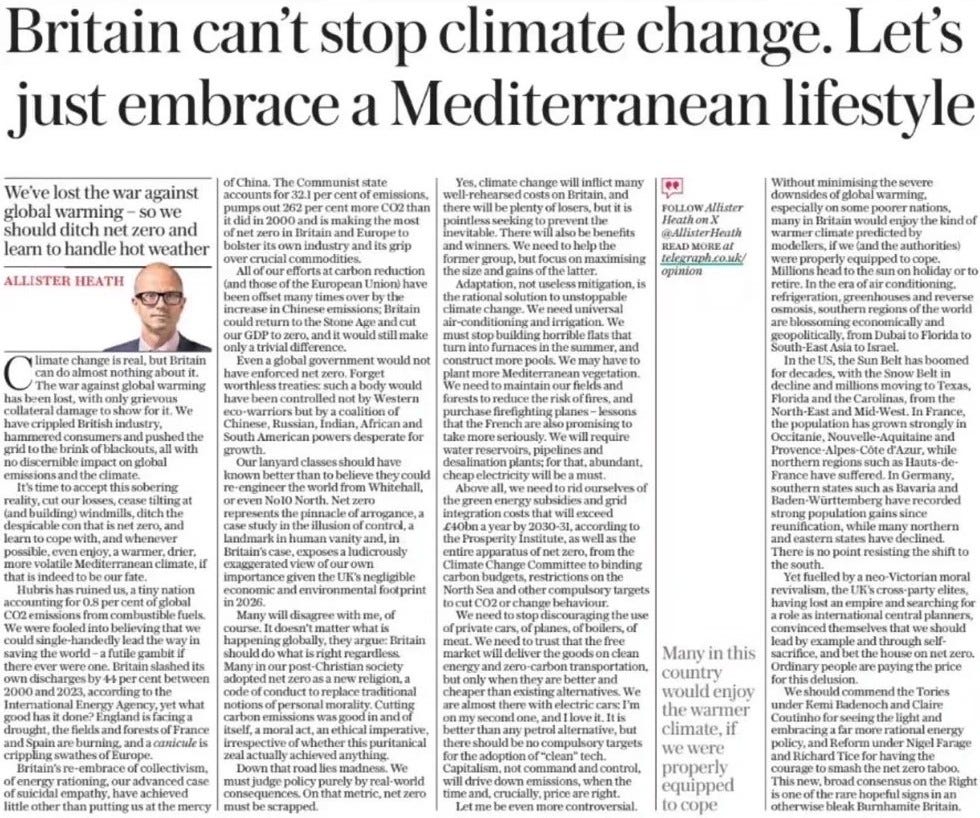
‘Britain can’t stop climate change. Let’s just embrace a Mediterranean lifestyle’
This has to be a serious candidate for the most foolish comment ever made publicly by a British newspaper editor. Allister Heath, editor of the Sunday Telegraph, opined:
‘We’ve lost the war against global warming – so we should ditch net zero and learn to handle hot weather.’
One might wonder which trench Heath occupied in the ‘war against global warming,’ given that the Telegraph titles have spent decades in the climate-denial camp.
From his privileged position of comfort and wealth, he added:
‘Yes, climate change will inflict many well-rehearsed costs on Britain, and there will be plenty of losers, but it is pointless seeking to prevent the inevitable.’
And:
‘It’s time to accept this sobering reality, cut our losses, cease tilting at (and building) windmills, ditch the despicable con that is net zero, and learn to cope with, and whenever possible, even enjoy, a warmer, drier, more volatile Mediterranean climate, if that is indeed to be our fate.’
Capitalism, the very system of planet-devouring economics that brought us here, will, Heath confidently proclaimed, ‘drive down emissions, when the time and, crucially, price are right.’
He continued:
‘Without minimising the severe downsides of global warming, especially on some [sic] poorer nations, many in Britain would enjoy the kind of warmer climate predicted by modellers… construct more pools…plant more Mediterranean vegetation.’
Jason Hickel, an economics anthropologist professor at the Institute of Environmental Science and Technology in Barcelona, noted of Heath’s article:
‘This grotesque headline is from the Telegraph. 3,000 people in Britain have been killed in heatwaves this year so far. 20,000 in Europe.
‘Even if Britain did get to “embrace Mediterranean life”, what about the actual Mediterranean, what do they get to embrace? What about India?’
Hickel added:
‘The indifference of the British elite toward mass suffering is astonishing.’
As for ‘the despicable con that is net zero’, it is a basic law of physics that to stop global warming, humanity has to cut net emissions of global-warming gases to zero. James Hansen, the NASA scientist who sounded the climate alarm to the US Congress in 1988, said three years ago that ‘we are damned fools’ for not acting upon warnings over the climate crisis. According to Hansen, there is a huge amount of global heating ‘in the pipeline’ because of the continued burning of fossil fuels. Moreover, he argued, the Earth is ‘very sensitive’ to the impacts of this; far more sensitive than the best estimates presented by the UN’s Intergovernmental Panel on Climate Change.
He said:
‘We are beginning to suffer the effect of our Faustian bargain [in burning fossil fuels]. That is why the rate of global warming is accelerating.’
Hansen added:
‘We are in the early phase of a climate emergency. Such acceleration is dangerous in a climate system that is already far out of equilibrium.’
A new study by the Potsdam Institute for Climate Impact Research shows that global warming has accelerated sharply since 2015. Stefan Rahmstorf, one of the study’s co-authors, warns that:
‘How quickly the Earth continues to warm ultimately depends on how rapidly we reduce global CO2 emissions from fossil fuels to zero.’
In his Telegraph piece, Heath adopted a classic diversionary tactic: blame China and growing nations of the Global South:
‘All of our efforts at carbon reduction (and those of the European Union) have been offset many times over by the increase in Chinese emissions; Britain could return to the stone age and cut our GDP to zero, and it would still make only a trivial difference.’
He continued:
‘Even a global government would not have enforced net zero. Forget worthless treaties: such a body would have been controlled not by Western eco-warriors but by a coalition of Chinese, Russian, Indian, African and South American powers desperate for growth.’
Heath neglects to mention the great strides that China, for example, is taking in boosting its renewable energy capacity and decarbonizing its economy. Moreover, many climate scientists disagree with cynical attempts to whitewash Britain’s historical responsibility for global warming since the Industrial Revolution.
Dr Ella Gilbert, a climate scientist and board member of the Energy and Climate Intelligence Unit, a non-profit UK organization conducting independent research and analysis on energy and climate, said:
‘The climate crisis is a global problem and every country should be acting to reduce emissions and build a greener global economy, especially those with the largest historical responsibility, like the UK. The climate doesn’t care where carbon comes from – whether [it’s] from multiple countries responsible for smaller proportions of emissions, or China.’
She added:
‘The UK may account for just 1% of current global emissions, but we’re responsible for 100% of our own emissions, and we have the opportunity to show global leadership by bringing them down.’
While Heath pines for a mythical Mediterranean lifestyle, soaking up sunshine and sangria by his pool, in the real world the Mediterranean will increasingly suffer ever more intense and persistent heatwaves of over 40C, with extensive wildfires forcing people to flee from their homes. In Britain, the hard reality is that we could face food shortages this year after severe droughts in parts of England, as well as climate-driven crop failures in major importing countries.
Heath’s article suffered such a severe public backlash that the original title of:
‘Britain can’t stop climate change. Let’s just embrace a Mediterranean lifestyle’
was later changed to:
‘We’ve lost the war against climate change. Time to scrap net zero’
One of our X followers asked if we could fathom Heath’s mindset. We pointed out the famous dictum by the US writer Upton Sinclair:
‘It is difficult to get a man to understand something, when his salary depends upon his not understanding it.’
Meanwhile, Andy Burnham, the putative savior of the genocide-participating Labor government, has maintained a stoic silence over the summer’s European wildfires and wider climate breakdown. Instead, he has promised he will take a ‘pragmatic’ approach to oil and gas drilling in the North Sea.
The dictionary tells us ‘pragmatic’ means: ‘dealing with things sensibly and realistically in a way that is based on practical rather than theoretical considerations’. There is, of course, nothing ‘sensible’, ‘realistic’ or ‘practical’ about burning yet more oil and gas, raising carbon emissions and global temperatures, and leading to ever-greater climate emergency death tolls.
Burnham says that:
‘There is a resource there [in the North Sea]. When people are struggling, we can’t ignore that.’
He would like us to believe that being ‘pragmatic’ is about helping the ordinary man and woman in the street, not the billionaire oil giants like Shell who have just posted profits of £7.37 billion for the April-to-June period, double last year.
Zack Polanski, the leader of the Green party in England and Wales, condemned Burnham’s comments:
‘Allowing new oil and gas drilling in the North Sea will worsen the climate breakdown, putting more lives at risk and doing untold damage to our economy. It’s not too late for Burnham to do the right thing and commit to leaving dangerous fossil fuels in the ground.’
Compare Burnham’s version of reality with that described a few years ago by Noam Chomsky:
‘I don’t know what word in the language – I can’t find one – that applies to people of that kind, who are willing to sacrifice the literal – the existence of organized human life, not in the distant future, so they can put a few more dollars in highly overstuffed pockets. The word “evil” doesn’t begin to approach it.’