






UPDATED on 28 August 2026.
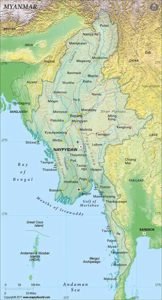 On 12 February, 2021, the United Nations Human Rights Council (UNHRC) adopted a resolution in which it criticized the removal of Myanmar’s democratically elected government by the military, locally known as Tatmadaw. The Council also called urgently for the immediate and unconditional release of all persons arbitrarily detained, including State Counselor Aung San Suu Kyi and President Win Myint and others, and the lifting of the state of emergency.
As the international community condemns the coup and shows support for Suu Kyi, it is important not to whitewash the latter as a savior of the Myanma masses. Neither is she a doyen of democracy nor a courageous anti-military leader; she is the face of an alternative ruling class project which aims to incorporate the Tatmadaw into a new geo-economic architecture. The coup is the culmination of that intra-elite power struggle.
Intra-elite Power Struggle
When the military regime under Saw Maung took power in 1988, it responded to the economic crisis by moving away from the earlier state-owned model and opening parts of the economy to market forces. The generals sought to preserve their political power while converting control over important productive assets into private wealth. This produced a hybrid system in which selected industries were opened to private ownership while the military retained decisive influence over strategic parts of the economy.
Eventually, the military’s plan gave rise to a clique of generals who control, through straw men, Myanmar’s biggest corporations, as well as the lucrative trade in jade and other precious stones, narcotics and timber. Suu Kyi and her National League for Democracy (NLD) tried to re-configure this model of military-dominated capitalism by implementing an aggressively pro-market reform agenda that included mobilizing Western and East Asian investment into regular channels. Her “Myanmar Sustainable Economic Development Plan” allowed foreign capitalists to invest up to 35% in local companies, as well as holding stakes of up to 35% in Myanmar companies traded on the Yangon Stock Exchange.
Defensive Posture
The conflict between the NLD and the Tatmadaw therefore unfolded within a relationship in which the civilian government repeatedly sought accommodation with the armed forces. Suu Kyi assumed responsibilities that had previously belonged largely to the military establishment, including a prominent role in the peace process. Her government also accepted elements of the centralized political order that had been constructed around Bamar-Buddhist dominance, limiting the distance between the NLD’s governing project and the institutional legacy of the Tatmadaw.
Suu Kyi simultaneously sought to prevent the military from using its constitutional prerogatives against the elected government. The National Defense and Security Council was especially important in this regard because it brought senior civilian and military officials together and possessed significant authority during a state of emergency. The NLD therefore had strong reasons to avoid allowing the institution to become the vehicle through which the Commander-in-Chief could expand his political authority.
Min Aung Hlaing nevertheless pressed for the council to be convened, while the NLD attempted to manage security policy through advisers of its own choosing. A state of emergency presented a particularly serious danger because the constitutional framework could place extraordinary authority in the hands of the Commander-in-Chief and potentially suspend the normal functioning of parliament. The struggle over the council thus reflected a deeper conflict over who would control the constitutional machinery of the state.
Neoliberalism with Ethno-racial Characteristics
Insofar that Suu Kyi wanted to establish the complete hegemony of free market on the soil of Myanmar by striking compromises with the military, she generated a politico-economic framework that had excluded the common people. Positioned between the Tatmadaw and multinational companies, she became impervious to the concrete demands of millions of Burmese.
The majority of Myanmar’s population has not been able to see the prosperity that Suu Kyi promised. One in four remained poor in 2017, according to the World Bank. Nearly half of those polled by the Asian Barometer Survey (ABS) in 2019 were worried about losing their livelihood, more than twice as many as in 2015. Some 54% said they were unable to access basic services, such as water, public transport and health care, up from 48% five years ago.
Suu Kyi’s government repressed a surge of labor organizing over the past five years. In particular, garment workers waged a massive organizing drive that was repressed by both the bosses and the government. In May 2020, six labor leaders were arrested for leading a strike that violated COVID-19 regulations in a factory in Yangon’s Dagon Seikkan Township.
The NLD administration also failed to challenge the exploitation of workers under military-dominated economic structures. Conditions in Myanmar’s jade-mining sector were particularly severe, with children participating in hazardous mining activities around Hpakan and facing risks such as deadly mudslides. Child labour remained widespread across the country, affecting more than a million children between the ages of five and seventeen. The persistence of such exploitation demonstrated the gap between the NLD’s democratic legitimacy and the material conditions experienced by working-class communities.
Unable to resolve the profound socioeconomic grievances confronting large sections of the population, the NLD increasingly operated within the ethno-nationalist framework surrounding Myanmar’s political order. Its accommodation with influential Buddhist nationalist forces helped sustain an environment in which hostility toward Muslims became increasingly normalized. Digital platforms further amplified communal narratives and discriminatory rhetoric. The resulting climate of persecution was especially devastating for the Rohingya, whose displacement into Bangladesh followed successive episodes of sectarian violence and military operations.
Governmental collaborationism with the Tatmadaw ensured that the Rohingya were left with no avenues for justice. One example of this is that the seven soldiers who were convicted and jailed for the death of 10 Rohingya men and boys during the 2017 military operations were released less than a year into their 10-year prison sentences. But the two journalists who reported the killing spent more than 16 months behind bars on charges of obtaining state secrets.
In the absence of the rule of law, the international community called for an independent investigation resulting in accusations of crimes against humanity. In December 2019, Suu Kyi had to defend her country from accusations of genocide at the International Court of Justice in The Hague. Domestically, both the government and the military used the increasing international criticism to rally their supporters behind them and to forge a unity, which is otherwise lacking in the multi-ethnic and multi-religious country.
The period of NLD rule also brought serious restrictions on the media. Press freedom deteriorated as the government relied on legal and administrative measures against critical reporting. During 2020, several independent outlets, including Karen News and Rakhine-based media organizations, lost access to local telecommunications networks after authorities accused them of spreading false information. These measures formed part of a wider environment in which journalists and news organizations faced increasing pressure from the state.
Yangon-based Khit Thit Media, Mandalay-based Voice of Myanmar, and Sittwe-based Narinjara News faced anti-terrorism charges for publishing interviews with the outlawed Arakan Army, which has been fighting for autonomy in the Rakhine and Chin states of western Myanmar. Reporters Without Borders ranked Myanmar 139 out of 180 in its 2020 World Press Freedom Index, while Freedom House categorized Myanmar as “Not Free”.
Defeating the Military
The protest movement that has broken out since the coup took place is the biggest since 1988. But the NLD will not take this movement to its final conclusion; it will stop half-way and maintain its strategy of cooperation with the Tatmadaw. Despite popular demands to amend the existing constitution, which gives too much power to the military leaders, the NLD had largely remained silent on that issue. Even with a majority in parliament and with full authority to make legislation, the NLD continued with its non-confrontational approach.
The NLD’s economic strategy also helps explain its limited confrontation with the military. Its leaders pursued foreign investment as a route toward capitalist development while leaving substantial institutional power in military hands. They were reluctant to mobilize their popular base against the Tatmadaw because a movement extending beyond the party’s control could have disrupted the economic and political settlement they were attempting to construct. The result was a widening gap between the government’s electoral legitimacy and its willingness to challenge the military establishment.
The experience of the 1988 uprising offers an earlier illustration of this problem. Suu Kyi entered politics amid a mass movement led heavily by students and workers, yet the democratic leadership eventually channelled that mobilization toward an electoral project instead of sustaining a direct challenge to military rule. The lesson for the present movement is therefore political as much as historical: democratic opposition will struggle to defeat the Tatmadaw if popular mobilization remains subordinate to the calculations of established political elites.