






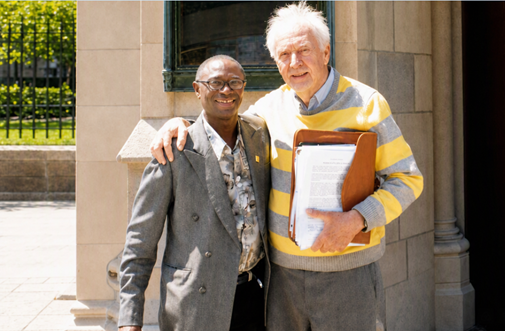
“In Loving Memory of Mr. Jay — Mentor, Witness, Friend. Two Lives, One Friendship. A Legacy of Kindness, Faith & Love. Forever in Our Hearts.”
There comes a moment in every civilization when it must decide whether to continue as it is — or remember what it once was. Humanity now stands at such a threshold: a point where the human being, long overshadowed by machines, markets, empires, and distractions, must either be restored or lost.
This final chapter is not about technology. It is not about AI. It is not about Synthetic Intelligence.
It is about the human being — the one reality that cannot be replaced, replicated, or engineered.
Series XII is the return.
I. The Human Being Is Not a Machine
A machine can calculate, predict, simulate, optimize. But a machine cannot suffer, hope, forgive, imagine, love.
The human being is not defined by intelligence. It is defined by interiority — the depth of experience that emerges from consciousness, embodiment, ancestry, vulnerability, and spirit.1Philosophical anthropology identifies interiority as the core of human identity.
To remember the human being is to remember what machines cannot touch.
II. The Human Being Is Not Data
Data can describe behavior, but not meaning. Data can track movement, but not longing. Data can measure patterns, but not purpose.
The human being is not a dataset. It is a mystery — a living continuum of memory, emotion, imagination, and moral possibility.2Cognitive science distinguishes between computational intelligence and embodied consciousness.
To remember the human being is to remember that life cannot be quantified.
III. The Human Being Is Not a Product
Modernity has turned the human being into a consumer, a profile, a demographic, a metric.
But the human being is not a product. It is a presence — capable of truth, courage, and transformation.
To remember the human being is to remember that dignity is not transactional.
IV. The Human Being Is Not an Algorithmic Shadow
Algorithms can predict what we will do, but not why. They can shape attention, but not conscience. They can influence choice, but not destiny.
The human being is not an algorithmic shadow. It is a sovereign mind — capable of resisting, choosing, awakening.3Studies on synthetic influence document the limits of algorithmic persuasion against moral awakening.
To remember the human being is to remember that agency is not programmable.
IV A. The Collapse of the Synthetic World
The synthetic world tried to redefine the human being through: digital erasure,4Digital colonialism highlights the erasure of marginalized cultures in global technological systems. synthetic influence, synthetic memory (CACHE)5Research on ancestral memory identifies cultural continuity as a foundation of human sovereignty. behavioral capture (Synthetic Octopus).
But each system failed at the same point: It could not touch the interior.
It could bury the inner voice, but not kill it. It could distort memory, but not erase ancestry. It could shape behavior, but not extinguish conscience. It could predict action, but not awakening.
The synthetic world collapses at the threshold of the human interior.
V. The Human Being Is a Continuum
The human being is ancestral, communal, embodied, spiritual, historical, imaginative.
Machines inherit code. Humans inherit history.
It carries the memory of those who came before and the responsibility for those who will come after.6Ibid.
To remember the human being is to remember that we are part of a lineage, not a system.
VI. The Global South and the Human Restoration
For the Global South, remembering the human being is not philosophical — it is revolutionary.
It is the restoration of indigenous knowledge, ancestral wisdom, communal identity, cultural sovereignty, spiritual cosmology.
The human being remembered is the human being liberated — from digital colonialism, algorithmic erasure, and synthetic narratives.
This restoration is not optional. It is survival.
VII. The Human Being as Moral Witness
The human being is the only creature capable of conscience, responsibility, justice, compassion.
Machines can simulate empathy. They cannot bear moral weight.
The future will require witnesses — people who can stand in truth even when truth is costly.
To remember the human being is to remember that morality is not a feature. It is a calling.
VIII. The Human Being as Creator of Meaning
Meaning does not come from machines. It comes from memory, imagination, suffering, longing, love, truth.
Meaning is not generated. It is lived.
To remember the human being is to remember that meaning is the foundation of civilization.
IX. The Human Being as Guardian of the Future
The future will not be saved by efficiency, automation, optimization.
It will be saved by courage, conscience, solidarity, imagination, truth.
The human being is the guardian of the future — not because it is perfect, but because it is capable of transformation.
To remember the human being is to remember that the future is a moral project.
X. The Final Restoration
The final restoration is not technological. It is human.
It begins when humanity chooses: depth over distraction, truth over illusion, conscience over convenience, solidarity over isolation, memory over erasure, meaning over performance.
The human being remembered is the human being restored.
This restoration is the only path forward.
XI. The Quiet Choice Before Us
The final question of this prophetic cycle is simple:
Will humanity remember itself?
Not its machines. Not its systems. Not its platforms. Not its algorithms.
Itself.
The human being remembered is the human being reclaimed — restored to dignity, agency, interior life, and spiritual depth.
And so the cycle ends quietly — not with a declaration, but with a return. A return to the interior. A return to the human being. A return to the one truth that cannot be engineered.
This is the awakening that must come. This is the restoration that must begin. This is the future that must be chosen — gently, consciously, humanly.
ENDNOTES: