




I just saw The Burial, the 2023 film based on real events and people. The main actors, Tommy Lee Jones and Jaimie Foxx, represent Jeremiah Joseph O’Keefe, a funeral home owner, and Willie Gary, his leading lawyer, who sued Ramon Loewen, a funeral owner shark with hundreds of, what he called, death businesses, played by Bill Camp.
It blew my mind. I identified with the main character, O’Keefe. Hencame from a white family of funeral home owners, mainly based in Biloxi, Mississippi where I had been an Airman at the Keesler Air Force base, in 1957, which I will come to later on.
The film focuses on a lawsuit O’Keefe filed, in 1995, in Hinds County, Mississippi, against racist Loewen, who blatantly exploited poor blacks. Willie Gary wins the case based upon the facts of racial discrimination and breach of contract. O’Keefe was awarded $500 million by the jury, which had a majority of black members. Loewen was allowed to settle for $175 million. After lawyer fees, O’Keefe shared 40% of his take with poor blacks victimized by Loewen.
Black people could not serve on juries or be judges in his hometown, Biloxi, in 1960-1964 when he had been elected to the Mississippi House of Representatives. By the time that he filed a lawsuit against the Loewen corporation, black people could legally serve on juries. However, they were still under-represented in most cities.
O’Keefe was a unique white Mississippi politician, because he actually acted against racism.
O’Keefe was interested in civil rights and took a stand on racial justice throughout his life. O’Keefe described an event early in his life that led him to being active and attentive to minority relations. While in college, he was asked to join a business fraternity. The fraternity told him that Jews and Blacks were not allowed to participate in the fraternity; O’Keefe told the fraternity that he was uninterested in joining unless they allowed minorities to participate and join. The fraternity obliged.
O’Keefe had been a pilot in WWII, winning several medals. That made him a popular candidate for winning the mayor election in Biloxi, 1973-81. In 1974, he prevented the KKK from demonstrating. This moral act led to death threats and a burning cross in his yard. O’Keefe stood his ground.
O’Keefe and Me
As I watched the film, I felt personally involved. When O’Keefe was in the House of Representatives, I had become an anti-war and civil rights activist, first in Los Angeles, then in 1964, in Moss Point Mississippi, just 35 kilometers from his Biloxi hometown.
By then, I had learned how immorally racist “America” is. (USA usurped the both continents of America for its own nomenclature. However, European mapmakers, and kings and queens decided to name the Americas after Amerigo Vespucci, an Italian explorer and navigator, the first European to explore and document the coast of Argentina.)
My father was an officer in the USAF. At 17, with his permission, I joined the United States Air Force, in 1956, to kill Russian Communists. When I was at Biloxi Keesler Air Force Base, there were sports activities. My tennis partner was a black Airman. We took our first pass to town, but were chased back to base by racists before we could step into any establishment. The next morning, we were reprimanded by the commander for not following, “the rules”.
I was degraded and sent to a radar station on a mountain top in Japan. The barracks were segregated. Some white racists from my barracks walked around in uniform with ball caps emblazoned with KKK. The commander did nothing.
Racism was even imposed in the nearby town where Japanese entertainment establishments were forced to segregate U.S. Airmen customers. That appalled me. One evening, I entered the “black bar” and was welcomed by black compatriots. The next day, I was tortured by my white “compatriots”. Five of them held me down naked, sprayed DDT aflame over my pubes, and then held me under snow. The base commander did nothing about this, which became a major factor that led me to oppose “American morality”.
After I got out of the USAF, I enrolled in college in Los Angeles, California. My first demonstration was against the Yankees-backed proxy invasion of Cuba, known as the Bay of Pigs. I held tightly onto a picket sign: “US OUT of CUBA”, and marched with a couple hundred others in front of the U.S. federal building. I signed up for membership in the Fair Play for Cuba Committee. (I have my membership card beside me as I write.)
It was April 19, 1961, and the CIA sponsored right-wing Cuban forces were getting their asses kicked! President John F. Kennedy was furious after being misled that the Cuban people would rise up against “dictator” Fidel Castro. He fired CIA Director Alan Dulles, whom President Lyndon Johnson later made chief investigator into who killed Kennedy. I have no doubt, and numerous independent investigation show, that the CIA agents were the “regime change” murderers.
In October 1962, I left the University of California with a friend, and headed in a VW to Costa Rica where we had learned one could hire a boat to Cuba. We wanted to study the Cuban revolution, which legislated equality for all immediately upon victory in 1959.
As we entered Costa Rica, the news broadcasted that the Missile Crisis had begun. Our contacts were nervous. Intelligence agents arrested us. Two guards shaved off my Castro-like beard while all the prisoners watched. No one was to speak with this “Communist wizard”.
After a week in one-cell isolation on bread and water, we were deported to the U.S.
Mississippi Long Hot Summer of 1964
Two years later, June 1964, I left Los Angeles with another friend in my Chevy to attend non-violent training at a college in Ohio before joining the Council of Federated Organization’s (COFO) projects to enforce the right of all people to vote, and have equal education. The coalition was formed by NAACP, CORE and SNCC—the youth group of the Southern Christian Leadership Conference led by Martin Luther King.
After a week’s training, especially in how to act non-violently when being attacked, nearly 1000 black and white civil rights activists were on our way to communities where there was local support for our projects. Local black families bravely offered their homes.
I drove with three others to our project at Moss Point. We stopped first at nearby Pascagoula. As we entered a “negro café”, an active NAACP member introduced us and people burst forth with questions, information and tips. They warned us about the “Tom” police — one had killed a black man a few months before. “He had done no wrong but he was a threat to the power structure.”
Earlier that day, two 16 year-old boys were picked out of a crowd at the softball field for “insulting” a white woman. Police jailed them and refused to let anyone see them or bail them out.
Moss Point lay eight kilometers inland, a typical small town of 7000. When we arrived, we again entered a “negro café” to find our bearings. Everyone knew of the project, and were curious about two blacks and two whites together in their town. They also knew that three of our colleagues had been arrested, further north in Neshoba county, where they were investigating a church burning and the beating of some blacks.
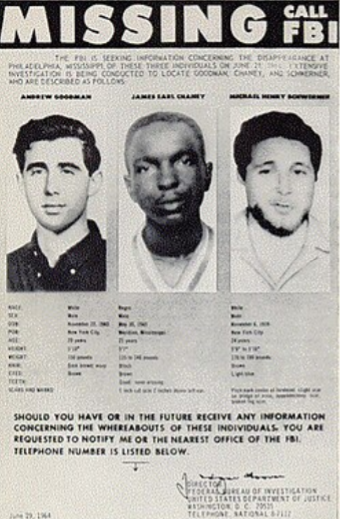 We called our headquarters. Yes: 21-year old black James Cheney, 20-year old white Jew Andrew Goodman, and 24-year old white Jew Michael Schwerner had been arrested and disappeared.
We found our new home, owned by Otis Colley. After a nights rest, we opened up the new project at an office provided by local people. The next two days, we held meetings with scores of young and old explaining the projects in which we wanted them to participate. People were nervous about the disappearance, but they began to organize. I set up the office where I would be communication secretary and in charge of security.
“Otis” and “Sarah” Colley had 11 children stuffed into their wooden-tar-papered house, which consisted of a small kitchen with an adjoining dining room, a small living room, a bathroom with shower, and two small bedrooms. One bedroom was given to us. The entire family of 13 people would sleep in the other bedroom and the living room for two whole months.
Mr. Colley told me—after we had lived with him a couple weeks although it felt like years of warm acquaintance—“Most of us Negroes say we’re not afraid but most of us are. I guess I’m not any more though. The white man has kept me down so long, and I have fought in my little way so long and nothing ever came of it. But now, all you people from everywhere are coming here not just to help us but to help everyone, including yourselves. And if you can do all that, I sure can fight for myself.”
Otis meant it. He encouraged others to make the humiliating but enriching effort to try to register to vote. He learned the basic skills we were teaching and he helped build the Freedom Democratic Party. He also helped lead an unofficial `defense squad´ to protect us COFOers. I learned about this one night when I awoke to relieve the pressure of beer. As I tip-toed across the living room headed toward the toilet, I saw Otis leaning back in his rocking chair facing the front window. In his lap lay a shotgun.
We talked of his attitude about defense the next day. Otis explained that we were their “instructors” but they were our foster parents and instructors too. He told me what many black people felt about us in these neighborhood/ghettos: they had to look after us just as they look after their own children.
Two nights after we arrived, I was on the lawn of our new home when a cop car pulled up with one of us, Howie, in the back seat. One of the cops came up to the lawn.
“Watcha doing here, boy?” constable Alford chawed.
We exchanged a few not-well-chosen words, and I was placed under arrest for “investigation”. The two constables drove to Pascagoula county jail at 85 miles an hour, with lights and siren turned off. They stopped in some woods, and talked with a handful of civilians armed with guns. The chuckling cops left their compatriots and drove us to the jail. Howie and I were, in fact, glad to arrive at the jail.
Tobacco-chewing police stereotypes told us: “We treat our niggers well, as long as they stay in their place…We don’t want you commie outside agitators coming to our fine magnolia state; people get killed for less…”
The officers escorted us to an elevator. We were made to face a jail cell as they smacked their hands with billy clubs. “You boys in for a good whoopin.”
We were pushed into the “nigger bull pen.” The cops yelled at the three black prisoners: “Here they are. Get’em boys.” as they smacked their clubs over the bars. Putting whites in a cell with blacks was an unusual thing to do. They hoped to intimidate the black prisoners to beat us. The forlorn prisoners were too confused to move. After long minutes of silent agony, broken by yelling cops smacking their wooden batons on steel bars, the police grabbed us and threw us into the white cell.
“It’s whoopin’ time,” the cops shouted, repeating the routine. About a dozen whites gathered around us. The lead man was dark-skinned and black-haired. I surmised that he might be Spanish-speaking. I spoke to him in rapid Spanish. His brown eyes lit up as his face contorted in confusion. The moment to strike us collapsed as the apparent leader recognized his mother tongue. I told him that he had no interest in treating us as the enemy. We were on the same side. He did not reply in kind but turned on the whites behind him. One pale Mississippian announced that he “hated all niggers and nigger lovers”, especially “outside agitators” who deserved a beating. However, the Mexican-American led the whites to the other end of the large cell where they held a long heated discussion about what to do.
The jailors were disappointed, so they tried scaring us. The boss said: “Your nigger leader was found tonight in the river dead. He’d raped one of your white girls, and got paid for that.”
It was around three in the morning when all fell silent.
Otis Colley had made contact with others in our project; volunteer lawyers were alerted. They arrived the next day and got us released.
COFO had a WATS line, and recorded this message about our arrests, June 23, and a fire set at our meeting hall.
Moss Point
June 24 :
The keeper of the Knights of Pythias Ha 11 reported seeing a white man set fire to the building soon after midnight . Damage was minimal, as the keeper soon had the fire under control. The building was to be used for a coming mass meeting. SNCC volunteers had just passed out leaflets announcing the meeting.
June 24 :
Two white summer volunteers, Howard Kirschenbaum and Ron Ridenour, were arrested shortly before midnight on the 23rd and subjected to a night of mental harassment and intimidation in the Jackson County Jail, Pascagoula
They were re l eased the next day, with no formal charges.
Our arrest made local and national media. FBI dossiers on my political activities cited our arrest and various media reports about it. The June 25 and September 14 1964 FBI reports start with the June 24 Los Angeles Herald-Examiner article about two students arrested on vagrancy charges.
Racist Mississippi Senator James Eastland reported this in the Senate. He accused the entire Civil Rights Movement as being run by communists. Local media, national Mississippi media, and many media throughout the nation, reported on this “communist plot” led by poor skinny me.
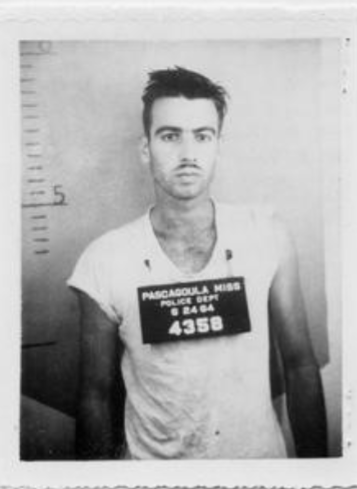 I later obtained 1000 pages of dossiers kept on me by National Security Council intelligence agencies. Some pages dealt with my participation in the Student Non-Violent Coordinating Committee (SNCC) civil rights struggle for black voter registration.
When I got out of jail, I went to our local meeting the next day. I was nervous about being a problem for the movement. However, James Foreman, executive director of the Students for Non-Violent Coordinating Committee (SNCC), who was my leader, and Julian Bond, who was my secretary-security chief, backed me up.
When I came in, I was met with cheers.
I still have the Mississippi license plate, number: J16684. Sixty-two year dirt is ground into the white metal background.
CONSCIENCE
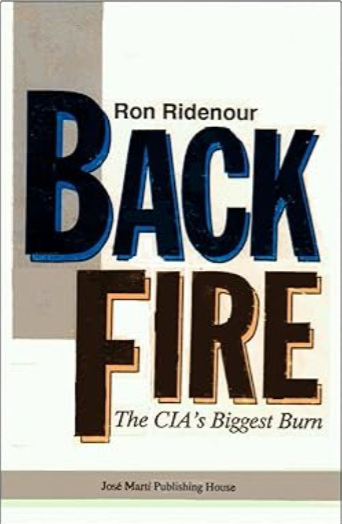
Years later, the Cuban Ministry of Culture invited me to work for its media. Overjoyed, I worked with warm-loving Cubans from 1987-96, writing articles and six books. My first book was “Backfire: The CIA’s Biggest Burn”. It shows how the CIA had always tried to subvert and “regime change” Cuba by assassinations, sabotage, bacteriological-chemical warfare, which killed over 100 people, including children, destroyed crops and pigs, exploded a Cuban civilian aircraft, in 1976, murdering 73 people, including a teen-age fencing team…
 In one of my book tours, speaking at Cambridge University, someone asked why I had become a revolutionary and had opposed racism early on. The question made me pause. Then it hit me!
A six year-old boy straddles a worn stuffed upholstered armchair. “Giddy-up, giddy-up” the cowboy orders his palomino as he rocks back and forth coaxingly, left hand gripping the reins. His leather chaps and felt Stetson flapping in the imaginary wind, he scoots across the range firing his six-shooter after the bad Indians. Just like his favorite star Roy Rogers and his horse Trigger, the fearless boy is protecting his people against the savages.
“BANG! BANG! Gotja. You’re dead.”
CRACK!
The cowboy stops dead in his tracks.
“That sounds like real bullets”, he says warily to himself, his big brown eyes blinking widely.
He dismounts and walks hesitantly to the smudgy window facing a dirty Newark street. From the second-floor apartment, he sees a human figure on the sidewalk across the street. The black boy is sprawled face down. Red liquid oozes from his back. An apple rolls slowly from his hand. A large man in blue uniform with pistol in hand hurries over to the boy.
“Are they playing cowboys and Indians too”, the little cowboy asks himself, frightened?
Later that day, Grandpa Tony came home and the boy heard him whispering to Grandmother Nana. Radio news reported that a policeman saw the boy steal an apple from Abe’s store. The policeman says he yelled for the boy to stop but the kid ran. The policeman shouted, ‘Halt or I’ll shoot.’ The boy ran faster. The policeman fired a warning shot up in the air, then another. Apparently, there was some sort of disturbance up in the air, and a bullet ended in the boy’s spine. He was just eight years old, not much bigger than Ronnie.
It was too difficult for me to comprehend, but I did understand that the boy would not play cowboys and Indians anymore. I could have been that boy. Grandma told me to forget about it. What happened to him couldn’t happen to me. After all, I was not a thief, nor was I black. That day I learned I was privileged—white never to be black.
Now, I think of what Nina Simone said when she left “America” behind her. She could not understand nor accept a destiny as a victim for something so absurd and misanthropic as racism. I was trapped in the color barrier too, despite the fact that I was born with the “dominating” color. That is a major reason why I abandoned living in “America”, never to return.
The song we sang that summer, night after night, ever so slowly, feeling each word, extending each syllable in the traditional cadence of the Negro spiritual, as we linked arms and swayed to the chant like melody. Tears flow down my cheeks as I write and sing this song.
We have walked through the shadow of death.
We’ve had to walk all by ourselves.
But we’ll never turn back.
No, we’ll never turn back,
Until we all are free,
And we have equality.
We have hung our heads and cried,
Cried for those like the three who died,
Died for you and they died for me,
Died for the cause of equality.
But we’ll never turn back.
No, we’ll never turn back,
Until we all are free,
And we have equality.