



UPDATED on 12 August 2026.
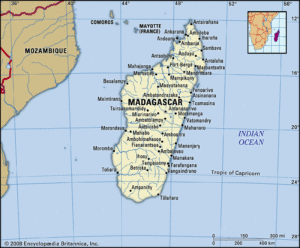 Madagascar is in great pain. Theodore Mbainaissem, the head of the World Food Programme (WFP) sub-office in Ambovombe, southern Madagascar, says: “Seeing the physical condition of people extremely affected by hunger who can no longer stand…children who are completely emaciated, the elderly who are skin and bone…these images are unbearable… People are eating white clay with tamarind juice, cactus leaves, wild roots just to calm their hunger.”
One third of people in southern Madagascar will struggle to feed themselves over the next few months. Until the next harvest in April 2021, 1.35 million people will be “food insecure” – almost double those in need last year – and 282,000 of them are considered “emergency” cases. Pervasive food insecurity in Madagascar is the result of a variety of factors.
Poverty
Food security is not only caused by a lack of food supply but also by the lack of political and economic power to access food. Thus, access to income is one potential means for alleviating food insecurity. In Madagascar, the majority of the people don’t have proper access to income.
Madagascar is one of poorest countries in the world. In the 2007/2008 United Nation Development Programme’s (UNDP) Human Development Index, an indicator that measures achievements in terms of life expectancy, educational attainment and adjusted real income, Madagascar was given the rank of 143rd out of 177 countries.
Madagascar’s economy is tiny. The market capitalization of U.S. tech giant Facebook is more than 40 times Madagascar’s national income. The company’s CEO, Mark Zuckerberg, alone is five times richer than the island nation. A large chunk of Madagascar’s minuscule national income is appropriated by the rich, evidenced in the declining consumption capacity of the poor. Between 2005 and 2010, consumption for the poorest households declined by 3.1%.
A COVID-19-triggered economic recession has debilitated an already impoverished people. The combined impact of global trade disruptions and pandemic restrictions is estimated to have resulted in a Gross Domestic Product (GDP) contraction of 4.2% in 2020. The poverty rate (at $1.9/day) is estimated to have risen to 77.4% in 2020, up from 74.3% in 2019, corresponding to an increase of 1.38 million people in one year.
Climate Change
Between 1980 and 2010, Madagascar suffered 35 cyclones and floods, five periods of severe drought, five earthquakes and six epidemics. Madagascar’s extreme weather conditions have intensified due to climate change, increasing food vulnerability.
Food insecurity affects all regions of the nation, and particularly those in the south, which have a semi-arid climate and are particularly exposed to severe and recurrent droughts. In 2019, a lack of rainfall and a powerful El Nino phenomenon led to the loss of 90% of the harvest and pushed more than 60% of the population into food insecurity.
Interruptions in food supply due to crop failures have resulted in sharp increases in the prices of different items. Some areas have seen the price of rice shoot up from 50 U.S. cents per kilogram in 2019 to $1.05 in 2020.
Extractivism
Mining has become an important component of Madagascar’s foreign-investment economy, particularly through projects involving mineral sands and other deposits. The expansion of these operations has generated conflicts over land and access to natural resources, especially where mining projects overlap with areas used for agriculture or subsistence activities. Restrictions associated with mining and conservation projects can therefore affect local livelihoods and contribute to pressures on household food security.
The effects of these policies can be seen in communities surrounding the Tsitongambarika Forest Complex. Research on the Bemangidy area describes disputes involving QIT Madagascar Minerals and local residents over access to forest resources and the implementation of biodiversity-offsetting measures. Residents reported that restrictions associated with the conservation programme reduced their access to resources on which they depended for their livelihoods.
These restrictions had consequences for local food production. Research on the community reports that residents lost access to productive areas and consequently had to cultivate less suitable land farther from the forest. The resulting reduction in agricultural capacity placed additional pressure on household subsistence.
Agro-export Firms
From 2005 to 2008, 3 million hectares were in the process of being sold to 52 foreign companies. These companies resemble private islands of profit-making that are disarticulated from local populations and national development projects. Since these companies are functionally integrated in a framework geared toward the enrichment of foreign investors, they have little regard for the food security of Madagascans.
In March 2009, the South Korean company Daewoo Logistics signed a 99-year lease in Madagascar for about 1.3 million hectares, or about half of the island’s arable land. It was the largest lease of this type in history and would have supplied half of South Korea’s grain imports. The proposed Daewoo project generated significant opposition within Madagascar, including from the Collective for the Defense of Malagasy Lands (TANY). The organization called for greater consultation with communities before large-scale foreign land agreements were approved. Political opposition intensified during the crisis surrounding President Marc Ravalomanana, and the incoming government subsequently cancelled the project. The proposed land deal raised international attention to the land grabs taking place across the globe, particularly given the contemporaneous food crisis.
Monopoly Capitalism
Hunger in Madagascar is the outcome of a confluence of crises. All of them are fundamentally related to capitalism — the system that generates the chaotic drive for ever-greater profits. In the monopoly stage of capitalism, the oppressed people are standing up against a system of generalized monopolies — a structure of power where a tiny clique of plutocrats and their tightly integrated productive apparatuses control the world.
Correspondingly, the Third World has seen its autonomy erode in the face of this neo-colonial onslaught, leading to the dominance of comprador bourgeoisie — a fraction of capitalists whose interests are entirely subordinated to those of foreign capital, and which functions as a direct intermediary for the implantation and reproduction of foreign capital. What we need today is an independent and unified initiative from the Third World, which brings oppressed countries like Madagascar into regional alliances aimed at de-linking from imperialist architectures and pursuing a socialist path.