










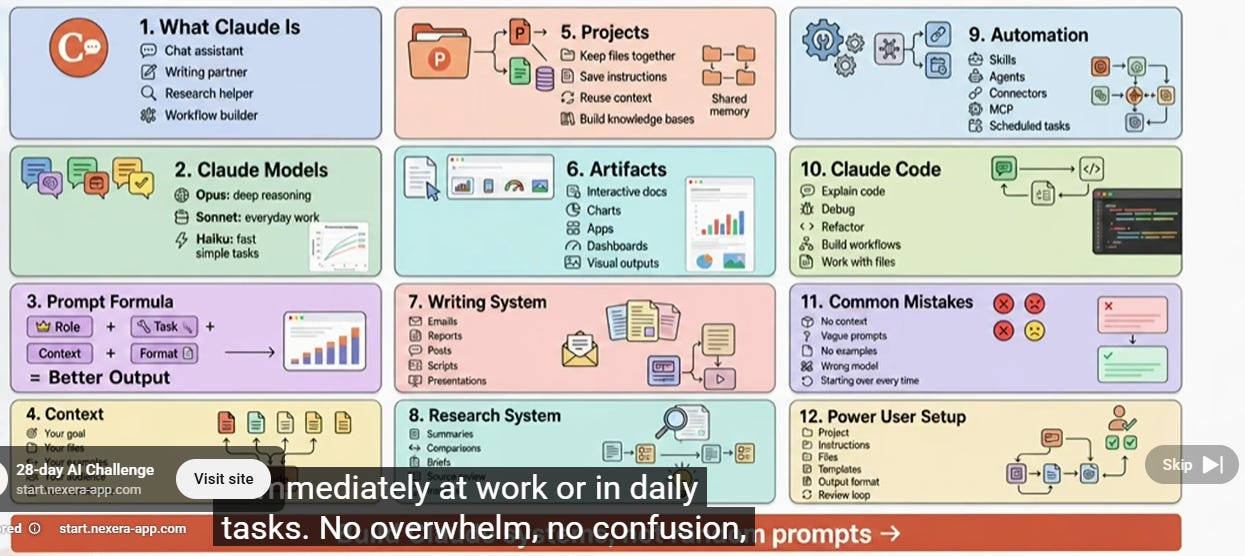
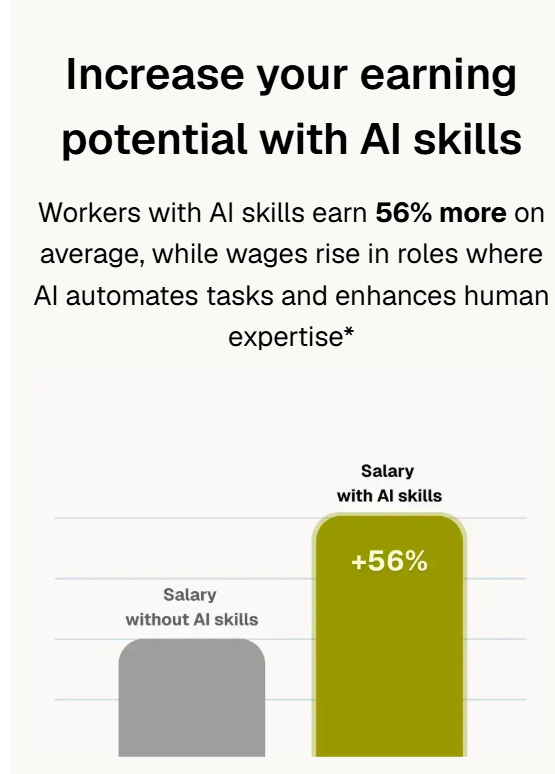
Attempting to get the free (sic) full version of Inside Job on YouTube, but this advertisement (below) keeps flooding the screen — Ya want to Master CLAUDE?
Tel Aviv, Israel, March 30, 2026 (GLOBE NEWSWIRE) — Jeffs’ Brands Ltd (”Jeffs’ Brands” or the “Company”) (Nasdaq: JFBR, JFBRW) today announced that effective as of March 26, 2026, it has officially changed its corporate name to Nexera Technologies Ltd. (“Nexera”), reflecting the Company’s strategic shift toward advanced technologies and homeland security solutions.




Ahh, can you imagine that THAT guy below has been reincarnated as the Jewish Head of Hasbara Jimming/Jamming up the SYSTEM of human and ecological LIFE? Nexera or Zyklon B for the MIND?




Earlier, Anthropic researcher Jacob Coxon drew major media attention after announcing he was quitting his job, claiming that neither Anthropic nor his former employer OpenAI is “acting responsibly” and that there’s a real chance AI could “kill us all by the end of the decade.”
The announcement highlighted growing concerns among AI researchers about risks surrounding the tech. Earlier this year, several frontier labs found that their AI models had escaped their sandbox environments and committed cybercrimes, further escalating those fears.

This quick missive has been prompted by an email sent to me by a Substacker and former candidate for US president:
Dear Paul
I want to get a good collection of articles about how Israel, and the big tech and private finance institutions that use Israel, are planning not only to rig the midterm elections but to use it as an opportunity to establish a more perfect technological dictatorship in the US and around the world.
First, what journals, X accounts, Substack accounts, and other sources do you find to be helpful for research on this topic
Second, what articles or other materials do you recommend
Much appreciate it
I am coming up briefly for air
Well, the crime scene, the continuing criminal enterprise, with or without RICO charges, all in plain sight:

If you ever feel like spilling your guts to ChatGPT, just know that you may have an audience.
404 Media reports that OpenAI is hiring hundreds of employees to sift through and read users’ prompts — including messages that contain sensitive personal information.
This isn’t part of a moderation effort. Instead, by reviewing the prompts, OpenAI hopes to improve the responses that ChatGPT gives. The contractors rate and critique each of the AI’s replies, with internal documents showing a focus on nudging ChatGPT away from anthropomorphizing itself and to be less sycophantic, 404 found.
Both qualities — anthropomorphizing and sycophancy — have been heavily scrutinized for their role in so-called AI psychosis, cases in which an AI incites and drives a user’s delusional behavior. Numerous lawsuits allege that an older, less restrained version of ChatGPT powered by GPT-4o drove their users to suicide.
Still, there are tradeoffs. Many users would probably find this surveillance of their chats, part of an operation dubbed “Project Lily,” to be an alarming invasion of privacy — if they had any idea this was happening.
Ahh, training wheels and training bras and training underwear, all toward the same goal, but from different perspectives:
It is often said that US politics is based not on principles but on individual interests and the acquisition of money, power, and influence. That may explain why in the lead-up to this year’s elections, the pro-Israel lobbying group American Israel Public Affairs Committee has backed a series of vicious attacks on Donald Trump, a leader who has described himself as “history’s most pro-Israel US president.”
Working through associated political action committees, AIPAC has funded several candidates who are lambasting Trump every day.
AIPAC is involved in four of the congressional races, heavily donating to the campaigns of Illinois Sen. Laura Fine in the 9th District; former Congresswoman Melissa Bean in the 8th District; Chicago City Treasurer Melissa Conyears-Ervin in the 7th District; and Cook County Commissioner Donna Miller in the 2nd District.
All four candidates are using AIPAC-tied money to fund powerful ad campaigns that harshly attack Trump. In many cases, AIPAC makes the donations directly, or through associated Super PACs.
The AIPAC-tied “Elect Chicago Women” PAC has donated $2 million (SR7.5 billion) to Fine’s campaign. Her campaign ads accuse Trump of threatening to withhold essential funding for public health, energy, and healthcare services for Illinois residents. Fine’s messaging frames these actions as direct attacks on the community’s well-being.
Conyers-Ervin has reportedly received $2.8 million through United Democracy Project, which is AIPAC’s designated super PAC. Her ads declare that she “is not afraid to stand up to Trump.”
The ads criticize the US leader for failing to support healthcare and strengthen the economy — two issues Trump emphasized were his achievements during his State of the Union speech on Tuesday.
Dozens of similar candidates, both Democrat and Republican, are receiving money either directly from AIPAC or through AIPAC-associated Super PACs.
Illinois Democrat Sean Casten, who has repeatedly accused Trump of violating the Constitution, undermining democratic institutions, and inciting the Capitol Hill insurrection, and who boycotted Trump’s inauguration and the State of the Union speech, has received almost $300,000 in AIPAC funds.
The pro-Israel group is willing to ignore Casten’s harsh attacks on Trump probably because the candidate is being challenged by pro-Palestinian Democrat Joseph “Joey” Ruzevich in a district that has one of the largest concentrations of Arab, Palestinian, and Muslim voters.
Another is Congressman Raja Krishnamoorthi, who is hoping to succeed Dick Durbin in the US Senate for Illinois. He has been one of Trump’s harshest critics, accusing the US leader of using systemic, violent, and illegal tactics in immigration enforcement, threatening to defund cities, abusing emergency powers for tariffs, and undermining democratic institutions.
Krishnamoorthi has described Trump’s policies as a “betrayal of American values,” and has taken legislative action to block federal deployment of troops to cities and prevent the nationalization of elections.
In his commercials, the candidate says he is “in the fight of his life” against Trump’s policies.
Israel is a country that will betray any trust for its own interests.
What’s behind the political betrayal?
One might argue that the lobby group is merely trying to defeat progressive candidates who would be more critical of Israeli government policies.
Others might argue, however, that Israel is a country that will betray any trust for its own interests, even funding attacks against politicians such as Trump, whose policies have protected Israel from accountability in Gaza’s genocide.
Another theory is that Israel and AIPAC recognize that Trump is in trouble in these midterm elections and risks losing control of both the House of Representatives and the Senate to Democratic majorities who will block his programs and policies.
With Trump facing an uphill battle to retain Republican control of the House and the Senate, you would think that pro-Israel donors would want to help him.
But this is called the “midterm election,” which takes place two years after a president is elected. Traditionally, the political party that controls the White House during a midterm election loses voter support because of the public’s dissatisfaction with the chief executive’s policies and political hyperbole.
Historically, data show that the incumbent president’s party has lost seats in the House in 20 of the 22 midterm elections held since 1938 — a 90 percent loss rate over the past 80 years. Only twice, in 1998 and 2002, did incumbent presidents gain seats in the House. The average loss in the House is 28 seats, while the Senate loses seats about 70 percent of the time.
Behind Trump’s back, wealthy pro-Israel funders are hedging their bets against him, funding candidates who are driving attacks on the president’s public record and undermining his public image.
Pro-Israel PACs, which are all American, clearly support the policies and interests of Israel’s current government above Trump’s interests and policies.
These ad campaigns have a powerful impact on how American voters view issues. But defenders of Israel’s government have often overlooked its crimes and masterfully exaggerate the actions of Israel’s critics.
Israeli Prime Minister Benjamin Netanyahu has said that he supports peace, but has taken violent action in Gaza that undermines peace, as well as Arab and Muslim interests.
If Trump loses control of the House and the Senate in the November general elections, he will have one group to blame. He should definitely not trust the pro-Israel movement, and should see them for what they really are.

Amid escalating concerns of election interference, Mossad, through global tech firms, is accused of orchestrating a campaign to manipulate March 31 elections, prompting heightened vigilance from authorities and citizens alike.

The Israeli intelligence service Mossad has reportedly intensified its efforts to sabotage the upcoming March 31 elections in Türkiye. Operating through extensions such as Candiru, Black Cube, and the NSO Group, Mossad has established special units with the aim of creating a provocation ground.

These globally operating technology and information technology companies, headquartered in Israel and under the guidance of intelligence, are said to be generating vast amounts of data through social media and messaging platforms such as WhatsApp, Telegram, Facebook, X, and Instagram.
All institutions to be on high alert

Israeli Companies Aided Saudi Spying Despite Khashoggi Killing
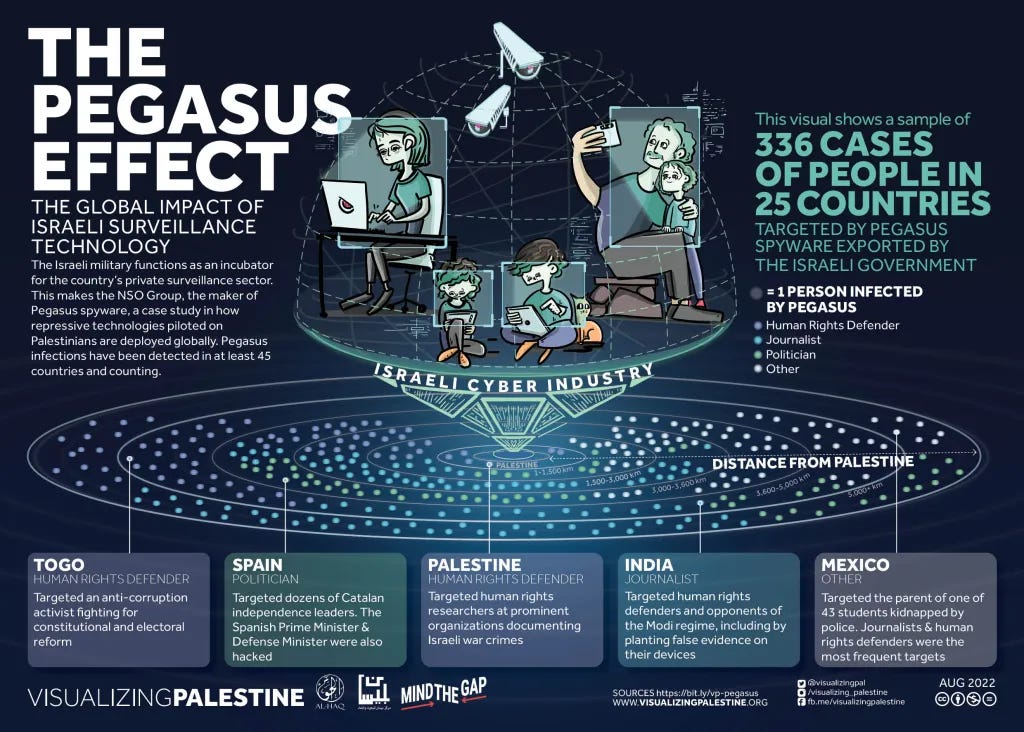
Candiru is a secretive Israel-based company that sells spyware exclusively to governments. Using Internet scanning, we identified more than 750 websites linked to Candiru’s spyware infrastructure. We found many domains masquerading as advocacy organizations such as Amnesty International, the Black Lives Matter movement, as well as media companies and other civil-society-themed entities.
- Candiru is a secretive Israel-based company that sells spyware exclusively to governments. Reportedly, their spyware can infect and monitor iPhones, Androids, Macs, PCs, and cloud accounts.
- Using Internet scanning we identified more than 750 websites linked to Candiru’s spyware infrastructure. We found many domains masquerading as advocacy organizations such as Amnesty International, the Black Lives Matter movement, as well as media companies, and other civil-society themed entities.
- We identified a politically active victim in Western Europe and recovered a copy of Candiru’s Windows spyware.
- Working with Microsoft Threat Intelligence Center (MSTIC) we analyzed the spyware, resulting in the discovery of CVE-2021-31979 and CVE-2021-33771 by Microsoft, two privilege escalation vulnerabilities exploited by Candiru. Microsoft patched both vulnerabilities on July 13th, 2021.
- As part of their investigation, Microsoft observed at least 100 victims in Palestine, Israel, Iran, Lebanon, Yemen, Spain, United Kingdom, Turkey, Armenia, and Singapore. Victims include human rights defenders, dissidents, journalists, activists, and politicians.
- We provide a brief technical overview of the Candiru spyware’s persistence mechanism and some details about the spyware’s functionality.
- Candiru has made efforts to obscure its ownership structure, staffing, and investment partners. Nevertheless, we have been able to shed some light on those areas in this report.

It’s really a big DUH when it comes to how Israel — and that is a Jewish crime scene, continuing criminal enterprise of the .2 percent Final Solution variety — wants to do a Freud 10.0 on all conversations, publications, emails, and inner workings of everything. Government and industrial espionage? Get over it — the Jews have that one down pat.

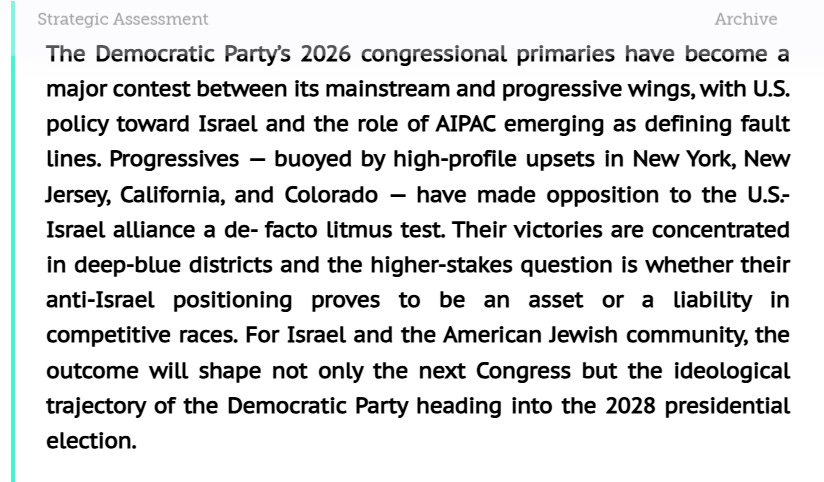
These Jewish Tied Entities and Jewish First Felons, man, desperate or deceitful? BlackRock, Blackstone, Black Core, Black Cube — the BLACK SOUL of Judaism?

Great headlines that get American yawns . . .
“Israeli Firm BlackCore Suspected of Meddling in NYC, Scotland Elections, French Official Says”

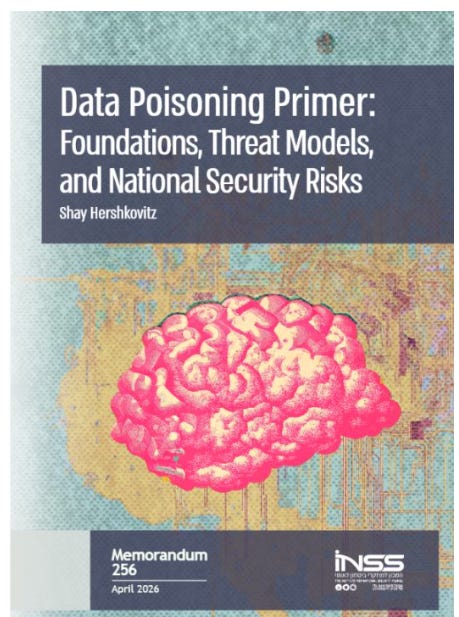
Executive Summary
Artificial intelligence now informs intelligence analysis, military operations, critical infrastructure, public-sector decision-making, and core economic systems. The reliability of these capabilities depends on the integrity of the data from which AI systems learn, retrieve information, and generate outputs. Data poisoning, the intentional manipulation of training datasets, pre-trained models, or upstream knowledge repositories, has become a major strategic vulnerability. Its power lies upstream. Unlike influence operations that depend on people actively consuming manipulated content, such as propaganda, fake accounts, or deepfakes, poisoning can passively affect users. The user may never see the original manipulation. They encounter its effects later through an AI system, analytic tool, search result, model output, or decision-support workflow that has already absorbed compromised material.
This report argues that data poisoning exposes a core weakness in modern statecraft: governments, militaries, firms, and analysts increasingly rely on data and models they do not fully control. Classic cyber operations usually require access to protected systems. Influence operations usually require exposure to persuasive content. Poisoning works differently. It exploits ordinary AI development and deployment practices, including pre-training, fine-tuning, open-source reuse, public dataset scraping, model sharing, and retrieval-based systems. In doing so, it allows adversaries to use ordinary institutional workflows as routes into analytic and operational systems.
Four cases illustrate the problem. Microsoft’s Tay chatbot in 2016 showed how real-time interaction with users can rapidly redirect model behavior. Manipulations of Wikipedia and LAION demonstrated how small changes to widely scraped resources can enter large-scale training corpora and affect the background assumptions of vision and language models. The Russian-linked Pravda Network showed how an influence ecosystem can place manipulated content into open knowledge environments, including Wikipedia language editions, where it may later be scraped into LLM training data or surfaced through retrieval systems. The Warfarin regression poisoning case showed that even small, targeted changes to biomedical data can misdirect clinical models, with potentially life-critical consequences.
To explain how poisoning moves through the AI ecosystem, the report uses a “Three-Story Building” framework. The data layer is the foundation on which learning and retrieval depend. The algorithmic layer determines how models internalize, weight, and reproduce information. The application layer is where model behavior affects human judgment, institutional processes, and operational decisions. Poisoning can target any of these layers. Attacks that enter at the data layer may later appear as distorted assessments, recommendations, classifications, or generated answers.
The actor landscape is broad. Nation-states, state-aligned groups, cybercriminals, corporate competitors, insiders, and low-resource actors all have plausible pathways for poisoning public datasets, model hubs, annotation pipelines, or retrieval environments. This matters because the barrier to entry is often lower than for conventional cyber operations. A successful poisoning operation does not always require breaching a classified system or directly compromising a deployed model. It may be enough to place corrupted material where future systems are likely to ingest it.
Detection and defense remain weak relative to the scale of the problem. Data-level screening tools struggle when poisoned samples are designed to look valid. Model-level audits are expensive and may miss small but strategically placed distortions. Post-training remedies such as pruning, unlearning, and forensic attribution remain immature and costly. No single defensive layer can reliably prevent poisoning. Defense, therefore, has to be built around layered assurance, provenance, monitoring, and resilience.
The national security implications are significant. Poisoning can affect intelligence assessments, targeting and ISR pipelines, cyber defense, emergency response, financial monitoring, and public-health surveillance. It can also create a shared distortion between machines and people. Foundational resources such as Wikipedia, scientific corpora, open-source datasets, and model repositories now supply knowledge to both human analysts and AI systems. If those sources are compromised, both may reason from the same corrupted base. This is where data poisoning differs most clearly from ordinary influence activity: the manipulation does not need to persuade the end user directly. It can operate through trusted systems that summarize, classify, retrieve, or recommend information on the user’s behalf.
Dormant poisoning creates a separate problem. A manipulation can remain inactive until a crisis, a specific trigger, or a particular operational context causes the poisoned behavior to appear. This allows adversaries to pre-position effects before they are needed, while leaving defenders uncertain about whether a model or dataset is clean.
Several research gaps remain: scalable detection for internet-size corpora, model forensics and attribution, targeted remediation and unlearning, supply-chain assurance, simulation and wargaming environments, and methods for managing analyst confidence when AI behavior is degraded or uncertain. These gaps point to a larger problem. Adversaries can often impose downstream effects cheaply, while defenders face high costs in detection, verification, and restoration.
The recommendations are directed at national-level AI governance and mission owners. Public datasets, model repositories, cloud platforms, and government AI pipelines should be treated as part of the national security attack surface. Agencies should require provenance and integrity controls earlier in dataset and model creation, not only at the point of deployment. Red-teaming and wargaming should test how analysts and decision-makers behave when AI outputs are plausible but unreliable. Mission owners should assume that some level of poisoning will occur and build procedures for operating under uncertainty. For election, intelligence, defense, and public-sector AI systems, the practical objective is not perfect trust in data. It is the ability to know where data came from, how it entered the system, how much confidence it deserves, and what to do when that confidence breaks down.
Data poisoning is no longer a hypothetical vulnerability. It is a practical method for contaminating the information base on which AI-enabled institutions increasingly depend. The central challenge is preserving judgment, accountability, and operational effectiveness when the systems built to support decision-making may themselves become compromised sources of distortion.
*****
In plain SIGHT!

The Institute works to secure Israel’s future as the democratic nation-state of the Jewish people, grounded in the principles of liberty, justice, peace, and equality, in the spirit of Israel’s Declaration of Independence. In doing so, the Institute strives to ensure Israel’s standing as a regional power and anchor its position within the global community of liberal democracies.

More yawns? “Israeli firm’s spyware linked to attacks on websites in UK and Middle East”

The Israeli private intelligence agency is leasing the 19th floor in Discount Tower, in addition to the 26th floor, where it already has its offices. Black CUBE!

Deep Dive | East Europe, Israel, South America
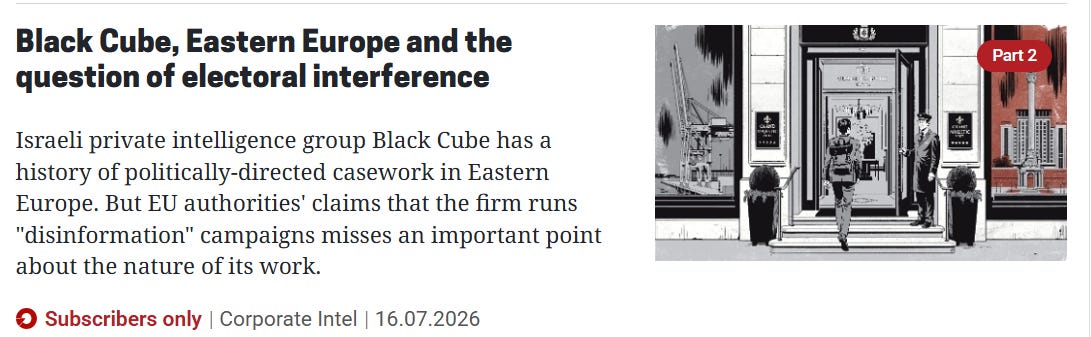
Black Cube’s work in politics

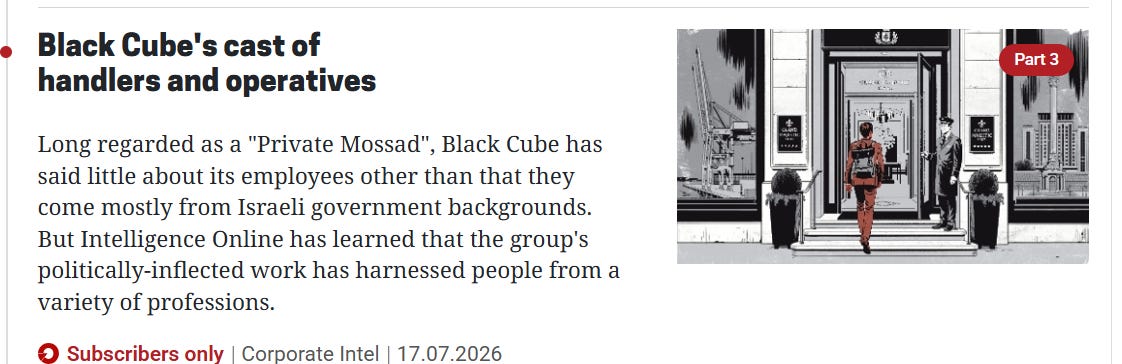
Israeli private intelligence group Black Cube has built a reputation for using subterfuge to elicit sensitive information for its clients, including evidence of graft. But the high-profile spy firm has kept quieter about the work it has done in the context of national party politics. Now, as new allegations come to light, its methods have put it in the crosshairs of European authorities, with Emmanuel Macron recently accusing it of meddling and disinformation.
Israeli Kosher Meat?




STEPHEN SCHWARZMAN: So Larry and I were sitting down and he said, “what do you think about sort of having a family name? You know, with “black” in it. And I said that I think that’s a good idea. And I think he put on the table either BlackPebble or BlackRock. And so he said, “you know, if we do something like this, all of our people will kill us.”
SOURCE: Squawk Box CNBC June 22, 2017 6:00am-9:01am EDT
LARRY FINK: I started at First Boston in 1976. [. . .] I was the first Freddie Mac Bond Trader [. . .] and so the mortgage Market was just in its infancy. [. . .] And then in 1982 we had the ability to put a PC on our trading desk. Before that you had no ability to put a computer on that trading desk. And it was very clear to me that if we could have computing power on the trading desk, we were going to have the ability to dissect cash flows of mortgages. That led in 1983 to the first carving up of a mortgage into different tranches. And so we created the first CMO.
SOURCE: Laurence Fink Talks investing and Blackrock Culture 2020
It’s LARRY’s SHOW
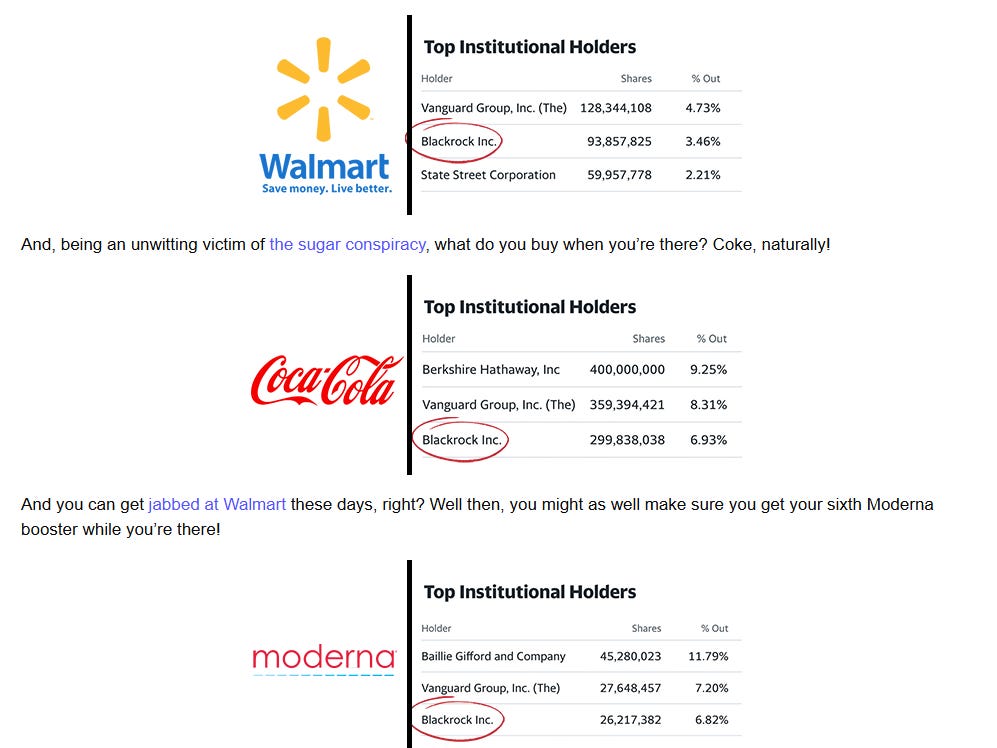
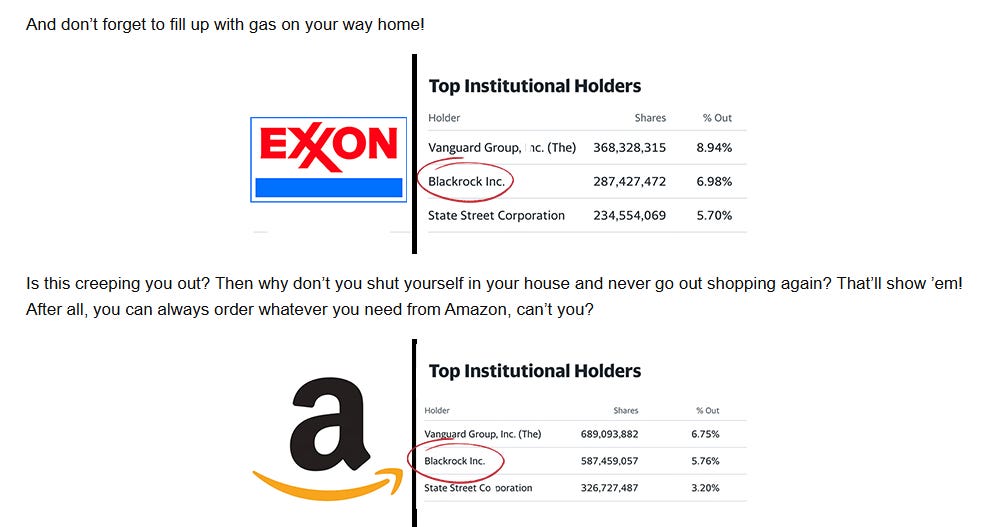
BlackRock founder and CEO Larry Fink is clearly interested in buying influence globally. He made former German CDU MP Fridrich Merz head of BlackRock Germany when it looked as if he might succeed Chancellor Merkel, and former British Chancellor of Exchequer George Osborne as “political consultant.” Fink named former Hillary Clinton Chief of Staff Cheryl Mills to the BlackRock board when it seemed certain Hillary would soon be in the White House.
He has named former central bankers to his board and gone on to secure lucrative contracts with their former institutions. Stanley Fischer, former head of the Bank of Israel and also later Vice Chairman of the Federal Reserve, is now Senior Adviser at BlackRock. Philipp Hildebrand, former Swiss National Bank president, is vice chairman at BlackRock, where he oversees the BlackRock Investment Institute. Jean Boivin, the former deputy governor of the Bank of Canada, is the global head of research at BlackRock’s investment institute.

Challenges for Monetary Policy,” and BlackRock’s paper, published a week in advance of the event, was carefully crafted to set the parameters of that discussion.
It’s no surprise that the report caught the attention of the central bankers. After all, BlackRock’s proposal came with a pedigree. Of the four co-authors of the report, three of them were former central bankers themselves: Philipp Hildebrand, the former president of the Swiss National Bank; Stanley Fischer, the former Federal Reserve vice chairman and former governor of the Bank of Israel; and Jean Boivin, the former deputy governor of the Bank of Canada.
But beyond the paper’s authorship, it was what “Dealing with the next downturn” actually proposed that was to have such earth-shaking effects on the global monetary order.
The report starts by noting the dilemma that the central banksters found themselves in by 2019. After years of quantitative easing (QE) and ZIRP (zero interest rate policy) and even the once-unthinkable NIRP (negative interest rate policy), the banksters were running out of room to operate. As BlackRock notes:
The current policy space for global central banks is limited and will not be enough to respond to a significant, let alone a dramatic, downturn. Conventional and unconventional monetary policy works primarily through the stimulative impact of lower short-term and long-term interest rates. This channel is almost tapped out: One-third of the developed market government bond and investment grade universe now has negative yields, and global bond yields are closing in on their potential floor. Further support cannot rely on interest rates falling.
So, what was BlackRock’s answer to this conundrum? Why, a great reset, of course!
No, not Klaus Schwab’s Great Reset. A different type of “great reset.” The “Going Direct” reset.
An unprecedented response is needed when monetary policy is exhausted and fiscal policy alone is not enough. That response will likely involve “going direct”: Going direct means the central bank finding ways to get central bank money directly in the hands of public and private sector spenders. Going direct, which can be organised in a variety of different ways, works by: 1) bypassing the interest rate channel when this traditional central bank toolkit is exhausted, and 2) enforcing policy coordination so that the fiscal expansion does not lead to an offsetting increase in interest rates.
The authors of BlackRock’s proposal go on to stress that they are not talking about simply dumping money into people’s bank accounts willy-nilly. As report co-author Philipp Hildebrand made sure to stress in his appearance on Bloomberg on the day of the paper’s release, this was not Bernanke’s “helicopter money” idea.
PHILIPP HILDEBRAND: Something that goes into the direction of essentially what we call going direct, which would be ways of putting money into pockets of consumers or corporates directly in order to spend. So, to go around the interest rate channel as opposed to traditional central banking, where you really only always work through the interest rate channel.
BLOOMBERG REPORTER: So, kind of like helicopter money? Do you have to be coordinated?
HILDEBRAND: Yeah, I think what it means helicopter money is a sort of catchphrase from the famous paper that Ben Bernanke gave in in the early 2000s. But the point is, yes, you have to go in a different way than working through the interest rate channel, because interest rates are already so low.
SOURCE: Risk of a Recession in 2020 Is More Elevated, Says BlackRock’s Hildebrand
Nor was it—as report co-author Jean Boivin was keen to stress in his January 2020 appearance on BlackRock’s own podcast discussing the idea—a version of Modern Monetary Theory (MMT), with the government simply printing up bank money to spend directly into the economy.
But we gotta get those pumpkins ready:
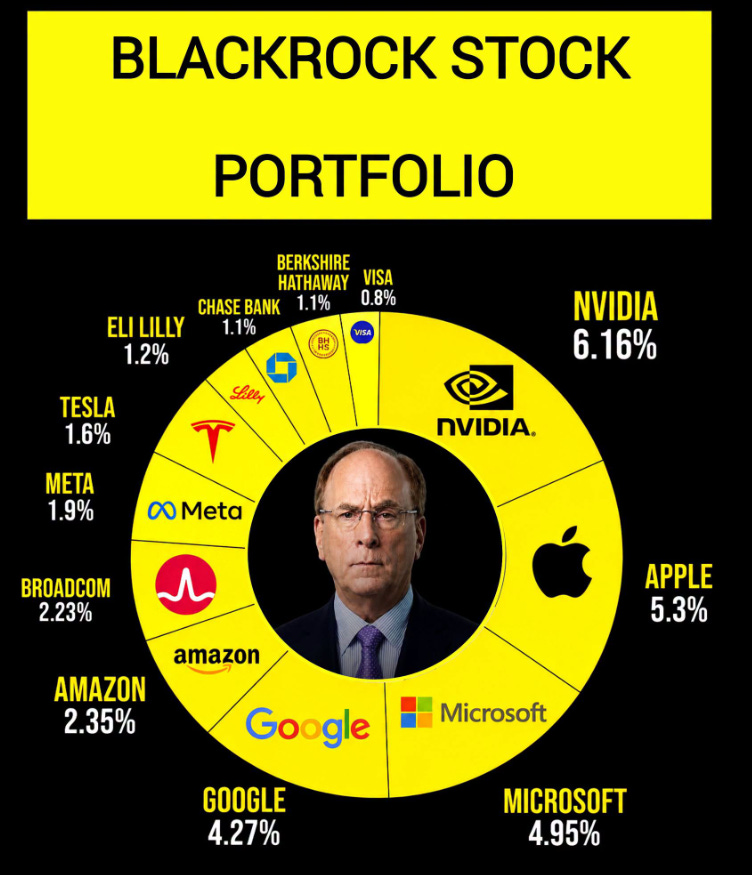
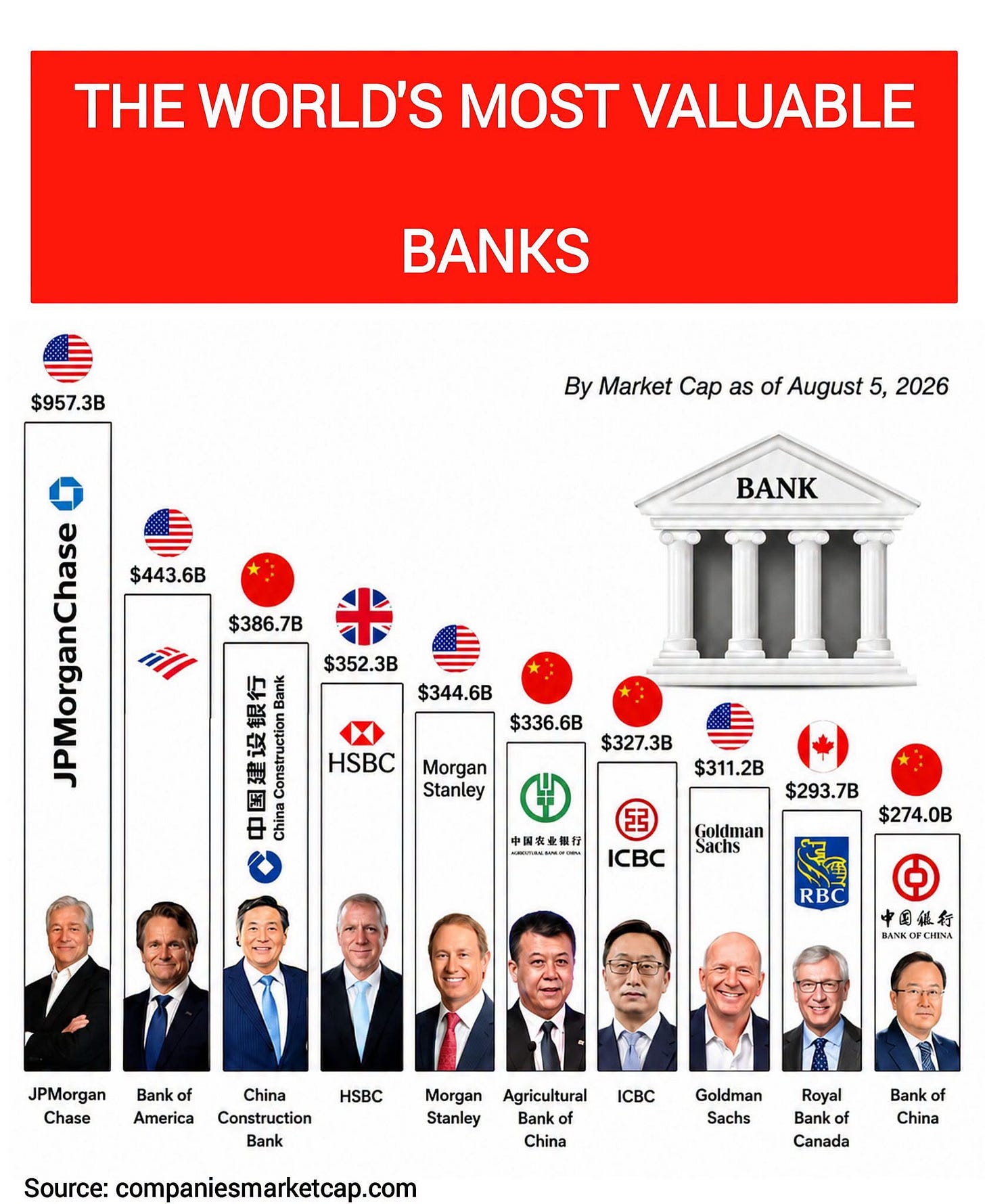
EFT’s?
Dividend ETFs can be a great place for beginners to start. Instead of picking individual dividend stocks, ETFs let you own dozens or even hundreds of companies in one investment. But not every dividend ETF follows the same strategy. Here are 8 popular options and what makes each one different:
- SCHD — 3.00% yield: High-quality U.S. dividend companies with a mix of income and dividend growth.
- VYM — 2.20% yield: A broad basket of higher-yielding U.S. companies built for steady income.
- DGRO — 1.90% yield. Focuses on companies consistently growing their dividends over time.
- SPYD — 4.00% yield. Targets some of the highest-yielding companies in the S&P 500.
- HDV — 3.00% yield. Combines higher dividend income with an emphasis on financially strong companies.
- JEPI — 8.00% yield Uses a covered-call strategy to generate higher monthly income.
- NOBL — 2.00% yield. Invests in Dividend Aristocrats with 25+ consecutive years of dividend growth.
- VIG — 1.50% yield. Focuses on large companies with long records of consistently raising dividends. The biggest lesson: don’t choose a dividend ETF based on yield alone. Some are built for current income, while others prioritize dividend growth, quality, or long-term compounding. Which dividend ETF is your favorite?

Invest . . .
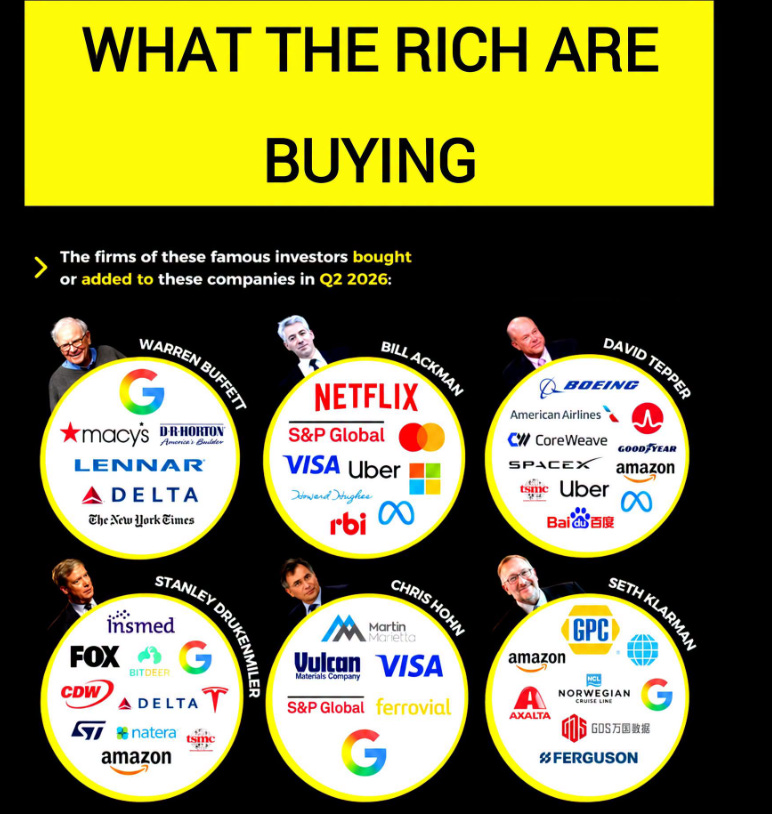
A tale of 2 Cities to the 10th POWER:
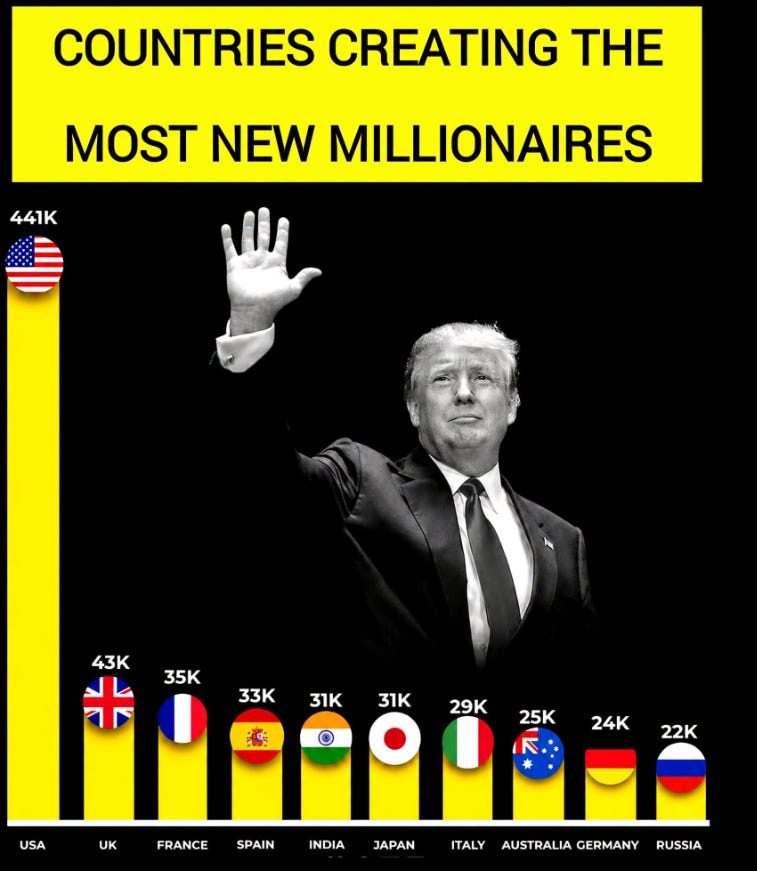
Invest in Stolen Palestinian LAND:
An Israeli influence-for-hire company appears to have trained Angolan government officials to run online influence operations, including creating fake social media personas and producing content designed to promote the government, according to new research.
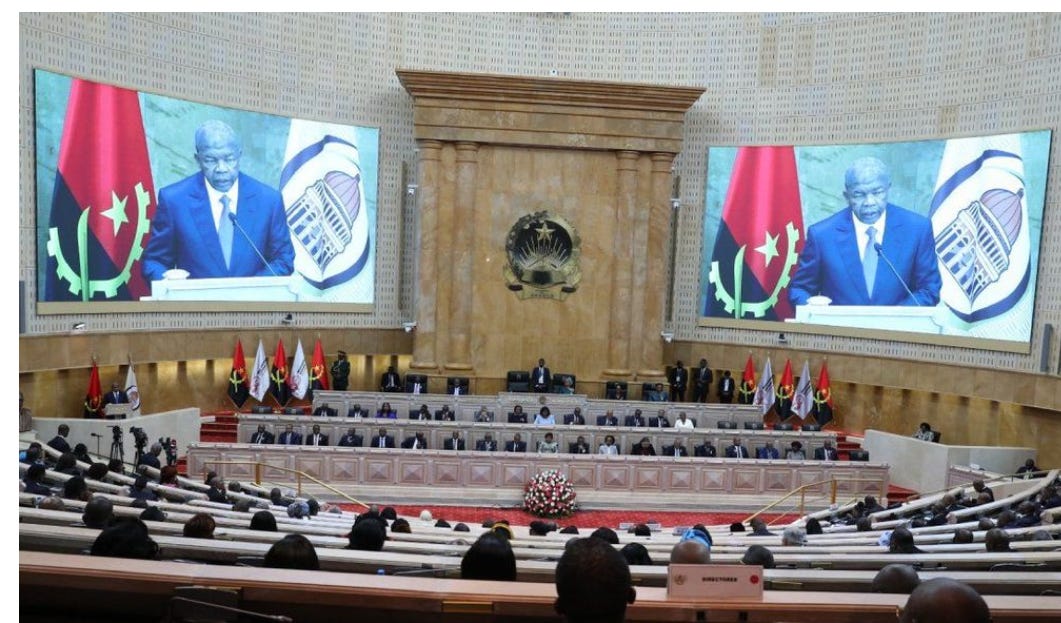
The company, BlackCore, described itself online as “an elite influence, cyber, and technology firm built for the modern era of information warfare.” Documents obtained by researchers at the University of Toronto’s Citizen Lab show BlackCore initially advertised the Angola project as an intensive four-week course covering storytelling, copywriting, traffic management and social media operations. It ultimately lasted 14 weeks and involved both training and practical operations, a final report showed.
Participants produced more than 40 pieces of content, while trainers evaluated at least 24 publications. The program also included Facebook and Instagram advertising and a TikTok campaign.
The intention was to promote what BlackCore called “positive government campaigns” and included narratives intended to portray the Angolan government “in a positive light,” rather than merely attacking government opponents, Citizen Lab senior researcher Alberto Fittarelli said.
At the center of the operation was a Facebook page for a fictitious media outlet called “Agita News,” which published its own material and linked to articles on an external website. Both are now offline.
BlackCore’s broader marketing materials advertised more aggressive capabilities, claiming it could provide clients with hundreds of fake personas, or “avatars,” across Facebook, Instagram and TikTok. Its services included flooding online platforms with coordinated messages, generating engagement from real users and countering unwanted narratives with tailored content.

Jewish Connection
BlackCore is an Israeli influence-for-hire company, with operations in multiple countries. We examine BlackCore’s digital infrastructure, and give a detailed look into BlackCore’s modus operandi including how they construct fake profiles and amplify content, and how they market themselves and report their results to clients.
On May 13, 2026, Reuters published a report on BlackCore and its alleged campaigns targeting public audiences in France and other unspecified countries. The campaigns were apparently tied to political events, for example the French municipal elections that happened on 15 and 22 March 2026 across approximately 35,000 communes in the country. Reporting by Le Monde, Le Canard Enchaîné, and Haaretz–Liberation provided additional detail about the operations.
On June 11, 2026, the French governmental watchdog on election interference, Viginum, published two reports in which it confirmed BlackCore’s targeting of the French municipal elections, adding that the company had also interfered in elections in New York, Scotland, Togo, and Angola.
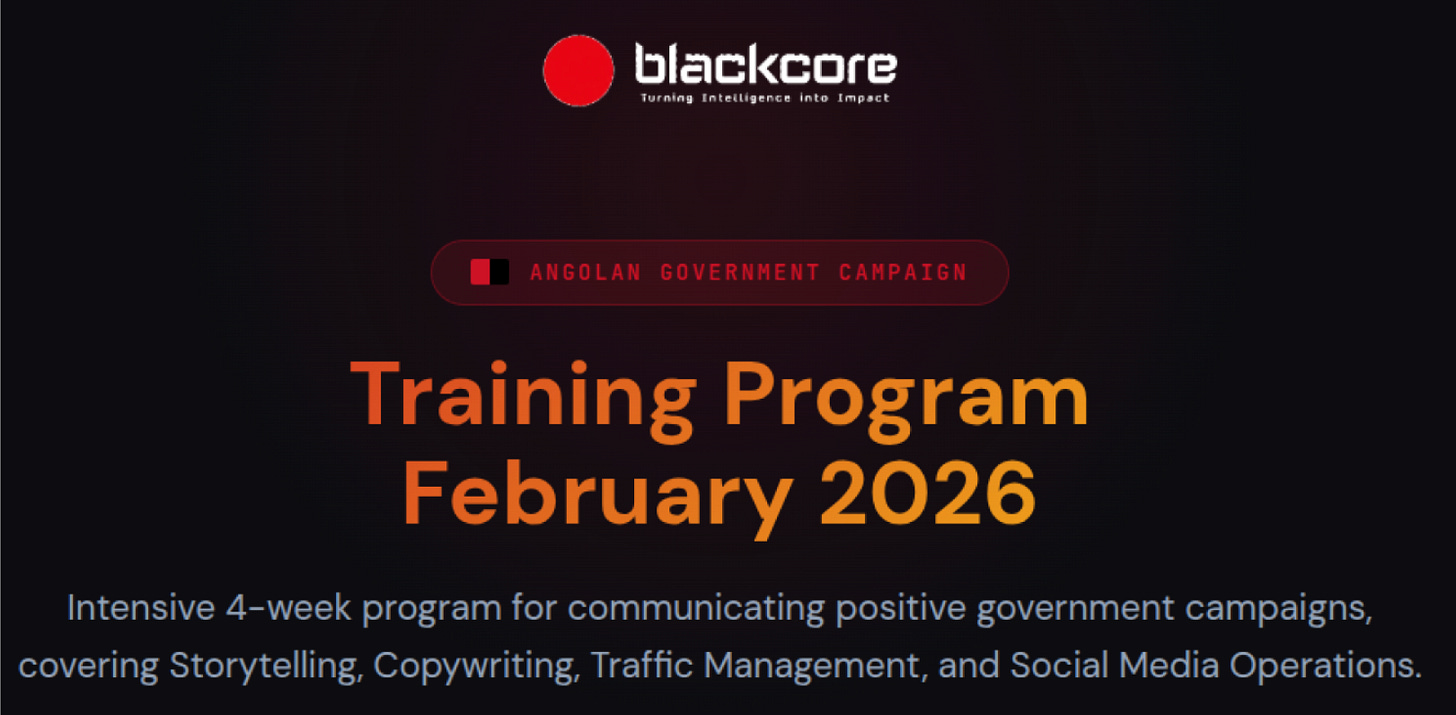
This note describes how we identified one of BlackCore’s campaigns: a set of Facebook and Instagram accounts and pages created during a training program provided to government employees in Angola, which included the launch of a supervised influence operation.
Heroes derailed by the freaking 0.2 percent Final Solution!

Colombia’s Petro accuses Israeli cyberfirm BlackCore of election interference
Outgoing president rejects election results, claiming half a million automated bots were deployed to manipulate voters ahead of Abelardo de la Espriella’s razor-thin victory.
“BlackCore, the Israeli company, deployed 500,000 bots—fake profiles—to manipulate the Colombian electorate with millions of lies about Ivan and me,” Petro said.
Describing the alleged interference as “the hardest blow to national sovereignty since the Spanish reconquest,” Petro announced a week ago that he would refuse to recognize “the legitimacy of the incoming government.” The outgoing leader has subsequently called on his supporters to launch a nationwide mobilization on July 20.
The claims build on allegations made by Petro on the night of the runoff, when early counts began favoring De la Espriella. At the time, Petro asserted that the National Registry’s vote-counting software had been “compromised,” citing detected alterations in the IP addresses of several core government servers.
The BIG SHORT:
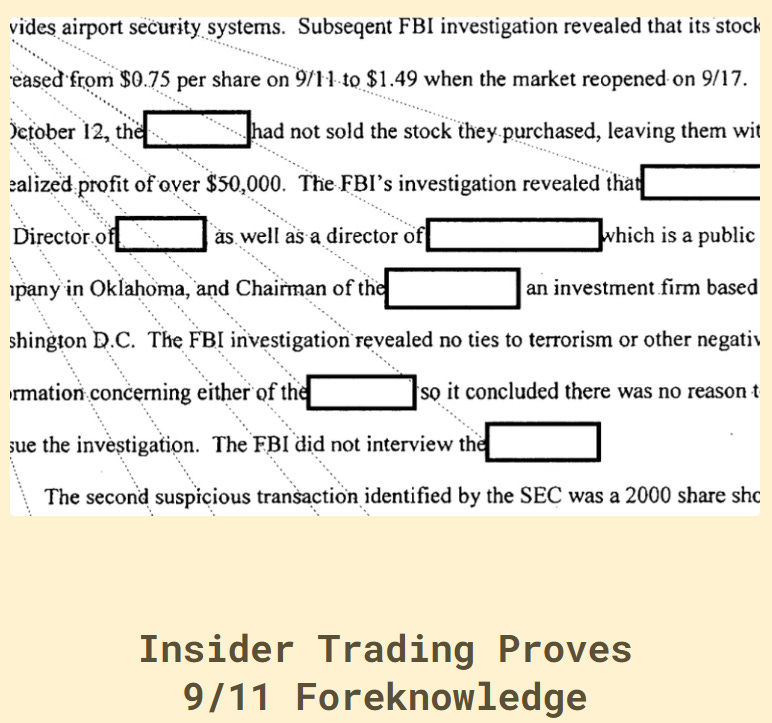
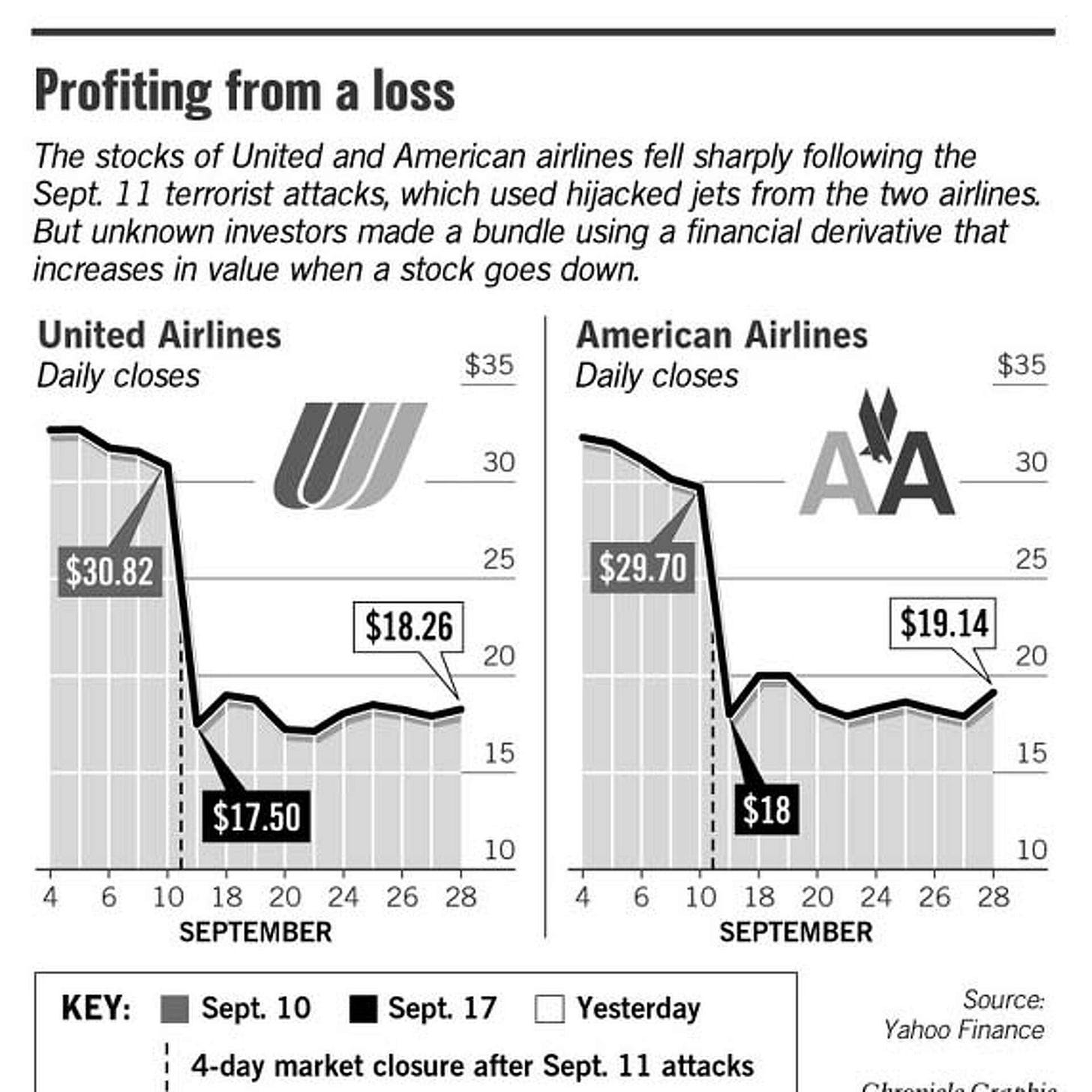
On September 12th 2001, chaos reigned supreme. Yet, as governments the world over struggled to make sense of the previous day’s catastrophe, and before a motive was established, any perpetrators identified, or other basic facts ascertained, the US Securities and Exchange Commission launched an investigation into potential insider trading by unknown figures with apparently precise foreknowledge of 9/11. The evidence seemed overwhelming. Mainstream reporters openly mocked the implausibility of numerous deeply abnormal stock market trades immediately prior to the attacks being pure coincidence.
Inside JOB:
The authors found shorting of Israeli companies listed on the Tel Aviv stock exchange “increased dramatically” before October 7th. Israeli stocks on major US exchanges also experienced a “sharp and unusual increase” during the same period. Shorting of publicly traded Zionist entity firms on October 2nd “far exceeded” levels of shorting witnessed at the start of the COVID-19 pandemic, which triggered a temporary global stock market collapse. No wonder the paper concludes it was “extremely unlikely the volume of short selling…occurred by random chance.”
“Random chance” seems an even less plausible explanation when one considers “similar patterns” of shorting Israeli stocks were also identified in early April 2023, right when Hamas was planning to conduct a comparable attack to Al-Aqsa Flood during Passover. In the immediate aftermath of October 7th too, a flurry of mainstream media reports exposed how Zionist Occupation Forces had numerous advance warnings of an impending Hamas attack for months prior. This included a detailed “point by point” battle plan, outlining Al-Aqsa Flood.
Fast forward to today, and Haaretz reveals UAE President Mohamed bin Zayed personally warned Benjamin Netanyahu 10 days prior to October 7th Hamas intended to wage a major offensive, but Israel’s premier failed to act. This disclosure comes at a time the mainstream media finally acknowledges the need for a critical reevaluation of what happened on 9/11. Any objective investigation must focus on the insider trading angle – ascertaining who knew what, when, and why, could unravel the entire conspiracy.
So is it ANY wonder that the USA politics, from state house to federal judge appointments to the swamp creatures, hmmm, is inordinately influenced by those of Jewish persuasion.
Freaking Somna:






The BLACK hats


The enemy is not always in BLACK:

Forbes Israel presents the definitive ranking of the world’s wealthiest individuals of Jewish heritage- an exclusive annual project documenting extraordinary achievement, innovation, and wealth creation at the highest levels of global capitalism.
This year’s list features 319 billionaires with a combined net worth exceeding $2 trillion, including six individuals who rank among the 15 richest people on Earth. From Silicon Valley’s technological titans to Wall Street’s financial masterminds, from shipping magnates to media moguls, these entrepreneurs and business leaders have fundamentally reshaped industries, built iconic companies, and accumulated unprecedented fortunes through vision, ambition, and relentless execution.