 Canada recently sanctioned the world’s second largest oil company that was born in struggle against imperial domination. The significance will be ignored amidst the latest drive to subjugate Iran.
On Tuesday Global Affairs sanctioned the National Iranian Oil Company (NIOC). People in Canada and Canadians abroad are now prohibited from transacting with the second largest oil firm in the world after Saudi Arabia’s Aramco. The entirely state-owned firm has some US$200 billion in assets and annual revenue of over $50 billion. NIOC is responsible for about half of the government’s income and manages 10% of global recoverable liquid hydrocarbon reserves.
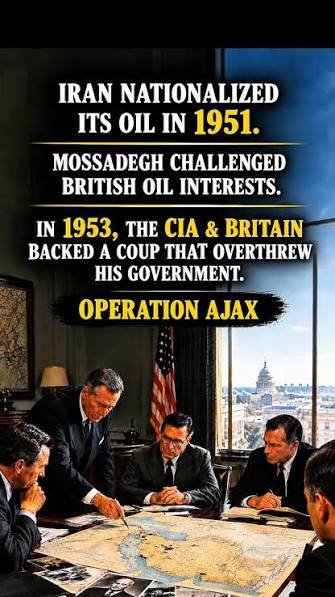
NIOC’s 1951 creation was an important moment of resource nationalism and anti-colonial sovereignty. The first (quasi) former colony to reclaim its oil, Iran’s nationalization would lead to the US and Britain overthrowing the country’s first popularly elected prime minister, Mohammad Mossadegh.
NIOC was formed as part of Iranians push to gain greater benefit from their huge oil reserves. As one of the earliest sources of Middle Eastern oil, the Anglo-Iranian Oil Company (BP’s predecessor) had generated immense wealth for British investors since 1915. Unwilling to yield any of its profits, Anglo-Iranian chairman Sir William Fraser responded to Iran’s attempts to gain a greater share of its oil wealth by proclaiming “one penny more and the company goes broke.” Yet a 1952 US State Department report showed the company was selling its oil at between ten and thirty times its production cost. It also treated its Iranian workforce terribly.
Needless to say, Anglo-Iranian Oil was unpopular. Even the State Department noted the company’s “arrogance had made it genuinely hated in Iran.” In the face of Anglo-Iranian intransigence, Prime Minister Mohammad Mossadegh defied London and supported the nationalization of the country’s oil industry.
Ottawa was not happy with the Iranian government’s move. In May 1951, external affairs minister Lester Pearson told the House of Commons the “problem can be settled” only if the Iranians keep in mind the “legitimate interests of other people who have ministered to the well-being of Iran in administering the oil industry of that country which they have been instrumental in developing.” Later that year Pearson complained about the Iranians’ “emotional” response to the English.
In response to Mossadegh’s oil nationalization, the British government organized an embargo of Iranian oil, which Ottawa followed. The embargo weakened Mossadegh’s government, enabling the CIA’s subsequent drive to topple the nationalist prime minister.
Following a meeting of the National Security Council on March 11, 1953, head of the CIA Allan Dulles gave the agency’s Tehran bureau one million US dollars ($8 million today) to be used “in any way that would bring about the fall of Mossadegh.” In All the Shah’s Men Stephen Kinzer explains: “Through a variety of means, covert agents would manipulate public opinion and turn as many Iranians as possible against Mossadegh. This effort, for which $150,000 was budgeted, would ‘create, extend and enhance public hostility and distrust and fear of Mossadegh and his government’. It would portray Mossadegh as corrupt, pro-communist, hostile to Islam, and bent on destroying the morale and readiness of the armed forces. While Iranian agents spread these lies, thugs would be paid to launch staged attacks on religious leaders and make it appear that they were ordered by Mossadegh or his supporters.”
Pearson did not protest the overthrow of Iran’s first elected prime minister. Privately, External Affairs celebrated.
The coup benefited foreign oil interests. While NIOC wasn’t shut down, the post-coup government allowed BP, Shell, Chevron, Exxon and others to dominate oil extraction in the country. After the 1979 revolution state control was asserted over NIOC. The Islamic government immediately ended foreign firms purchasing privileges and terminated their contracts.
Tuesday’s announcement that Canada was sanctioning NIOC and ten other major Iranian entities is a way to support the US’ bid to suffocate Iran economically. That campaign is part of a broader US/Israeli war. In the latest example of Ottawa’s support for the aggression, Global Affairs shared a G7 statement on Wednesday effectively blaming Iran for responding to US/Israeli attacks. It noted, “We strongly condemned Iran’s attacks against its neighbours and the disruption of international trade, energy security, and the global economy caused by the obstruction of transit passage through the Strait of Hormuz. We reaffirmed the importance of protecting civilians and civilian objects, and called on Iran to respect its international human rights and humanitarian law obligations. …. We underscored the importance of the defensive activities undertaken by U.S. Central Command in the Strait of Hormuz to demine the waterway and escort civilian vessels.”
Canada has long backed foreign exploitation of Iran. Sanctioning its prized national oil company confirms it.