







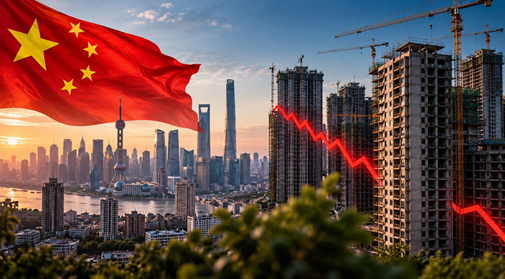
Between 1998 and 2021, China experienced the biggest property boom in history. Hundreds of millions of people moved into modern, spacious urban housing, millions of construction and manufacturing jobs were created, and in cities like Beijing, Shanghai, and Shenzhen, property prices multiplied several times over.
At its peak, in the third quarter of 2021, China’s Real Residential Property Prices Index reached 113 points.
But then, seemingly, everything changed.

The story of China’s supposed “total collapse” has been told a thousand times. This article won’t repeat it. Instead, it will examine a deeper question: Was there ever a true meltdown at all?
Property prices fell, and yes, some of the damage that followed was real. But at the same time, the rest of China’s economy kept moving.
Real GDP has grown every year since 2022, including 5% in 2025. Chinese AI labs are producing models that easily compete with American ones at a fraction of the cost. China leads the world in electric vehicles, batteries, and solar.
That doesn’t look like an economy that just went through what hedge fund manager Kyle Bass called “the US financial crisis on steroids.”
Western analysts, like Kyle, often miss two important nuances in this story: perspective and policy.
1. Perspective: What Does a Home Actually Mean?
I was born in the United States and I can understand how China’s property market might look like a “total collapse” from the American perspective.
In the United States, housing is often treated as an investment first and a home second. It’s something to buy, flip, and cash out of. So the health of the housing market is judged largely by whether prices are going up or down.
By that measure, China looks like a disaster.
But as someone who has personally bought and sold property in China (yes as a US citizen) I can tell you that the mindset is very different.
In China, a home is a home first. It’s the price of admission to marriage, starting a family, and retirement.
And this is where the story gets interesting.
Towards the end of the two-decade boom, many Chinese people, especially younger generations, began experiencing something people in the West know all too well: housing was becoming a commodity.
Prices were rising so quickly that young people couldn’t enter the market. It was turning into a real bubble.
But as more people began expressing those concerns, Beijing took notice.
2. Policy: How Beijing Responded to the Bubble
In 2016, Xi Jinping introduced a slogan that has been repeated ever since: “Houses are for living in, not for speculation.”
Following that, regulators spent years tightening borrowing restrictions on property developers, with the Three Red Lines becoming the centerpiece of the policy.
And it worked: debt-fueled speculation ended.
Now, that doesn’t mean the process was painless. Not at all.
Several large developers had to shut down, and unfinished pre-sold homes remain a source of anger among buyers.
But because the bubble was addressed through policy rather than simply being left to burst, the widespread shock many Western analysts predicted never came.
It was a controlled descent, intended to prevent a much bigger problem down the road.
A More Affordable Housing Market?
China’s property market has therefore matured, not collapsed. And the changes have also improved the affordability picture.
According to the Bank for International Settlements, China’s real residential property price index has fallen by about 25%, from 113 to roughly 85 in early 2026.
Meanwhile, incomes have moved in the opposite direction.
According to China’s National Bureau of Statistics, median disposable income increased by about 21%, from 29,975 yuan in 2021 to 36,231 yuan in 2025.
Prices down. Incomes up.
As a result, the income-to-price ratio has improved sharply, and millions of young Chinese can now afford a home they couldn’t afford before.
And here’s the ironic part: ask a young American which housing market they’d rather be in, and I think most would gladly trade places.
So, What Is a Home Actually For?
This isn’t a black-and-white story. It’s about something much more fundamental: what a home is supposed to be.
Are houses, as Xi Jinping puts it, “for living in, not for speculation”?
Or are they primarily a vehicle for building wealth, as in America, a country now led by a real estate developer whose policy is, in Donald Trump’s words: “I want to drive housing prices up… we’re going to keep them wealthy”?
Perhaps the real question isn’t simply whether China’s housing market has collapsed or recovered.
It’s whether we’ve lost sight of what housing is actually meant to provide.