


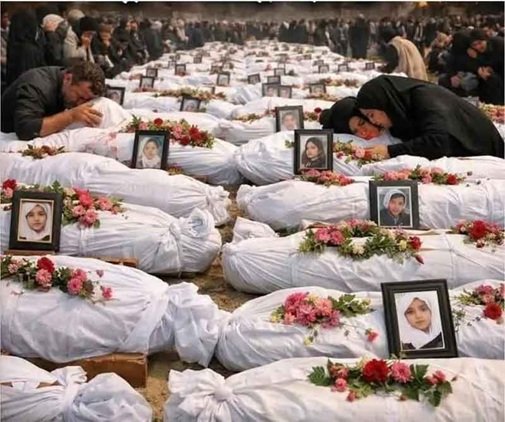
 This month has seen the United Nations issue two reports alleging the commission of war crimes and crimes against humanity by the United States in two theatres of engagement. In one, the UN Independent International Fact-Finding Mission on the Islamic Republic of Iran concluded that the US had committed war crimes in two attacks on Iran on the first day of the war killing civilians, including over 120 children. The other, featuring exploits in the Caribbean Sea entitled Operation Southern Spear, involved the extravagantly murderous campaign waged by the Trump administration against alleged drug traffickers using small vessels. These narco-strikes (a reported number of 68, resulting in the deaths of 223 people), provoked the Special Rapporteur on Human Rights and Counter Terrorism, Ben Saul, to find “reasonable grounds” that they constituted “crimes against humanity of murder under customary international law”. The killings were “unlawful and intentional under international law.”
On February 28, in the opening phase of its pre-emptive, illegal war against Tehran, the US armed forces bombed the Shajareh Tayyebeh elementary girls’ school in Minab, Hormozgan Province. Over 160 people died, among them 123 children under 13-years of age. The school, which had been labelled by the Defense Intelligence Agency a legitimate military target, was struck by three missiles. (This had been casually euphemised as a targeting error based on obsolete intelligence: the site of the school had originally been part of an Islamic Revolutionary Guard Corps (IRGC) naval base but was separated from that facility between 2013 and 2016 and converted into a civilian educational site.) That same day, an athletic facility in Lamerd city, Fars Province, where girls were undergoing sports training, was struck by a Precision Strike Missile, resulting in the deaths of 22 civilians, including two schoolgirls, two schoolboys and a 2-year-old girl playing in front of her home.
The attack on Minab was found to be “a violation of the obligation to distinguish between civilian objects and military objectives and the prohibition of making civilian objects the object of an attack, as well as the principle of precaution”. The strike on the Lamerd facility also gave the Mission “reasonable grounds to believe” that it constituted “the war crime of launching an indiscriminate attack resulting in the loss of life or injury to civilians or damage to civilian objects.”
The Minab attack had been targeted “with the requisite mental element of recklessness (dolus eventualis).” This assessment was reached given the “deprioritization” by the Trump administration on mitigating harm to civilians, evidenced by public statements by senior officials scornful of international humanitarian law, and the failure “to update information in relation to the school in […] targeting databases” that would have accounted for the current status of the building. “Rather, the United States directed the strikes at the building of the school while being aware of a substantial risk of striking a civilian object and acting recklessly as regards the possibility that this would happen.”
On Operation Southern Spear, Saul’s briefing note found that the attacks launched against the designated narco-vessels amounted “to serious extrajudicial killings in violation of the right to life, being unjustified in national or personal self-defence or under international humanitarian law, the international law of the sea, narcotics suppression conventions, or international counter-terrorism law”. Rather damningly, these strikes had also done nothing to stem the supply or price of cocaine, instead producing “ballooning effects” while ignoring the primary cause of overdose deaths in the US: fentanyl and opioids. Most cocaine, in any case, tended to be transported “on container ships (not small boats), most of which are never inspected at ports and then cross the United States’ land borders”.
Saul also took issue with the exculpatory grounds of self-defence, so adamantly insisted on by the Trump administration. There was no inherent “right to use self-defence against the criminal groups listed as terrorist organizations.” Even if the vessels and crew were members of criminal groups so listed as terrorist in nature, these entities “have not mounted any ‘armed attack’ on the United States so as to trigger a right of self-defence.” The US had not claimed these vessels and crew to be armed with military means to launch attacks with the scale and gravity expected by conventional forces.
The issue of an imminent threat to life had also not been demonstrated in the context of these killings. “The concept of an imminent threat to life does not stretch to encompass an attenuated chain of causation in which potential future deaths result from drug consumption after numerous intervening steps occur.” Nor was there evidence that the use of force was a matter of last resort, let alone necessary and proportionate, given the admission by Secretary of State Marco Rubio “that vessels could have been intercepted but the United States instead chose to destroy them to deter other drug traffickers.”
In terms of recommendations, Saul’s report proposes that Washington conduct necessary, impartial, independent and transparent investigations into the killings to comport with international standards; prosecute the relevant perpetrators in the chain of command, both military and political, and provide appropriate remedies and reparation to the victims and families. It also notes, with regret, the penalisation of former military personnel who had insisted that illegal orders be disobeyed. “Even if humanitarian law applied, every combatant has a duty to disobey a manifestly unlawful order, including orders to commit the war crime of murdering civilians, and bears criminal liability where the person knew the order was unlawful or should have known because of the manifestly unlawful nature of the act so ordered.”
The outcome of these reports will be few and inconsequential. The war against Iran continues in staggered fashion, threatening, if anything, to expand. At the UN General Assembly, President Donald Trump continued airing threats of existential annihilation against Tehran while fantasising about war aims unfulfilled. Killing alleged narco-terrorists continues to fixate those buccaneers at US Southern Command. On September 19, for instance, SOUTHCOM announced, not giving anything resembling detail, the killing of “four narco-terrorists” in a “lethal, kinetic strike on a go-fast vessel operating along established narco-trafficking routes in the Caribbean.” The intelligence behind the operation had been “confirmed”, something only the most credulous inside or outside the Pentagon would believe without question.
Republican Rep. Thomas Massie has filed eight articles of impeachment against the Secretary of Defense Pete Hegseth citing the strike against the school in Minab and Operation Southern Spear and good grounds for doing so. Relevantly, Article IV charges the Secretary “with ignoring laws that minimize civilian casualties”, while Article V alleges the replacement of “maritime law enforcement with unauthorized military targeting of suspected drug traffickers, resulting in at least 221 deaths.” While this should have been brought to a full House vote on September 17, House Speaker Mike Johnson and other GOP grandees saw fit to cancel that day’s proceedings of the chamber, thereby prolonging it till after the midterm elections. The rot, having set in from the top, shows few signs of being addressed.