






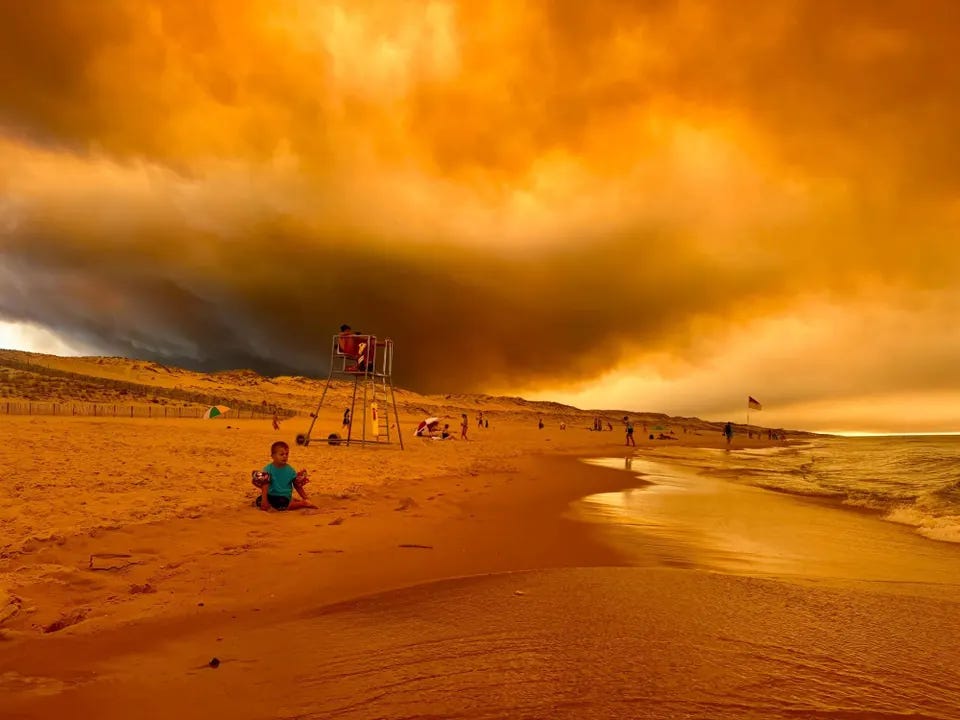
If you need an indication of how divorced the ‘mainstream’ media is from reality, consider this: the possibility of at least 4 billion deaths resulting from 3 degrees Celsius of global warming by 2050 made barely a dent in news headlines.
Last year, a team of experts from the Institute and Faculty of Actuaries and the University of Exeter published a report, ‘Planetary Solvency – finding our balance with nature’. The report examined the risks and likely catastrophic impacts if humanity does not take immediate, decisive action to stop greenhouse gas emissions, which have already led to increasingly devastating wildfires, flooding, droughts, harvest losses, and threats to the food supply.
The current global temperature rise, compared to pre-industrial times, is on the verge of breaching the 1.5C ‘cap’ agreed in 2015 at the Paris climate summit. Protesters said then: ‘1.5 to stay alive’.
However, on the present trajectory of emissions, the Intergovernmental Panel on Climate Change estimates a rise of around 2C by 2050, possibly as early as 2039. A 2C rise by 2050 was the ‘highly likely’ case included in a range of scenarios considered by the expert actuaries and Exeter researchers. They labeled 2C warming as ‘catastrophic’ and listed a number of associated impacts on climate, nature, society and human mortality:
· Breakdown of some critical ecosystem services and Earth systems.
· Major extinction events in multiple regions.
· Ocean circulation severely impacted.
· High number of climate tipping points triggered, with a partial ‘tipping cascade’, increasing climate instability even further.
· Severe socio-political fragmentation in many regions; low-lying regions lost.
· Heat and water stress driving involuntary mass migration of billions of people.
· Catastrophic mortality events from disease, malnutrition, thirst and conflict.
And the starkest conclusion of all:
· The deaths of at least 2 billion people.
As utterly grim as this was, the expert team also included an even more ‘extreme’ scenario of 3C warming by 2050 which cannot be ruled out; indeed, it is highly plausible. Recently, New Scientist reported a new climate study that concluded the world may warm by 25 percent more than current projections, suggesting around 3.25 °C of warming by 2100. In fact, some reputable scientists believe that a 3C temperature rise by 2050 is the most likely outcome if the current dangerous fossil fuel trajectory continues. For example, the German Physical and Meteorological Societies issued a joint warning last year that the planet could warm by 3 °C above preindustrial levels by 2050. Leon Simons, a Dutch climate researcher and the Executive Director of the Club of Rome Netherlands, produced this useful thread on X about the warning.
Climate scientist Bill Hare, CEO of policy institute Climate Analytics, warned:
‘This is just physics. We’re losing the ability to limit warming even by two degrees without strong action and people need to be aware of that and be aware that it’s a political failure. It’s not an act of God or anything. It is just because politicians in many places are not acting fast enough.’
Arguably, there are no politicians in positions of real power who are ‘acting fast enough’. In fact, they are avoiding, even blocking, substantive action on climate. They have essentially been captured by fossil fuel interests.
So, what would be the effects of 3C global warming? The ‘Planetary Solvency’ report estimated that there would be at least 4 billion deaths. There would also be:
· Multiple climate tipping points triggered, and a tipping cascade.
· Breakdown of several critical ecosystem services and Earth systems.
· High level of extinction of higher order life on Earth.
· Significant socio-political fragmentation worldwide and/or state failure with rapid, enduring, and significant loss of capital and systems identity.
· Frequent large scale mortality events.
To put things in awful perspective, 4 billion deaths is around half the current global population.
Note that the 4 billion figure did not appear in the title of the report. Nor was it addressed in the main body of the text. Instead, it appeared in an appendix on page 32 of the 40-page report.
How did the Guardian report it? With the headline, ‘Global economy could face 50% loss in GDP between 2070 and 2090 from climate shocks, say actuaries’. The figure of 4 billion dead was only mentioned in passing in the fifth paragraph.
Later that month, an Observer piece on the climate crisis by Robin McKie, a former science and environment editor of the Observer, addressed the report:
‘It argues the global economy “could face a 50% loss in GDP between 2070 and 2090, unless immediate policy action on risks posed by the climate crisis is taken,” adding: “Populations are already impacted by food system shocks, water insecurity, heat stress and infectious diseases. If unchecked, mass mortality, mass displacement, severe economic contraction and conflict become more likely.”’
McKie then quoted Bill McGuire, emeritus professor of geophysical and climate hazards at University College London, who called the report ‘a stark message’. McGuire continued:
‘In light of the projections in Planetary Solvency, it is pretty clear that hope is now a luxury we can no longer afford, and the truth is we are in deep, deep excrement that is getting deeper by the day.
‘It is a simple fact that there is now an extraordinary disconnect between government and business actions and the reality of the colossal impacts of climate breakdown of society and economy.’
There was, however, no mention in the Observer article of the likely billions of deaths.
We could not find a single article about the actuaries’ report in any other national UK newspaper. Nor could we find anything on the BBC News website. This silence is extraordinary. It is a stunning example of propaganda by omission; arguably the greatest crime of state-corporate media.
As it happens, the team of experts that produced the report included an actuary from the UK government Actuary’s Department. The government website therefore posted an anodyne summary, titled ‘Actuaries highlight the increasing risk of Planetary Insolvency’. But it made no mention of the prospect of billions of deaths.
The Gargantuan Lie
Adam McKay is the Academy Award-winning director of ‘The Big Short’, ‘Vice’, and ‘Don’t Look Up’. In this most recent film, two astronomers go on a media tour to warn humanity of an approaching comet that will destroy Earth, only to be met with apathy, political denial, and corporate greed. Clearly, the film was an allegory for the climate crisis.
McKay recently wrote a powerful piece titled, ‘The Gargantuan Lie That is Collapsing The World’s Climate’.
He wrote:
‘It is a lie told worldwide by hundreds of thousands of institutions, elected officials, many universities, legacy news, some large non-profits and eventually—as the deception entered mainstream culture—even by ourselves, to ourselves, every single moment of every day… This massive lie can best be summed up as “when it comes to climate change… we have more time.”’
This lie is not ‘the kind of total climate denial one would find on the extremist, lunatic fringe inhabited by the likes of Alex Jones or the current U.S. President.’ Instead, it is a lie that has prevented serious action being taken to cut emissions:
‘Every day this deception whispers seductively in the ears of mankind: “global warming is real but not urgent… Keep doing what you’re doing.”
‘Less embarrassing than “climate change is a Chinese hoax,” but every bit as unscientific and ridiculous, it is the preferred lie of the ruling class, mainstream news media, and corporations.’
The grand lie of ‘we have more time’ includes:
‘lofty-sounding promises to reach “Net-zero emissions by 2050,” as if 24 years from now was soon enough. There are the queries of “What’s your carbon footprint?,” as if individual people with plastic bags or straws were the problem and not gigantic multinational corporations. There’s the accusation that anyone who expresses urgency is a “doomer.”’
McKay added:
‘In service of the Great Lie, the government of the United Kingdom even tried to bury a climate report from its own intelligence agency before it was leaked. To my knowledge there aren’t many spies being called tree huggers, unless they’re undercover of course. But the MI5 and MI6 are clear-eyed about the danger that’s coming. The report warned that “global ecosystem degradation and collapse threaten UK national security and prosperity.”’
The Energy and Climate Intelligence Unit, a non-profit UK organization, found that almost two-thirds of articles in UK national newspapers that referenced wildfires during this summer’s record-breaking temperatures failed to mention climate change.
The ECIU also reported that 72% of coverage of the UK’s June heatwaves likewise failed to mention climate change. An analysis by Climate News Tracker in May found that more than half of UK television and radio news coverage of that month’s heatwave also failed to link it to climate change.
And yet, UK climate breakdown is ‘coming faster and harder’, according to the economist Professor Matthew Agarwala, the chair of sustainable finance at the University of Sussex Bennett Institute. We may now be entering a ‘perfect storm’ of climate impacts that could devastate the country’s infrastructure and food supply.
Luke Tryl, UK director of More in Common, a non-profit research agency that aims to understand what Britons think and why, noted recently via X:
‘Weather may be getting cooler, but what has been the impact of recent heatwaves on public attitudes to and salience of climate and net zero? Two thirds of the public say they are worried about hot weather and 86% think climate change at least partially responsible.’
Geoffrey Lean, formerly of the Independent, and the world’s longest-serving environment journalist with a 56-year career, responded to the survey results:
‘What a disconnect! The vast majority of people rightly link the heatwaves with climate change, but another survey has found that two thirds of media articles on them fail to mention it. The Government seems stuck in same elite Westminster/Whitehall/Fleet Street bubble….’
Likewise, the BBC is failing to properly inform viewers about the realities of the climate emergency. Zack Polanski, leader of the Green Party of England and Wales, says the BBC is instead choosing to follow the lead of right-wing newspapers owned by billionaires. He told the National newspaper in Scotland:
‘It’s really important we have a public service broadcaster but what’s happened is the denigration of trust because of years now of overreporting on Reform.
‘I think the most obvious example is Question Time, the constant seat that is given to a Reform spokesperson. But sometimes we miss the point if we just focus on Question Time; I think it’s much more insidious than that.’
He continued:
‘I think it’s daily, I think it’s in the commentary around British politics, I think it’s constantly through the frame of what Reform are saying, or there is a much bigger problem where The Telegraph or The Times or the Mail will put something on their front page and then the BBC allow those billionaire-owned newspapers to set the news agenda.
‘It’s corrosive to our political discourse and our national conversation.’
Polanski called on UK prime minister Andy Burnham to block plans to exploit the Rosebank oil field west of Shetland and the Jackdaw gas field in the North Sea. Climate scientist Bill McGuire noted:
‘The climate doesn’t care about what pleases the fossil fuel industry or is perceived as politically palatable. It cares about the greenhouse gases in the atmosphere.’
So far, Burnham has shamefully neglected to tackle the climate crisis, or even discuss it publicly. A recent government ‘severe alert’ sent to phones in the UK only went as far as warning that people ‘should not undertake any activity that could start a fire, including disposable barbecues, firepits, garden incinerators or fireworks.’ The word ‘climate’ did not appear.
He has yet to make a decision on whether to approve the Jackdaw and the Rosebank fields. According to a recent report in The Times, government ministers are concerned about the ‘optics’ of giving approval during a summer that has seen a series of intense heatwaves and wildfires in many parts of the UK. The decision is now expected to be delayed until the autumn.
After speaking with Burnham in a phone call, US President Donald Trump said that opening up new oil and gas fields would help solve Britain’s ‘energy problem’ and make the UK ‘pretty rich’. Burnham has reportedly said that he would adopt a ‘pragmatic’ approach. That hardly inspires confidence that he is serious about cutting emissions of dangerous global warming gases.
The 4 Billion Dead Movement
Early in 2026, a new climate movement emerged in the UK: 4 Billion Dead (4BD), founded by climate activist Roger Hallam, co-founder of Extinction Rebellion, Just Stop Oil, and Insulate Britain. Hallam is a former organic farmer who, motivated by the loss of his business due to extreme weather events, later became a researcher in the study of mass mobilization at King’s College London.
In 2024, Hallam was sentenced, along with other activists, for his part in organizing a climate action to disrupt traffic on the M25. His sentence was initially for five years, later reduced to four years on appeal. He was released in 2025 after serving around thirteen months in prison.
The name of the 4BD movement comes from the worst-case scenario included in the expert actuarial report discussed earlier. The movement’s call for international climate activism stated:
‘You felt this summer. Across the world it was felt.
‘The heat that didn’t break. The grass that turned to straw then dust. The rivers running low. Heatwaves killing thousands of people.
‘It will get worse. Not might. Will. Every year temperatures will rise and more people will die.
‘Last year the truth came out. The British insurance industry produced a report on the climate crisis, predicting at least 4 billion deaths at 3C of global warming – possible by mid century.
‘4 billion. Half the Earth’s population. Dead.
‘Sit with that number for a moment. There are no words.’
On the 4BD website, Hallam has written about how this movement will differ from the ‘old’ climate movement. The first aspect, he says, is to recognize that what humanity is facing is not ‘merely an “issue” that requires a “campaign” to “fix it”.’
He continued:
‘What we face requires us not just to change the world but to change how we see the world and ourselves. We are not going to have any resilience unless we first take the time to focus on what it means to live a good life in the appalling context we are presented with.’
Inspired by India’s fight for independence against British rule, he points to Mahatma Gandhi’s concept of ‘self-purification.’
Hallam explains:
‘We have to detach ourselves from our egos – that bit of ourselves that wants success – to win. And that part of ourselves which is filled with judgement against those who we see as responsible for this ultimate catastrophe. Both paths lead to burnout and/or violence. And paradoxically, neither of these outcomes will lead to “success”.’
The second aspect of importance is that 4BD will operate within the law, because otherwise:
‘In the increasingly authoritarian contexts we face, direct action will most likely lead to the arrest and imprisonment of people in the organisation and force its closure.’
A third component is a ‘grand vision’ for 4BD as:
‘part of an international movement which, as conditions worsen, seeks to provide a positive radical alternative to the default collapse into fascism. Along with partner groups and networks we are demanding a political revolution – a fundamental change in how decisions are made in our society’.
Taking Back Power
Professor Kevin Anderson, a climate scientist at the University of Manchester, has long spoken forcefully about the real risk of societal collapse under global warming and the urgent need to make substantive cuts in emissions. In a recent interview with Novara Media, he pointed out that tackling climate change means improving the everyday lives of those large numbers who are currently struggling:
‘better [public] transport, better homes which improves the well-being of the people in those homes…which improves the educational attainment of their children. So, this is win-win-win for those communities.’
He also reminded viewers that power in society resides with the general population. We do not have to genuflect before Bill Gates, co-founder of Microsoft, and pay attention to his views on climate, while the media flock adoringly around him.
Anderson says of technical and political elites:
‘I don’t think these people have power unless we allow them to have power.’
The ‘real skill’ of elites, with their self-serving neoliberal agenda, is to:
‘break the world into individual components. As individuals we have very little power. As collectives, we have far, far more power than Gates, [Elon Musk], [Jeff] Bezos [founder of Amazon], the PM [Prime Minister]. So, the trick of those who want to maintain power is to make sure the rest of us just continue as individuals, not as collectives.’
He referred to the Suffragette and civil rights movements:
‘We can see where collectives come together [and change society]’.
Elites have always resisted change from below because they have done remarkably well under the status quo. The same holds today, where we are encouraged to see ourselves as individuals competing against each other, rather than ‘citizens in a collective, a community, a society, a country.’
Anderson summed up:
‘So, I do not hold that they [elites] have the power. We have allowed them to have the power by allowing them to reduce us to individuals. We can take that power back any time we want to do.’
And that is the key to tackling the climate emergency.