







Orientation
The rise and fall of Promethean Europe
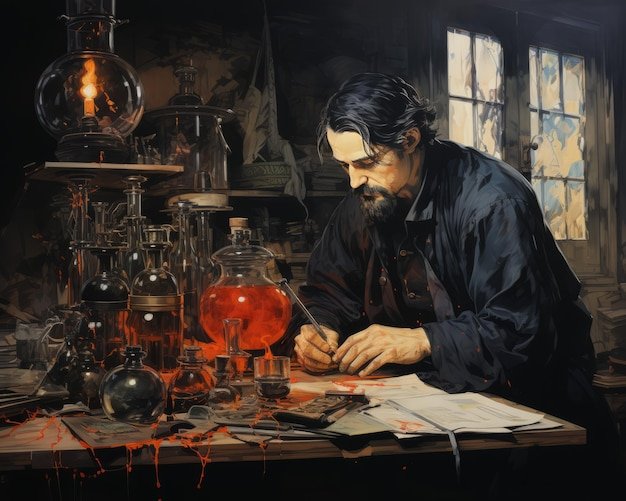
From the 15th through the 19th century the various countries in Europe were both loved and feared around the world. Scholars like Patricia Crone, Jared Diamond, John A. Hall, C.R Hallpike and William McNeill wrote books about what made Europe different from other parts of the world. Eric Jones wrote a great book called The European Miracle. I’ve written two books on the subject, Forging Promethean Psychology in 2017 and Lucifer’s Labyrinth in 2019. But the 20th century told a very sad story about Europe beginning with the two World Wars. After World War II Europe became a vassal of the United States and has continued to be one through today. The Promethean, Faustian fire (see image above) that once fueled scientific and technological revolutions has grown dim. It has been replaced in philosophy by anti-materialist, anti-realist philosophy beginning with existentialism, then morphing into the Frankfurt School in the 1960s and early 1970s, then the various kinds of structuralism and culminating in postmodernism.
A glimmer of hope in the darkness
Today the European rulers cannot claim one head of state that has enough backbone to stand up to the United States and demand respect for its national economy. Europe is hardly a third force between BRICS on the one hand and Mordor (the US) on the other. In fact, I believe Europe’s only hope is to join with China, Russia and Iran in the building, spreading and linking of Eurasian civilizations. If we are to have any hope for a European recovery the first step is to understand that the United States is no longer a continuation of the Enlightenment spirit. It is the enemy of Europe. Then I will write about to what extent a cultural group which calls itself the “New Right” in Europe has anything to offer. not only for a European Renaissance, but it also might rekindle its Faustian fire with and through the BRICS countries. My article will be an integration of a wonderful book by Michael O’Meara, New Culture, New Right.
Where are we going?
This article is divided into four sections. The first third is about the differences between Europe and the United States and why Europeans should be anti-American. The second section contrasts the differences between the European right and the neocon right of the United States. The third part of my piece describes some of the reasons why the European New Right is against the liberalism of the United States. I close with the reasons why there is a glimmer of hope for Europe.
United States is Anti-Europe
Unlike the right-wing neocons of the United States, much of the New European right has always viewed the US as a greater threat to Europe than communist Russia. Conservative revolutionaries between 1918 and 1932 in Europe supported the National Bolsheviks and revolutionary Europeanists, New Rightists consider the US to be anti-Europe.
Pilgrims insist on starting from scratch
Beginning with the Pilgrim fathers, their North American wilderness was conceived of as the New Israel, a pure land uncorrupted by Babylon. In Puritan mythology John Winthrop, the first New England governor was portrayed as a Moses-like figure who led his followers out of Egypt to the Promised Land. From the start, American’s Judaizing settlers would define themselves as rejecting the Old World of Europe. Instead of the old estate and status differences that resulted in an existing biocultural form in Europe, America was founded on the fantasy that it could create on ideal world out of nothing, just like the God of Genesis created the world out of nothing.
Rejecting the sense of destiny and tragedy that had constrained Europeans over the centuries New England’s pious fathers took it for granted that behaviors that were based on European antecedents were immoral and unenlightened, while those of the up-and-coming city on a hill would thrive. The notion of a patrimony, of an inheritance to be nurtured and passed on to successive generations is also alien to a people that has always been weary of the past and by implication, considered themselves humans of the future. Seeing themselves as self-made men created out of nothing Americans expect the same of others. The downside according to Michael O’Meara was that in the long run, America condemned itself to rootlessness and sterility. Their plain churches resembled town halls rather than the druids’ sacred groves or the gothic masterwork. The Biblical Hebraic Christianity of America’s founding generation actually bore little resemblance to its European counterpart. The American religious tradition most resembled that of Judaism. A US Protestantism had a perceived aim of uplifting modern the Israelites in their modern Canaan.
New Englanders hoped to spare themselves the scourge of Old European world ways by:
- spurning liturgical religion;
- the aristocracy;
- the fine arts;
- humanist traditions of the Renaissance;
- the aesthetic hedonism of the Baroque and
- the regalist authority of the monarchical or imperial state.
Immigrants readily believed that the Atlantic crossing had put more than an ocean between themselves and the backward ways of the Old World. For such people, religious, ethnic or even communal identity is simply a private matter like the Protestant conscience. O’Meara claims at no point has it been possible in American history to talk about its people as a distinct, ethnic or national entity. Nathaniel Hawthorne wrote that Americans have no country. They were not a people, only a population devoted to a common economic endeavor. In a society of disparate individuals what was common, making money alone serves the measure of a human worth. Like Max Weber’s Puritan the American seeks salvation by amassing wealth. It is not who you are but what you have. Yet this Puritan liberal notion that an individual’s merit is synonymous with his material success is alien to the European spirit. What existed was a cosmopolis potentially open for business to all humanity.
Legalistic-economic frame trumps politics
According to Carl Schmitt, politics means the back-and-forth power struggles between groups over decisions of social policy. But in the United States, according to O’Meara, politics was mediated by and took a back seat to the state’s legal institutional activities and the rules and laws under capitalism. In other words, real power in the US fell into the hands of judges using constitutional principles combined with the class interests of capitalists. Dismissing the European notion that the state is the ultimate expression of the people’s will the American ruling class sought to bypass the political (embodied in the state) for the legal and the economic. This legalistic-capitalist structure had no attachment to any ethnic, religious or national values. This formation claims to adjudicate conflicting claims of citizens on the basis of strictly supposedly neutral criteria. Implicit in the country’s constitutional order is the notion that the law can be just without conforming to the specific class or ethnic values it might have served.
For example, O’Meara points out that people from China, Mexico or Egypt are thus given the same right of citizenship as European-Americans or European extraction, as if they belonged to the same political organic body. Liberals have trouble accepting that the political world is independent of abstract legal principles or laws of capitalism as they apply to individual citizens. A society of these nomadic individual citizens is cut off from rooted ethnic, cultural or political identity. This situation is good for the elite of the courts and capitalism and bad for the vast majority of people.
Aristocratic South
In contrast to the Puritan north, the American South is closer to the legacy of the English gentry than New England’s puritan merchants and far more European in character. Its gentleman slaveholders, Anglican churches and Ciceronian educational tradition gave Southern civilization a character unlike the bourgeois North. Yockey called the Civil War a war between quality and quantity. In addition to Francis Yockey critics included T.S. Eliot, Ezra Pound, Francis Parker, James Burnham, Thorstein Veblen, Henry James, and Lothrop Stoddard. These were the standard bearers of high culture. GRECE, the founding organization of the New Right considers them prophets without honor. Yet these great figures never occupied the country’s pantheon or animated its collective project. Their armies of the Civil War and later the Rebel South were a direct expression of the warrior spirit native to men of Indo-European origin. The American South is the one region in Mordor where the aristocrat is respected and martial values are still evident.
Europe reduced to vassal states
After the two World Wars, the Cold War distracted Europeans from resuming their Promethean project. In the late 60s, GRECE refused to stand with the flag-waving anti-communism of the mainstream right in the United States. However, among the European rulers the anti-communism of the postwar American right helped to justify the Americanization of Europe. American antipathy for Europe as a whole is hidden under the guise being anti-German and anti-fascist. But this U.S. hostility long preceded the Cold War and began with the Paris Peace Conference. The Romanov, Hapsburg, Ottoman and Hohenzollern empires were dissolved into liberal states without the slightest considerations of viability or feedback from European powers. O’Meara contends that Wilson succeeded in wrecking the European state system. Today the constant military presence of the US keeps Europeans from settling their own affairs. US troops were allowed to occupy strategic areas of Europe, especially Germany, and to develop a vast infrastructure to support US interests.
Far from just protecting Europe from the dreaded Communist menace, NATO’s real purpose was to prevent the resurgence of an independent Germany. As for France, the United States occupation there after World War II dominated all aspects of French life. Mordor took control of: mainstream newspapers; infiltrated the major trade unions with its own “business unionism”; broke strikes; manipulated public opinion; bought politicians and organized against communism in Italy (Operation GLADIO). The European common market has long been a creature of US interests and has rarely demanded reciprocity with US capitalist markets. Economic integration was initially promoted by the Marshall Plan with anti-communist strings attached.
NATO acts as if it were the Pentagon’s foreign legion. “Economic unity” and the development of supernational agencies like the EU to facilitate international trade do not express European sovereignty but the potential dissolution of all sovereignty. To justify European submission to American power a new ideology “Atlanticism” was developed to foster the illusion that the US was not only the defender but the heir to European civilization. O’Meara informs us that half of all French legislation today originates with the EU and the Euro has replaced the French franc. Most sources of news, information and entertainment are provided by multinationals or American firms. Military defense has been taken over by NATO. Not a single European state today has the capacity to resist the powers of international finance.
O’Meara contends that the terrors the US inflicted on German, Italian, Japanese, Korean, Vietnamese, Cambodian, Iraqi and Serbian civilians in the last ½ century are comparable only to Genghis Khan. He further claims that Mordor’s aggression stemmed from the country’s Hebraic puritanical righteousness. Yet in spite of everything, O’Meara claims Europeans are better educated and more skilled than Americans, have deeper cultural resources and their economy is more productive, their populations and markets are larger and possess greater artistic, scientific and technological capacity potentially is higher.
New European rightists believe Europe is in decline. The continent no longer lives according to European criteria. Self-serving technocracies, run by American rulers, manage its lands with a multinational homogenized conception of man that promotes their European deculturation. In addition, the great influx of militant Afro-Asian immigrants and refugees are totally alien, if not hostile to France’s European civilization. These assaults on European identity came as a result of a thirty-year war between the US and Germany.
Opposition In France to Gaullists on the right and Jacobin nationalists on the left, both of whom think the nation-state is an indispensable source of sovereignty, US-controlled institutions and see the nation-state as a relic of modernity. Notions of territoriality, sovereignty and authority have been emptied of their former significance. The citizen is reduced to rights-bearing abstraction and the nation is conceived to be homogeneous territory shorn of its intermediate bodies. Thanks to Mordor, the nation-state is turned into a contractual association of uniform citizens subject to a single law, a single market and single national identity. The US imposed an inorganic or ahistorical concept of the nation, analogous to the liberal idea of the individual and associated with the centralized institutions of the nation-state stripped of its religions, culture and ethnicity membership. Those intermediate bodies like corporations, guilds, orders communes that had mediated the individual’s relationship to the state were likewise abolished. International financial speculation of Mordor capitalism obliterates historical institutions and regional identities. They wish for a totalitarian consumption, homogenization of culture and the corporate organization of social life.
Below is a summary of differences between Europeans and the United States.
Table 1: Differences Between Continental Europe and the United States
| Continental Europe | Category of Comparison | United States |
| Indo—European paganism | Sacred worlds | Puritan-Judaism |
| Build from previous bio-cultures | Continuity vs novelty in societies | Protestant pilgrims start fresh with the absolutely new |
| Patrimony—inheritance passed on | Continuity across generations | Rootless |
| Distinct ethnic and national identity, religious identity | Ethnic and national identity | Ethnic, national identities marginalized They were not a people – only a population devoted to a common economic endeavor |
| Politics is back and forth decision-making of groups less mediated by law and commerce Schmitt |
Place of politics | Politics is mediated by constitutions and capitalist rules |
| Expression of peoples’ will Territoriality and sovereignty are important |
Role of the state | Detachment from any specific body of ethnic cultural values Bureaucratic systems of apolitical governance |
| Faustian orientation to work Acceptance of some claims to superiority and inferiority |
What is the good life | Inorganic materialism shirking life’s tragic dimension Ideological denial of superiority and inferiority |
| Individual embedded in collective political community | Place of community | Little investment – individual on one hand & universalism on the other |
| Less influence of mechanization on life | Impact of the industrial revolution on mechanization | More mechanized various facets of human existence |
| More bounds on individualist accumulation | Wealth accumulation | Individualist right to limitless accumulation of wealth |
| The past matters | Attitude towards the future | The past is an embarrassment The future is what matters (progress) |
| Europe has a history of intermediate bodies | Place of Intermediate bodies | The nation-state of the 2nd half of the 19th century pulverized intermediate bodies |
The New European Right’s Opposition to the United States
The United States is an enemy of Europe
GRECS refuses to identify Europe with the United States as a joint Western venture. Decades before communism’s fall GRECE began advocating a general withdrawal from NATO and put Europe’s interest first. They view the United States as a techno-economic system, not a civilization. Far from being an expression of Europe, the US is an enemy of Europe. Neither culturally nor geopolitically should Europeans share common bonds with the US. Europe should reject notions of any “Atlantic” community along with pointing out many instances when the United States has thwarted the most vital European interests. What does the New Right have to offer that can:
- help to re-create a Renaissance in Europe and
- contribute to Eurasian civilizations of China, Russia, Iran and other BRICS countries.
In order to proceed we must make some crucial distinctions between the right-wing in the US from the European New Right.
Left and Right Wing in Historical and Cross-Cultural Perspective
O’Meara begins by defining the left broadly (and here we can include both liberalism and socialism) which stands for the exploratory side of human nature in which projects are undertaken by individuals openly committed to advancing science and technology founded on the gradual improvement of human life driven by human control of economic resources. I contrast this liberal orientation to conservativism generally without yet distinguishing between the conservatives of the US vs the conservatives in Europe. What is in parenthesis are conservative values.
- Protestant individualism (aristocratic individualism)
- Pro-science, pro-technology (humanities, arts)
- Latent Gnosticism (what is self-evident and everyday)
- Progress – the past is identified with the world’s imperfections (cycles)
- Democracy – hierarchy
- Experimental (tradition)
- For Pluralism (monism)
- Debate dialogue (monology)
- Revision (vs revelation)
- Idealism (vs realism)
- Immanent (vs transcendent)
- Urban merchant class (aristocrats, kings)
- Personal conscience (ecclesiastical authority)
- Skepticism (obedience)
- Relativism, tolerance (absolutism)
- Enlightenment (ancients)
- Contract (vs status)
- Planned engineered society (vs organic)
- Prose (vs mythic, poetic)
- Change (what is perennial)
- Desacralization, secular (sacred is primary)
- Economics is the heart of social life whether in capitalism or socialism (politics)
- Optimism about humanity (humanity is a flawed creature)
Today in both Mordor and Europe these liberal characteristics are scarce, but all these left-wing characteristics are worth reviving in Europe. Many may be of service to BRICS countries provided European imperialism is left at the door.
After the Whig Revolution of 1688 the claims of private property began to supersede blood and heritage. The social contract would surpass status as the juridical foundation of society. The organic society of the conservatives was being slowly undermined by liberal attempts to separate the economy from its social roots (Karl Polyanyi). It was in America that Enlightenment liberalism found its greatest champion and modernity found its fullest realization. Cynically interpreted historians like Norman Cohn in his book The Pursuit of the Millennium perceive the left as essentially a secularized this-worldly Christian heresy.
What Michael O’Meara calls “the new right” or the European right is foreign to Yankee experience because Yankees have never known a culture-bearing aristocracy, an enrooted peasantry or an insurgent bourgeoisie. All three have characterized Europe. This means the right-wing in the United States is reacting to a different set of circumstances than the right-wing in Europe. According to O’Meara the political history of Europe since the Middle Ages is the story of the right’s decline. The reactionary character io the right was especially pronounced in the period of the French restoration between 1815 and 1830.
The 19th century French reactionaries remained conservative and anti-bourgeois in ways that are entirely foreign to American life. Charles Maurras started Action France and his followers were cultured, uncompromising anti-liberals who played the primary ideologist and a prominent role in French cultural life between the Dreyfus Affair and the Vichy regime. They were engaging critics of the Republican bourgeoisie and its egalitarian, individualist beliefs. These reactionaries defended the organic foundation of French communal life. On the whole, O’Meara claims European political life possesses far greater diversity of ideological affiliation and a weaker national consensus than US politics.
The Americanization of the European Right can be traced back to the late 19th century when industrialism shifted power from agriculture to commerce, eliminating conservative’s historical social base and forcing its defenders into the arms of the modern bourgeoise. The decisive realignment came after 1945 In the West. The old paleoconservative Right lay in ashes implicated with fascism on the continent. With the coming of Hollywood films, jazz and standardized commodities reflecting the American look, French culture began to retreat. It was difficult to understand how much their Cold War alliance to America and implicitly its cultural order had implicated European rulers in this deculturing process. Please see Seducing the French: The Dilemma of Americanization by Richard Kuisel. Yet in spite of everything European politics is again beginning to deviate from the American model in France, Italy, Belgium, Germany, Spain and Greece. All are today experiencing a revival of anti-liberal politics.
Alarm Bells Sound for the New European Right
In 1978 the French media discovered GRECE, led by a shinning young journalist Alain de Benoist who had reached a European-wide audience. The European media began to take alarm. With Thatcher’s recent triumph in Britain and Reagan’s imminent victory in the United States they seemed to riding an international wave of anti-liberal revival. Other commentators went so far as to search for SS funding behind GRECE. Little did they understand that the continental New Right had very little in common with Thatcher or Reagan. Because the New Right had opposed a liberal communist coalition, they were automatically called fascists and targeted for the same punishments as their alleged German and Italian supposed compatriots. Yet those imprisoned, hounded and murdered French rightist had many veterans of the anti-German resistance. Dominique Venner dismantles the fiction that the Left dominated the French Resistance, showing instead that it originated with the nationalist Right, especially the far Right. The Conservative revolutionaries of 1918-1932 called the two World Wars “European Civil Wars”.
May 1968: The Left
The Left radical rebellion was carried out by middle class youth unfamiliar with the pre-American Europe. Like Marx, they took their liberal modernist traditions for granted, rebelling against the family and church. Human rights moved to the center of the Left value system. A secular version of Christian salvation myth served to legitimate the universalizing analysis of Western rationality and progress. For Left liberals, the May events sought the final liberal triumph over whatever aristocratic, clerical traditions that lingered in European life.
May 1968 the New Right GRECE founding
Meanwhile, according to O’Meara, the antiliberal movement against the de-Europeanizing forces of Americanization established after 1945 would never succeed as long as the culture remained steeped in liberal beliefs. GRECE wanted to redeem the soul of European culture. It founded a journal, organized study groups, promoted research and sponsored conferences. Further, it defined itself as pagan rather than Catholic. The growth of its international reputation in the late 70s and early 80s culminated in the formation of similar tendencies in some other European countries. GRECE was founded in 1968. The basic tenets of evolutionary psychology, behavioral genetics, molecular biology, sociobiology and ethnology all seem to contradict liberal notions of the primacy of the environment in understanding change and stability. It was a mortal sin among liberals and socialists in the West to recognize differences between groups in spite of the fact that recognition of cultural and racial differences are accepted everywhere in the non-white world.
Early Philosophical and Bio-evolutionary Influences
It was the French who were the most representative of Europe’s people combining Celtic, Germanic and Greco-Roman strains. It is only fitting therefore that a European Renaissance start there. The early GRECE devoted considerable attention to Europe’s Indo-European, classical and medieval origins for identifying the historical character of its identity. They have done the same with Greco-Romans. Though critical of Christianity’s non-European origins, they admitted that the Catholic Middle Ages was important for integration of the Celtic, Germanic and Slavic people. Influenced in Germany by Nietzsche in the early years they also tended to obscure the more Mediterranean influences like Julius Evola, Armin Mohler Thierry Maulnier, and Ernst Junger. In the second half of the 1970s the ethnologic studies of Konrad Lorenz took center stage in their cultural politics. Lorenz’s work on animal behavior stressed the primacy of the evolutionary heritage. Louis Dumont and Georges Sorel were incorporated for their critique of mass society, parliamentary democracy and the pathology of a machine-made civilization like the US. The new European Right was cynical about universals. They felt that the only universals shared with another cultures are those found in our animal nature. Otherwise, cultures were too different to compare.
Five Currents Running Through GRECE
Five currents running through GRECE include:
- the anti-modern tradition of Rene Guenon and Julius Evola;
- communitarian or Volkisch, traditions emphasizing European nationalism and the centrality of continental identity;
- paganism as to opposed Christianity in the name of primordial European values;
- scientific orientation towards the life sciences along with their genetic, eugenic implications, and
- geopolitics of tellurocracy (Ludwig Klages).
The Old European Right vs American Neo-Conservative Right
Before turning to the New European Right’s criticisms of liberalism here is a comparison between the European New Right and the Neocons in the United States. As you can see from Table 2 below the European New Right is vastly different from the US right-wing Neocons. I will just touch on the economic differences before leaving the rest of the table for you to peruse. Unlike the Neocons in the United States the European New Right is against capitalism and unlike the US Neocons it is not preoccupied with wars and imperialism. Unlike the Neocons, it does not support free trade and the free market fundamentalism of von Hayek and the Austrian school. It advocates protectionist foreign policies of economists Fredrich List. Unlike the Neo-Cons the New European Right is open to socialism and is not anti-Russian. In fact, the United States is their ultimate enemy. Russiaphobia is sent packing in the New Right movement. Please see the Table 2 for the rest of the differences, some of which will be articulated shortly.
Geopolitics
The European Right prefers the international order of states to be understood as “geopolitics” because this school of thinking differs from the politically correct “political science” and “international relations” pushed in the Anglo-American world. Anglo-American “International Relations Theory” studies the world through an anti-communist and anti-global south perspective. Geopolitics, on the other hand represents a form of political thought that studies continental conflict irrespective of established ideological (capitalism vs communism) and social evolutionary ideologies like Modernism.
Anglo-Americanism international relations was laid out by Halford Mackinder. The island of England, according to Mackinder, must endeavor to maintain its hegemony over Eurasia through its occupation of Western and Central Europe. England at the end of the 19th century practiced a kind of sea-going “nomadism” hostile to rooted cultures and settled inland peoples. Mackinder’s hope was containment of the “Eurasian landmass” because the world’s heartland is invulnerable to sea power. Only a strong anchorage in its rimlands and coast lines can maintain its hegemony. Its job is to restrain the continental land potential of a united Germany and Russia. Mackinder was hardly practicing a scientifically objective international relations theory.
The lineage of geopolitical thinkers stretches from Friedrich Ratzel and Karl Haushofer to Jean-Francois Thiriart and Heinrich Jordis von Lohausen, all of whom recognize the spiritual bonds which linked organically formed civilizations peoples. At the time of the Franco-Prussian war Renan wrote that the great tragedy of European history was that the Germans and the French did not understand each other. GRECE has strived to overcome this.
Given the nature of the existing geopolitical realities, GRECE has long sympathized with Russia, even during the Cold War. They made a positive assessment of National Bolshevism. Informed by the interwar activities of Ernst Niekisch, this revolutionary nationalist offshoot of the Conservative revolution, Niekisch advocated making a break with Western European powers – Britain and the US – and facilitating a relationship between Germany and Russia.
Table 2 The European New Right vs American Neo-Cons
| European New Right | Category of Comparison | Liberal conservatives Neocons of the United States |
| Against it – anti-bourgeois | The place of capitalism | For capitalism |
| Against imperialism | Place of imperialism | For imperialism |
| Supportive of unions that aren’t “Business unionism” | Place of unions | Against unions, union busting |
| Othmar Spann The of Economics(1930) who was for protectionism as was Friedreich List | Economics policy | von Hayek and Milton Freidman Ludwig von Mises Free trade |
| Paganism of Indo-Europeans | Sacred tradition | Judeo-Christian |
| History from below is important | History | The only history that matters is that of great men |
| High culture is important Organic intellectuals |
Importance of culture | High culture is unimportant |
| Open to a dialogue with socialism Alexander Zinoviev |
Attitude toward Socialism | Anti-communism |
| Evolutionary psychology, behavioral genetics, molecular biology, sociobiology and ethnology | Place of Biology | Social Darwinism |
| Alain De Benoist, Alexander Dugin, Guillaume Faye | Theorists | Leo Strauss, William Krysta Robert Kagan, Daniel Bell Samuel Huntington |
| Conservative Revolution 1918-1932 | Roots | Began at the end of WWII |
| Nietzsche, self-overcoming Faust | What is human nature like? | Sensuous and egotistical nature |
| Organic whole | What is society? | Composed of atomistic individuals |
| Tradition of Rene Guenon – Pre-17th century | Starting point of history? | Imagines capitalism goes all the way back Adam Smith – truck and barter in hunting and gathering societies |
| United States | Who is the greatest international threat? | Russia |
| Geopolitics Friedrich Ratzel and Karl Haushofer to Jean Thiriart and Heinrich Jordis von Lohausen, Aleksandr Dugin |
International affairs | Geopolitics
Mackinder, Thayer, Skyman Keanan, Kissinger, Brzezinski |
The New Right vs Yankee Liberalism
Liberals Reign of Quantity
When the New European Right speaks of liberals, they are not referring to the left liberalism of FDR in the U.S. but to right-wing libertarian liberals. These liberals want to uncouple the economy from the Church, the State and the community. The economy was reduced to money-making. Liberals want to refashion state and society according to its contractual theory of politics. The adoption of neoliberalism in Europe is what is continuing to put Europe in dire straits.
Liberalism dualism at the hands of Descartes
Usually the origin of liberalism is tracked philosophically to Locke or Hume but this is a mistake. It is Descartes’ severing of the world into matter vs mind, subject vs object that inadvertently set the table for quantification, homogenization and universalization that is essential for capitalism to operate. Instead of envisioning reality as holistic with intertwining connections between material and ideological dimensions, Descartes directed philosophy away from the organic operation of the whole human being toward the epistemological separation of subject and object. Descartes then painted a picture of matter as homogeneous, permeable and a quantitative substance. He hoped to avoid the qualitative attributes that previously complicated scientific abstraction. This homogenization of matter becomes the foundation capitalists’ quantitative flattening of commodities on one hand and the homogenization of individual on the other. Descartes not only separated the material world and the individual but he detached reasoning from time, place and circumstances. Descartes treats time as another form of quantity, to be geometrically rendered into a linear succession of “nows”. In philosopher of science Stephen Toulmin’s words, reason was replaced by rationality. The thinking subject ceased being in the world and became a disembodied subjectivity. Thanks to Descartes the prospect of multiple interpretations of events (hermeneutics), religious and secular concepts of transcendence beyond everyday life and the constraints of biology are suppressed. What all three had in common was they couldn’t be qualified.
Descartes dualism emphasizes that rationalism’s calculating faculties were all that were needed to generate substantial insights into the nature of the world and the meaning of life. Nietzsche called this quantification “the counting mania” of the merchant. Rationality to the merchant is little more than mathematical operations. This way of thinking spread beyond philosophy and capitalism to the state. The function of the state became a matter of weighing and of counting the noses of its population.
Liberal individualism
In the Enlightenment’s philosophical anthropology, the individual was posed as a primary constituting an end-in-itself. They were detached from the “we” of their people, the culture, the history, even the biological stock from which they emerged. At the hands of Hobbes, human needs are reduced to appetite and aversion. Freedom is the individual’s right to choose their own ends – however incompatible they may be with their communal attachments. The individual has no other obligations than what bought and sold in the capitalist market. Freedom is devoid of meaning and purpose. Liberalism ignores the qualities that distinguish one person from another, what used to be referred to as station, character, breeding, race, culture and history. Inferior or superior individuals are viewed as either victimized or privileged, not better or worse. The individual is an ahistorical, transcultural essence. Yet somewhere out of this, humans everywhere, however egoistic and unrelated, are supposed to evolve into a single brotherhood. Like equality and individualism, universalism assumes its most consequential form in the capitalist marketplace. The more the self-interests of these individuals converge in this way the more they allegedly contribute to the benefit of society. The capitalist market allegedly establishes a general equilibrium of interests among atomized individuals.
Human Rights as a pulverizer of community
Natural rights are derived from man’s humanity as opposed to common rights based on specific sociohistorical attachments. Instead of organic bonds regulating traditional society, the rule of law rises above concrete historical relationships of territory, climate and language. This abstract humanity makes no reference to ethical consensus or cultural context in which common rights apply. The individualistic focus on human rights similarly takes no account of the society in which the individual belongs. De Benoist points out that if these rights, inspired by individualist principles of the liberal market, were applied worldwide they would justify the abolition of the Indian caste system, Confucianism, Islam and virtually every vestige of traditional culture because traditional cultures refuse to put the individual on a pedestal at the expense of the community. The liberal today loudly proclaims the rights of humanity but says nothing essential about the rights of communities. For liberals all communities are on the verge of totalitarianism. The only rights they actually acknowledge are those activities sanctioning activities of the individual in the global capitalist market.
The nation-state and the market
In the capitalist market, the private realm of individual competition rose with the nation-state which:
- removed particularities of provinces, principalities and city-states which blocked trade;
- disembodied individuals from their communities;
- set a common system of laws which superseded local constraints and
- commodified labor into wage slavery.
Liberals have sought to depoliticize the state and restrict its power to the abstract individual, not a citizen embodied in a larger community. The German identitarian Pierre Krebs observes the Europe of the Greek gods, the Germanic mysteries, Roman law and Celtic metaphysics has been overrun by zombie Europe of merchants and judges. If this is interesting to you, Michael O’Meara cites James Burnham’s Suicide of the West as representing the most important critique of liberalism by an American since Yockey’s Imperium.
Federalist imperium in place of nation-states
The New Right supports what is called a “Federalist imperium” as opposed to the model of the nation-state. Federalism avoids many of the anti-intermediate identities’ impact of the centralizing nation-state together with the EU’s homogenizing economic logic. It seeks to go beyond a uniform mass of human rights-bearing individuals with the EU with its centralizing market. GRECE contraposes the theoretical legacy of Johannes Althusius, an early federalistchampioning the communal character of political humanity and what should be the divided nature of sovereign power. The state was to be federated, ranging from guild, and corporations to towns and provinces. Each successive level drew its legitimacy and its capacity to act from the autonomy of the lower level. Within each ascending system of federated communities, sovereignty was never totally alienated, only delegated. Neither the nation-state nor the global village will do. Rather, there would be civilizational entities capable of defending culturally defined territories from the hostile forces of global capitalism and its vassal, the nation-state. What is needed is a political force, rooted in the continental civilization traditions. A continental trade bloc would serve as a geo-economic alternative to the monetarist free trade dogmas of the globalists. Economic unity ought to be subordinate to the civilizational, political and ethnocultural requirements of unification
Pagans vs Judaeo-Christians
Judeo-Christians
New Rightists claim that liberalism is but a culmination of modernization of an earlier, primeval threat, Christianity. One of the major differences between the American and European right is the latter’s rejection of Christianity for Indo-European paganism. The ascending Church was imbued with an ontology informed by the Jews’ resentment of gentile kingdoms. Its West Asian roots seem degenerate compared to paganism. Here we have:
- original sin;
- self-abnegation;
- guilt and
- monotheism.
Protestantism, particularly Calvinists, attempted to re-root Northern European peoples in the Hebraic forms of the early Church.
New Rightists share Nietzsche’s contention that Christianity was a slave revolt against aristocratic ideals. Its gospel of love and salvation was little more than a plebian venting against an instinctive hatred of ascending life. In contrast to the pagan tradition, monotheism was an inexhaustible source of rigidity and fanaticism. They executed thousands of the druids various kinds of heretics and witches. Christians came to see themselves as God’s children indifferent to if not contemptuous of various ethnonational ascriptions which are thought to be dividing humanity, obstructing the spread of the Word of God. As Louis Pauwels describes it, Christians have no homeland (do you want to use “homeland”), only God’s Promised Land.
Indo-Europeans
O’Meara points out that the history and study of the Indo-Europeans rarely makes it into the university curriculum because they have been stigmatized by their association with the Nazi’s Aryan cult. Yet the Indo-Europeans, especially their Greco-Roman, Celtic, German offshoots are the ones New Rightists claim are Europe’s founders. When the GRECE first took up its cultural strategy to rebuild the European right in the late 1960s, Indo-European studies were a “terra incognita” with the intelligentsia, even though France was home to one of the world’s greatest Indo-European scholars, Georges Dumezil. Dumezil was forced to find employment outside of France because there was no place for him in the French University system. GRECE does not view the Indo-Europeans as a racial group, but a linguistic and cultural one. What was at stake was a biocultural identity, not race. Dumezil spent his entire academic life comparing the literary remains of the different Indo-European people in 60 books and related details from the ancient Sanskrit Rig Veda, the Homeric epics, Irish tales of Cuchulainn, Norse sagas and other literature to patterns. Europe stemmed from Indo-European, Greek thought and Latin institutions . For millennia it constituted a complete civilizational realm.
Paganism
The guilt, fear and self-hating of Judeo-Christian monotheists are not native to the Rig Veda, the Iliad or the Edda. As Ernst Junger warns, only a return of the old gods can save us from the impending chaos. O’Meara employs Europeans to reject the misanthropic religion that leaves humanity begging for forgiveness from a god forged in the image of a Near-Eastern despot. The renowned French specialist in Celtic culture, Jean Markale points out the ancient Celtic thought lacked the strident black and white dualism of Judeo-Christian theology. In the pre-Christian world there was no divinity superior to life. Humanity and the gods were the same substance as the world. The gods of this polytheistic pantheon reflected life’s manifold possibilities subject to time, chance and contingency. The Greeks treated their gods as projections of the most successful specimens of their own caste. The differences between humanity and gods were matters of degree, not kind. Every time a pagan surpassed himself in overcoming his egoism and achieving tragic grandeur, he came to resemble his gods. Their gods did not lay down universal laws, for they were themselves creatures of their universe. Their myths render humanity’s encounter with the world a living heritage, turning discontinuity and innovation into a coherent tradition.
Pagans valued honor, loyalty, courage, balance, restraints and respect for multiplicity. GRECE claims that Christianity never fully conquered Europe and the greatest European achievements: Gothic Cathedrals; the music of Bach and the chivalric ethic were expressions of Celtic or Germanic paganism. The Faustian aspiration for the infinite worlds to be worked on through theory and practice asserted itself even after their conversion to Christianity. It could be found in the Quest for the Holy Grail, the conquest of the world’s oceans and the splitting of the atom and explorations into space. Nietzsche was a favorite philosopher of GRECE also because he embraced of the old myths, a refreshing contrast to the bloodless philosophy of Christians and modernists.
Eternal Return
Nietzsche’s will to power compels humanity to confront what he believes are the essential and eternal in life again and again. His most radical idea is the thought of Eternal Return. It is a principle of becoming that knows neither beginnings nor endings, only the process of life returning to itself but enabling humanity to recreate ourselves again and even as he fully acknowledges the inescapable constraints of structures and systemic forces in his life as well as inevitable death.
As de Benoist writes, the historical past is a dimension, a perspective implicit in every given moment. Each present contains it. Events are historically forever situating themselves and do not happen just once and for all. Nor are they universal. The events of the French Revolution is long past but its meaning never dies and always changes. As Zhou Enlai once quipped when asked about the significance of the French revolution, “It’s too soon to tell”. [This is disputed. Some say Zhou was referring to the Paris Commune — DV ed] The past does not occur once and then freeze behind us. The past is never superseded. It is never entirely behind us.
Is There a Glimmer of Hope for Europe?
O’Meara contends that no people today are more afflicted by liberals’ petty enfeebling and disintegrating effects than Europeans. The loss of Europe’s distinct ethnocultural identity implies a loss of Europe itself. Europeans are subjected to European Union laws, NATO laws and the rules of capitalism that isolate them and decontextualize them. The alternative is to abandon liberal practices that have stupefied Europeans over the past half century and return its European identity that was once its glory between the 15th through the 19th centuries.
Europe is hardly one among many equally worthy civilizations. O’Meara claims by all accounts it is in a league of its own. The Belgian National Bolshevik Jean Thiriart claims that European culture is still the culture of civilized people everywhere whether it is Tokyo, Moscow, Singapore or Pasadena. Who stands in the vanguard of Europe’s New Right future? Alain de Benoist, Guillaume Faye, Robert Steuckers, Pierre Vial, Pierre Krebs, Tomislav Sunic, and Jean-Claude Valla. The European New Right has influenced the popularization of Dumezil and German thinkers like Carl Schmitt, Arnold Gehlen, Ernst Niekisch, Armin Mohler and Ernst Junger. It has generated renewed interest in ancient, medieval and epic traditions in European thought. The New European right anticipated the collapse of the Soviet Union and the impending demise of American imperial power. It dissected the spiritual void of consumer society and revived the vast literature against liberalism. It exposed the heavy-handed implications of political correctness on the lives of European and American scholars and foresaw the anti-identitarian implications of globalization, mass immigration and multiculturalism.
In my book Forging Promethean Psychology, I identified twenty two tension points that have resulted in both synthetic movements and degenerative movements brought to the world by Europe. Any civilization that can produce these is worth betting on.
European Dialectical Tension in Society
1) Humanity has a destiny, is self-reflective and is not determined (as opposed to being predetermined by external forces).
2) Nature is malleable and it is possible to shape her for the benefit of our species through science (as opposed to being externally determined by luck, chance or determinism).
3) Human society is malleable and can be changed by collective human practice (as opposed to society being a creature of nature).
4) Material abundance is at least a necessary condition for a good life and happiness: consumption, capitalism (as opposed to material abundance being a danger to a good life).
5) The future will be better than the past (linearity as opposed to cyclic changes).
6) Natural resources, tools, finished products and labor should be owned and determined by private sources: capitalism (as opposed to being held in common).
7) Social loyalty can be created over long spatial distances, for example, nationalism (as opposed to loyalty based on locale or regions).
Biophysical Nature
8) The material world has autonomy and should be appreciated on its own terms through science (instead of being the result of spiritual forces).
9) Nature can be perceived objectively through science (as opposed to being intuited through spiritual practices).
10) Sight is the most noble and of the five senses (as opposed to touch and smell which were more common in the Middle Ages and in collectivist societies).
11) All bio-physical relations in nature can be understood as measurable, mathematical and quantitative relations which is mechanistic (as opposed to qualitative organic relations).
12) Representational epistemology (as opposed to resemblance and anagogy) is the best way to comprehend religion (Protestantism). It is also the best way to gain knowledge in art, including illusional perspective in painting, theatre and the novel. This is opposed to resemblance epistemology in painting, medieval theatre and in epic literature.
13) The complexity of nature is best understood by proceeding from the micro and working towards the macro. This can be seen in science with atomism. This is opposed to starting from the macro world.
Psychology
14) The individual has value and should be treated as an end-in-itself (as opposed to being an organic member of a kin group).
15) Individual self-development is possible (as opposed to having an “essence” that remains the same as in temperament theory in the Middle Ages or in astrology in collectivist societies outside of Europe).
16) All psychological-social relations are organized as a contract based on the ideas of Hobbes, Locke, Rousseau (as opposed psychological-social relations being organic.)
17) An individual’s psychology should be separated between the mind and the body based on the ideas of Descartes (as opposed to mind-body integration).
18)The psyche of the individual is a concentrated, centralized and focused into a “monotheistic” psychology (as opposed to a “polytheistic” psychology of many voices).
19)The cognitive processes of the mind work best through what I call “hyper abstraction –
statistical rationality, deductive logic, inductive logic and abductive logic (as opposed to the moderate abstraction of reason described by Stephen Toulmin).
20) The body must be controlled through becoming civilized (upper classes) and being disciplined (lower classes).
21) The body needs to be stimulated through coffee and tobacco at work (as opposed to beer and wine) in performing alienated labor.
22) The imagination can be cultivated through magical means as in Renaissance magic and hypnosis in addition to emptying the mind through prayer.
Statistically, in cross-cultural psychology 70-80% of the population is collectivist and most of the countries in BRICS are collectives. In these 22 characteristics of the Europe most of them are individualist answers. Because Europe is very unlikely to ever regain imperialist control of the countries in BRICS or their allies, collectivists in BRICS’s Eurasian civilizations can learn from the 22 contributions of Europe without feeling threatened. In fact, two of the biggest powerhouses in BRICS, China and Russia have been built from an admiration of Marx and Engels and the 22 individualist characteristics of dialectics. I think there is hope for Europe but only if it looks East towards Asia and Russia.