







I was born in the south-east of England 17 years after the end of the Second World War, the most destructive conflict in human history. As a child, the 17-year gap seemed a lifetime; as a 64-year-old, it seems like the immediate aftermath. Everyone had fought in the war: your teacher, newsagent, headmaster, dentist, doctor. I met stereotypically mustachioed friends of my dad who had fought in Spitfires in the skies directly overhead. Or they had flown Lancaster bombers over Berlin: ‘I was just a taxi driver running a night-time service, there and back.’
Relentlessly propagandized to celebrate the great victory by films, TV series, documentaries, comic books, and toys, I became an avid builder of model tanks. When I was thirteen, a middle-aged German businessman with a partially melted right hand visited our house. He had been a tank commander in the war. Knowing I would be fascinated, my dad ushered him into my room and showed him the tanks I had built. Clearly dismayed, the visitor shook his head and pointed to an electric guitar I had been playing:
‘Metal is better used for making those than for tanks. War is terrible, really terrible. Forget about all of that!’
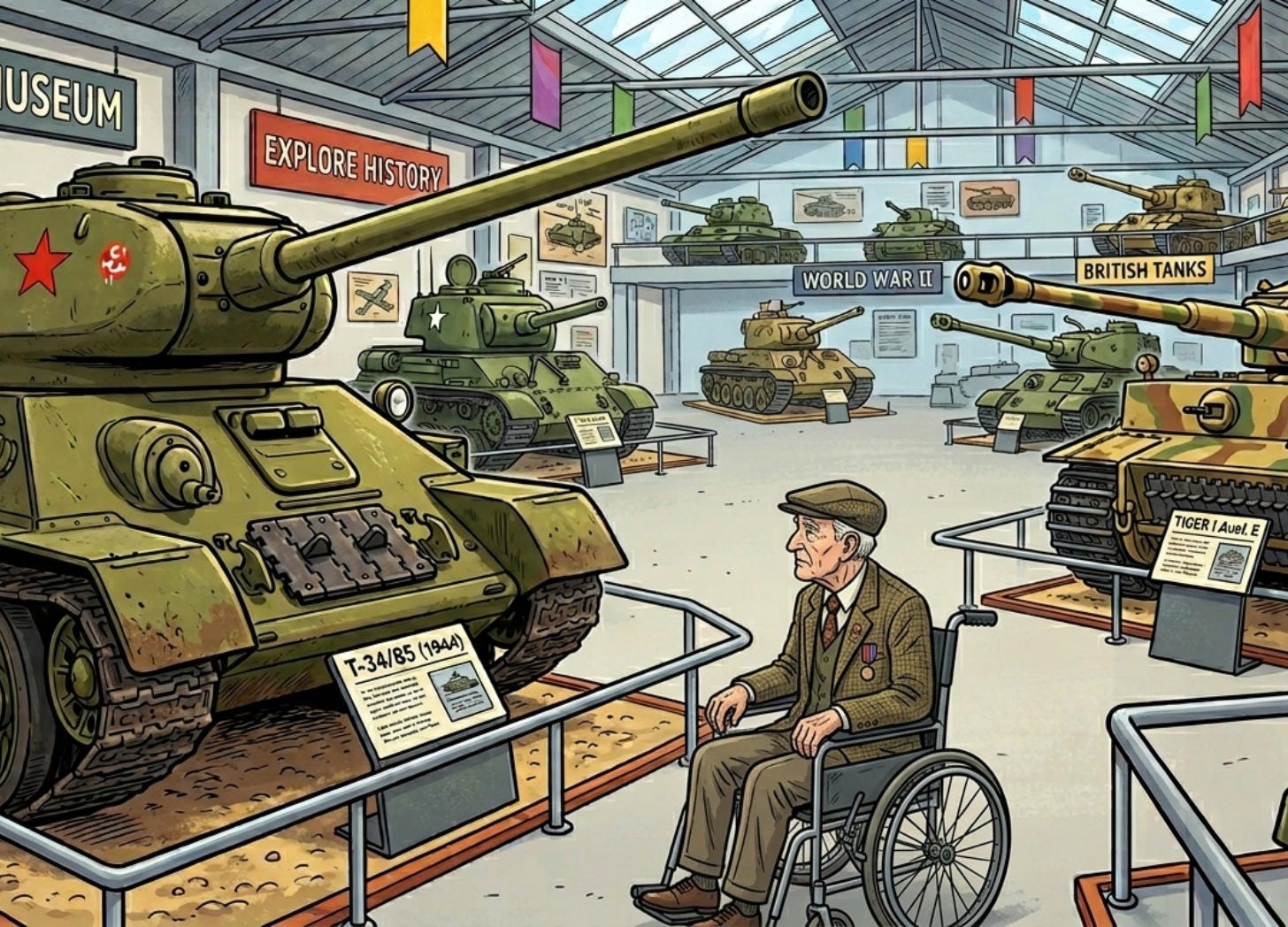
Decades later, bemused by my youthful enthusiasm for war, I took a train from Bournemouth a few stops down the track to the tank museum at Bovington. I climbed inside one of the early Second World War German tanks that had invaded France and the Soviet Union. The inside of any tank is so brutal that making contact with any part of it risks injury. Momentarily losing that awareness, I banged my head against a cluster of metal spikes poking down from the turret. It hurt. Even as a stationary museum exhibit, a tank can harm you. I struggled to imagine how anyone could be inside such a thing when it was moving or under fire.
I rapped my knuckles against the front of a Soviet T-34: Donald Trump’s claims notwithstanding, the tank, 57,300 of them, that defeated Hitler. If you rap your knuckles against the wall of a building, there’s a response – the energy resonates in the brick or concrete; you have some effect. When you rap your knuckles against a tank, there’s no reverberation, nothing; you have no effect at all. And you can’t lift the tracks of a large tank, even an inch; they are like slabs of rock.
Rolling gently around the T-34 was an elderly man in a wheelchair. Old school, he was chatting to everyone, making friends at every turn. He was the right age, and I wondered if he had lost the use of his legs while fighting these metal monsters.
As I walked on, I had a growing sense that war was the quintessence of all that is anti-human, anti-life. The tank is perfectly symbolic of the ego, of its hostility, aggression, rejection, and hatred. What I found staggering was just how much time, energy, and resources had been devoted to the development of these weapons – the investment of engineering and other technical expertise defies belief. The power was impressive, but where, as a teenager, I had felt excitement, I now felt a queasy revulsion. And a deep weariness – there was nothing inspiring or enlivening in all of this; the whole focus of the museum led down a cul-de-sac of killing and death, which made it, in the deepest sense of the word, boring.
Why is it that wars are a perennial feature of human experience? The towering walls surrounding so many of the world’s cities are a testament to that grim reality. Just this year, after the ruthless blitz on Venezuela, the US and Israel have waged a war of aggression on Iran, with Cuba also in the crosshairs.
Is war genetically hardwired, an inevitable product of nature ‘red in tooth and claw’? Is it something we could somehow choose to renounce, if enough of us chose to do so? Of course, I know the arguments: Perpetual War is the result of economic and political momentum that has built up over decades and centuries. If you don’t fire the missiles, the factories close. If you don’t have an enemy, you can’t fire the missiles. If the ‘Bad Guy’ doesn’t exist, you have to invent him. As the historian Howard Zinn said so well:
‘It seems to me that it only takes a little bit of thought to realise that if wars came out of human nature, out of some spontaneous urge to kill, then why is it that governments have to go to such tremendous lengths to mobilise populations to go to war? It seems too obvious, doesn’t it? They really have to work at it…. Most humans don’t respond to appeals to go to war on the basis of Let’s go and kill. No, Let’s go and free somebody. Let’s go and establish democracy. Let’s go and topple this tyrant. Let’s do this so that wars will finally come to an end.’ (Howard Zinn, ‘Power, History and Warfare’, Open Magazine Pamphlet Series, No. 8, 1991, pp.4-5)
But this reminds me of the ‘infinite regress’ problem of religion: Who created the universe? God. But then, who created God? If wars don’t come out of human nature, what about the fact that so many people consistently fall for the propaganda manufacturing consent for war? Does that gullibility and indifference come out of human nature? And why are people willing to work for militaries operating at the whim of obviously barbaric, greed-driven governments and defense industries that kill for profit? And why do people work for fossil fuel companies in an age of catastrophic climate change? Why do they continue to participate, ignoring the evidence of their own eyes – literally, the obvious facts of their day-to-day experience, of existential catastrophe? Why are we so easily seduced by fake dreams of Star Trek to the Moon and Mars when the journey that really matters is ‘Earth Trek’? Are we somehow destined, designed, doomed to sleepwalk to disaster? But why? The questions echo across the universe… Sometimes, we receive a kind of answer.
Monte Cassino – ‘That Were Rough’
Because the previous service back to Bournemouth has been canceled and the train is crowded, I drop into the only seat available. To my surprise, I see that the person sitting next to me in a seat reserved for the disabled is the guy in the wheelchair I saw in the museum. Within seconds, I learn that he is called Billy. We have more room than people in the other seats because we are facing the curved wall of the toilet. Parked against this wall is his wheelchair. His legs are outstretched, and he is holding a pair of crutches.
It slowly dawns on me that Billy, in fact, has two artificial legs. And it becomes clear again that he is one of those chatty types who knows that everyone is basically the same: everyone is friendly and likes a good chinwag. We are soon nattering, and Billy is 81 years old and has had a ‘grand time’ in the museum.
He mentions something about Africa and the war. I take up the obvious prompt and ask him if he saw action. He looks me in the eye, ‘Oh yes,’ he saw action alright. ‘Apparently,’ I offer, ‘Spielberg’s film “Saving Private Ryan” gives a pretty good idea of what war is actually like.’
‘No, no,’ he says dismissively, exactly echoing the German tank commander I met in my youth, ‘they never show it like it is, they make it look glamorous, exciting. It isn’t glamorous. War is terrible, really terrible.’
Words are such small containers, and something is missing from this: ‘terrible’ doesn’t seem to capture the extent of the awfulness. I want him to tell me how war is terrible and why it is terrible. I want to know just how terrible this life we are living can be. I try again:
‘So, you were in the thick of it…’
‘I were in North Africa at Tobruk. They had us under siege.’
‘Must’ve been dreadful in that heat.’
He laughs and points at the carriage floor.
‘We used to dig holes in the sand at night and bury the beers, then dig ‘em up the next day, and we had freezing cold lager. Bloody marvellous!’
He laughs:
‘That kept us cool!’
This isn’t quite what I’m after, either – the refrigeration of beers! – but that’s what I get. Billy isn’t interested in communicating the terribleness of war; he’s interested in the scams, tricks, and fiddles.
‘We landed at Sicily, and then, when we’d got them out of there, it was mainland Italy. We moved up to Monte Cassino – that were rough.’
Monte Cassino was one of the fiercest battles of the war – the Allies suffered 55,000 casualties battling up a mountain to eject German troops from a bombed-out monastery at the top. It was utter carnage. Billy says:
‘We were crossing this river, and we were just slaughtered. Out of a thousand men, 300 were killed crossing that river. It were so bad that people who’d got hit were getting hit again coming out on stretchers. It were that bad!’
I have to ask, feeling as if I already know the answer:
‘Is that where you lost your legs?’
‘Oh no!’ he says. ‘I got through the war without a scratch. They never touched me.’
I’m too surprised to be polite:
‘Then what happened to your legs?’
‘I was a smoker. I had circulation problems, and I went to a doctor when I were in Canada, and he said: “Forget about cutting down, if you have so much as one cigarette a day, I guarantee you’ll be back here for amputation.”’
‘So, what happened?’
‘I kept on smoking!’
‘You kept on smoking?’
Around us, silence falls as a dozen fellow travelers start paying attention.
‘My wife smoked. And my brother-in-law, who was living with us then, smoked, and it was so tempting.’
He points to his artificial legs:
‘I had this one off in ‘67, and this one in ‘68.’
‘My God, and do you still smoke?’
‘Oh no! I gave up in ’78. It were New Year’s Eve and I said to my wife, “That’s my last fag! That’s it!’” And that were it. I’ve never had a fag since.’
He pats a leg and looks out of the window:
‘It’s no problem, I’m used to them now. It’s no problem getting around.’
With that, he puts his hands into his crutches, struggles to his feet, positions his legs, and does a near-perfect Tin Man impression in the direction of the toilet.
See also ‘A Lefty Progressive Goes To The Seaside’, part of the ‘Lefty Progressive Daytrip’ series.
This article was posted on Tuesday, April 21st, 2026 at 10:38am and is filed under Cuba, England, Film, History, Iran, Venezuela, War.