





UPDATED on 28 August 2026.
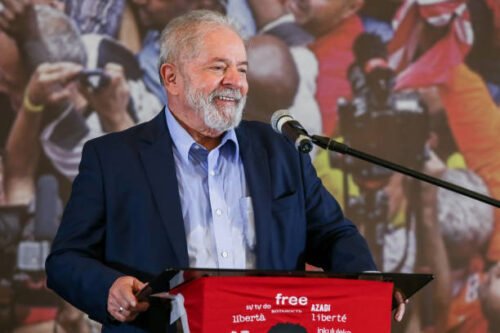
SAO BERNARDO DO CAMPO, BRAZIL – MARCH 10: Luiz Inacio Lula da Silva, Brazil’s former president, speaks during a press conference after convictions against him were annulled at the Sindicato dos Metalurgicos do ABC on March 10, 2021 in Sao Bernardo do Campo, Brazil. (Photo by Alexandre Schneider/Getty Images)
On January 24, 2018, in Porto Alegre, Lula was tried at the Federal Court of Appeals for the Fourth Region (TRF-4), which confirmed the decision of Judge Sergio Moro and sentenced him to twelve years and one month in prison. According to the Clean Record Act, he would now be ineligible for the 2018 elections.
Critics of the prosecution questioned the evidentiary basis of the case and raised serious concerns about procedural fairness. They pointed to restrictions on the defense, the treatment of witnesses, the legal basis of some of the accusations, and what they regarded as an abuse of prosecutorial authority. Concerns about Judge Sergio Moro’s impartiality also became central to the controversy surrounding Lula’s conviction.
There were popular demonstrations in Lula’s support and disapproval of the decision. Unfazed, Lula gave an electrifying speech on April 7, 2018, calling on his allies and admirers to turn into millions of Lulas. “All of you, from now on, will turn into Lula and will walk around this country doing what you have to do. They have to know that the death of a combatant will not stop the revolution.” On the same day, Lula turned himself in by ten p.m. at the Federal Police headquarters in Curitiba. On August 17, 2018, the United Nations Human Rights Committee requested that Brazil’s government not prevent Lula “from standing for election in 2018 presidential elections, until his appeals before the courts have been completed in fair judicial proceedings.” None of this had an impact on the Brazilian ruling elite which was hell-bent on putting Lula in jail.
A Grassroots Leader
Today, Lula walks as a free man after the Supreme Federal Tribunal (STF) – Brazil’s highest court – struck down all the criminal convictions against him on March 8, 2021. Opinion polls suggest that Lula is the best-placed politician to challenge the ultra-right President Jair Bolsonaro in 2022 elections. At the same time, Bolsonaro is fast losing his appeal among the electorate; as per a Datafolha survey published on 16 March, 2021, his disapproval rating hit a new high at 54%.
Lula’s political appeal is inseparable from the social distance between his origins and Brazil’s traditional political establishment. He grew up in a poor rural family and experienced deprivation from childhood. His early years involved precarious work before he entered formal industrial employment in São Bernardo do Campo. These experiences shaped his later identification with organized labor and gave his political career an unusually direct connection to Brazil’s working-class movements.
During his youth, Lula held several low-paid jobs before entering the metalworking industry. His employment at Indústrias Villares brought him into the trade-union movement in São Bernardo do Campo. He became one of the most prominent labor leaders of the late 1970s, helping organize strikes against Brazil’s military dictatorship. The Workers’ Party (PT) emerged from this wider labor and social movement in 1980. After unsuccessful presidential campaigns, Lula won the presidency in 2002, becoming the first working-class president of Brazil and one of the country’s most consequential political figures.
Lula’s governments expanded social programmes aimed at reducing poverty and improving access to basic services. The scale of these policies became central to his political reputation among poorer Brazilians. Lula himself summarized his record in terms of expanded social mobility: “I have made upward social mobility possible for the most underprivileged people in Brazil. I helped lift 36 million people out of extreme poverty, I have settled farmer families on 47 million hectares (almost 50% of what was done in five hundred years of Brazilian history), I helped another 40 million Brazilians escape poverty and join a new lower middle class, I have brought electricity access to more than 15 million people”. His administration also institutionalized the Fome Zero programme, which became a public policy in 2003. During his presidency, the government expanded higher-education initiatives, including PROUNI, while FIES was subsequently restructured to broaden access to university financing. These measures contributed to Lula’s reputation among low-income voters and strengthened the association between his presidency and social inclusion.
Left’s Resurgence
A survey released on December 16, 2010 showed Lula’s approval rating at 87%, an unprecedented level. A Sensus Institute survey showed the same, qualifying Lula as the president with the highest ratings on the planet – Nelson Mandela left the South African government in 1999 with an approval rate of 82%. Datafolha’s survey showed an approval rating of 83% and concluded that Lula ended his second term with more support than when he started his first term (76%). From this, it is evident that Lula is deeply etched in the political consciousness of the Brazilian citizenry. With the dropping of all charges against him, it is possible that the Brazilian Left will see a resurgence in its national strength.