

Sudan is a country where 9 million people have been driven from their homes; 34 million are in need of assistance; 19.5 million people do not have enough to eat; and drones killed more than 300 civilians in three weeks in October alone, many of them in crowded markets.
The United Nations calls it the “world’s largest humanitarian crisis.” Yet if you asked your neighbors what is happening in Sudan, few could tell you anything. Here we explain in plain language what this war is about, why so few people have heard of it, and who is making money while Sudanese people die.
What is happening in Sudan?
Sudan is a large country in northeast Africa, on the Red Sea, with a population of about 50 million people. In 2019, after months of peaceful street protests, Sudanese people overthrew the dictator Omar al-Bashir, who had ruled for 30 years. Subsequently, a transitional government was formed, in which the generals shared power with a small group of civilian leaders.
That government did not last. In October 2021, two generals seized power together in a coup d’état. One was Abdel Fattah al-Burhan, the head of the “Sudanese Armed Forces” or “SAF.” The other was Mohamed Hamdan Dagalo, whose nom de guerre is “Hemedti,” the head of a paramilitary force called the “Rapid Support Forces” (or “RSF”). The RSF grew out of the Janjaweed militias that committed mass atrocities in Darfur between 2003 and 2008.
The two generals fell out over the question of who would control the guns. On 15 April 2023, fighting broke out in the capital Khartoum and spread across the country—not a war between “Muslims” and non-Muslims, or a war of ideas, but a war between two armed groups fighting for power, land, and money, with civilians caught in the middle.
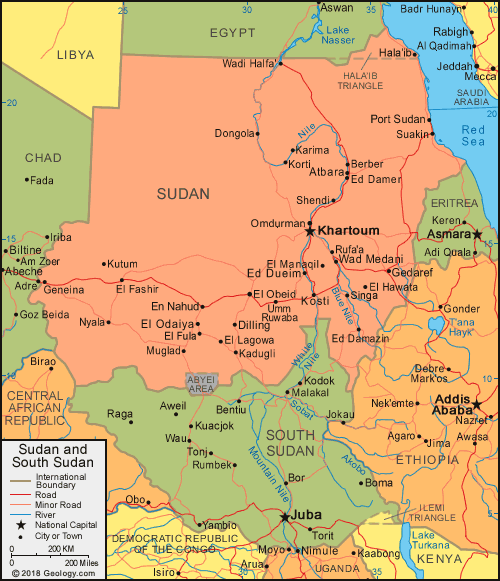
Today the country is split into two territories. The SAF holds Khartoum, the north, and the east, including Port Sudan on the Red Sea. The RSF holds almost all of Darfur in the west and runs a rival government there. The heaviest fighting is now in Kordofan, near central Sudan, and in the state of Blue Nile, in the southeast.
A meeting of mediators in Geneva ended on the 21st of October without a ceasefire.
Why the 2019 transition failed
After al-Bashir’s fall, there was no democratic transition in any real sense. What happened instead was a political deal between the SAF and the RSF, the two forces actually in control on the ground, and a small group of leaders from revolutionary organizations, including the Sudan People’s Liberation Movement-Revolutionary Democratic Front (SPLM-RDF), whom the military accepted as representatives of the civilian side. In other words, this period cannot be called democratic. It was a power-sharing arrangement between the two sides.
The group that represented the civilian side, the Central Council of the Forces of Freedom and Change (CCFFC), kept political representation to itself. It extended the transitional period more than once. It never created the Transitional Legislative Council required by the transitional constitution, even though that Council was meant to give the revolutionaries a voice and keep the transition in check. Over time, disputes grew between those who had climbed into civilian power and the revolutionaries on the street, and also between the CCFFC and the prime minister Abdalla Hamdok. In 2021, Hamdok’s government also stayed silent while protesters were attacked and killed, most notably at the first anniversary of the sit-in, in front of the prime minister’s office. As a result, the government, and Hamdok himself, became cut off from the revolution happening on the street.
There was also an unspoken dispute between Hamdok and some CCFFC leaders over who had the power to appoint people to senior posts, which deepened the rift between them. While these divisions grew, the SAF and the RSF watched and waited, until the coup came. Some have said that there was an indirect understanding between Hamdok and the military because he believed the revolutionaries would support him once the CCFFC was pushed aside.
After the staged arrest and his return as the prime minister appointed by the military, the revolutionaries on the street did not stand with him. Protests continued, and dozens of revolutionaries were killed. He then resigned and left for the United Arab Emirates (UAE).
It is also worth noting that some military leaders have stated that certain members of the CCFFC who led the revolution asked the military to extend their partnership for 15 years without elections, on the grounds that this was needed to dismantle the old regime. This shows that calling these leaders democratic is inaccurate. What resulted from their rule was not a democratic system but a failed transition, undermined by both sides: the civilians who took the lead and the military who kept the real power.
The human cost
Nobody knows how many people have died. The conflict monitor ACLED (the Armed Conflict Location and Event Data Project) had recorded about 56,000 deaths by June 2026 and calls that number “conservative.” Some estimates reach as high as 150,000. The former U.S. envoy Tom Perriello has put the death toll above 400,000. Since many hospitals are closed or destroyed many deaths are never counted.
What we do know is shocking. Besides the problems of displacement and hunger mentioned above, there are the health problems and the lack of aid. Around 40 percent of health facilities are not functioning and 17 million people lack safe drinking water. Cholera and measles are spreading. By April 2026, only 20 percent of the UN’s aid plan for Sudan had been funded.
The worst single atrocity came in October 2025, when the RSF captured El Fasher, the last army-held city in Darfur, after an 18-month siege. The UN human rights office documented more than 6,000 killings in just three days, and says the real number is much higher. In February 2026, UN investigators concluded that the RSF’s campaign against non-Arab peoples there, especially the Zaghawa and Fur, bears the hallmarks of genocide.
The SAF (i.e., “the army”) is not innocent either. Its air strikes and drones have hit markets and villages, and in 2025 the United States determined that it used chemical weapons (chlorine) in 2024, although they deny using such weapons. UN investigators say both sides commit serious crimes against civilians. To stand with the Sudanese people means standing with civilians, not with either general.
Why is the world not watching?
Sudan is called a “forgotten war.” But it was not forgotten. It was ignored.
The numbers are clear. During one year, the New York Times ran almost ten times as many articles about Gaza as about Sudan, and more than thirteen times the number of articles about Ukraine. A recent university study of the Swedish press found that, in a month when all three wars were raging, Gaza and Ukraine filled 98 percent of the war coverage. Sudan appeared in just five articles, 1.5 percent.
Of course, Gaza and Ukraine deserve attention. The question is why Sudanese lives seem to count for so little. Part of the answer is racism. Western media too often treat suffering in Africa as normal, as “just another day in Africa.” One wonders how many Western journalists actually believe that Africans deserve to live in peace?
The other part of the answer is politics. Western newsrooms follow their governments. The war in Ukraine and the genocide in Gaza are situations in which Washington and Europe openly arm one side, so they are treated as “our” story. In Sudan, the main foreign backer of the RSF is the UAE, a close Western ally and a country that buys huge amounts of Western weapons. Looking closely at Sudan would mean asking uncomfortable questions about the West’s own friends. Silence is easier.
Silence also has a cost. Crises that get no coverage get no money and no political pressure. When the cameras are absent, the killers feel free to do whatever they want.
America’s role
The United States likes to present itself as a peacemaker in Sudan. Its record tells a different story.
- Punishing ordinary people. From 1997 to 2017, Washington kept Sudan under sweeping economic sanctions, and from 1993 to 2020 listed Sudan as a “state sponsor of terrorism.” These measures hurt hospitals, students and businesses far more than they hurt the dictator. Even after the 2019 revolution, the new civilian government had to pay U.S.$335 million in compensation and had to agree to normalize relations with Israel before Sudan was removed from the list. Many Sudanese saw this as blackmail, at the very moment when their democracy most needed help.
- Bombing. In August 1998, U.S. cruise missiles destroyed the al-Shifa factory in Khartoum, claiming it made chemical weapons. It actually produced over half of Sudan’s pharmaceuticals. The U.S. has not apologized.
- Shutting the door. Sudan was on President Trump’s travel ban list in 2017 and again in 2025, closing America to people fleeing this war.
- Arming the arms supplier. This is the most serious issue today. Members of the U.S. Congress from both parties say there is credible evidence that the UAE is arming the RSF. Yet in May 2025 the Trump administration bypassed a congressional hold on arms sales and approved a U.S.$1.4 billion arms sale to the UAE, including helicopter and F-16 parts. In August 2026, senators again asked the Secretary of State to pause arms sales to the UAE. However, the sales continue.
To be fair, Washington has also taken some action to reduce the violence. In January 2025 it declared that the RSF had committed genocide and sanctioned both Hemedti and Burhan. But sanctions on two generals mean little when billions of dollars in weapons keep flowing to the RSF’s main foreign backer. The UAE even sits beside the United States in the “Quad” group (the U.S., Saudi Arabia, the UAE, and Egypt) that is supposed to mediate peace.
Who gets rich from Sudan’s war?
Sudan is not a poor country. It is one of Africa’s biggest gold producers, has fertile farmland, and sits on one of the world’s most important shipping routes, the Red Sea. This war continues largely because people outside Sudan are profiting from it.
- Gold traders in the UAE. The RSF controls most of Sudan’s gold mines, especially in Darfur. Much of that gold is flown to Dubai, enters the world market, and pays for more weapons, which are used to capture more mines. The UAE’s own trade ministry says it imported U.S.$1.97 billion of Sudanese gold in 2024. Hemedti’s family and associates run gold companies, some registered in Dubai. The army also sells gold in order to fund its own violence.
- Arms suppliers. In September 2026, a UN fact-finding mission found that a network of people and companies linked to the UAE, with routes through Chad, Libya and Somalia, supplied the RSF with weapons, drones and training. The UAE denies this. The same mission found that the SAF uses foreign-supplied drones, such as Turkish-made Bayraktar Akinci drones, in strikes that harmed civilians.
- Mercenaries. UN investigators documented up to 2,000 former Colombian soldiers, recruited through private firms, who operated drones and artillery for the RSF, including during the attack on El Fasher.
- Western weapons manufacturers. Every arms sale to a country that fuels this war is profit for the companies that make the weapons, and jobs and influence for the governments that approve the sales.
In short: Sudanese gold leaves the country, foreign weapons come in, and Sudanese civilians pay with their lives. As long as the war continues, military generals and their foreign partners will grow richer and richer.
What can ordinary people do?
Sudan’s war can feel far away and impossible to fix. But outside support for each side is exactly what keeps it going, and that means outside pressure can help end it.
- Learn and share. Read Sudanese voices, such as Radio Dabanga and Sudan Tribune, and talk about Sudan. Silence is what the profiteers want.
- Press your government. Ask your representatives to stop arms sales to any country arming either side, and to support extending the UN arms embargo from Darfur to all of Sudan.
- Ask questions about gold. Ask jewelers and companies where their gold comes from.
- Give directly. Sudanese volunteer groups called Emergency Response Rooms run community kitchens and clinics, often reaching people that big agencies cannot. Donate directly to these organizations when you can.
The people of Sudan showed the world in 2019 that they could bring down a dictator peacefully. They did not choose this war. Two generals and their foreign backers chose it for them. The least the rest of us can do is look, speak, and refuse to let our governments profit from their suffering.