






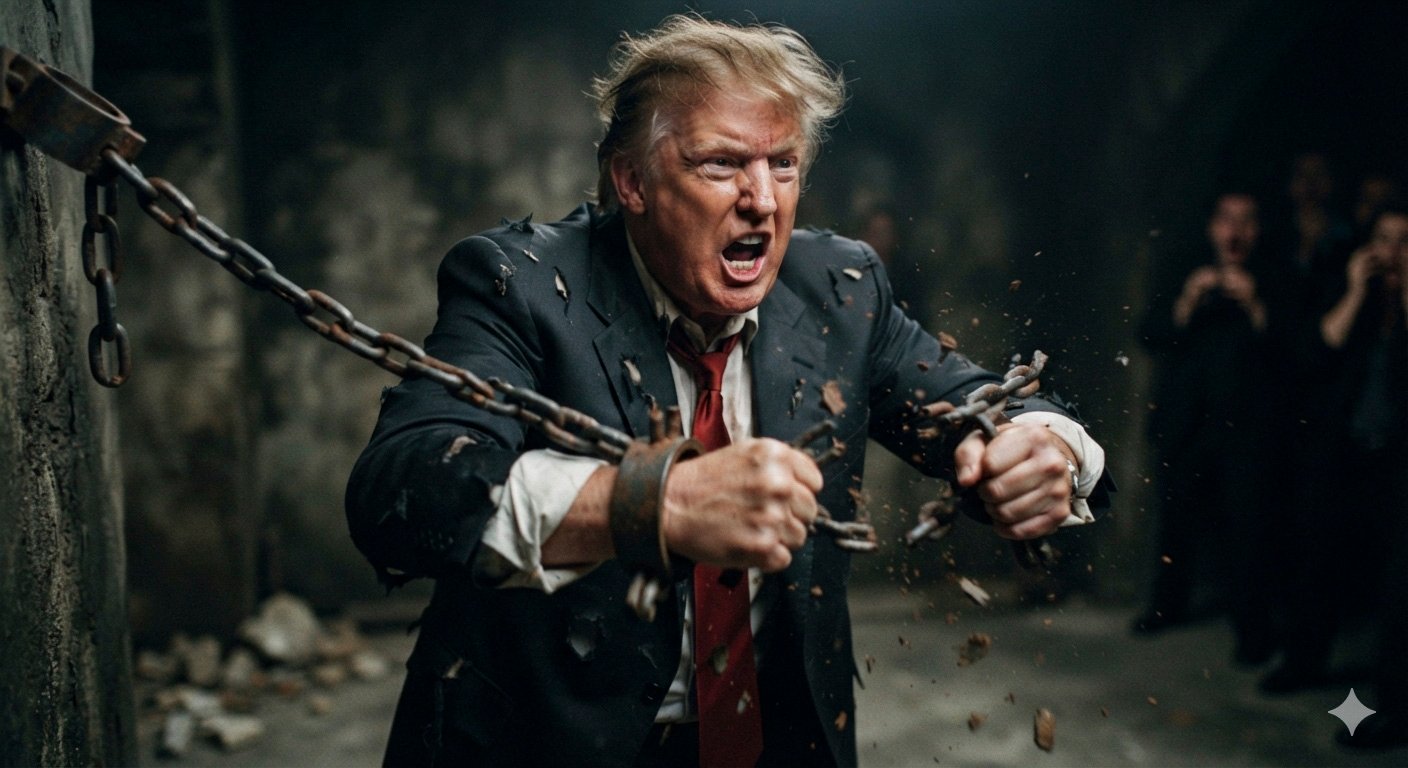
 The unchaining of a pre-existing malady triggered by the sudden acquisition of great power.
By now, there can scarcely be anyone on the planet who does not realise that Donald Trump suffers from serious psychological problems. The public record of his mental ailments and behavioural idiosyncrasies is voluminous and well-worn (e.g., Blunt, 2025, 2026a, 2026b; Hedges, 2026; Lieberman, 2026).
An important part of the reason for the wide coverage is that, as heads of state go, the amount and variety of his supply of material to work with is unusually generous – many would say uniquely so – which in some ways makes him a soft target. But, when he stands out in the ways that he does and the likes of Hedges (2026, ibid) cast him persuasively as the embodiment of evil, can we really protest too much?
For the man himself, of course, there can never be enough attention. He basks in it. He is addicted to it. His ego depends on it – positive or not, so long as he is centre stage and in the spotlight. We also know that he somehow manages to have a very thin skin and a very thick skin at the same time – perhaps we all do to some extent – choosing impulsively when to take offence, when to be contemptuously dismissive of critics, and when simply to behave as if they did not exist. The latter options made much easier by the conviction that he can do no wrong. A conviction that goes unchallenged by the well-behaved choir that surrounds him, which he selects, conducts and choreographs.
The criticism made here is likely to fall into one of the latter categories. A destination made more likely by the fact that his self-proclaimed omniscience is certain to reduce to a mere trifle the burden of the abnormal behaviour I am about to add to his long list of maladies – that is, heaped on top of his malignant narcissism, megalomania, and accelerating senile dementia (see Blunt, 2026b, ibid).
No need to remind ourselves either that, in addition to its being a normal part of the job, in countless other ways he is richly deserving of everything he gets by way of critical scrutiny. So, there is no reason to fret or soul search unduly.
I should say that I do not mean by this somewhat frivolous introduction to trivialise a subject that could mean life or death for millions of people. And neither do I mean to malign needlessly or unfairly a handicapped senior citizen who has already attracted more critical and derisive attention than anyone – save a person of his unusual qualities – would warrant and be able to endure.
But for so many obvious reasons Donald Trump is a special case, a case that he would undoubtedly say, “the world has never seen the likes of before” (and nearly everyone else would say, sotto voce, “hopes fervently never to see again”).
So, while what follows might seem like a minor and gratuitous embellishment of an already colourful and over-examined condition, I shall argue that this small addition, this small step in the evolution of President Trump’s multifaceted persona is ground for yet another giant leap of concern for mankind.
It is on this basis that I shall proceed.
Enter Hubris Syndrome: the final addition to his pathological crown of thorns.
What is Hubris Syndrome?
The Hubris Syndrome (HS) was developed from a study of 100 US presidents and UK prime ministers conducted by David Owen and Jonathan Davidson in 2009, which was published in the journal, Brain (Owen & Davidson, 2009). The lead author, Lord Owen, was foreign secretary in the 1977-79 Labour government in the UK and a founder member of the Social Democratic Party, so he had first hand insights into the matters he was addressing. Owen is also a medical doctor and neuroscientist. Like many social anthropologists and other social scientists, his data were either derived from “lived experience”, or what Mosse (2013, p. 228) calls “reflective observant participation”, or from secondary sources.
Owen and Davidson were interested to discover how the sudden acquisition of great power changes a leader. They concluded that the constellation of symptoms they observed in the political leaders they studied were so consistent as to constitute a syndrome, the principal features of which entailed:
-
A narcissistic propensity to see their world primarily as an arena in which to exercise power and seek glory.
-
A predisposition to take actions which seem likely to cast themselves in a good light.
-
A disproportionate concern with image and presentation.
-
A messianic manner of talking about what they are achieving and a tendency to exaltation.
-
An identification of themselves with the nation, to the extent that they view the outlook and interests of the two as identical.
-
A tendency to speak of themselves in the third person or use the royal “we”.
-
Excessive confidence in their own judgment and contempt for the advice or criticism of others.
-
Exaggerated self-belief, bordering on a sense of omnipotence, in what they personally can achieve.
-
A belief that rather than being accountable to the mundane court of public opinion or colleagues, they will be vindicated by history or a higher power.
-
An unshakable belief that that court will find them righteous.
-
Loss of contact with reality, often associated with progressive isolation.
-
Restlessness, recklessness, and impulsivity.
-
Letting a broad, “moral” vision override any practical consideration of costs or outcomes.
-
Falling into “hubristic incompetence,” where policies fail because the leader ignores the basic nuts and bolts of governance.
We should note that, like malignant narcissism, HS has not been recognised formally by major professional bodies. It does not have a diagnostic code in either the Diagnostic and Statistical Manual of Mental Disorders of the American Psychiatric Association or the International Classification of Diseases of the WHO. Instead, it is classified as a clinical construct – an acquired, power-induced behavioural change rather than a mental illness.
However, there is support for its formal classification. Proponents argue that HS deserves formal recognition because the way in which it is acquired, and when, distinguish it from standard developmental mental illnesses (e.g., Selten, 2023). While disorders like narcissism are usually enduring or chronic, lifelong personality traits, HS is a distinct, power-induced behavioural change that occurs late in adulthood, triggered purely by an injection of great power.
Owen and Davidson argued so in their original study, stating that HS results in measurable cognitive impairment – such as a total loss of empathy and an inability to judge risks – that is a response to power-rich environments, making it a unique occupational hazard of leadership that requires its own medical classification.
I am not the first to attribute HS to Donald Trump. Indeed, David Owen himself, in a book published in 2018 (updated in 2020) (Owen, 2018a; 2020), explores how in his first term as President, Trump became a “world-class narcissist” and acquired HS. Writing in The Sunday Times later the same year, Owen noted that while standard narcissism is blatantly attention-seeking, hubris is characterized by a unique state of overconfidence and arrogance, concluding that “Trump as president displays both hubris and narcissism” (Owen, 2018b).
Overlaps with Malignant Narcissism
As suggested above, the symptoms of HS overlap partly with those of malignant narcissism. Both conditions involve arrogance, self-absorption, and an obsession with image. Sometimes HS is assumed to be the same as narcissism, which Owen (2018b, ibid) denies: “A common misconception is that hubris is indistinguishable from narcissism. On the contrary… narcissism is expressed with a blatantly attention-seeking, grandiose sense of self-importance… while hubris is characterised by overconfidence, overambition, arrogance and excessive pride.” Trump displays all these behaviours to the extreme.
The term “malignant narcissism” was coined by the psychoanalyst Erich Fromm in 1964 (Fromm, 1964). Twenty years later, Otto Kernberg formalised it in the psychiatric literature as a severe clinical syndrome that combines narcissism with antisocial behaviour, paranoia, and a relentless need to control others (Kernberg,1993). The narcissist needs power to protect a fragile ego.
Consistent with Owen and Davidson, the acquisition of great power therefore reinforces or amplifies existing symptoms (of malignant narcissism) and adds new ones, specifically items 4, 5, 7, 9, 11, and 14 in the above list.
For President Trump, it cultivates the delusion that he embodies the state (Symptom 5), meaning that any opposition is viewed as personal disloyalty and/or treason. It also leads directly to the final symptom on the list: hubristic incompetence (Symptom 14) – when a leader stops listening to experts, ignores inconvenient facts, and makes decisions based entirely on personal, unpredictable whims.
When Hubris Syndrome is Ingrained
This is where the view of Trump’s mental state that is presented here augments the original propositions.
The hypothesis that I set out below is not susceptible to strict falsification in a Popperian sense (Popper, 2002). Its acceptance and validity rely on its plausibility. There is no neurological or biochemical test that can be given to assess whether he has the condition or not.
Many clinical diagnoses of mental illness have this quality. They depend on judgements made normally by qualified and experienced clinicians about the fit between a person’s behaviour and a constellation of symptoms that are agreed to constitute a particular mental illness.
Trump invites a much wider range of interest and opinion than usual for the reasons we have given. His constant exposure in the mainstream media provides more than sufficient data upon which to make a judgement. Such data demonstrate unequivocally that Trump’s behaviour satisfies every one of the 15 traits of HS listed above.
But when did he acquire the malady? And, after he acquired it, did it ever go away?
Owen and Davidson argued that HS develops only after someone gets power and disappears when they lose it.
It seems inconceivable to me that Trump suddenly got a fresh bout of this illness from his second term in office. Much more likely is that he arrived with it fully formed. His behaviour during his first term as president, and before then as an oligarch, strongly suggest that his HS behaviour was not ephemeral (e.g., Barrett, 2016; Kranish & Fisher, 2017). Trump’s HS did not fade away in-between his terms in office. It was there, either lurking just beneath the surface or being manifested to the extent that his power contexts permitted. His latest occupation of the White House simply brought the condition into full flower.
It was not so much that the symptoms of HS dissipated in-between his presidential terms but more that the scope and sphere for their expression contracted or expanded. The extravagance of the expression of his hubristic behaviours simply waxed and waned as a function of his power to indulge them.
Trump’s malady – his HS – was completely unchained by his second term in office.
All too Familiar Consequences
When more conventional leaders assume high office, advisers and the legal system act as a brake on their worst impulses.
If the argument made here is valid, in Trump’s case, he began his second term as President with all 14 symptoms of hubris intact – but made latent or muted by context. The extreme power derived from his ascension to head of the most powerful nation in human history then acted as a turbo-charged accelerant of his (HS and other) abnormal behaviour, an addictive intoxicant whose pleasures he had experienced before. No need for him to acquire anything new, just to unleash what was already there.
Someone who was always prone to being inebriated by the exuberance of his own psychological state became much, much more so. To the point where Hedges (2026, ibid) asserts: “By any standard of morality, Trump is depraved. But adorned with the power of the state, he descends to another level — the level of evil.”
Showing that Trump displays the symptoms of HS is not difficult. Even to the untrained eye, his daily behaviour obligingly provides countless corroborations of the HS symptom checklist’s validity as a depiction of his psychological profile.
The obsession with image, the third person talk, and the claims of omnipotence are constant. His belief that he constitutes the state, combined with his contempt for expert advice and the courts, are standard practice. He inhabits a fantasy world oxygenated by the constant sycophantic praise from those around him, which together with his complete self-absorption distort reality.
The dangerous mix of recklessness, incompetence, and unconcern for others is nowhere more evident than in his chilling address to the United Nations General Assembly on 22 September 2026 (NBC News, 2026). There, standing before world leaders, he casually announced that he had a “big decision to make” about the war with Iran, treating the fate of a nation like a reality television choice. In a uniquely bizarre display of messianic omnipotence, hubristic confidence, and detachment from reality, he mused whether to forge a peace agreement or simply to “annihilate” the nation and drive it “into hell”.
In one breath, and not for the first time, he threatened to wipe a fellow UN member state off the face of the Earth; in the next, he confidently predicted, “I believe we’ll make a deal right after the election because it doesn’t make sense for them not to.”
There was no noticeable change of emotion in his announcement of each of these possibilities. He clearly treats global apocalypse and geopolitical dealmaking as comparable, interchangeable options that he can choose between. When a proposal for a rapid reopening (within 7 days) of the Strait of Hormuz was offered a few days later by Iran, President Trump rejected it (Associated Press, 2026).
In short, his UN announcement repeated the familiar mafia don dictum: “either you agree with me and do as I say or I will destroy you.”
Once again, the world, this time via the UN, was enthralled by a lunacy the likes of which it “had never seen before” in a head of state.
Conclusion
Before Trump burst onto the global political stage, a discussion such as this one would have been unimaginable. Now it has become the stuff of everyday political discourse. We have become inured to it and, in many cases, to the suffering it creates and threatens (e.g., Blunt & Varro, 2026).
Notwithstanding letters and public pleas to members of Congress by the indefatigable and ever hopeful Jeffrey Sachs – who observed that a president claiming the right to annihilate a civilization while the legislature stays silent represents “the constitutional order collapsing in public” (Sachs, 2026) – what is to be done?
The fact that Sachs had to write such a letter in the first place is itself a measure of the sham that that the US democratic system has become, reinforcing innumerable other indicators of its decline. So there is scant hope there.
In view of this, it seems reasonable to wonder whether we have been reduced simply to hoping that, following defeat in the midterm elections, and with his HS muted by his lame duck loss of power, Trump will spend the final two years of his presidency so befuddled by senile dementia that he will be content with golfing at Mar-a-Lago rather than lashing out wildly in the way that his speech to the UN portends and his loss of power in both houses will allow.