






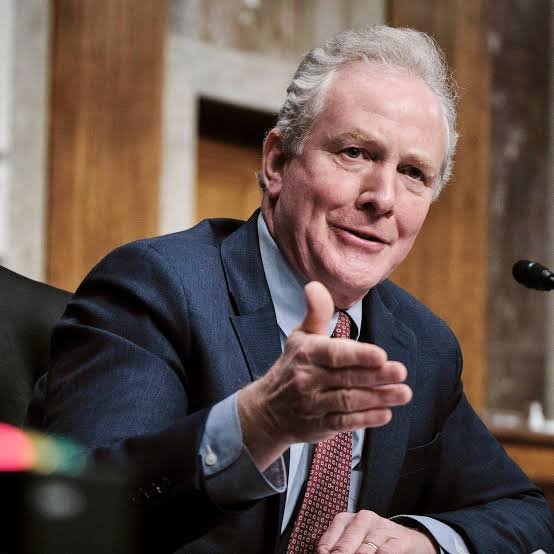
Several years ago, the late Foreign Service Officer, Eugene Bird, led a small delegation, which included me, to visit our congressional Representative, Chris Van Hollen. Gene Bird presented a firm position; he and his vast following intended to back candidates who demonstrated a positive attitude toward the rightful Palestinian demands of relief from Israeli oppression and would work to unseat those who favored apartheid Israel. Van Hollen listened carefully and made no commitments, except remaining committed to the Democratic Party position, which faithfully followed AIPAC.
New York Times
The congressional Representative represented a liberal democratic community, which overwhelmingly supported Israel at that time. Tied into the Party apparatus, and needing its support to remain in Congress and advance to higher levels, Van Hollen did what junior officials do to gain advancement — keep a low profile, don’t confront the establishment, and bide the time. The time arrived, and Senator Chris Van Hollen has become one of the highest-ranking members of the U.S. government to argue for Palestinian rights. His guest essay in the May 26, 2026, New York Times, “The Hard Truth My Party Needs to Face,” pressed the unmute button and urged repressed voices to be loudly heard.
In Ramallah, I spoke with Palestinian American parents who can’t get justice for their children killed by violent settlers or Israeli security forces. I’ve seen aid trucks turned back from Israeli checkpoints while children in Gaza were starving on the other side. And I’ve seen how the once bustling city of Rafah was reduced to rubble by the Israel Defense Forces with American bombs and bulldozers.
It is these experiences — and watching this dangerous trajectory accelerate — that have shaped my growing alarm, which the American people increasingly share. They do not want to be complicit in ethnic cleansing in the West Bank, or what human rights organizations and scholars have determined to be genocide in Gaza.
Van Hollen’s change in attitude, and willingness to express the change, is one of the most significant and dramatic political events of the year. His trajectory from Party faithful to Party critic reflects the change in attitude of his constituency and guarantees a reshaping of Democratic Party Middle East policies. Nobody can argue with his eloquently recounted and first-hand experiences of oppression of the Palestinians. The Senator is credible, has no reason to exaggerate, and can be trusted. Who can contend the hard truth, and why contend it? Not following the Maryland Senator’s warning continues being an accomplice to murder and committing political suicide.
Speaking with an independent voice, Maryland’s junior Senator endorsed Abdul El-Sayed for Michigan’s Senate seat in the 2026 Democratic primary and broke with Democratic leadership. In response to the rise of Democratic Socialists within the Democratic Party, Van Hollen stated, “The Democratic Party is a ‘big tent’ and should make room for people with lots of different voices.” Chris Van Hollen has saved and reconstituted himself; in doing that, he has saved and reconstituted the Democratic Party. He cannot stop; the American people need more of his vision. Sen. Chris Van Hollen has said that he is ‘kicking the tires’ on a potential 2028 presidential bid. Chris, stop kicking the tires; you can drive the car.
It is not too early to detail the characteristics of the potential candidates in the 2028 presidential race, including Republicans. Evaluating their current impressions and potential, and observing changes in their perspectives and outlooks, reveals the future outlook for the United States and its political system. In the final days of September 2026, a crash investigation indicates only two Democrats and two Republicans are in the running for president.
Political pundits race back and forth, run up and down, go through gyrations of motion, emotion, and scattered thought to analyze the candidates, shape their campaigns, steer voter choices ─ all a waste of money, time, and words. Prepping a candidate is easily explained. Examine the candidates, Democrat and Republican, selected by the public to the highest office and, except for a few miscreants, they have most of these characteristics in common:
- An established and high position in government,
- Amiability, a relaxed and pleasant manner,
- Agreeableness, and willingness to please,
- Charm, a power of attracting others,
- Strongly expressed desire for wanting to be president.
Combine those characteristics with a proven record of accomplishment, dedication, and healthy thought, and, well, who can beat that?
John F. Kennedy had few credentials to become president; he charmed the voters.
George W. Bush had no worth and proved it, but he was a “good guy.”
Barack Obama had no possibility of becoming the Democratic candidate or an elected president. He had little government experience, was not favored by the establishment, and did not represent the face of the white majority. The voters liked and trusted him. No other reason; it was that simple.
Yes, of course, we have the highly unlikeable Donald Trump; why did he win? The voters selected the less unlikeable; Hillary Clinton and Kamala Harris made stomachs churn and faces grimace. Most any other Democrat could have beaten Trump.
Richard Nixon does not fit the pattern, so it seems. Despite being known as “tricky Dick,” Nixon had an engaging rapport with a sufficiently large segment of the population, who found him likeable in an unlikeable way. He spoke his mind and revealed his flaws; he did not make them feel inferior.
The Democratic Party field for the highest office features:
- Kamala Harris, an already rejected candidate who had less appeal than Trump,
- Pete Buttigieg, an eloquent speaker, who was mayor of a small city, South Bend, Indiana, and was never elected to federal office,
- Ro Khanna, a California Representative on the progressive left,
- Andy Beshear, a moderate Kentucky governor,
- Mitch Landrieu, former New Orleans Mayor, and never elected to federal office.
- Ruben Gallego, a former Marine, previously an Arizona Representative and presently a Senator, who won in a state that Harris lost,
- Chris Van Hollen, previously a Maryland Representative and presently a Senator,
- Mark Kelly, previously a naval aviator, astronaut, and presently an Arizona Senator who carries a pro-Israel stigma.
- Cory Booker, New Jersey Senator, and carrying a pro-Israel stigma.
- Gavin Newsom, California Governor,
- Josh Shapiro, Governor of Pennsylvania, and carrying a pro-Israel stigma.
- Alexandria Ocasio-Cortez, congressional Representative from New York.
Who can gain the nomination and win the presidency?
Start with a few caveats that characterize all presidents after the year 1900.
(1) Candidates that did not rise to federal office above that of congressional Representative or mayor never reached the highest office. The suspected reasons are the limited constituency, limited national exposure, and electorate distaste for giving national power to an official that represented a small group.
Eliminates Pete Buttigieg, Ro Khanna, Mitch Landrieu, and Alexandria Ocasio-Cortez.
(2) All presidents, except three, have either been a President, Vice President, Senator, or state Governor. The three exceptions are William Howard Taft, who was Governor of the Philippine territory, Secretary of War in Theodore Roosevelt’s cabinet, and Roosevelt’s choice for the presidency; Herbert Hoover, who gained the reputation of a humanitarian, deeply involved with the world’s troubles, an innovator and tireless worker who invigorated the government during the roaring 20s as Secretary of Commerce and rescued the mid-West from the devastation caused by The Great Mississippi Flood of 1927; and Dwight Eisenhower, whose WWII exploits as leader of the Allied Expeditionary Force made him a national hero.
(3) Candidates raising campaign money from AIPAC, or have been too favorable to Israel, will have no chance of being nominated.
Eliminates Mark Kelly, Cory Booker, and Josh Shapiro.
Apply the caveats, and the Democratic presidential opportunity is restricted to five possible candidates.
Dispense with Kamala Harris. She arrived by mistake and has little following.
Senator Gallego has too much baggage. Having been a roommate and close friend of disgraced and resigned California congressional Representative Eric Swalwell, who was accused of sexual misconduct, and also having faced allegations of similar behavior, of which he has been cleared, Gallego will be haunted and taunted by the charges and will lose a sufficient segment of the women’s vote.
This leaves Governors Newsom and Beshear, and Senator Van Hollen.
California Governor Gavin Newsom has the desired characteristics to be nominated and elected to the nation’s highest office. For personal reasons, Newsom does not want to be president. Having refused to seek the office on two occasions — in 2020 and 2024 — at times when his candidacy might have saved the nation from the Biden eclipse and the Trump ordeal, there is little likelihood he will change his mind when the Democrats have viable candidates, and the Republicans are not scheduled to entertain a Trump “look-alike.” Newsom is stuck in California and does not want to leave the state. His recalcitrance and parochial attitude will displease voters.
Wikipedia
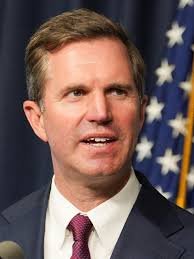
Kentucky Governor Andy Beshar’s political stance is similar to Governor Newsom, a little lighter in accomplishment and a little broader in national attention. Beshar has voter appeal.
Senator Van Hollen has political elements that are attractive to the “left wing” of the Democratic Party, a growing constituency that seeks change from the conventional operations and could capture the primary votes. His principal problem is being too fervent in his convictions, too tight in his appearance, and too combative with his antagonists. A pleasant and agreeable person, Van Hollen does not radiate the charm that stirs the electorate.
If the conventional forces that determine a candidate are operable in 2028, Kentucky Governor Andy Beshar will gain the nomination. If the trend of anger against the conventional system persists, revising U.S. policies with Israel becomes a principal focus, and Democratic Socialism is accepted as an alternative to welfare capitalism, Senator Chris Van Hollen will mount the stage, place his hand on the Constitution or Bible, and swear allegiance to the Constitution.
The Republicans have only two choices for a nominee — Vice President JD Vance and Secretary of State Marco Rubio. The Secretary of State has strengthened his appearance, but still has a ” schoolboy” image, which, together with his close relation to AIPAC and devotion to apartheid Israel, gives him few votes. J.D. Vance’s experience as a Senator and Vice President appeals to voters. He has the advantage of replacing a fading Donald Trump in the next two years, and will use that advantage to promote himself.
J.D. Vance is a formidable candidate. He is an eloquent speaker, has a commanding voice, is a good debater, and displays knowledge of events. Four limitations:
(1) He is sleepy-eyed, at times giving a droopy and tired appearance.
(2) His conversion to traditional Catholicism, with a semblance of adhering to a Christian nationalism that seeks to reorder society according to Christian values, may attract traditionalists in the Catholic Church and others who subscribe to having “family values” dominate our cultural and social life. However, a major part of the population reacts negatively to attempts to narrow the separation between church and state, control morality, and bring church doctrines into government operations. The Vice President has received strong criticism for attacking “childless cat ladies” as “miserable” and bad for society (which he later referred to as a “boneheaded” statement); saying, “You go on Twitter, and almost always the people who are most deranged and most psychotic are people who don’t have kids at home,” and proposing extra voting power to parents with young children, permitting them to vote for their children. He defended the remarks as “sarcasm aimed at the corporate and political establishment rather than individual childless people.”
(3) His defense of and attraction to ultra-right political Parties in Europe antagonizes a mass of Americans who are aware of World War II and believe the United States is, and should continue to be, the beacon of democracy.
(4) He carries the baggage of being closely associated with the Trump administration.
The short experiment with self-aggrandizing tyranny is coming to an end. Polls predict a massive Democratic sweep in the midterms, which should carry into the next presidential election. Those associated with the disgraced Trump administration will be able to be nominated- who else is there? Doubtful any of them can get elected. Kentucky Governor Andy Beshar is a likely future president of the United States of America. If so, what happens to Senator Van Hollen? Next Secretary of State?