



Early Morning: Watering the Roots
Before processing any political thought on Palestine, we have to ask ourselves one simple question: What did the beloved martyrs of Palestine, like Ghassan Kanafani and Naji al-Ali, say—or what would they say—about this?
If the answer is “I don’t know,” then that is what needs to be recovered first. Before anything else.
Our martyrs did not sacrifice their lives to be put on a shelf or a poster.

Work Break: When a Word Is a Crime
When we ignore or miss the fundamentals that Palestinians have been repeating about their struggle against zionism and imperialism since before their Nakba, it produces not only blind language—a language that replaces Western apartheid and settler-colonial reality with empty radical words—but something criminal.
“Faced with such clarity of purpose—where military conquests justify colonial settlement, erasing all enemy rights—blind language becomes more than a meaningless phenomenon. It becomes a crime.”
— Ghassan Kanafani, Thoughts on Change and the “Blind Language”
But, the politically illiterate want to inform us.
They scream: “Jewish supremacy”—brought to you by the Jewish Agency. But our “activist” who wants to “inform” others, highlighting “facts,” doesn’t know—or forgets—that this agency is a well-known Western zionist agency, and that it was using the name of Judaism. Still, our uneducated ‘activist’ wants to spread the half-truth and frame it as “Jewish supremacy”—exactly the intention of zionists, who were largely secular and wanted to call their colonial laws “Jewish laws and rights,” not what they actually are: Zionist supremacy.
Even the agency called it “colonization,” but that did not register in the mind of the “activist.”
We learned in elementary school that zionism is a Western colonial tool, as the aware Palestinians taught us. So where is this “activist” getting these views? Which Palestinian or other Arabs with authority on the cause—like the martyrs from al-Qassam until the Sayyid—secular or not, spoke like this “activist”?
And since when do Western Yanks spread around the words of frustrated Palestinians??
We should be careful with the Yanks’ love and support for our cause when some of us repeat a discourse that doesn’t represent the cause, and only represents the Yanks’ own beliefs. They benefit most from the occupation of our land, not the Jews of Yemen, Morocco, Iraq, Chile, India—and don’t forget the Chinese Jews.
And just make it simple for the thickheads: if Daesh had an agency called “Muslim Agency” and printed a statement full of supremacy, would our friend here call it “Islamic supremacy”?
If you cannot understand simple facts about the difference between a Western political ideology and faith, then good luck to the Palestinian cause with such “activists.”
The bastard sweat exploiter is screaming: Get back to work!!
Book title: Know Your Enemy, by the Palestinian Research Center.
After Work: A Familiar Strategy
There is a noticeable, growing, familiar trend in capitalist Western discourse on Palestine: complicit Westerners, preying on the frustration of vulnerable Palestinians, are hijacking—once again—the Palestinian struggle, which is about plain imperialist intervention, occupation, and domination in the region and nothing else, to promote sectarianism, religious fanaticism, and the same old fascism.
The imperial, old colonial equation of divide and conquer, using sectarian tactics, is still well and alive.
“There is no doubt that the reactionary, the opportunist, the regionalist, and the sectarian—knowing that the word reactionary also means sectarianism—meet in their goals with the goals of Israel and colonialism, whether they intended that or not… In fact, the reliance of colonialism and Israel on this trio is almost complete. And it is natural that all their plans are based on cooperation with this trio to implement all their plans.
As proof of that, it is worth citing another excerpt from Israel’s secret plan for the year 1957:
‘To eliminate Arab unity, and spread discord among the Arabs, rapid measures must be taken, which are the establishment of the following states:
• A Druze state in the desert region and Jabal al-Druze.
• A Shiite state in part of Lebanon, Beirut (as in the original) and its surroundings.
• A Maronite state in the mountainous region of Lebanon to its southern borders.
• An Alawite state from Latakia to the Turkish border.
• A state for the Kurds in northern Iraq.
• A state or independent region for the Copts…’
This passage indicates—conclusively—the extent to which Israel benefits from reaction, sectarianism, and regionalism in implementing its plans.”
—Ghassan Kanafani, The Arab Cause During the Era of the United Arab Republic
Zionist discourse translates colonial conquest into religious geography.
Know Your Enemy! The reactionary and sectarian frame is the blind language in its most dangerous form. It looks like analysis. Look a little bit closer: it is a substitution.
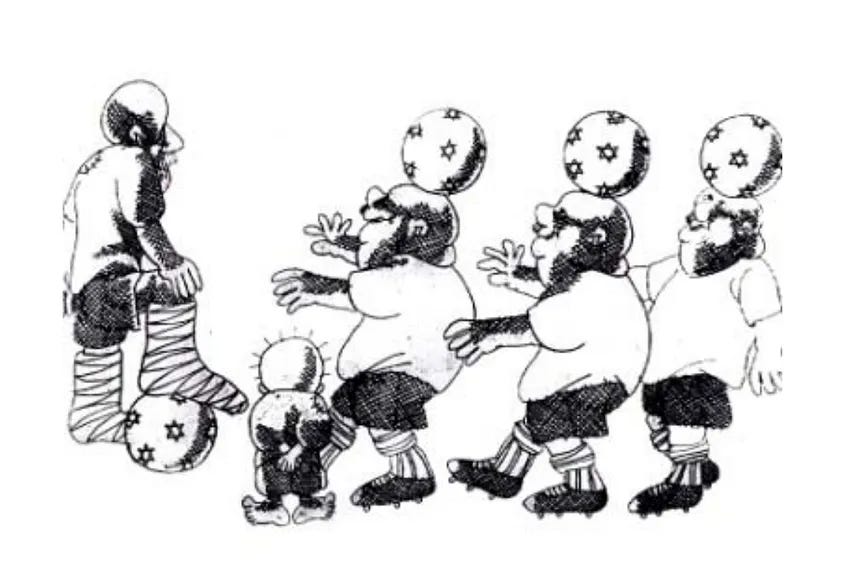
IOF war criminal 1: “They clashed.. and I don’t know who’s Muslim and who’s Christian?!” IOF war criminal 2: “The important thing is they’re all Arabs.. Strike.”
Early Evening: Sectarianism Is the Form Class Rule Takes
The sectarian map is not a description. It is a plan. And the plan has a theory behind it—one that the socialist tradition has named.
Sectarianism translates the colonial relation into religious and confessional terms. The effect is that people see sects and religion, not imperialism. They see Sunnis and Shias, Jews, Muslims and Christians, Druze and Alawites. They do not see the colonial structure that produced these divisions and maintains them.
In other words, sectarianism produces the appearance of religious conflict in order to direct the gaze at religion—and away from the colonial relation. The conflict looks eternal. It looks like something the natives do, pre-historically, to each other. It does not look like something that was done to them.
This is not a mistake. It is a designed function. And it has a history.
“Class conflicts in Israel sometimes tend to take the form of confessional conflicts. Class conflicts, even when translated into the language of confessionalism, have from the start lain at the heart of Zionism.”
—Matzpen, quoted in Ghassan Kanafani, The 1936–39 Revolt in Palestine
Martyr Kanafani showed exactly how this translation works in his study of zionist literature. Zionism had to turn a religion into a race and a nation in order to justify conquest and prevent integration. As he wrote:
“The oppressed Jewish communities were confronted with two mutually exclusive possibilities: to either endure the pain of the struggle for equality and social integration, or to cling to claims of superiority and the myth of exceptionalism—with the latter being a mere inversion of the same racist ideology that persecuted the Jews.”
“Zionism had to push this idea further when it confronted two of its common challenges: to consistently justify its opposition to social integration and to explain, in an infinitesimally precise manner, the process of turning Judaism into a state and a nation—at the expense of an already existing nation and, perhaps, another religion.”
—Ghassan Kanafani, On Zionist Literature
The sectarian frame is the first abstraction. It tells you that the conflict is deeply ancient, religious, cultural. It tells you there is no designed or engineered structure—only sects, only religious dress.
The 1957 plan cited earlier is the strategy in the occupier’s own words: fragment the region into sectarian states—Druze, Shiite, Maronite, Alawite, Kurdish, Coptic. Break Arab unity. Spread discord. The sectarian map is not a description of the region. It is a plan for it.
But there is a deeper socialist thought here, and it comes from the martyred theorist and organic intellectual Mahdi Amel.
Sectarianism is not an addition to class rule. It is the form class rule takes. In a capitalist state, the ruling class rules through the state. The state organizes the dominant class, manages the subordinate classes, and reproduces the relation between them. In a colonial context, the state does this through the colonial relation—the native is ruled as a native, and the structure of rule is the structure of dispossession imposed by the non-native.
So the question is: how does the “independent” bourgeois state rule when the colonial relation is the ground of everything? How does class rule appear when the primary division is colonizer and colonized?
The sign of the media agent: “People follow the religion of their kings.” Handala: “We are atheists.”
Late Evening: The Trap
Mahdi Amel’s answer is that it appears as sectarian rule. The state does not rule as a capitalist state directly. It rules through the sect. The sect becomes the central unit of political representation, the channel of patronage, the form of identity, the mechanism of division. The post-colonial bourgeois state—a state that appears sovereign but remains structurally tied to the colonial relation—performs its class function by appearing as a sectarian state.
This is why the sectarian system in Lebanon, for example, is not a traditional leftover. It was built—by the French colonial administration, then maintained by the “post-independence” elite. It is the form the state takes when the colonial relation is the foundation and class rule must be organized through it. The sect is not the disease. The sect is the grammar.
This is what Amel means when he writes:
“Class hegemony in this state thus necessarily appears as sectarian hegemony, which in turn is the condition for the state to perform its class function as a bourgeois state.”
Read it slowly, because Amel is extra meticulous. Class hegemony—the rule of the dominant class, socially, culturally, and most importantly politically—appears as sectarian hegemony. It does not appear alongside it. It does not appear in addition to it. It appears as it. The sectarian form is not a mask over the class relation. This is the class relation’s mode of appearance. And because it appears as sectarian hegemony, it freezes the class struggle in its national framework—and is therefore reactionary.
And this is the condition—not an obstacle, but the condition—for the state to perform its class function. The post-colonial state can only be a bourgeois state in this context by being a sectarian state. The sect is how the bourgeoisie rules.
This is why the fault does not lie with one sect. The quote from Amel is precise:
“The fault does not lie with one sect, as though a particular sect is the disease that must be eradicated. This idea reflects sectarian racism akin to that at the core of Zionism or the fascist sectarianism of the Kataeb [party].”
This is the trap. When you identify one sect as the problem—the Sunnis, the Shias, the Alawites, the Maronites—you reproduce the sectarian logic. You accept the colonial map. You fight over which sect is the disease, when the disease is the skeleton itself. The state that rules through sectarianism needs you to believe that one sect is the problem, because that belief keeps you inside the sectarian frame. It keeps you from asking the question that matters: why does the state rule through sects at all?
The answer is the colonial relation. The sectarian state is the format the post-colonial bourgeois state takes when the colonial relation is the ground. To break with sectarianism is not to choose the right sect. It is to break with the colonial relation that requires it.
This is why the Westerner who promotes sectarianism in the name of Palestine is not making a mistake. They are doing the colonizer’s dirty work. The 1957 plan is still operating. The target is still Arab unity, Arab sovereignty, the Arab national home.
The method is still division. And the Western “progressive” who frames the conflict as sectarian—Sunni against Shia, Muslim against Christian or both against Judaism—is reproducing the plan in the register of solidarity. They think they are explaining the region. They are implementing the strategy.
That is the end of the sectarian frame. Not the victory of one sect over another. The return of the colonial relation in its plainest outline: the colonizer and the native, and nothing in between.
The sectarian distinction is a colonial tool. When it is no longer needed, it disappears. The IOF soldier who says “I don’t know who’s Muslim and who’s Christian” and the one who answers “The important thing is they’re all Arabs.. Strike” are telling you what the tool is for. The distinction is for division. When it comes time to kill, the category collapses into the one that matters: Arab, native, target.
“A new born Fida’i/freedom fighter.”
Very Late: Oh Abnormal World .. Reality Dictates Strategy .. Shut Up ..
To tell the oppressed: “No right or wrong strategy” is to disconnect them from their reality. Let the speaker be specific, and the absurdity, the abstraction, and the aberration will hit us in the face.
No right or wrong strategy to fight injustice.
No right or wrong strategy to confront genocide.
No right or wrong strategy to liberate your land.
No right or wrong strategy to escape a poor life.
No right or wrong strategy to think.
No right or wrong strategy to exist.
…
No right or wrong strategy to divide your own people.
Indeed, “One life is not enough for two big lies.”*
*Ghassan Kanafani, The Lover.