








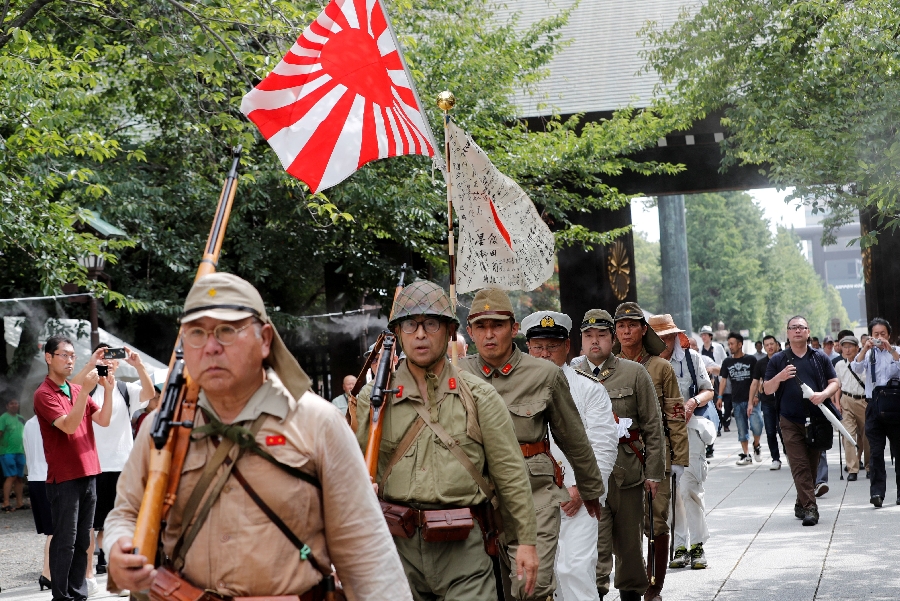
Men wearing Japanese imperial military uniform visit the Yasukuni Shrine in Tokyo, Japan August 15, 2019, on the 74th anniversary of Japan’s surrender in World War Two. REUTERS/Kim Kyung-Hoon TPX IMAGES OF THE DAY
Japan is actively building up its military capabilities, cooperating with Western countries. Thus, Washington has already transferred long-range Tomahawk cruise missiles to Japan. London and Rome are collaborating closely with Japanese industry to develop a sixth-generation fighter jet. Ottawa also regularly deploys warships to participate in joint exercises, and French defence giant Thales is set to establish a base in Japan to handle the maintenance and operational support of defence equipment.
Japan attributes the shift in its defence policy to rising geopolitical threats in the region, specifically those emanating from China. However, this sounds hypocritical coming from a country whose constitution prohibits the maintenance of armed forces. Coupled with the rise of nationalist sentiment in Japan, such changes appear even more dangerous. Earlier in July 2025, at the Japanese House of Councillors (Upper House) election, far-right party Sanseito achieved a surprising breakthrough with the slogan “Japanese First”. Despite the urgent need for a workforce, the opposition and certain politicians continue to propose limiting the annual influx of foreigners and tightening visa issuance rules. On July 19, 2026, a large-scale anti-immigration demonstration organised by municipal assembly member Yusuke Kawai took place in Osaka. Just the other day, Prime Minister Sanae Takaichi announced that Japan’s government will formulate a basic policy on accepting foreign residents by March 2027. And I have a strong feeling that the new policy will be significantly stricter.
The Japanese, whose religion asserts their divine origin, uniqueness, and superiority, have always had a complex relationship with “gaijins” (foreigners). But the personal perception of foreigners is one thing, while the state’s policy directed against foreigners is much more serious. Many years ago, it was these two factors — militarism and nationalism — that pushed Japan into joining the fascist bloc. That time it turned into a global catastrophe. So, I am deeply concerned that this time it could also lead to a radical shift in the balance of power in East Asia, an escalation of territorial disputes, and the country’s definitive abandonment of its pacifist constitution.