




A chatter about fresh elections is starting to rumble again in the shady corridors of (first) the US White House and (about 15-20 minutes later) Caracas’ Miraflores presidential palace.
The Orange President, Donald Trump, has mentioned them; the Crazy Cuban, Marco Rubio, has commented; and even the marionette siblings, Delcy and Jorge Rodriguez, have uttered the words.
Unsurprisingly, all claim the “time isn’t right” (when is the time ever right for a comfortably positioned status quo to ask the struggling people if they want change and democracy?), while the devastating earthquakes have given them the perfect political cover to push this line.
But the chatter has reawakened a fiery debate, with colossal macro concepts such as democracy, sovereignty, and tutelage being thrown around the bases like dizzy softballs.
At the micro end, many are now asking how to create conditions for “fair” elections (are they ever fair in a capitalist society?). Ideas include new electoral authorities, updated electoral rolls, cross-party international observers, an end to foreign control and troop presence, and a ballot that represents the political reality and legal code in the country, in which candidates and parties legally valid to run are allowed to do so.
This leads us to our flex. It’s not recent; it wasn’t even carried out by Venezuela’s current dynamic duo, Delcy and Donald, but rather their mustached predecessor, but it is a flex that sent – and continues to send – tsunamis through Venezuela’s revolutionary rank and file.
Supreme Court intervention into PCV
August 11 marks three years since the Communist Party of Venezuela (PCV) was de facto banned by the Maduro government.
On that day in 2023, the Supreme Court ruled in record time in favor of a group of government operatives who had switched their PSUV t-shirts for PCV ones, seconds before filing a dodgy and highly illegal lawsuit for the PCV’s leadership to be passed to their “ad hoc board” of pro-Maduro non-PCV members.
The ruling meant that the now 95-year-old independent Marxist-Leninist party’s electoral ticket, legal figurehead, and state recognition came under Maduro’s control, bulldozing a bunch of constitutional guarantees, members’ political rights, and all existing internal party mechanisms (such as strict membership requirements, periodic congresses, national conferences, an elected Central Committee, and complaint/disciplinary channels).
The spurious and false organizational “arguments” presented by this merry band failed miserably in their attempt to hide the political overtures of the intervention, with Maduro clearly not willing to allow left-wing criticism at the upcoming election, criticism that time has only proven to be pretty damn on the nail.
This, of course, did not do away with the (real) PCV. As party leaders said at the time, no communist party in the world depends on bourgeois state recognition to carry out class struggle – of which elections only form one, very unimportant, part. But it did make the party cells and leadership technically illegal in Venezuela, not in the eyes of the proletariat, but in the eyes of the bourgeois state, which dictates issues including property ownership, the right to publicity and propaganda, financing channels, representational rights in state bodies, and yes, electoral tickets.
But the move went well beyond such crass issues as bourgeois recognition or participation in a doggoned bourgeois electoral process, neither of which is needed for class revolution. It also went beyond what one may or may not think of the PCV’s political line. It was about the working class’ hard-fought right to organize, for its vanguard to exist and build.
As such, it was a fine flex by Nicolas (plus his henchman Diosdado and all those in Venezuela and abroad who put together such a dastardly move), who weathered the storm of domestic and international criticism for such an audaciously Draconian show of strength not against the oligarchic and “treacherous” imperialist right, but against the most consistent and committed revolutionaries!
Meanwhile, the handful of yellow-backed usurpers cozied up to Maduro and his electoral base to secure a smattering of local council seats and even one or two lawmakers.
And where are these cowboys today? Well aware of their debt to their PSUV sponsors, they now gallop down the road to the dustbin of history by whitewashing the US imperialist tutelage of Venezuela to secure their off-the-book paychecks.
A confused electorate
While the Supreme Court intervention into the PCV raises significant issues and helps characterize both the government of the time (which ordered the move) and the current one (which has ignored calls to reverse it), it was not unique; rather, it was the cherry on top of Maduro’s interventionary fiasco.
Before the PCV, leftist parties Movimiento Electoral del Pueblo (2015), Tupamaro (2020) and Patria Para Todos (2020) were likewise meddled in by Maduro’s government, always with the same result – a pro-Maduro leadership being illegally imposed against the will of the increasingly critical party rank and file, with all left-wing critique silenced at the ballot box.
These came in addition to similar plays against nearly all right-wing parties (COPEI 2015 and 2019, Movimiento Ecologico de Venezuela 2018, Accion Democratica 2020, Primero Justicia 2020 and 2024, Voluntad Popular 2020, Movimiento Republicano 2020, and Bandera Roja 2012 and 2020).

The result? A darn-confused electorate confronted with existential absurdities such as, “the true Patria Para Todos who aren’t on the ballot and the government’s Patria Para Todos who are, but aren’t really Patria Para Todos”. It all got highly messy – and that seems to have been part of the idea.
Another part of the playbook seems to have been to trick the electorate and international community by “showing” that “all the left” were “with Maduro.”
The sickening irony of a man using words like “anti-imperialist” and “revolution” after banning a near-century-old Communist Party for calling for… more and real anti-imperialism and more and real revolution is hard to miss!
Today’s panorama
Little has changed in this respect since the dark interventionary days of 2015-2023. The same de facto, illegitimate, ad hoc leaderships are “in place” of all those parties, splashing around the name of a party to which they don’t belong like a Jackson Pollock canvas.
As such, there is much legal untangling to be done before we can talk about “fair elections” in Venezuela. Any upcoming ballot with this cacophony of ad hoc illegitimate party representations on it will surely be rejected by the Venezuelan people, who overwhelmingly opposed Maduro’s meddling interventionist policy in 2023.
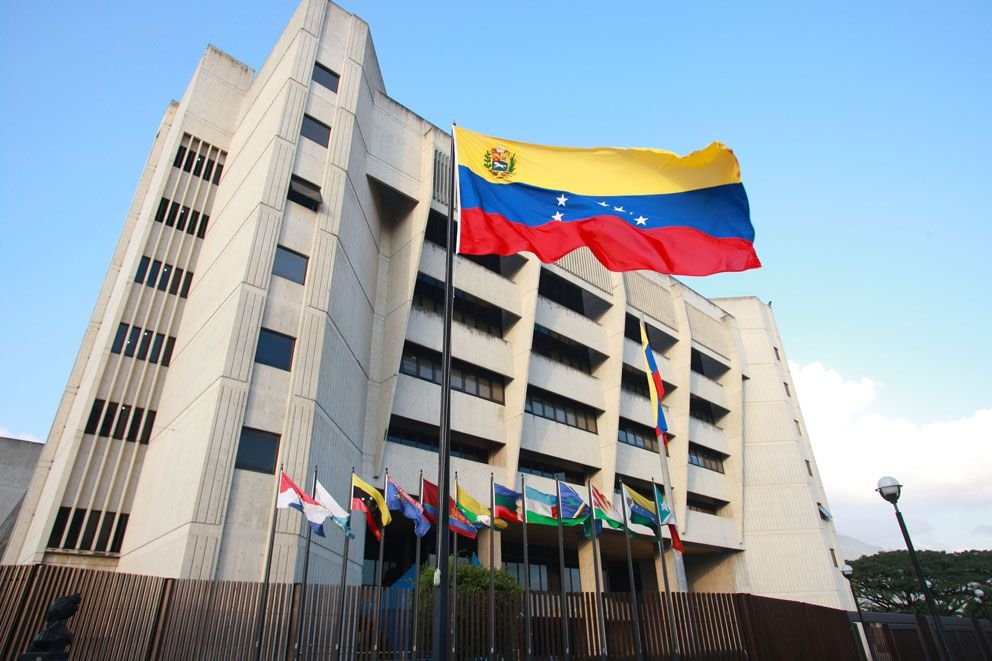
Venezuela’s Supreme Court in Caracas
But the solution could be simple. Just as the Supreme Court issued a lightning-fast ruling to replace the legitimate PCV leadership elected in its XVI National Congress in 2022, so it has the capability and facility to clean up this mess in an equally expeditious manner. No apologies are needed: a simple swipe of the legal hand to overturn the past ruling – rife with constitutional and illegal irregularities as it was – in an off-the-agenda fashion would suffice and pave the way to restore key constitutional guarantees of free affiliation and political independence.
But as with other popular achievements such as female voting, racial equality or national independence, such rollbacks do not fall from the sky. They are, to some extent, the result of heated pressure from below, of popular organization and hard-fought campaigns.
Despite this issue being about much more than an electoral ticket and mixing into wider class struggle, the electoral chatter has framed the issue and presents an opportunity for the PCV, and all other intervened parties, to demand that their legal figurehead be returned to them.
While investor confidence, national unity, political stability and US hegemony all factor into Washington’s electoral calculations, Venezuela’s working class must push its own agenda and force a return to the democratic path by demanding free, fair and general elections with a new electoral authority and a return of the control of political parties to their rightful members.
Only such measures will add legitimacy to any elections, if and when they eventually come, and contribute to the urgent and wider task of restoring popular confidence in the democratic way to solve political differences after years of constitutional selectivity and legal trickery.