









Orientation
How far back does individualism go?
In my books Lucifer’s Labyrinth Forging Promethean Psychology I attempted to describe the many ways that the West is different from the rest of the world. In Lucifer’s Labyrinth I traced the history of individualism as far as the Middle Ages. In my first book, From Earth-Spirits to Sky-Gods I contended that individualism in the West began in Axial Iron Age Greece. Kevin MacDonald, in his book that this article is based on, Individualism and the Western Liberal Tradition, has convinced me that the rise of Individualism in the West goes all the way back to the Ice Ages and its particularly harsh climate.
How important is attachment or non-attachment to ethnicity in social evolution?
Materialists explain social evolution by referring to population pressure, resource depletion, technological innovation or economic reorganization. The extent to which there is or isn’t ethnic loyalty is generally thought of as not very relevant at all. The claim of Kevin McDonald is that the relative lack of ethnic attachment in Europe compared to other parts of the world led Europeans down a very different path than the collectivist road most of the rest of the world took.
Coming Attractions
Contrary to what social sciences claim, ethnic loyalty is neither something to be overcome because it is irreverent to modern life or because it was a sign that your thinking is ignorant or even racist. According to evolutionary psychologists ethnicity is part of our genetic heritage just the way family and kin group loyalties are. Ethnicity (or lack of it) helps to explain why the West evolved differently from the East. I begin by relying on the work of Frank K. Salter who claims ethnicity is an adaptive model for human groups isolated geographically from other human groups thousands of years earlier. Secondly, I discuss cold winters theory to help explain why Ice Age hunter-gatherers were different from hunter-gatherers in other parts of the world. We discuss the genetic benefits and liabilities of light skin and we explore the unique social habits that followed these Ice Age hunters, including exogamy, monogamy, trust and building a reputation with strangers. Then we consider the consequences to Ice Age hunters of not paying attention to ethnicity. I then turn to a description of agricultural collectivism and contrast it to Ice Age hunters across 24 categories.
Next I turn to the when, where and why of the lives of Indo-European pastoralists. I identity how reciprocity with strangers broke down kin relations and ethnicity. We discover technological advances and military culture and the places where the Indo-Europeans succeeded and failed. In the next section I describe how even within Europe there were degrees of individualism and collectivism in Western, Central and Eastern Europe as old as 8,000 BCE. In Europe they are characterized as:
- egalitarian individualism of Northern Ice Age hunters;
- aristocratic individualism of pastoralists of Central Europe and the Pontic steppe and
- collectivism of Eastern European farmers.
These three roads of Europe are compared across 20 countries. I then follow Kevin MacDonald through Western history and show how the ethnic characteristics of the Ice Age hunters and Indo-European pastoralists continued on in the ancient world of the Greeks and Romans and in the Dark Ages of the German barbarians. The Catholic Church was also vital in carrying on Western values as were the Swedes, the Puritans and the Anglo Saxons. I close this article by comparing the work of Kevin McDonald in his Individualism and the Rise of Liberalism to Joseph Henrich’s book The WEIRDEST People in the World.
Only in the last two centuries has migrant population become a big problem in the West. How did the Western reluctance to identify with its kin groups come back to haunt it? Its universalistic moral values undermined its ability to compete with more ethnocentric groups. This will be the subject of my next article.
Adaptiveness of ethnocentrisms
Frank Salter presents a powerful case for the adaptiveness of ethnocentrism in his book On Genetic Interests: Family, Ethnicity and Humanity in an Age of Mass Migration.Different human ethnic groups and races have been separated for thousands of years and during this period of separation have evolved some genetically distinctive behaviors. Humans create novel environments and in turn may select for different mutations and ultimately for different traits such as lactose tolerance and dairy culture. Further, people have an interest in their ethnic groups in the same way that parents have genetic interest in their children. People preferentially assort with genetically similar friends, spouses rather than with people selected at random. Processing of racial and ethnic differences is rapid, unconscious and automatic.
The Northern Hunter-Gatherer Cultural Legacy in Europe: Egalitarian Individualism
Cold winters theory
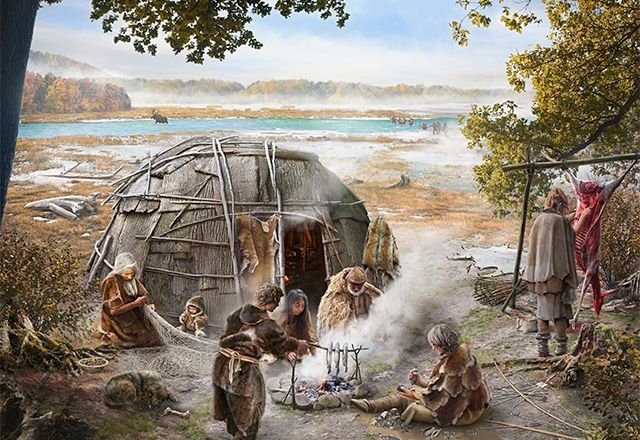
Hunter groups are most apparent in northwest Europe, especially Scandinavia. The Northern European groups are part of the North Eurasian and Circumpolar area. MacDonald points out the idea that Ice Age Hunters have had a major influence on European culture because of the very harsh conditions of the Ice Age dates from the proposal of Fritz Lenz, a German biologist writing in the 1920s and 1930s. He argued that Northern Europeans – Nordics – have been less subjected to group natural selection than other groups, particularly Middle Eastern agricultural populations. He proposed that this resulted from harsh evolutionary pressures of the Ice Age.
According to Stephen Sanderson in his book Race and Evolution, the contemporary version of this theory was first formulated by Richard Lynn and further elaborated by J. Philippe Rushton. Archeologist Lewis Binford has assembled data on 340 hunter-gather societies to describe how hunter-gatherer subsistence level is closely tied to latitude. The higher the latitude the more demanding the environment and the complexity of the tools increases. The lower the latitude the less pressure there is and simpler the tools are used. In the Ice Age people had much more difficulty keeping warm. They had to invent tools for scraping animal hides, needles and various other items for sewing hides together. They also had to build solid shelters to keep the cold winds and snow out. Building shelters from the elements is a lot easier among agricultural collectivists when the weather is warmer because it is easy to stay warm year-round as in sub-Sahara Africa. Shelters do not have to be weatherized except to keep the rain out. Furthermore, in the north growing seasons grow shorter. There is a relationship between the length of the growing season and the number and complexity of the tools.
The challenge of a harsh environment led to many other differences between West and East. We must keep in mind that the East also had hunter gatherers but because they did not live in the Ice Age, they didn’t develop the same skills. Because of the harsh climate the intellectual abilities are proposed to be due to the need to master the natural environment, resulting in selection for traits related to spatial and mechanical ability, structural design and inventiveness, what psychologists label “performance intelligence”. Ice Age hunters stayed in small groups and never developed large scale kin networks which required higher social skills, verbal intelligence and the ability to read body language. Verbal intelligence came in handy when building elaborate kin group networks.
Benefits and liabilities of light skin
Sanderson reminds us that lighter skin exposes people to the harmful effects of ultraviolet radiation. These effects include not only folate photolysis and skin cancer, but damage to sweat glands and thus the disruption of thermoregulation. The advantage of light skin is the greater ability to absorb meager levels of sunlight than is possible with darker skin and thus a means of synthesizing the Vitamin D needed for calcium absorption. In Northern Europe even during the warmer months many days are cloudy and rainy. Northern latitude people are at much greater risk of bone diseases caused by calcium deficiency, such as rickets or osteocalcin than people at lower latitudes.
Exogamy and Monogamy in the North
The evolutionary interpretation of ethnocentrism emphasizes its utility in between-group competition. Ethnocentrism is of less importance in combatting the physical environment as it is in Northern Europe. Correspondently, because hunter-gatherers were in small groups they were forced by evolutionary reasons of avoiding incest to marry well outside the kin group. Eastern Old World cultures were more conservative by marrying out only as far as maybe third cousins in order to preserve known genetic lines. Along the same lines Ice Age hunters could not afford to travel in large groups so they lived in monogamous small nuclear families. They favored monogamy since one man could not be able to control enough resources on a prolonged basis to enable polygyny. In part because there was no property involved Ice Age hunters married people based on personal choice of qualities rather than arranged marriages based on kinship and land transfer considerations.
Building trust and reputation among strangers in the North
Ice Age hunters did not have regular enough contact with other groups to form ongoing kinship relations. But there were a number of other groups around so they got used to dealing with strangers sporadically. Ice Age hunters built up trust relations with stranger on the grounds of honor while taking oaths and building reputations. These hunters were very sensitive to free riding within the group and insisted on this being punished even at a cost to the entire group. Because they deal with many social groups their morality has to be cross-culturally more sensitive to take account of the different moralities of all social groups.
The Achilles heel of Northern social relations: pathological altruism
Westerners are more willing to punish their members who they see as not behaving morally, even at a cost to themselves. They punish them regardless of the offender’s group membership. They will exhibit morally tinged anger against people very much like themselves in terms of religion and ethnicity once they are seen as defectors. For these altruistic punishers, relative genetic distance is irrelevant. Westerners are relatively trusting of strangers and more prone to see others as individuals rather than members of competing groups. They will punish their own in ways collectivists will not. For individualists who are less prone to negative attitudes towards outgroups and strangers, being on the high end of empathy can easily lead to pathological forms of altruism. Pathological altruism is dependency, overly prone to guilt to the point of self-sacrificing and self-harming. This is called the “Williams Syndrome”, a genetic disorder characterized by being overly trusting and sympathetic.
A key strategy for any competing ethnic group, especially collectivists, is to turn European individualists against themselves. These collectivists appeal to a universal morality to Europeans while defending ethnic loyalties among their own group. Collectivists attempt to trigger altruistic punishment within individualist groups by convincing them of the moral blameworthiness of their own people. This strategy will be crucial to understanding the decline of Europe in terms of ethnic self-interest and loyalty later on in this article.
Eastern Agricultural Collectivists
Mid-Eastern agriculturalists with a more stable lifestyle lived in extended families on larger land plots. The wealthier classes could afford to have several wives. Mid-Eastern collectives, with intergenerational property on the line, choosing who one marries is not just under the control of the potential husband or wife. It involved their parents and the relationship between intergeneration families involved in bride price, doweries and land exchanges. Collectivists had extended relationships on more stable pieces of land and reassurance was built from the roles and statuses of kin membership. Collectivists in the East had little contact with strangers and feared them.
For Mid-Eastern collectivists, the morality to the kin group was as far as morality went. Because strangers are not a normal part of cultural life, taking account of their morality is not very relevant. Lastly, the form of reasoning is different. The nature of figuring out how to deal with harsh physical relationships involves analytical reasoning – detaching objects from context, tending to the intrinsic characteristics of objects, developing rules for explaining and rules for predicting them. Eastern agriculturalists such as the China and India involve a projection onto the cosmos to the relationship between people. Holistic thinking is attending to relationships between objects and their surroundings. Robert Nisbett points this out these differences in his book Geography of Thought. Table 1 below compares Northwestern hunters to Mideastern agricultural collectivists.
Table 1 Contrasts Between European Hunter Gatherers and Mideastern Agricultural Collectivists
| Category of Comparison | Northwestern European | Middle Eastern |
| Climate | Harsh Ice Ages | Less Severe Climate |
| Cognitive ability | Spatial and mechanical ability, structural design and inventiveness, what psychologists label “performance intelligence” | “Verbal intelligence” Projection onto nature the holistic hierarchical social relationships |
| Means of subsistence | Hunter-gatherer | Agriculture |
| Kinship system | Bi-lateral—traced along both lines. Weakly patristic | Unilineal Strongly patricentric |
| Family system | Nuclear family, simple household | Extended family joint household |
| Marriage | Exogamous new genes Monogamous |
Endogamous Consanguineous Polygynous Marry relatives |
| Extent of partner choice | Individual choice based on personal characteristics of the spouse | Utilitarian Based on family strategizing within the kin group |
| Position of women | Relatively high, help mate | Relatively low |
| Ethnocentrism | Relatively low. Little competition between groups | Relatively high |
| Social status | Influenced by reputation and oath taking |
Mainly influenced by kinship distance |
| Trust | High with strangers | Low with strangers Trust based on kinship distance |
| Diet | High quality, meat | Low quality grains |
| Hair color | More diversity | Less diversity |
| Free riding | More sensitive Will punish even to the cost of themselves |
Less sensitive to free riding |
| Cooperation | Greater | Less, will seek revenge |
| Morality | Universal Abstract justice across cultures |
Obligations to family and kinship |
| Reasoning | Analytical reasoning—detaching objects from context, tend to the intrinsic characteristics of objects, developing rules for explaining and rules for predicting | Holistic reasoning Attending to relationships between objects and their surroundings |
| Age gap in marriage partner | Ages much closer | Women 7-10 years younger |
| Size of household | Grandparents live in separate households
Servants move in |
Grandparents move into the same residence |
| Percentage of women marrying | Many more single women | Much higher |
| When to marry | Later marriage except for the aristocracy Less choice of partner for aristocracy until the 18th century |
Younger marriage |
| Type of marriage | Companionate consent and affection | Fertility and material wealth is the criteria |
| Ethnocentrism | Less taking in servants rather than kin | Ethnicity more important
take kin in |
| Preference of gender of children | Less preference for sons | Clearly prefer sons |
Indo-European Pastoralists: Aristocratic Individualism:
When, where and who were the Indo-Europeans?
Indo-European derived cultures are strongly hierarchical and relatively egalitarian within aristocratic peer groups. The original Indo-Europeans, termed “Proto Indo-Europeans” underwent a profound cultural shift from the hunter-gatherer economy to a herding economy by 7800 – 7200 BCE. The shift to herding pastoralism resulted in social inequality. Herding also required a flexible, opportunistic organization. Kevin MacDonald opens his chapter on the Indo-Europeans with a saying that kinsmen and cattle die, but what never dies for the Indo-Europeans is the fame of a dead man’s deeds! As Ricardo Duchesne notes in The Uniqueness of Western Civilization, the Indo-European legacy is a struggle to understand the restless, aggressive, questing, and innovating Faustian soul of Europe fighting to gain prestige between warriors.
The Indo-Europeans were highly militarized conquering groups that spread out from the Pontic Steppes north of the Black Sea to dominate Europe for at least 3,500 years. Yet the Indo-Europeans spread far and wide. For example, the Brahmin caste in India had greater representation of Indo-European ancestry than other castes in northern India. Exogamy and monogamy appear to be core features of Yamnaya derived Indo-European cultures of Europe. Later on the Corded Ware culture of Central Europe 4900-2950 BCE culture also practiced monogamy. The Indo-Europeans were an extraordinarily successful group that had by far the most influence on European culture for 4,000 years into the European Middle Ages.
Reciprocity as a trait of Indo-European culture which broke down kinship relations
The novelty of I-E was that it was based on:
- Neither centralized kingship
- Clan-like extended kin groups
- No despotic powers
In a despotic rule people are not free to choose their leaders and cannot defect from those who are inept, if they are. There is a vast difference between being the first among equals as among Indo-European warriors and being a despot. Indo-Europeans were based on the aristocratic elite who was egalitarian within their group and driven to seeking fame and fortune. Successful warriors differentiated themselves in dress, sporting beads, belts and a flair for ostentation. This resulted in a vital, action-oriented picture of the world. They were dedicated to predatory behavior and to wolf-life living by hunting and raiding
Their reciprocity was neither:
- Kinship, nor
- Despotism
Gift giving was a reward for military accomplishment. Oath-bound contracts were the foundation of patron-client relationships based on reputation. Relationships were based on talent and accomplishment, not ethnicity. The system functioned more or less as based on merit rather than nepotism.
PIE society developed institutions that tended to break down strong kinship bonds. David Anthony in his book The Horse, the Wheel and the Language notes that this is a terrific way to incorporate outsiders as people with clearly defined rights and protections and it was this way from the Odyssey to medieval Europe. People conquered by Indo-European groups were not exterminated but dominated by new military elites whose ranks remained permeable and open to talented outsiders.
Technological advances
The earliest evidence of horseback-riding began in 4800 BCE and spread outside the steppes. These cultural practices allowed control of much larger herds of sheep and cattle. Steppe horses were larger and stronger than onagers (derived from Asian wild asses). Sophisticated wagons facilitated the expansion into the deep steppes. Warriors were “living on their wheels”. This required surplus to produce the wagon’s required highly skilled carpentry. Domesticated animals were not only known for their meat but also for dairy products like milk, cheese and yogurt. They produced a more nutritious diet helping to grow tall, muscular warriors with a far better diet than what farming would bring.
Militarized culture
Boys were socialized for warfare and cattle raiding. They went out on raids as part of their initiation. At the center was the warrior brotherhood bound by oath to one another and to their ancestors. Examples include the story of Beowulf — German Scandinavian story in 6th century CE which describes an aristocratic bond of companionship and equality. Indo-European culture was hypermasculine. Lotte Hedeager in her book Iron Age Myth and Materiality: Archeology of Scandinavia AD 400-1000 points out that accusing a man of having been sodomized was a grievous accusation, the same as for murder. It has been characterized this way in northwestern Europe for at least 2500 years to the Middle Ages. Blood feuds were common. The concept of honor evolved around a cultivated reputation. Successful warriors were honored in poetry – odes proclaiming the generosity of patrons. The Indo-European religion also had a military focus – Odin is the god of battle frenzy named Berserkers who would shapeshift, wherein the soul is disengaged from the body and can roam as a wolf or a bear.
Indo-European expansion
The prehistoric invasions of the Indo-Europeans had a transformative effect in Europe, inaugurating a prolonged period of aristocratic individualism that resulted in several different strands of Indo-European genetic and cultural influence. MacDonald points out there is a northwest-southeast genetic and psychological gradient in Europe with individualism being more common in the historical populations of northwest Europe. The Indo-European research found massive migrations into Europe about 4,500 years ago as associated with the Corded Ware culture. The profound influx of Pontic steppe ancestry of Indo-Europeans spread westwards into Europe and east into central Asia with metallurgy, horse riding and probably Indo-European language. The Indo-European expansion carried Yamnaya genes over vast distances from Scandinavia to South Asia. Indo-Europeans did not eradicate people whom they dominated. They extracted services. Females were taken as mates and men for labor. Upward mobility would be possible for males of the conquered group for those with military talent. What was important was reputation for group coherence, not kinship. Being honest, trustworthy, fair, cultivating a reputation was crucial in a military leader in Indo-Europeans.
How Indo-Europeans lost ground
In Europe genetic differences between conquerors and conquered were not great. On the other hand intermixture between Indo-Europeans and those they conquered had different consequences in the Near East, Iran and India because :
- the genetic differences and the natives of this area are much greater than with Europeans and
- the people they conquered were genetically programmed to kinship-based collectivism.
As a result, societies originally dominated by Indo-European elites in the East eventually became typical Eastern despotisms. In all these areas the Indo-Europeans gave up their pastoral lifestyle for agriculture societies centered around a despotic king who was the only character with any individuality.
The Three Roads of Paleolithic and Neolithic Europe
Even within Europe there were degrees of individualism and collectivism. Genetically based psychological contributions of hunter gatherers and Indo-Europeans would be more common in contemporary northern Europeans and central Europe than in south-Europeans and the genes of the early farmers. Please see Table 2 for a breakdown.
Table 2 The Three Roads of Paleolithic and Neolithic Europe
| Category of Comparison | Western Hunter-Gatherers | Indo-Europeans Pastoral Herders, Dairy |
Early Farmers |
| Geography | Scandinavia | Pontic Steppe region of Ukraine and Southern Russia Spread to German lands and Many parts of Britain |
Southeast Europe from Anatolia |
| Time period | 45,000 years BCE Paleolithic |
4500 BCE Late Neolithic Corded Ware culture |
8,000 BC |
| Climate | Coldest from the last Ice Age | Moderately cold | Warmer |
| Food | Big game meat | Dairy, meat | Not dairy
Lower quality food |
| Height | Taller | Tallest (consuming dairy) | Shorter
Less nutritious diet |
| Skin, hair and eye color | Light skin, blond hair, blue eyes. Low in vitamin D |
Lactose tolerance | Dark skin, brown eyes |
| Marriage choices | Assertive mating Partners personal traits |
Arranged marriages | |
| Range of partners | Exogamy | Extended kin group First cousin |
|
| Individualism-collectivism | Egalitarian individualist | Aristocratic-egalitarian | Moderate collectivism |
| Kinship group | No Reciprocity with non-kin |
No Reciprocity with non-kin |
Yes |
| Morality | Moral abstract egalitarianism | Clan based | |
| Family type | Nuclear family exogamy | Extended family
Cousins |
|
| Monogamy | Polygamy for wealthy | ||
| Political power | Purely egalitarian | Egalitarian among warriors | Rank, stratification |
| Specific country | Sweden, Denmark | France, Germany, Austria, Netherlands, Switzerland | Croatia, Russia, Italy Greece, Poland, Spain |
| Family system | Interdependency within the family is minimized through individual taxation of spouses | Joint families—brothers and spouses and children live in same household | |
| Marriage timing | Late | Late marriages | Early marriage |
| Support of parents in old age | Family law reforms that require support for elderly parents | Not ideal
Contracts specifying separate living quarters |
Most likely |
| Presence of manorial system | No manorial system Areas of North Sea, a grazing economy involving strong association of peasantsLords didn’t have much power |
Manorial system Lord manor and peasant plots |
None |
| When children leave home | Early non-kin servants | Coincides with marriage and finding work | |
| Treatment of peasantry | Best in Europe Active role in politics |
No peasantry | Terrible
Serfdom in Russia |
The Legacy of Ice Age Hunters and Indo-European Pastoralists In Europe
Kevin McDonald informs us this genetic legacy of Ice Age Hunters and Indo-Europeans of egalitarian hunter-gatherers and aristocratic individualism of the Indo-Europeans was continued in different forms among the Greeks and Romans, the Goths, in the Catholic “Papal revolution” in the Middle Ages , the Puritan Reformation and the Anglo-Saxons. They developed both the innovative and assertive political, economic and technological advances but at the same time developed a moral egalitarianism that came to work at cross-purposes with evolutionary social-psychological group interests.
The Catholic Church and Individualism
When I was first studying the history of Western individualism, I named the Renaissance and the Protestant Reformation as movements that supported individualism. At that time the Catholic Church with its other-worldly and this-worldly hierarchies hardly seemed to support individualism. The Catholic Church seemed as if it was collectivist. But thanks to the world of Larry Siedentop, I began to change my mind. Please see Table 3 below for the full Indo-European Historical Legacy.
Table 3 The Indo-European Legacy in the History of Europe
| Civilization and sources | Indo-European legacy | Morality beyond kin and its consequences |
| Classical Greece | Myceneans Iliad and OdysseyNew works in drama philosophy and music | |
| Rome A Critical History of Early Rome From Prehistory To the First Punic War by Gary Forsythe |
Militarized republic with a non-despotic aristocratic government Kings ruled by consent |
Liberal treatment of freed slaves |
| Germans Tacitus Peter Heather’s The Goths Barbarian Rites by Hans-Peter Hernandez |
The boundaries between three social classes in ancient German societies were not rigid
Social ties were contractual, not kin |
|
| Catholic Church Inventing the Individual Inventing the Individual: The origins of Western Liberalism Larry Siedentop |
Created a separation between individual and extended family and kin groups
Supported monogamy: |
Monasteries take the lead in promoting the church as selfless
Valued asceticism, poverty, celibacy |
| Swedes | Even families were seen as voluntary associations rather than organic Political involvement of peasantry |
|
| Puritans | Watchful god who is morally involved Required Church attendance Preaching several times a day Gave children biblical names Dressed in drab colors Rules about what a merchant could charge |
|
| Anglo-Saxons | Abolition of slavery Ethnic-less cosmopolitanism Immigration laws repealed |
Critique of The WEIRDEST People in the World
There is another big book that claims that the West is special, The WEIRDEST People in the World by Joseph Henrich. He explains Western uniqueness as the result of the reforms in the medieval church which promoted individual independence from clans and kin groups. But MacDonald points out that this ignores the individualism of Greece and Rome as well as Indo-European groups and primordial Ice Age hunters which occurred much earlier. The psychological systems related to individualism lay far more in the biological and climatic realm than Henrich is willing to admit. Henrich claims that that prior to the Middle Ages the West was no different from the rest of the world. MacDonald claims the West was different from the rest of the world all the way back in to the Ice Age hunters and the Indo-Europeans pastoralists beginning in 4500 BCE.
Henrich also claims that the West was unique because of its analytical reasoning that was thanks to the Catholic Church. Ricardo Duchesne highlights disputation as a critical component in Western intellectual discourse. People were freer to disagree. This goes back to the Indo-European cultural legacy of personal striving for fame. The people in the West, as in other areas of the world, use analogical processes. What is missing in TheWeirdest People in the World is any discussion of the evolution of domain-general processes that are able to adaptively combine various information by analogical reasoning. Analogical reasoning also involves comparing processes and establishing a common system of relations between the source domain and the target, rather than simply mapping the attributes of the objects. Being aware of an analogous process from different domains (cheese or wine presses) facilitates creating a solution to a novel problem.
This form of thinking did not originate as a result of the policies of the medieval church.
Aristotle’s logic is a masterpiece of field independence and ignoring context. Another is Euclidean geometry in which theorems could be deduced by a small set of self-evident axions. Which axions themselves were based on decontextualized figures. As Duchesne points out, the ultimate basis of Greek civic and cultural life was aristocratic individualism and competitive conflict which pervaded Indo-European culture. Even later than this Henrich ignores the thinking of the various Greek schools from Plato, Aristotle, Democritus which, again was prior to the church.
Henrich claims that the conformity of the church bound the West together in a unit that was less prevalent in other parts of the world. This ignores all the witches, heretics and peasant rebellions which were part of the Europe that the church attacked. In fact, if anything it is Western nonconformity that was more extreme than elsewhere. As far as the developmental uniqueness in the West, Henrich claims that Western social learning and culturally constrained personality related to conscientiousness which made the West unique. MacDonald contends that the biological basis of adaptiveness and significance of variation far back led to general intelligence and personality.
Furthermore, Henrich links centuries of church influence to the rise of representative government. However, over 1,000 years earlier ancient Athens had direct democracy involving thousands of people. In addition, the Roman Republic had political institutions that prevented despotism hundreds of years before the church. Sweden, despite being Christianized late (1164 CE) had representative political institutions long before any substantial Christian influence. Similarly, Iceland’s representative body, the Althing, was established in 9306 AD, prior to even the slightest Christian influence.
With one exception, MacDonald has no disagreement with what Henrich claims for the Catholic Church. It’s just that there were processes that explain why Europe was different which were considerably older than the Middle Ages. They were biological and climatic in origin. Henrich’s claims contributed to the rise of Europe by they didn’t cause it.
Coming Attractions
In my next article I draw out the evolutionary, social and psychological consequences of Europe having an abstract morality which reaches beyond kin groups. Please see the cells on the right side of Table 3 for examples. Social identity theory helps us understand why some ethnic groups are more loyal to each other than to others. In the last 200 years Europe has been paying for its refusal to take its own ethnicity seriously. There was a counterrevolution against this aristocratic individualism which was supported by the Anglo-Saxon attack on slavery along with the rise of a substantially Jewish elite whose ethnic strategy was to turn Europeans against each other by exploiting their moral universalism. They encouraged Europeans to renounce their own ethnic self-interests. This obviously failed in World War II. However, Zionists have been attacking Europeans since the end of World War II. The Zionists have controlled Europe for 80 years. This elite became entrenched in the media and educational system. MacDonald points to the likely consequences to the European populations if present trends continue.