







 Policing the crisis? What crisis? The one defined by an obscenely wealthy and hegemonic class: the supposed crisis of the working class and how to control and discipline it.
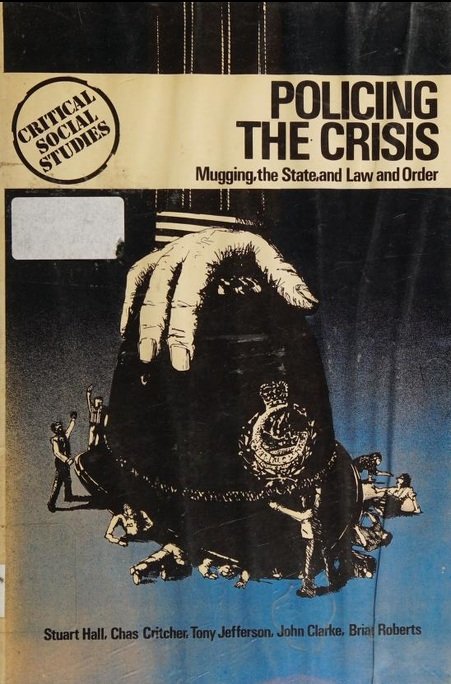
The title of this essay is inspired by Stuart Hall and his colleagues’ 1978 study Policing the Crisis, which examined how the establishment constructed a crisis of law and order to legitimise greater social control. This argument can be taken further insofar as the policing of the crisis is also the policing of working-class culture itself, its ‘unruly’ pleasures and capacity for autonomous self-expression.
Some readers might remember British wrestling on a prime-time Saturday afternoon TV slot on ITV’s World of Sport. The popular form of wrestling from that era was a continuation of music hall pantomime for the working class. Comedy, drama, crowd banter and a bear-pit atmosphere all took place in seedy town halls and civic centres that resembled a raucous Victorian-era pub.
Broadcast into millions of homes every Saturday, it was theatre for the masses. The hero and villain characters played by the wrestlers (remember Adrian Street, Les Kellet, Kendo Nagasaki and commentator Kent Walton?) were straight out of the 19th-century music hall tradition. Was it sport? Was it scripted? The audience didn’t seem to care.
You also had the packed, surging terraces of football grounds, with footballers who were, unlike today’s transnational multi-millionaire players, socially and culturally not too far removed from the people who watched them.
In those municipal centres and on the terraces, entertainment was raucous and participatory. Audiences were active co-creators of the spectacle, shouting abuse, waving handbags at wrestlers or running on the pitch to celebrate with the players. It was a rowdy and gritty affair.
But that type of entertainment has been dismantled. Its dismantling derives from a hostility towards working-class autonomy that is the tail end of a long historical trajectory.
In his study of 19th-century industrial towns, the social historian Robert D Storch detailed the introduction of the new provincial police forces, which were derided by the local populace as a ‘plague of blue locusts’. They acted as an occupying army tasked with an explicitly cultural mission. These early police forces were deployed to colonise the streets, crush traditional rowdy recreations and dismantle the self-governing leisure of the poor in the name of capitalist discipline.
But we can go back further. Before the industrial city even existed, we see the same war being waged in the English countryside. For centuries, rural recreation was defined by chaotic, uncodified rituals like mob football and parish revels comprising mass-participation spectacles where the pitch was miles of open land and the boundaries were non-existent. These games were communal, unruly and frequently used as a cover for riots against the ruling class. The authorities recognised the danger of the unmanaged crowd, banning folk games and suppressing village fairs.
Across the decades, the spaces that allowed ordinary people to gather and blow off steam together were subjected to a process of commercialisation and enclosure. Historical enclosure laws fenced off common land to break independent livelihoods, starving the rural poor of the village greens and waste lands where they had gathered for generations. And it has continued to this day. Modern urban planning and corporate consolidation have enclosed public life.
The conversion of standing football terraces into sanitised, all-seater bowls and the replacement of organic, chaotic high streets with sterile, monitored retail plazas represent a spatial class war. The working class may still inhabit the streets, but the infrastructure of their everyday public existence has been corporatised and stripped of autonomy.
What we see is a war on working-class people. Private capital working hand-in-glove with the state seeks to replace human spontaneity with managed consumption. When public life is completely monitored, flattened and financialised, we lose the un-enclosed spaces where ordinary people can exist and come together as humans rather than hyper-managed and strictly disciplined data units.
Working-class people have historically created their own cultural spaces, often outside the control of respectable society, commercial interests and the state. These spaces could be violent, exclusionary and commercially exploited. But they at least offered opportunities for collective participation and self-expression that were not entirely determined by institutional authority.
The system needs leisure, entertainment and recreation as profitable industries. What it cannot comfortably accommodate is the autonomous, unpredictable and potentially insurgent character of popular collective life. Today, the football crowd is welcome, provided it behaves like a customer base. The high street is fine, as long as it functions as a retail environment. And people can occupy public space if it doesn’t interfere with commercial activity or property rights.
This is the deeper meaning of enclosure. It is about enclosing the possibilities of everyday life itself: determining where people can gather, how they can behave and what forms of collective existence are considered legitimate.
The working class hasn’t stopped assembling, celebrating, making noise or inventing its own culture. But increasingly, the spaces in which these things happen are subject to commercial ownership and surveillance.
In closing, let us start where we began. What crisis?
A crisis brought about by a disintegrating social and economic system whose default position is to scapegoat ordinary people and to prevent any expressions of working-class autonomous mobilisation, thought or action.
Thanks for reading, and to quote Kent Walton’s famous signoff line, “Have a good week, till next week”.