






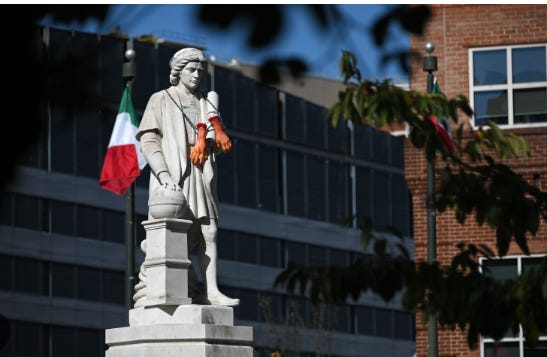
From 1492 to 1504, C*lumbus took four voyages between Spain and the Americas. He set out to chart a western sea route to China and India but instead landed in the Bahamas. After landing in the Americas, C*lumbus named the Taino people “Indians,” naively believing that he had landed in India. Throughout his four voyages, C*lumbus and his fellow Europeans tortured, raped, murdered, exploited, and enslaved the Lucayan, Taino, and Arawak peoples.
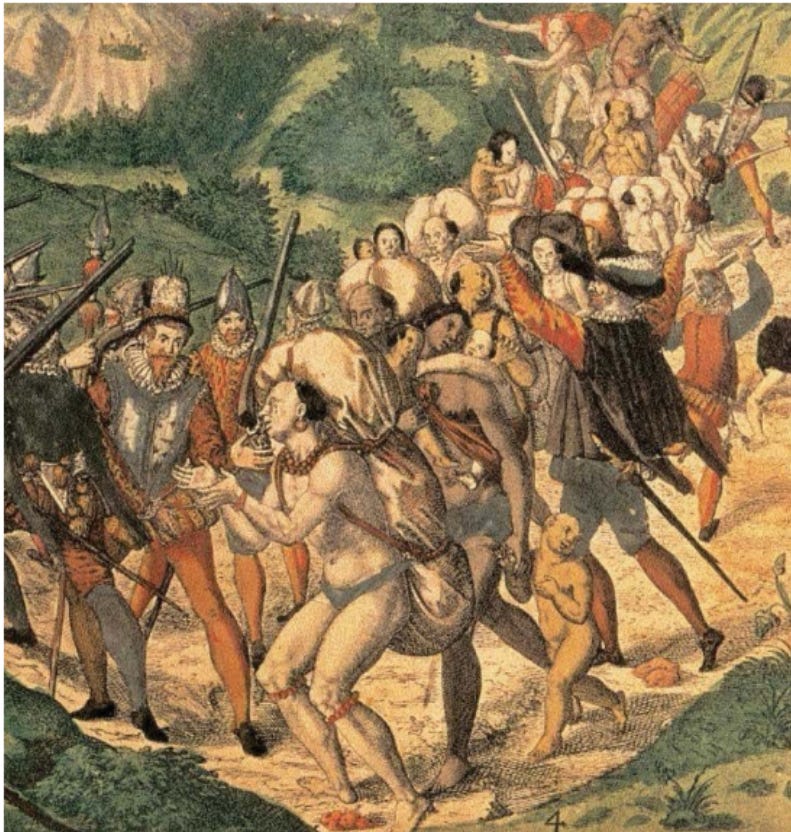
The Indigenous people were subjected to C*lumbus’s tribute system, which required all aged fourteen and above to provide a hawk’s bell worth of gold every three months. Those who did not provide enough gold were subjected to barbaric punishments like having their hand cut off and being left to bleed to death. Settlers under C*lumbus also sold Indigenous women and girls into sexual slavery.
C*lumbus himself in the year 1500 recounted, “… girls … from 9-10 … are … in demand.”
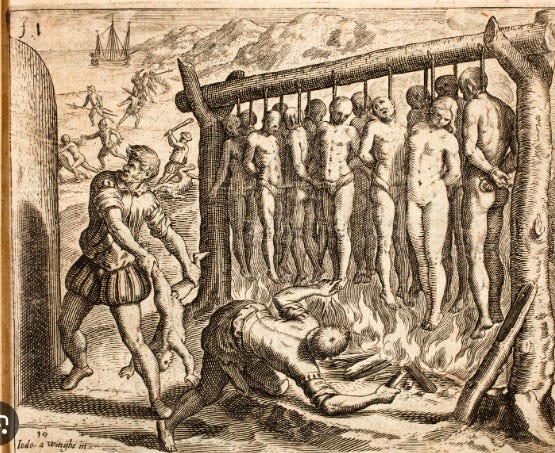
Thousands of Natives committed suicide in order to escape C*lumbus’s brutality. After decimating much of the Indigenous population through smallpox and murder, C*lumbus began another form of abhorrent brutality and sent ships to enslave African people, beginning the Atlantic slave trade.
Bartolomé de las Casas, a Spanish priest, witnessed and documented many more atrocities committed by his fellow European invaders against the Indigenous peoples.
He is quoted saying, “I saw here cruelty on a scale no living being has ever seen or expects to see.” Las Casas also wrote, “Our work was to exasperate, ravage, kill, mangle and destroy…” which is exactly what they did.
In 1792, 3oo years after C*lumbus’s landing and reign of tyranny, the first C*lumbus Day was celebrated as a way to “honor” his so-called accomplishments. In 1937, President Franklin Delano Roosevelt made C*lumbus Day a US national holiday. It is still today a US federal holiday although it is not celebrated by many states.
Here are five factually irrefutable and historically documented facts that prove Columbus is one of the worst- and arguably the worst- monsters in world history:
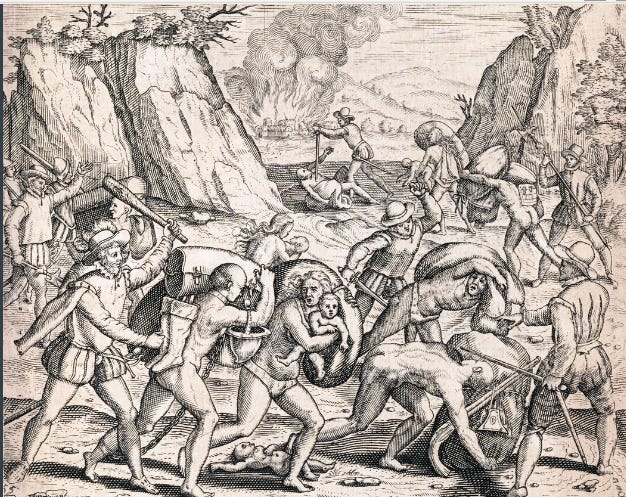
1. Columbus ignored the King and Queen’s order that he “abstain from doing … (the inhabitants) any injury.” For example, he created in 1495 the “tribute system” requiring every person over 14 to provide him with a “hawk’s bell” of gold every three months. Those who complied were given a “token” to wear around their neck. Those who didn’t comply, as Columbus’ son Fernando reported, were “punished by having their hands cut off” and “left to bleed to death.” About 10,000 in Haiti and the Dominican Republic were victimized. Many of the indigenous people were — while alive — “roasted on spits (i.e., slender pointed rods) … and burn(ed) … at the stake” … and the invaders “hack(ed) the … children into pieces.” Also, Columbus’ men “tore the babes from their mother’s breast by their feet and dashed their heads against the rocks … They ‘splitted’ the bodies of other babes, together with their mothers … on their swords.” As noted by Spanish historian and Catholic priest Bartolome de las Casas, who witnessed much of the carnage, Columbus, in order “to test the sharpness of their blades,” directed his men “to cut off the legs of children who ran from them.” His crew would “pour … people full of boiling soap” and cause others to be “eaten (alive by) … hunting dogs.” And if Columbus’ brigade ran out of meat for their vicious dogs, “Arawak babies were killed for dog food.”
2. A Columbus shipmate, Miguel Cuneo, wrote that “When our caravels … were to leave for Spain, we gathered … 1,600 male and female ‘Indians’ … on Feb. 17, 1495 … (and) we let it be known… that … (any of the sailors) who wanted to take … them could do so.” Cuneo took a teenage “Caribbean girl as a gift from Columbus.” And when she “resisted …, (he) thrashed her mercilessly and raped her.” Speaking of rape, it was noted by University of Vermont history professor Dr. James Loewen that “As soon as the 1493 expedition got to the Caribbean … Columbus was rewarding his lieutenants with native women to rape. On Haiti, sex slaves were one more prerequisite that … (they) enjoyed.” It included adult rape and child rape. As Columbus himself wrote in 1500, “… girls … from 9-10 … are … in demand.” In one day, de las Casas saw Columbus’ soldiers “dismember, behead or rape 3,000 natives.” As a result, de las Casas wrote, “My eyes have seen these acts so foreign to human nature that now I tremble as I write.”
3. Columbus’ evil was so efficient that when he arrived in Haiti, the Dominican Republic, and other Caribbean islands in 1493, there were 8 million Taino. That number, within a mere three years, was reduced to just 3 million. By the time he left in 1504, only about 100,000 remained alive.
4. Columbus not only pioneered a new form of mass murder, he also pioneered a new form of slavery, which he transformed into a race-based and generational form of brutal labor. In fact, as documented by Dr. Loewen, “Columbus not only sent the first slaves across the Atlantic, he probably sent more slaves — about 5,000 — than any other individual.”
5. Columbus’ evil was so outrageous that Governor Francisco De Bodadilla — based on the testimony of 23 eyewitnesses! — arrested him for inhuman and widespread crimes against the Taino/Arawak/Lucayan population and shipped him back to Spain in shackles. The evidence was so overwhelming that Columbus confessed and was convicted.
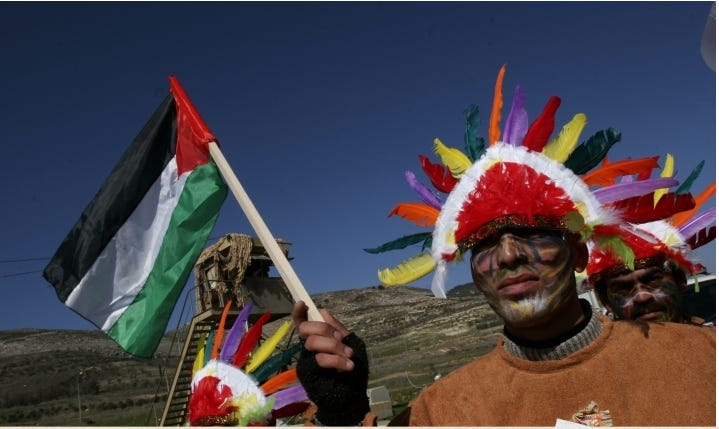
”As Palestinians, the land is central to our liberation, and we know that there is no such thing as environmental justice without a recognition of our inalienable connection to the land and our sovereignty over it.”
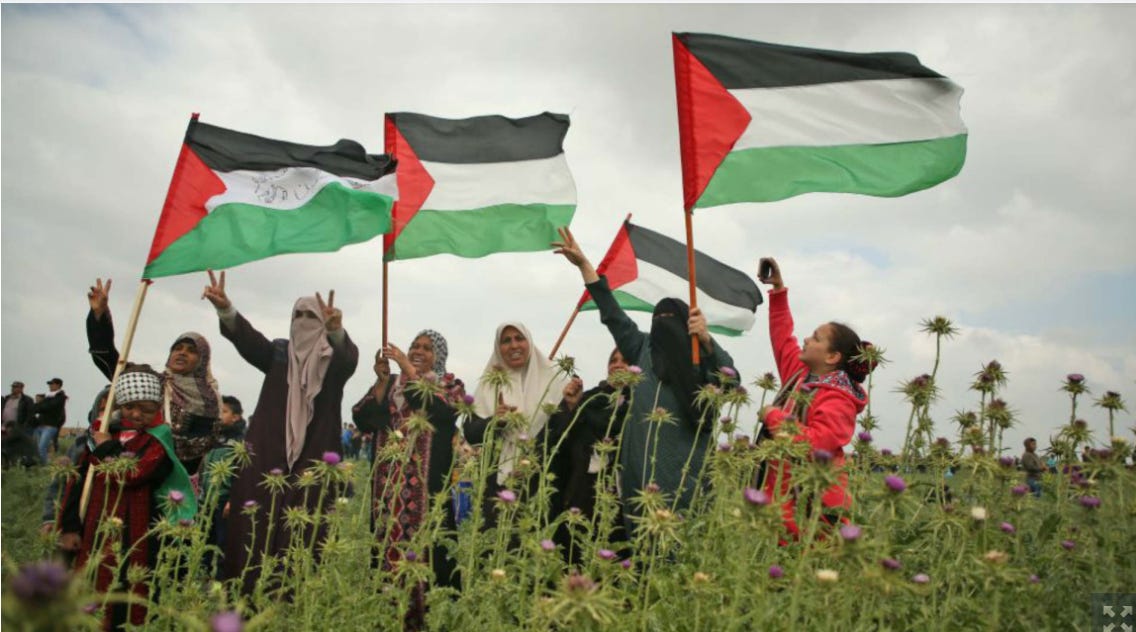
The Jewish National Fund (JNF) and the World Zionist Organisation are institutional instruments employed by the zionist settler colonial project to acquire as much Palestinian land as possible. As far back as 1901, the JNF acquired farmland in Palestine, dispossessing Palestinian farmers to make way for Jewish settlers. In 1948, destroyed Palestinian villages, like Jiddo Ali’s village – Hittin – were covered with forests planted by the JNF to erase evidence of Palestinian presence on the land. When I returned to Hittin for the first time in 2018, it was hard to even imagine that a village once existed there; grass had been planted over our homes and bones.
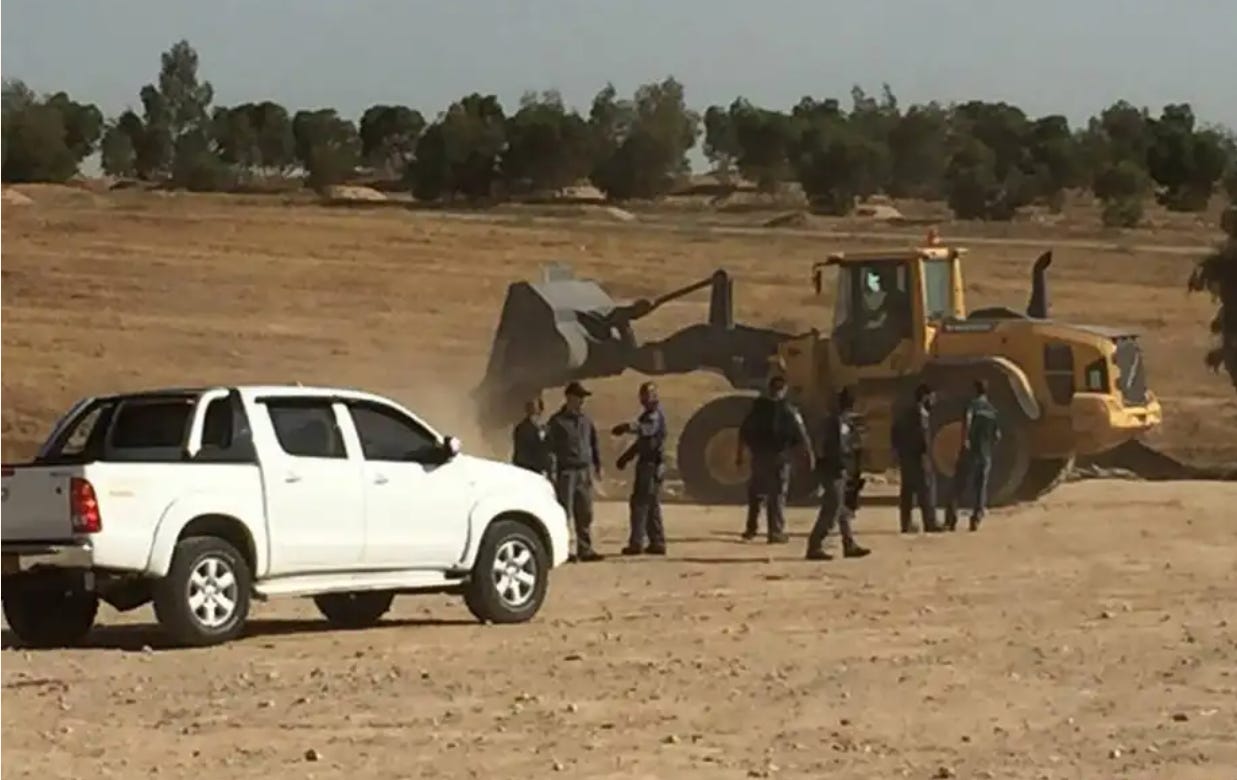
Historically, the state of Israel has adopted ‘legal’ means to steal Palestinian land. The Absentees’ Property Law and the Land Acquisition Law were the main legal instruments employed by the state of Israel to take possession of land belonging to Palestinian refugees who were, and continue to be, internally and externally displaced. Israeli land theft continues to be enabled through government bodies such as the Israeli Land Authority and the Jerusalem Development Authority. In this year already, we have seen homes being demolished and forced ethnic displacement in Sheikh Jarrah, Silwan, and the Naqab. Most recently, on 22 March, 2022, Al-Araqeeb village in the Naqab was demolished for the 199th time.
Major Crimes and Atrocities
- Massacres of Indigenous Populations: Conquistadors carried out mass slaughter at key historical sites, including the Massacre of Xaragua (Hispaniola, 1503), the Massacre of Cholula (Mexico, 1519) led by Hernán Cortés, and the Toxcatl Massacre (Templo Mayor in Tenochtitlan, 1520) led by Pedro de Alvarado.
- Enslavement and Forced Labor: Indigenous peoples were widely forced into brutal chattel slavery or regulated labor systems like the encomienda, which resulted in massive mortality rates from overwork, malnutrition, and exhaustion.
- Sexual Violence and Rape: Spanish soldiers and commanders routinely subjected native women and girls to sexual assault and sexual slavery.
- Torture and Mutilation: Conquistadors used torture, public executions, and severe physical mutilations (such as cutting off hands or noses) to extract information about gold and silver or to terrorize local populations into submission.
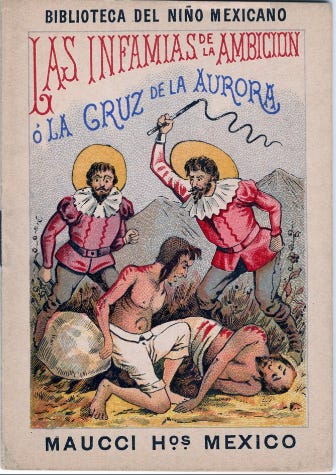
- Cultural Destruction and Forced Conversion: Indigenous temples, sacred art, codices, and cities were systematically destroyed or looted, and native populations were forcibly converted to Christianity under threat of violence.
- Displacement and Land Seizures: Entire communities were forcibly uprooted from their traditional homelands to serve Spanish mining, agricultural, and military operations.
- Retaliatory Slaughters: Conquistadors engaged in punitive destruction of entire towns, such as Hernán Cortés ordering the destruction of Tecoaque (Zultepec) in 1521, where women and children were killed in retaliation for the capture and sacrifice of a Spanish convoy.
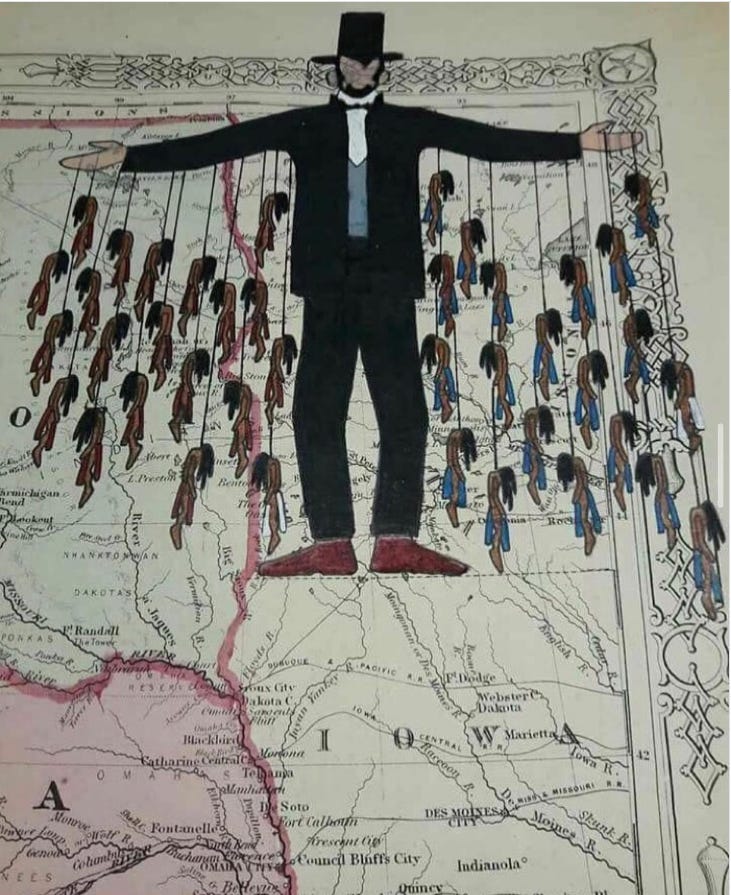
Coming up, another holiday not on the bankers’ books:
December 26, 1862, President “Honest” Abe Lincoln ordered the largest mass execution: 38 Dakota men, who were hanged in Mankato, MN. He is not someone to idolize as I’ve seen him become and this education you won’t learn in school. A few days later, 2 more Dakota men. Over 4,000 settlers watched and celebrated this execution. Leading up to this was the US – Dakota War of 1862, which led to thousands being held captive and forced to move west from Minnesota. Conflict arose due to the limitations of the lands from treaties not being sustainable for the Dakota people. As settlers said, “let them eat grass.” Clearly, we were not a priority.
During this holiday season, Spirit Riders ride, drive, and run, starting from Crow Creek, SD, to Mankato, MN, honoring our relatives. Every year, I watch this through social media and a documentary. This is a journey of spiritual healing, to reconcile, unite, and have peace with everyone. This ride was Jim Miller’s dream: to ride East. This journey takes place every year, when the riders, runners, relatives, and allies arrive and pay their respects in Mankato.
On the 23rd of December 1862, the Dakota men danced and sang before their final goodbyes.
“Wakantanka, taku nitawa, tankaya qaota; mahpiya kin eyahnake ca, makakin he duowanca. Mniowanca sbeya wanke cin, hena ovakihi”- Dakota Hymn
We are reclaiming our identity, we are reclaiming our culture, and we are honoring our ancestors who made sacrifices to get us where we are now. We won’t forget this injustice. And we continue to still fight the oppressive systems against us and folx of color for visibility, respect, and inclusion. Today, we honor our relatives.
Prayers up, tobacco down.
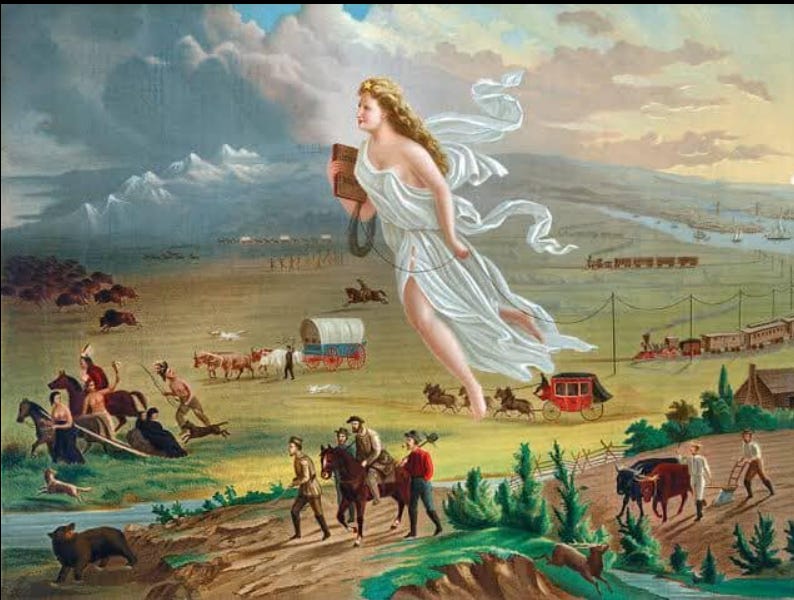
American Progress? John Gast.
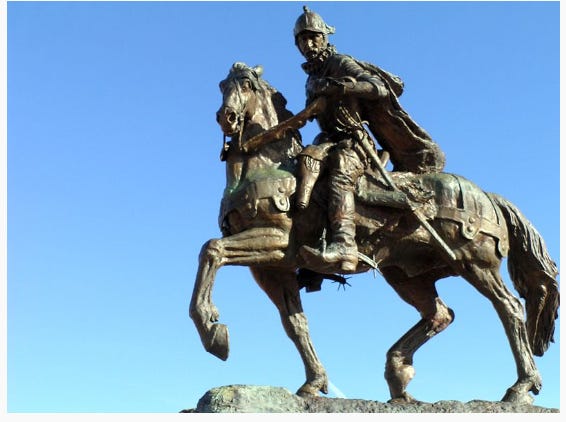
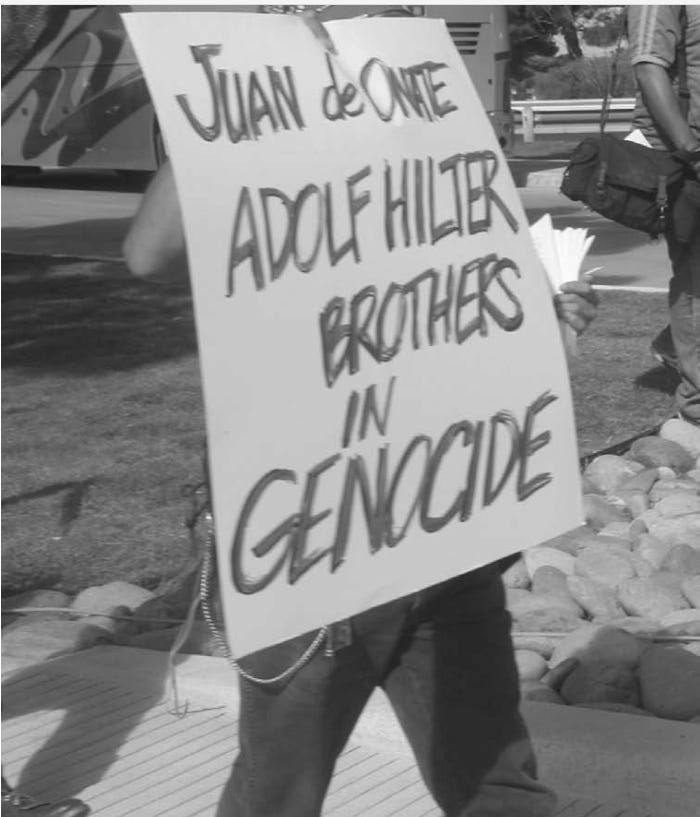
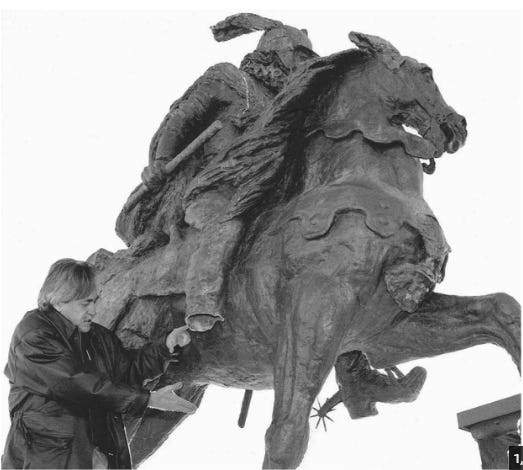
Juan de Oñate was a Spanish conquistador and the first colonial governor of New Mexico who colonized the region, brutally suppressed Indigenous revolts, and was later convicted by the Spanish crown for excessive cruelty.
Major Actions and Expeditions
- Colonized New Mexico: Commissioned by King Philip II in 1595, he led an expedition across the Rio Grande in 1598, established the first permanent Spanish settlement at San Juan Pueblo, and served as New Mexico’s first governor.
- Explored the West and Plains: He led expeditions into the Texas Panhandle, Oklahoma, the Great Plains (reaching Quivira in Kansas), and descended the Colorado River to the Gulf of California.
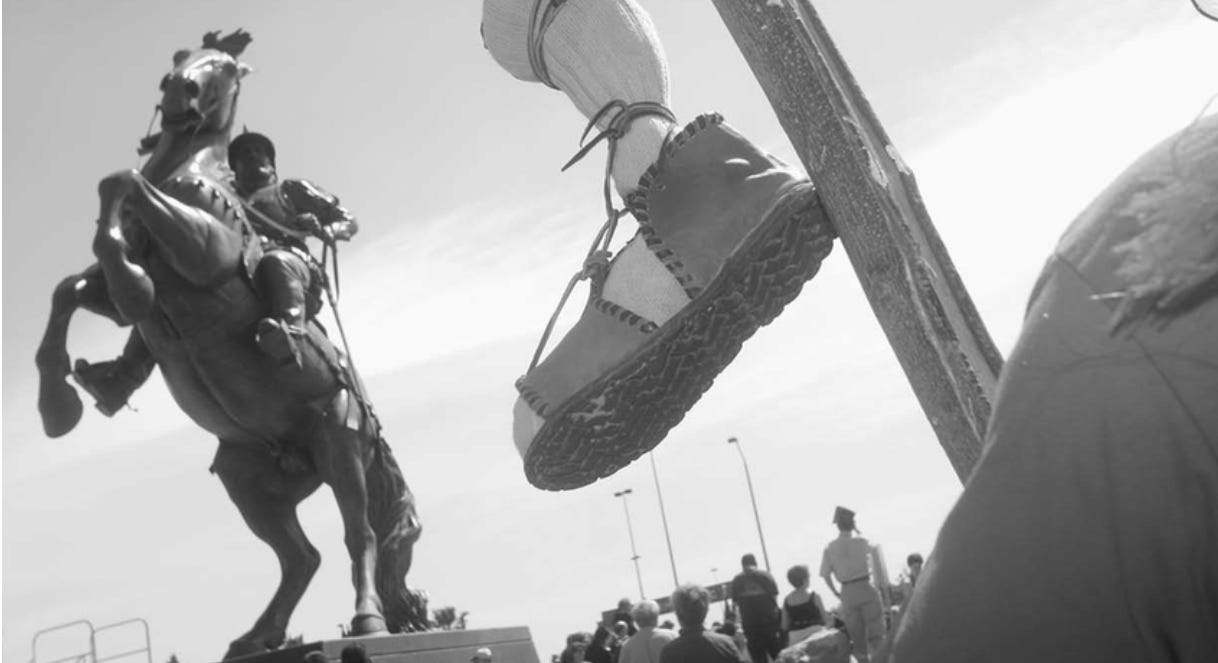
- Perpetrated the Acoma Massacre (1599): After the Acoma Pueblo people rebelled against Spanish demands for supplies and killed several Spanish soldiers, Oñate brutally crushed the resistance. He ordered the deaths of roughly 800 to 1,000 Indigenous people, sentenced surviving men over age 25 to have one foot amputated, and forced women and children into 20 years of servitude.
- Trial and Banishment: Due to his extreme violence, financial mismanagement, and mistreatment of both Native Americans and Spanish colonists, he resigned in 1607 and was tried and convicted by the Spanish government in 1613–1614 for excessive force and cruelty, resulting in fines and banishment from New Mexico.
Israeli Prime Minister Benjamin Netanyahu prays while wearing the tefillin (phylacteries) of Israel Defense Forces 1st Sgt. Sean Carmeli, a Texas-born lone soldier who fell in Operation Protective Edge

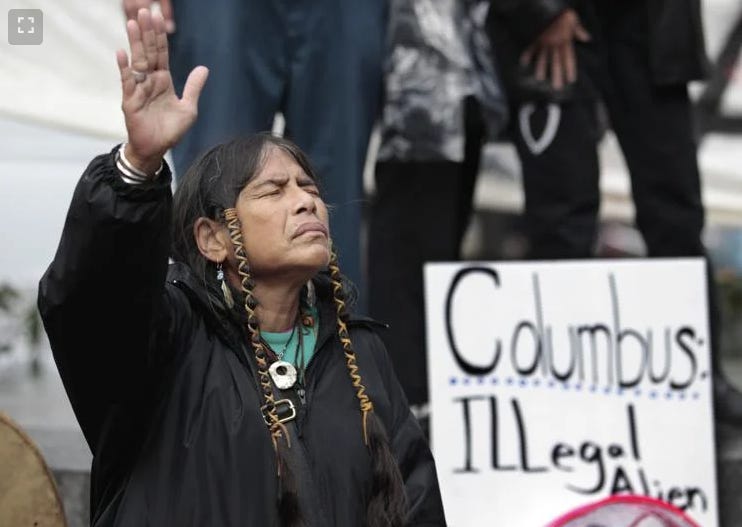
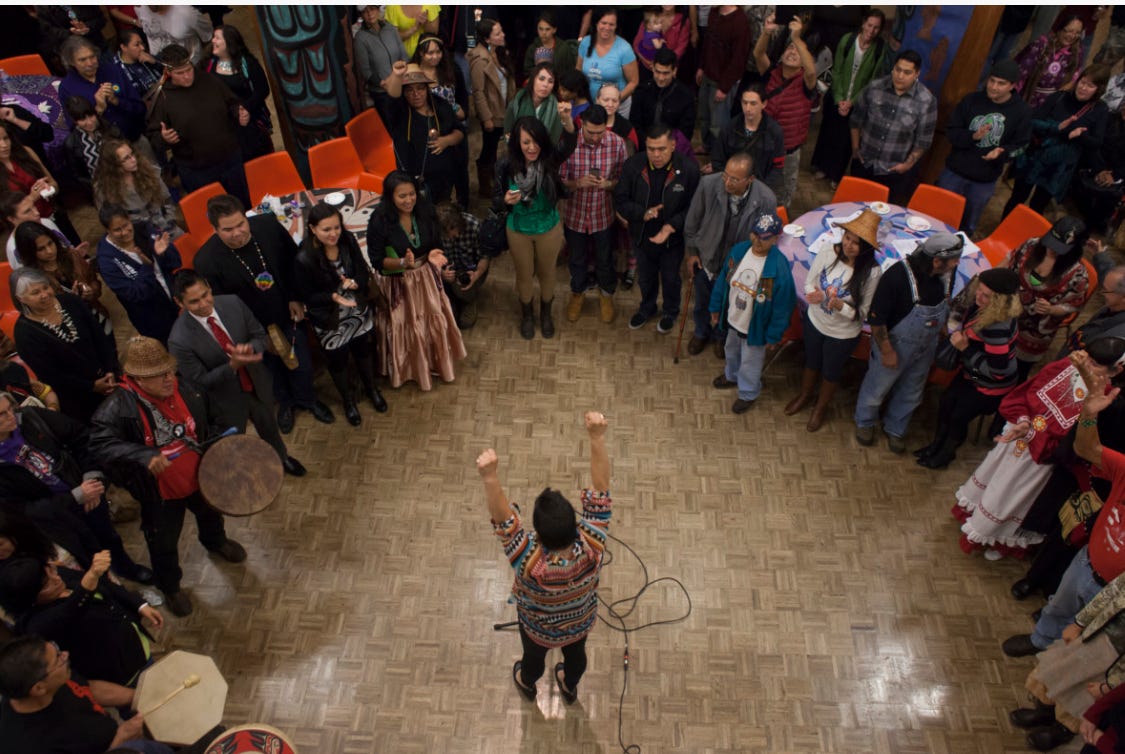
Rene Roman Nose addresses the crowd during a celebration marking Indigenous Peoples’ Day at the Daybreak Star Cultural Center on October 13, 2014 in Seattle, Washington. Earlier that afternoon, Seattle Mayor Ed Murray signed a resolution designating the second Monday in October to be Indigenous Peoples’ Day.
Everyday in the Nation is Palestinian-Indigenous Peoples’ Day:
A group of Palestinian teens performs dabke.

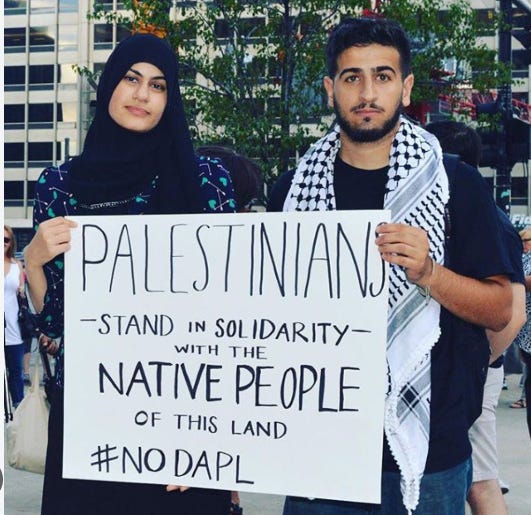
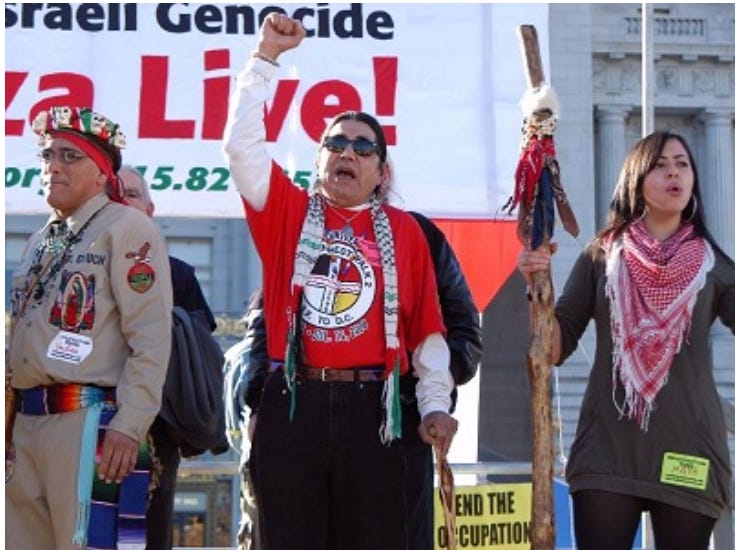
A mural by the Navajo artist Remy denounces Israeli occupation of Palestine.
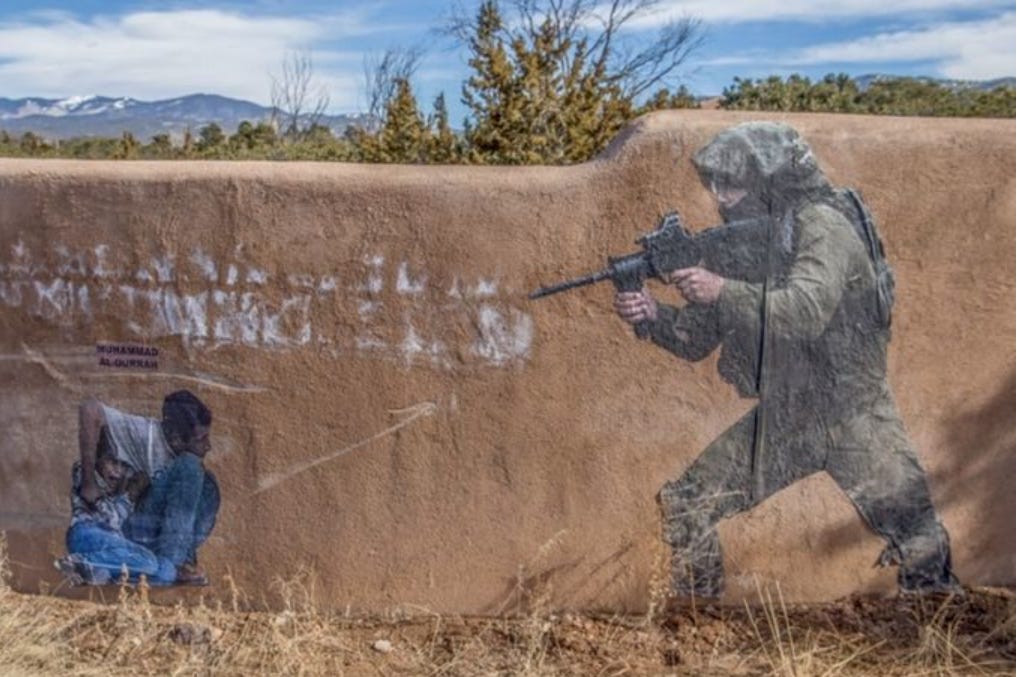
“Indians and wolves are both beasts of prey, tho’ they differ in shape.”
– President George Washington (1789-1797)
“The Arabs will have to go, but one needs an opportune moment for making it happen, such as war.”
– Israel’s first prime minister, David Ben-Gurion (1948-54 and 1955-63)
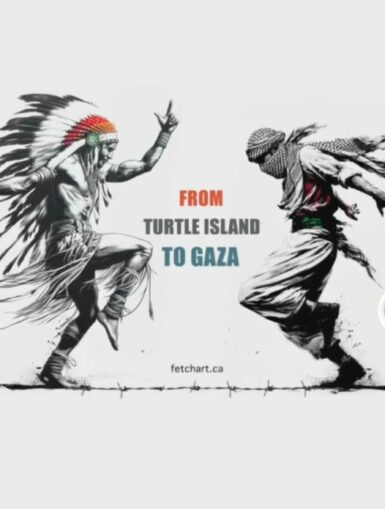
The two countries have used religion to legitimize their land grabs and to ethnically cleanse the indigenous populations. The driving force behind the dispossession of Native American and Palestinians has been the myths of chosenness and exceptionalism; notions that imply supremacy.
The writing, oratory, and political speeches of the colonists, are replete with references to the colonies as the New Canaan, the “shining city upon the hill,” and a country blessed by God. Those same references are expressed today by US officials and politicians.
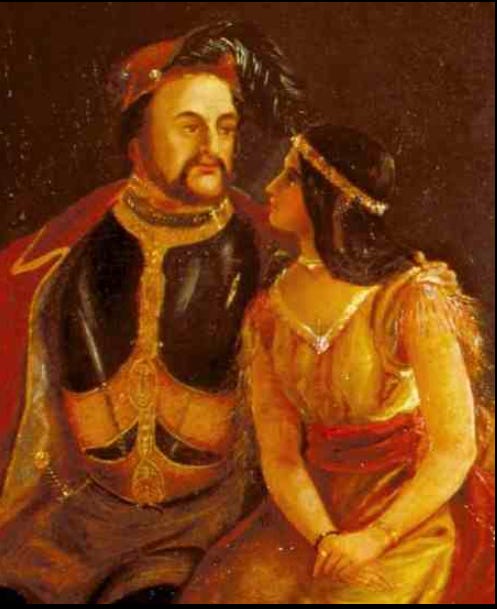
John Rolfe, one of the original founders of the 1607 Jamestown colony, noted that the colonists are “a peculiar people, marked and chosen by the finger of God, to possess (the land), for undoubtedly He is with us.” And in the Massachusetts Bay Colony (founded in 1628), its founder, John Winthrop, spoke of the Puritan covenant with God and that “we must consider that we shall be a city upon a hill. The eyes of all people are upon us.” The ideas of covenant and exceptionalism were internalized by America’s founders and are manifested in national policy to the present.
Like the religious sects from Europe that colonized North America on the belief that they had reached the Promised Land and that their culture and societies were superior to the Native Americans they encountered, Israel’s European founders, its officials, politicians and many of Israel’s Jewish citizens have expressed similar convictions.
In a 2014-2015 Pew Research poll, 48 percent of Israeli Jews said Palestinians should be transferred or expelled from Israel. And in a 2018 Haaretz-Dialog poll, when asked if they believe that the Jews are a chosen people, 56 percent of Israeli Jews said “yes.” The figure rose to 79 percent among self-identified right-wing respondents.
The history of the United States and Israel raises a compelling question: What would both countries be today if their forebearers had believed in working with, learning from and sharing the land with the indigenous people? Removing and inflicting injustices upon them has reinforced in both the US and Israel, political cultures of imperialism and supremacy.
The loss of home, dispossession and exposure to political and physical violence that has shaped the lives of Native Americans and Palestinians are crimes against humanity. But in spite of the hardships, trauma and attempts to erase them, Native American and Palestinians have survived and have grown stronger. Neither group has accepted foreign domination; and their culture of resistance continues to inspire.
– Dr. M. Reza Behnam is a political scientist specializing in the history, politics and governments of the Middle East. He contributed this article to The Palestine Chronicle.

John Winthrop Dreams of a City on a Hill, 1630
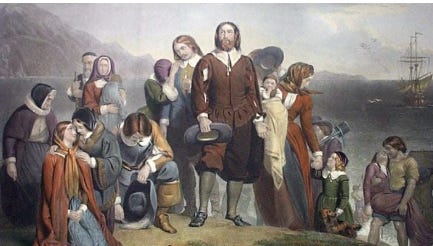
John Winthrop delivered the following sermon before he and his fellow settlers reached New England. The sermon is famous largely for its use of the phrase “a city on a hill,” used to describe the expectation that the Massachusetts Bay Colony would shine like an example to the world. But Winthrop’s sermon also reveals how he expected Massachusetts to differ from the rest of the world.
A Modell Hereof
God Almighty in his most holy and wise providence hath so disposed of the condition of mankind, as in all times some must be rich some poor, some high and eminent in power and dignity; others mean and in subjection.
The Reason hereof:
1st Reason.
First to hold conformity with the rest of His world, being delighted to show forth the glory of his wisdom in the variety and difference of the creatures, and the glory of His power in ordering all these differences for the preservation and good of the whole, and the glory of His greatness, that as it is the glory of princes to have many officers, so this great king will have many stewards, counting himself more honored in dispensing his gifts to man by man, than if he did it by his own immediate hands.
2nd Reason.
Secondly, that He might have the more occasion to manifest the work of his Spirit: first upon the wicked in moderating and restraining them, so that the rich and mighty should not eat up the poor, nor the poor and despised rise up against and shake off their yoke. Secondly, in the regenerate, in exercising His graces in them, as in the great ones, their love, mercy, gentleness, temperance etc., and in the poor and inferior sort, their faith, patience, obedience etc.
3rd Reason.
Thirdly, that every man might have need of others, and from hence they might be all knit more nearly together in the bonds of brotherly affection. From hence it appears plainly that no man is made more honorable than another or more wealthy etc., out of any particular and singular respect to himself, but for the glory of his Creator and the common good of the creature, Man. Therefore God still reserves the property of these gifts to Himself as Ezek. 16:17, He there calls wealth, His gold and His silver, and Prov. 3:9, He claims their service as His due, “Honor the Lord with thy riches,” etc. — All men being thus (by divine providence) ranked into two sorts, rich and poor; under the first are comprehended all such as are able to live comfortably by their own means duly improved; and all others are poor according to the former distribution….
Question: What rule must we observe and walk by in cause of community of peril?
Answer:
The same as before, but with more enlargement towards others and less respect towards ourselves and our own right. Hence it was that in the primitive Church they sold all, had all things in common, neither did any man say that which he possessed was his own. Likewise in their return out of the captivity, because the work was great for the restoring of the church and the danger of enemies was common to all, Nehemiah directs the Jews to liberality and readiness in remitting their debts to their brethren, and disposing liberally to such as wanted, and stand not upon their own dues which they might have demanded of them. Thus did some of our forefathers in times of persecution in England, and so did many of the faithful of other churches, whereof we keep an honorable remembrance of them; and it is to be observed that both in Scriptures and latter stories of the churches that such as have been most bountiful to the poor saints, especially in those extraordinary times and occasions, God hath left them highly commended to posterity…
Thus stands the cause between God and us. We are entered into covenant with Him for this work. We have taken out a commission. The Lord hath given us leave to draw our own articles. We have professed to enterprise these and those accounts, upon these and those ends. We have hereupon besought Him of favor and blessing. Now if the Lord shall please to hear us, and bring us in peace to the place we desire, then hath He ratified this covenant and sealed our commission, and will expect a strict performance of the articles contained in it; but if we shall neglect the observation of these articles which are the ends we have propounded, and, dissembling with our God, shall fall to embrace this present world and prosecute our carnal intentions, seeking great things for ourselves and our posterity, the Lord will surely break out in wrath against us, and be revenged of such a people, and make us know the price of the breach of such a covenant.
Now the only way to avoid this shipwreck, and to provide for our posterity, is to follow the counsel of Micah, to do justly, to love mercy, to walk humbly with our God. For this end, we must be knit together, in this work, as one man. We must entertain each other in brotherly affection. We must be willing to abridge ourselves of our superfluities, for the supply of others’ necessities. We must uphold a familiar commerce together in all meekness, gentleness, patience and liberality. We must delight in each other; make others’ conditions our own; rejoice together, mourn together, labor and suffer together, always having before our eyes our commission and community in the work, as members of the same body. So shall we keep the unity of the spirit in the bond of peace. The Lord will be our God, and delight to dwell among us, as His own people, and will command a blessing upon us in all our ways, so that we shall see much more of His wisdom, power, goodness and truth, than formerly we have been acquainted with. We shall find that the God of Israel is among us, when ten of us shall be able to resist a thousand of our enemies; when He shall make us a praise and glory that men shall say of succeeding plantations, “may the Lord make it like that of New England.” For we must consider that we shall be as a city upon a hill. The eyes of all people are upon us. So that if we shall deal falsely with our God in this work we have undertaken, and so cause Him to withdraw His present help from us, we shall be made a story and a by-word through the world. We shall open the mouths of enemies to speak evil of the ways of God, and all professors for God’s sake. We shall shame the faces of many of God’s worthy servants, and cause their prayers to be turned into curses upon us till we be consumed out of the good land whither we are going.
And to shut this discourse with that exhortation of Moses, that faithful servant of the Lord, in his last farewell to Israel, Deut. 30. “Beloved, there is now set before us life and death, good and evil,” in that we are commanded this day to love the Lord our God, and to love one another, to walk in his ways and to keep his Commandments and his ordinance and his laws, and the articles of our Covenant with Him, that we may live and be multiplied, and that the Lord our God may bless us in the land whither we go to possess it. But if our hearts shall turn away, so that we will not obey, but shall be seduced, and worship other Gods, our pleasure and profits, and serve them; it is propounded unto us this day, we shall surely perish out of the good land whither we pass over this vast sea to possess it.
Therefore let us choose life,
that we and our seed may live,
by obeying His voice and cleaving to Him,
for He is our life and our prosperity.
— John Winthrop, “A Model of Christian Charity,” in A Library of American Literature: Early Colonial Literature, 1607-1675, Edmund Clarence Stedman and Ellen Mackay Hutchinson, eds. (New York: 1892), 304-307.
https://www.youtube.com/live/A-HK-uV3nVY?si=O8hcHytNMttarw8e

Jewish intellectual leaders have also embraced this notion of American exceptionalism. In a sermon in 1939, R. Moshe Feinstein lauded the 150th anniversary of the ratification of the United States Constitution, contrasting American liberty with the Soviet “Amalek.” (Darash Moshe, vol. I, 415). Bernard Revel heralded the new Yeshiva College as the “House of God on the Hilltop.” Similarly, R. Jonathan Sacks championed the motif of covenant in “Christian Charity” as a model for our own thinking as religious Jews.
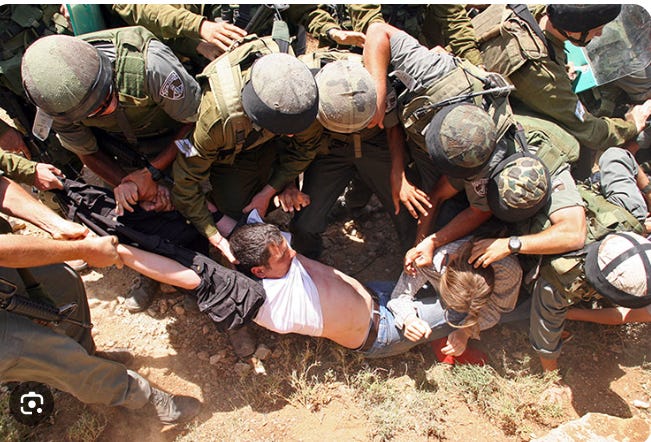
That Jewish Columbus Day!
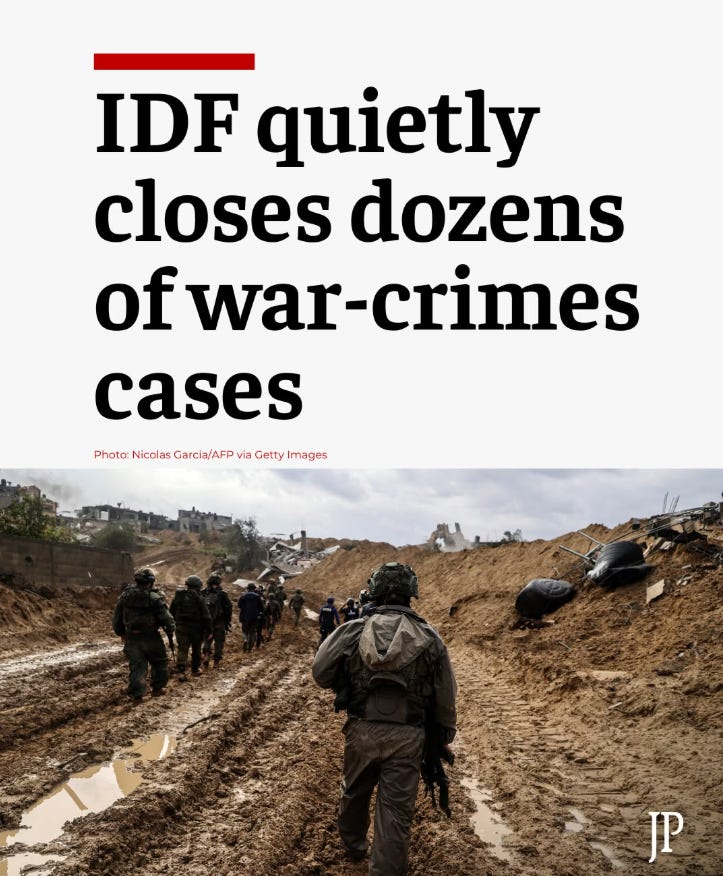
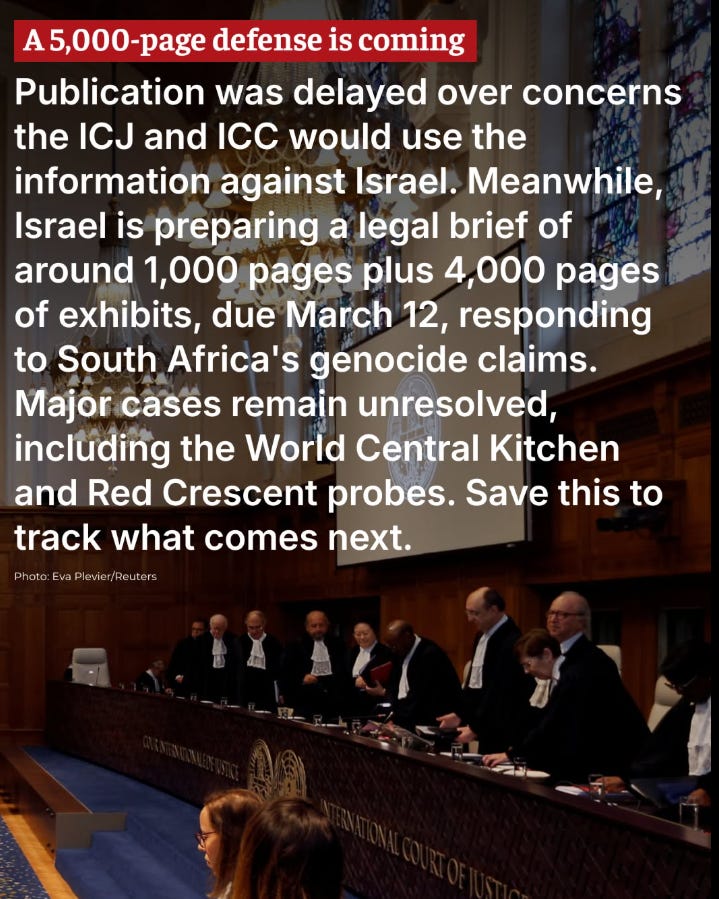
Francesca Albanese, the United Nations Special Rapporteur on the situation of human rights in the Palestinian territories occupied since 1967, has published multiple reports accusing the Israeli military (Israel Defense Forces, or IDF) and the Israeli government of committing serious violations of international law, war crimes, and acts of genocide during military operations in Gaza and the West Bank.

Key Reports and Accusations
- “Anatomy of a Genocide” (March 2024):
- Presented to the UN Human Rights Council, Albanese’s report concluded that there are “reasonable grounds” to believe that Israel has crossed the threshold of committing genocide against Palestinians in Gaza.
- The report accuses the IDF of systemic patterns of violence, including the intentional targeting of civilians, hospitals, and protected infrastructure, massive forced displacement, and the creation of life-threatening conditions through the restriction of food, water, and medical aid.
- Reports on Occupied Territories and Unlawful Killings:
- Albanese’s periodic reports have condemned IDF military tactics in the West Bank and Gaza, citing unlawful killings, arbitrary detentions, and the destruction of civilian property.
- She has alleged that the rules of engagement used by the IDF display a profound disregard for the distinction between combatants and civilians, violating the Geneva Conventions.
This article was posted on Wednesday, October 14th, 2026 at 8:00am and is filed under Activism, Gaza, Genocide, Indigenous Peoples, Occupation, Palestine, Turtle Island, Tyranny, United States, Zionism.