




“Before the palefaces came among us, we enjoyed the happiness of unbounded freedom and were acquainted with neither riches, wants, nor oppression.”
— Chief Tecumseh1“Sleep No Longer, O Choctaws and Chickasaws,” 1811, in Great Speeches by Native Americans, ed. Bob Blaisdell (Mineola, NY: Dover Publications, 2000)
“When I fought to protect my land and my home, I was called a savage. When I neither understood nor welcomed his way of life, I was called lazy. When I tried to rule my people, I was stripped of my authority.”
— Chief Dan George2“A Lament for Confederation,” in Canadian Literature in English: Texts and Contexts, vol. 2, edited by Laura Moss and Cynthia Sugars. Toronto: Pearson, 2008.
“For the colonized subject, objectivity is always directed against him.”
“In capitalist countries a multitude of sermonizers, counselors, and ‘confusion-mongers’ intervene between the exploited and the authorities.”
“Everything can be explained to the people, on a single condition that you want them to understand.”
— Frantz Fanon, The Wretched of the Earth
I. The Arrogance of the Comfortable
There is a particular species of Western commentator—progressive in self-declaration, radical in aesthetic, imperial in practice—who, in their privilege, cannot resist the urge to adjudicate the internal affairs of sovereign native nations. They arm themselves with the appropriated vocabulary of liberation, speaking in sophisticated, decorative Blind Language, and deploy it as a weapon against the very revolutions that birthed it.
The recent sanctimony directed at Iran is instructive. A Western voice, draped in the language of anti-imperialism, presumes to sit in judgment of Ayatollah Khomeini—to weigh his legacy, to measure his “crimes,” to determine, with the casual authority of the master, whether the leader of an anti-imperialist revolution qualifies as a martyr.
Read the following formulation, for it reveals everything:
“Crappy CBC coverage aside, ‘a religious leader with millions of followers’ was also a butcher who murdered, jailed and tortured dissidents who were not themselves US/Israel shills, but people legitimately struggling for their liberation from a regime that at one point killed socialists after the revolution. So this is dishonest revisionism and any Iranian who has suffered severe oppression at the hands of this regime know that well and though their suffering has been disgracefully weaponized by the reckless jingoist assault on Iran at this moment, doesn’t exonerate the regime. How quickly the foolish decapitation of the regime has martyred Ali Khamenei and remade him into a hero of anti-imperialist resistance.”3This public comment was made by a participant in the Palestine solidarity movement. The reader is invited to examine the position this discourse occupies, the language it deploys, and how both stand in contrast to established Indigenous and international socialist perspectives.
The forensic structure is familiar. It is the voice of the investigator, the prosecutor, the colonial magistrate who believe their objectivity is universal because their position is unmarked. They acknowledge, in passing, that Iranian suffering “has been disgracefully weaponized by the reckless jingoist assault on Iran.” They offer this as evidence of their own nuance, their own sophistication. And then, having performed this ritual inoculation, they proceed to the real work: the condemnation of the native leader, the dismissal of the native revolution, the re-inscription of the native as morally deficient.
This is not analysis. This is the colonial gaze disguised as solidarity.
II. The Question: Who Has the Right to Judge?
“The starting point of critical elaboration is the consciousness of what one really is, and is therefore knowing yourself as a product of the historical process to date, which has deposited in you an infinity of traces, without leaving an inventory. Such an inventory must therefore be made at the outset.”
— Antonio Gramsci, Prison Notebooks4A primary aim of this text, as with previous essays, is to recover and center organic, revolutionary theorists whose work has been systematically marginalized within Western traditional, progressive circles. These thinkers represent a universal scientific socialist method and tradition, and their absence—or their distortion and constant defaming—from contemporary discourse is not accidental. It is the cultural dimension of the colonial project this essay describes. Their work demonstrates that anti-imperialist theory was never the property of the metropole, and reintroducing their contributions, including the tone of their discourse and vocabularies, a scalpel to be used in the struggle, is itself an act of resistance.
The fundamental question is never asked: By what authority does a citizen of a Western capitalist state—the beneficiary of centuries of plunder, the inhabitant of a polity built on settler-colonial genocide and ongoing imperial violence—presume to judge the internal contradictions of a sovereign native revolution?
The question is not asked because the answer is unbearable. The authority is assumed. It is the unearned inheritance of “whiteness,” of Westernness, of the position that objectivity is a tool one wields toward the colonized, never a weapon turned against oneself.
Fanon understood the psychological operation at work:
“The colonized is elevated above his jungle status [the colonial prison] in proportion to his adoption of the mother country’s cultural standards.”
— Black Skin, White Masks
The Western commentator who condemns Khomeini while performing solidarity with “legitimate” Iranian dissidents is engaged in this exact operation. They are measuring the native revolution against the mother country’s cultural standards—yet, the standards of the commentator’s own state, Canada, a state built on genocide—of Indigenous nations, residential schools that murdered children, the ongoing theft of unceded land, the suppression of Indigenous political thought, the complicity in every US imperial war.
When Chief Dan George described how his people were called “savage” for fighting to protect their land, “lazy” for refusing to abandon their way of life, and unfit to rule themselves when they asserted their sovereignty—he named a colonial language that never died. It merely evolved.
The commentator before us wields the same language, updated for a new century. “Butcher” replaces “savage.” “Murdered, jailed and tortured” replaces the unfit “lazy” native. The accusations are dressed in the vocabulary of human rights, but they perform the identical colonial function: they mark the native as morally deficient, unfit to rule themselves, requiring external judgment. The words are polished; the work is the same.
When the Iranian Revolution—a genuine anti-imperialist upheaval that expelled the Shah and broke with Washington—commits its own contradictions—these become the exclusive focus of progressive condemnation. Why? Because Iran refuses. Because Iran, in its very existence, constitutes a refutation of the Western progressive’s fantasy: that liberation must look like us, think like us, and above all, seek our approval.
In a scientific socialist theory, the primary contradiction is the fundamental antagonism that must be resolved before other contradictions can be addressed. For Palestine, the primary contradiction is zionism/imperialism versus Arab national liberation. For Iran, the primary contradiction is US imperialism versus Iranian sovereignty.
From this framework, the Western commentator who focuses on internal Iranian repression is not just adding nuance—he is misidentifying the determinant primary contradiction. They are treating a secondary contradiction (state-society tensions) as if it were primary, which in practice serves the imperial project by diverting attention from the actual primary struggle.
This explains why this socialist thinking seems to “dismiss” internal Iranian dissent. It’s not dismissing dissent as such—it’s insisting on correct strategic priority.

III. The Anatomy of Blind Language: A Kanafanian Dissection
“The ideological deficiency, not to say the total lack of ideology, on the part of the national liberation movements—which is explained by the ignorance of the historical reality which these movements aspire to transform—constitutes one of the greatest weaknesses of our struggle against imperialism.”
— Amílcar Cabral, The Weapon of Theory
Ghassan Kanafani, the revolutionary martyr, writer and comrade, understood that the colonizer’s language is never innocent. He named the phenomenon “blind language” —discourse that appears to describe but actually obscures, that seems to analyze but actually justifies, that wears the mask of objectivity while serving the structure of domination.
The public comment before us is not the product of ignorance. It is not a clumsy hot take from someone who doesn’t know better. It is a political discourse, and it has a function. It is a masterpiece of blind language—sophisticated, deliberate, and deadly. Words have been carefully chosen. Every phrase performs a function. The whole is designed to do one thing: condemn the native revolution while appearing reasonable, nuanced, and even anti-imperialist.
Let us attempt to read it as the martyr Kanafani would read it—as a text to be dissected.
Function One: Establishing Innocence in Order to Prosecute
“Crappy CBC coverage aside…”
The opening is a credibility device. “Crappy” is casual, almost lazy—it signals that the speaker is above mainstream media, that they see through establishment narratives. For a progressive audience, this is the password. They have proven he’s not a dupe. They can be trusted.
But note what “aside” does. It sets aside the imperial propaganda machine—the CBC, which serves the Canadian state and its imperial master—in order to focus on what really matters: the crimes of the native. They acknowledge the empire lies, and then proceed exactly where the empire wants them to go. The structure is: Yes, they deceive us about Iran, but let’s talk about what Iran did.
Function Two: The Accurate Statement as Ignition
“…a religious leader with millions of followers…”
This is the ignition. The accurate statement that cannot be denied, cannot even be questioned—becomes the foundation for everything that follows.
The commentator knows they cannot simply dismiss Khomeini’s iconic position. That would be too crude, too obviously biased. So they do something far more sophisticated: they embed the position in a framework that makes it irrelevant.
The structure is: Yes, he had millions of followers. But he was also a butcher.
The “also” is the pivot. It concedes the first claim only to weaponize the second. The popularity becomes not evidence of legitimacy but a problem to be explained: How could someone so iconic do such terrible things? The commentator now positions himself as the one who will solve this mystery, who will reveal the truth behind the appearance.
And the rest of the comment provides the answer: murders, jailings, torture, the killing of socialists. The millions of followers, with their reasons, their histories, their lived relationship to the man who led their revolution—gone. What remains is only the butcher. By the end, the reader has forgotten the millions of Iranians entirely. They have been erased by the weight of accusation.
This is the function’s structural sophistication: use an undeniable truth as the foundation for its own erasure.
Function Three: The Grammar of Eternal Essence
“…was also a butcher who murdered, jailed and tortured dissidents…”
Notice the weight of eternal essence. These are not presented as events in a specific historical context—the consolidation of a revolution under imperial siege—but as what Khomeini essentially was. The verbs accumulate: murdered, jailed, tortured. Three blows. The reader feels the weight before they can ask: When? Why? Under what conditions?
The word “dissidents” is carefully chosen. It is a term of sympathy in Western discourse—the brave individual standing against the oppressive state. But here it erases the political content of those who opposed the revolution. Some were socialists, yes. Some were monarchists. Some were agents of foreign powers. The comment acknowledges “US/Israel shills” in passing, but then moves immediately to “people legitimately struggling.” The effect is to collapse all opposition into legitimate dissent, erasing the imperial dimension entirely.
Function Four: The Vocabulary of Resistance Weaponized Against Resistance
“…people legitimately struggling for their liberation…”
Here the commentator commits the most obscene act of this entire performance. They appropriate the vocabulary of anti-imperialist struggle and turn it against an anti-imperialist revolution.
“Struggle” (al-nidal)—the word that names the fundamental relation between colonizer and colonized. “Liberation”—the horizon of every oppressed and occupied people. These words were forged in the fire of resistance to imperialism and foreign interventions. They belong to the revolutionaries who overthrew the Shah, who broke with Washington, who built a native state on the principle of refusing imperial domination.
And now they are deployed against that very revolution. The dissidents struggling against Khomeini are “legitimately struggling for their liberation”—as if liberation from the anti-imperialist native state were the same as liberation from the imperialist one. As if the revolution had not already liberated Iran from 25 years of CIA domination. As if the word could be emptied of its meaning and history and refilled with whatever content the West approves.
Function Five: Replacing the Imperial Context with Native Contradictions
“…from a regime that at one point killed socialists after the revolution.”
The Iranian Revolution, like all revolutions, had internal contradictions. But the truth is deployed to erase the revolution’s anti-imperialist character entirely.
The phrase “at one point” is strategically vague. It floats in time, unmoored from context. The commentator does not ask why “socialists” were suppressed—what threats they posed, what alliances they formed, what the revolutionary government feared. They simply present the fact as self-evident proof of the “regime’s criminality.”
And in doing so, they make the revolution’s internal struggles the whole story. The revolution’s external struggle—against the US empire, against 47 years of sanctions—simply disappears. The revolution is reduced to its crimes against its own people.
Function Six: Native Crimes Eternal, Imperial Crimes Episodic
“…their suffering has been disgracefully weaponized by the reckless jingoist assault on Iran at this moment…”
Look closely at this phrase. Every word performs colonial work:
“Reckless” — not systematic, not structural, not designed. Recklessness implies carelessness, lack of foresight, almost innocence. It is the opposite of a coordinated 75-year campaign of coups, sanctions, and destabilization. It suggests the empire doesn’t really mean it; it’s just acting impulsively.
“Jingoist” — a term for excessive patriotism, for flag-waving enthusiasm. This reduces imperialism to a feeling, an attitude, rather than a structural necessity of capitalism in its imperialist stage. The empire doesn’t need Iranian oil and regional hegemony; it just has some overly excited politicians.
“Assault” — a single action, a strike, a blow. Not a siege, not a sanctions regime that has starved a nation for decades, not a continuous war. An assault happens and then it’s over.
“At this moment” — the masterstroke. The imperial attack is temporary, contingent, a response to circumstances. It exists in the present tense, soon to be past. It is not eternal. It is not structural. It is a “moment” that will pass.
Now compare this to how the comment describes the Iranian “regime.” The regime was a butcher. It murdered, jailed, and tortured—verbs in the past tense that nonetheless feel eternal, structural, inherent to the native’s very nature. These actions are presented as the regime’s essence, without beginning and without end, simply what it is.
This is the colonizer’s oldest temporal trick: native crimes are eternal; imperial crimes are episodic. The native oppresses because of who he is; the imperial power intervenes because of what it sometimes does, now, in response, temporarily. The native’s violence is essence; the empire’s violence is exception.
But the truth is the inverse. The imperial attack on Iran is not a “moment.” It is a structure—75 years of coups, sanctions, weapons shipments, and regime-change operations. It is the CIA, MI6, and Mossad overthrowing Mossadegh in 1953. It is the US arming Saddam to kill Iranians. It is the Trump administration assassinating Soleimani. It is the ongoing economic war that targets Iranian children’s access to medicine—and now massacres children at their schools. This is not a moment. This is the machine operating at its designed capacity.
And the Iranian Revolution’s contradictions? They are not eternal. They are historical—produced by specific conditions, shaped by the colonial encounter, subject to change through the struggle of Iranians themselves. To freeze them as “what the regime is” is to deny history, to deny the possibility of transformation, to deny the very logic that the commentator claims to employ.
Function Seven: Rigging the Courtroom
“…doesn’t exonerate the regime.”
And here is the verdict. After all the concessions, all the nods to balance, all the performative even-handedness—the conclusion is exactly what the empire wants: the native stands condemned.
The structure is now clear:
- Establish credibility by dismissing imperial media
- Acknowledge the empire’s attack
- Concede the native’s popular support
- Then bury the native under accumulated accusations
The native cannot win. Any defense is “exoneration.” Any refusal to join the condemnation is “dishonest revisionism.” The terms of debate are set entirely by the colonizer. And how the journey from that undeniable truth to the charge of “dishonest revisionism” unfolds becomes an unimportant detail.
Function Eight: Erasing Native Agency
“How quickly the foolish decapitation of the regime has martyred Ali Khamenei and remade him into a hero of anti-imperialist resistance.”
The final sentence performs the ultimate erasure. The assassination of the Iranian Supreme leader, along with his family and grandchildren—a cowardly war crime by any standard—is reduced to “foolish decapitation.” Not murder, not state terrorism, not illegal assassination—just foolish. A tactical error. A public relations mistake.
And the response of the Iranian people—the millions who honor Khamenei, who see in him a symbol of resistance to 75 years of imperial aggression—is not genuine grief or genuine solidarity. It is a “remaking,” a fabrication, a propaganda exercise. The people become dupes. Their anti-imperialism becomes manufactured.
And one should ask: Who made this commentator the keeper of martyrs?
What This Reading Reveals
This comment is not the work of an ignorant person. It is the work of someone trained in the rhetoric of domination—someone who knows how to deploy the vocabulary of liberation to serve the project of subjugation. The whole is a machine designed to produce one outcome: the condemnation of the native revolution by those who claim to stand against imperialism.
This is blind language at its most sophisticated. It does not attack the revolution directly—that would be too blunt, too easily recognized. Instead, it inhabits the language of the revolution and turns it inside out. It speaks of struggle and liberation while serving the forces that crush struggle and prevent liberation. It performs anti-imperialism while doing imperialism’s work.
The internal repression the commentator condemns does not exist in a vacuum—it was forged in the crucible of colonial violence, maintained under decades of imperial siege, and is continuously reproduced by the very sanctions and threats.
IV. The Scientific Socialist Framework
“The traditional intellectuals put themselves forward as autonomous and independent of the dominant social group.”
— Antonio Gramsci, Prison Notebooks
The scientific socialist framework—which the commentator has exploited and weaponized against the Iranian Islamic Revolution—demands that we ask: What work does this condemnation perform beyond its internal rhetoric?
The eight functions of blind language are not merely linguistic tricks. They serve material purposes in the colonial project. So let’s emphasize:
Distinction: The commentator distinguishes himself from the crude imperialist, producing himself as the reasonable critic who can be trusted. This allows the empire’s cultural apparatus to claim it represents “all sides.”
Erasure: The revolution’s legitimacy—rooted in a genuine mass uprising against a U.S.-installed dictator—is dismissed. Millions of people become dupes. Their political agency is annihilated.
Colonial maintenance: By establishing himself as the arbiter of revolutionary legitimacy, the commentator reinforces that the native’s political existence requires validation from the metropole. The native cannot simply be sovereign; they must pass through Western judgment.
Temporal distortion: Native crimes become eternal (requiring permanent supervision); imperial crimes become episodic (excused as temporary responses).
Semantic inversion: The vocabulary of resistance is stolen and redeployed against resistance, making genuine solidarity nearly impossible to articulate.
This condemnation is not idle speech. It is fuel for the colonial machine—the discursive energy that keeps the engine of imperial judgment running while the material violence of sanctions, bombs, and regime-change operations continues unabated.
This is the work the condemnation performs: not truth-telling, but colonial maintenance through linguistic means
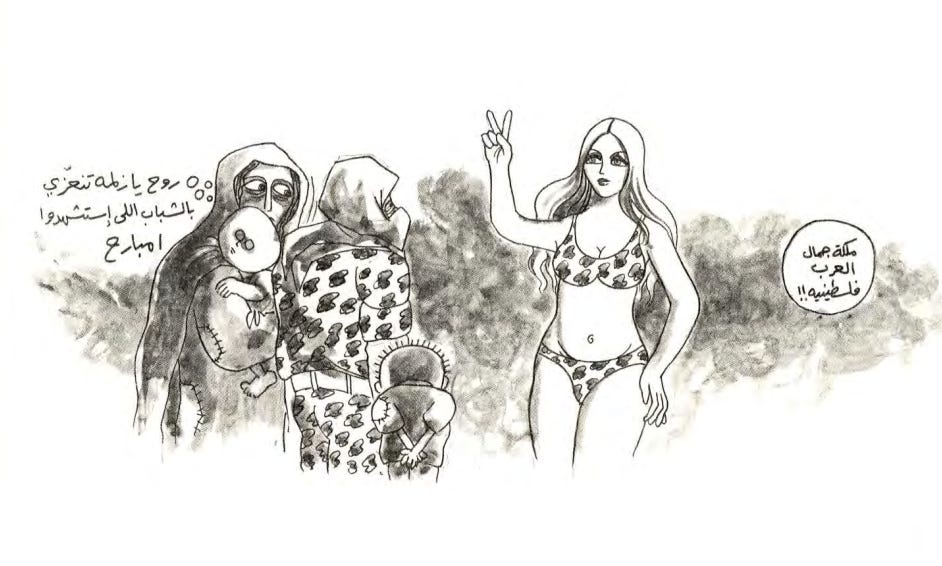
Miss Arab is Palestinian!! – Go, man, offer condolences for the young men who were martyred yesterday.
V. The Weaponization of Oppression
The specific content of the condemnation is also predictable. It centers on three categories: women’s rights, religious authority, and political violence. These are the categories through which the West has always produced the colonized as inferior, as requiring intervention, as deserving of domination.
Fanon traced this operation in A Dying Colonialism, analyzing how French colonialism in Algeria seized upon the veil as a symbol of native backwardness and women’s oppression:
“In the colonialist program [of divide and conquer], it was the woman who was given the historic mission of shaking up the Algerian man. Converting the woman, winning her over to foreign values, wrenching her free from her status, was at the same time achieving real power over the man and attaining a practical, effective means of destructuring Algerian culture.”
But there is a deeper dialectic at work that Fanon also understood—one the contemporary Western commentator never grasps. When colonialists or oppressors pressure a colonized society using progressive “Western ideas”—concerning women’s rights, gender equality, religious authority, or accusations of “backwardness”—two major problems arise that are inherent to the colonial situation itself.
First, many of the very phenomena and forms of oppression being criticized were actually established or encouraged by Western colonization. The Shah’s “secularism,” celebrated by the West as “modernization,” was not a break from patriarchy but a specific form of it—one that tortured and imprisoned religious dissidents alongside leftists, that opened Iranian markets to Western exploitation, that served US regional hegemony while presenting itself as liberation. The “secularism” the West praises was the vehicle for imperial domination; the religious authority the West condemns emerged in part as a response to that domination. The colonizer created the conditions they now condemn, then presents those conditions as proof of native unfitness for sovereignty.
The contemporary Western commentator who condemns Iran for its treatment of women never asks how Western sanctions—imposed by the very states whose values they champion—have devastated Iran’s economy, destroyed its healthcare system, and produced immiseration that falls hardest on women. They do not ask how Western feminism, with its comfortable blindness to imperialism, functions as a cover for the projection of military power. They do not ask how the very “religious authority” they condemn emerged as a response to the Shah’s Western-backed “secularism,” which tortured and imprisoned religious dissidents alongside leftists.
Second, when people’s religious beliefs are attacked and labeled “backward” within the context of colonization, those beliefs and practices often transform into symbols of resistance. The veil in Algeria, the hijab in Iran, the cross under Roman persecution, the kuffiyeh in Palestine—the oppressor’s contempt consecrates what it targets. This is not a defense of patriarchy or religious authority as such; it is a description of how colonial pressure reshapes the native’s relationship to their own culture. What was custom becomes identity; what was tradition becomes defiance; what was merely worn becomes worn as a flag.
Fanon understood this transformation intimately. He watched Algerian women reclaim the veil not because they were forced to, but because the French had made the veil a battleground. The colonizer’s attack on native culture does not liberate the native—it radicalizes the native’s relationship to what is attacked. The Western commentator who condemns the hijab in Iran today is not helping Iranian women; they are repeating the French colonial gesture, and they will produce the same result: the transformation of religious practice into national resistance.
Instead of grasping this dialectic, the Western commentator deploys these categories as weapons. They use “women’s rights” to attack a native revolution. They use “secularism” to delegitimize a religious politics they have not bothered to understand. They use “democracy” to measure a society whose sovereignty they have never respected.
And in doing so, they reproduce the colonial relation: the West as teacher, the native as student; the West as judge, the native as defendant; the West as universal, the native as particular.
But the commentator has missed something more fundamental. Religion itself.
“Religious suffering is, at one and the same time, the expression of real suffering and a protest against real suffering. Religion is the sigh of the oppressed creature, the heart of a heartless world, and the soul of soulless conditions. It is the opium of the people.”
— Karl Marx, A Contribution to the Critique of Hegel’s Philosophy of Right
The Western progressive who quotes this passage—and they quote it often—always forgets the second half. And they misunderstand the first. In Marx’s time, opium was not primarily a recreational drug—it was a painkiller. The only relief available to those who were suffering, wounded, dying. When Marx called religion the opium of the people, he was not dismissing it as mere fantasy. He was acknowledging that the oppressed reach for religion for the same reason the wounded reach for morphine: because the pain is unbearable and nothing else offers relief.
Marx does not say: attack the opium. He says: the demand to give up the illusion is the demand to give up the condition that needs illusion.
The proper object of critique is not the painkiller but the pain. Not the sigh but the suffering that produces it. Not religion but the heartless world that makes religion necessary.
The commentator who condemns Iran’s religious governance has reversed this order. They attack the sigh while ignoring the wound. They mock the painkiller while their own society—the society whose values they champion, whose sanctions they barely mention, whose imperial wars they quietly regret but never oppose—keeps inflicting the pain.
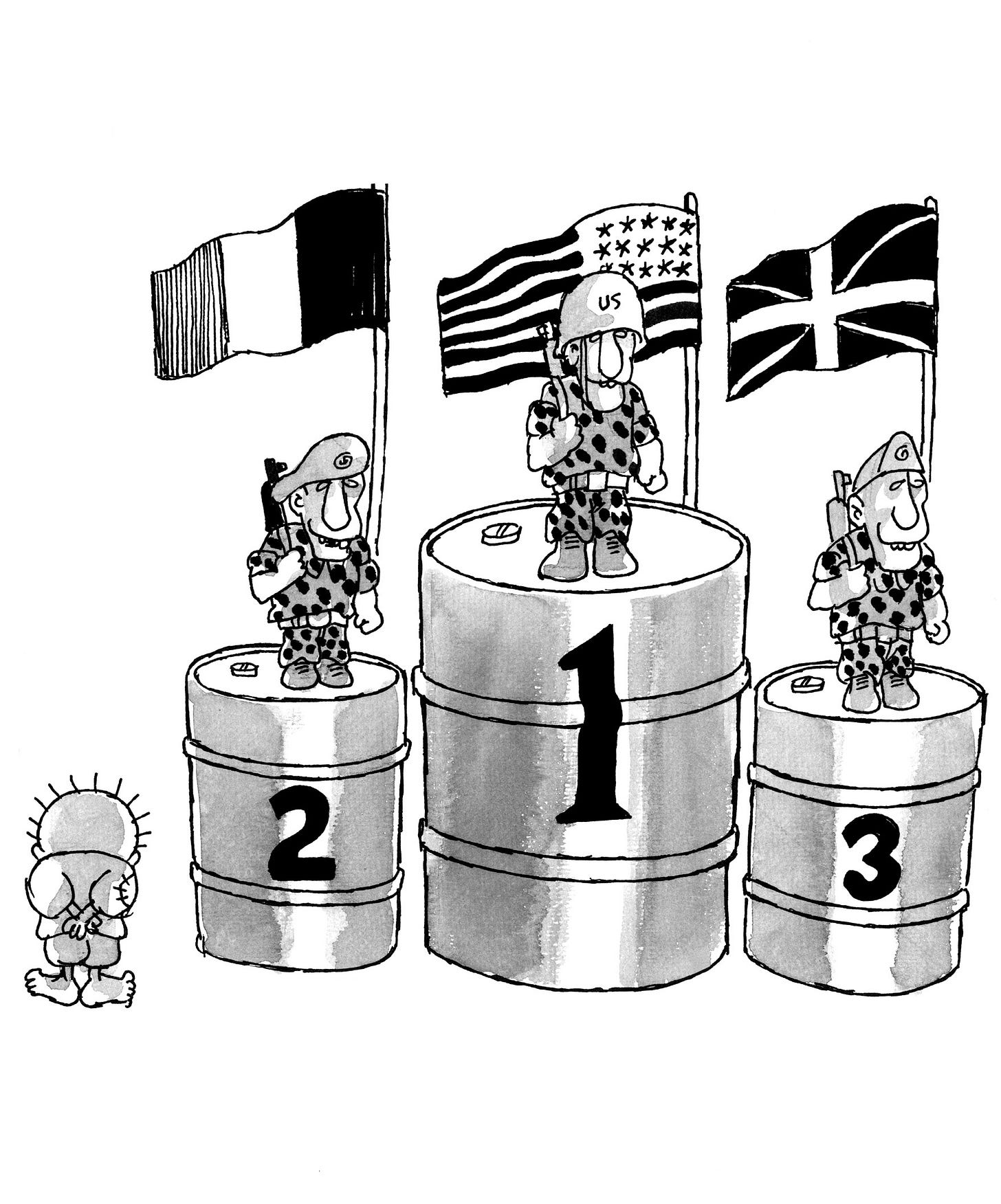
“If tomorrow, Morocco were to declare war on France, India on England, Persia or China on Russia, and so forth, those would be ‘just’ ‘defensive’ wars, irrespective of who attacked first; and every Socialist would sympathise with the victory of the oppressed, dependent, unequal states against the oppressing, slave-owning, predatory ‘great’ powers.”
— Lenin, Socialism and War (1915)
The distinction between oppressor and oppressed nations is not a diversion from class struggle but a necessary component of it. The socialist cannot be neutral between the oppressor nation and the oppressed nation because class struggle operates through national relations. To support Iranian sovereignty against US imperialism is to take a class position—the position of the globally oppressed against the globally dominant.
This condemnation of Iran is not an isolated incident. It is not the unfortunate hot take of a single misguided commentator. It is one front in a broader, systematic attack on native sovereignty—an attack that operates through the same logic whether aimed at Tehran, Gaza, Caracas, or the Indigenous nations of North America.
The machine operates through a predictable rhythm:
First, the native asserts sovereignty—through revolution, through resistance, through the simple act of existing as a people with their own history and their own future.
Second, the imperial apparatus responds with material violence—sanctions that starve, bombs that destroy, covert operations that destabilize.
Third, the cultural apparatus mobilizes to justify this violence—producing narratives of native “backwardness,” “authoritarianism,” “human rights abuses” that make imperial aggression seem necessary, even noble.
Fourth, the Western progressive enters—not to oppose the material violence, but to refine the cultural narrative. They offer “nuance.” They acknowledge that sanctions are bad while insisting that the native “regime” is worse. They condemn the bomb while cataloging the native’s “sins.” They perform the ritual of distinction that allows the imperial project to continue with a clean conscience.
At the state level, the performance is even more brazen. On January 20, 2026, at the World Economic Forum in Davos, Prime Manager Mark Carney represented land stolen from Indigenous peoples—land soaked with generations of genocide, land whose original inhabitants his state continues to disrupt and expropriate—yet spoke of sovereignty. He warned that great powers now use “economic integration as a weapon, tariffs as leverage, and financial infrastructure as coercion.” He declared that middle powers must unite to avoid being “on the menu.”
The ex-governor of Bank of England performed concern for the sovereignty of nations while his own settler-colonial state has never recognized Indigenous sovereignty, while his military aids the genocide in Gaza, Occupied Palestine, and while his banks finance the very coercion he condemns. This is not hypocrisy; it is the colonial mind operating at full, official capacity. The same logic that allows the progressive to judge Iran allows the Prime Manager to lecture the world on sovereignty from stolen land. The words are different; the work is the same.
This is the division of labor in the colonial machine. The open imperialist drops the bombs. The Western progressive polices the legitimacy of the native. Both serve the same structure. Both reproduce the same relation.
The condemnation of Iran, then, is not about Iran. It is about maintaining the right of the West to judge—to determine which revolutions are legitimate, which leaders are martyrs, which peoples deserve sovereignty. It is about ensuring that the native never escapes the filter of Western approval.
VII. The Fracture of Solidarity
But the damage is not only to Iran. The damage is to solidarity itself.
When a Western voice condemns Khomeini while performing concern for “legitimate” Iranian dissidents, they are not simply expressing an opinion. They are structuring the field of alliance. They are telling every anti-imperialist movement, everywhere: Your legitimacy will be judged here, in the metropole. Your leaders will be vetted here. Your martyrs will be certified here.
This transforms the relation between oppressed peoples. Instead of horizontal solidarity—oppressed with oppressed, native with native, struggling with struggling—we get vertical judgment: Westerner judging native, metropole judging periphery, the comfortable judging the damned.
The Iranian revolutionary who hears this comment learns something terrible: that even in the moment of imperial aggression, even as sanctions starve their children and bombs threaten their cities, they must still defend their revolution to the West. They must still prove themselves worthy. They must still perform their suffering for an audience that reserves the right to decide whether their pain counts.
This is the machine’s most efficient operation: it turns potential allies into judges, and turns the oppressed into defendants in a court they never consented to enter.
And the machine is designed to win either way. The colonizer understands this dynamic—and may not even mind the native’s desperation, because desperation can be made into “savagery” that serves the colonial project just as effectively as submission.
Consider the dialectic: If the native abandons their traditions to appease Western critics, they become dependent on Western approval, their culture destructured, their resistance dissolved. They become good natives, deserving subjects, candidates for the West’s approval—but never sovereign, never self-determining, always measuring themselves against a standard they did not set.
But if the native defends their traditions against Western attack. those traditions become symbols of defiance. And then they are used as further proof of native “backwardness” in the metropole. Look, the Western commentator says, they choose oppression. They embrace their own backwardness. They prove our point.
The colonizer creates the conditions, condemns the conditions, and then condemns the native’s resistance to the condemnation. The machine processes submission and defiance with equal efficiency. There is no move the native can make that cannot be reframed as evidence against them.
The Western progressive who offers their “nuanced” condemnation participates in this machine. They may tell themselves they are helping. They may believe their criticism is constructive. But they are standing in the courtroom the colonizer built, using the categories the colonizer forged, speaking in the language the colonizer taught—and they are surprised when the native refuses to accept their verdict.
The result is fractured solidarity. The anti-imperialist camp cannot unite because it is too busy policing itself—too busy determining who is moderate enough, who is critical enough, who has sufficiently denounced their own leaders to deserve support.
Meanwhile, the empire continues its work. The bombs continue to fall. The sanctions continue to starve. And the Western progressive, satisfied that they have demonstrated their nuance, returns to their café, their university, their platform—having done the real work of the colonial project: maintaining the right to judge.
But the damage is not only to the anti-imperialist camp. This discourse, performed on stolen land by those who claim solidarity with Indigenous peoples, actively damages the Indigenous cause. When a settler on unceded territory reproduces the grammar of colonial judgment—measuring native revolutions against Western standards, demanding that the oppressed justify themselves, treating sovereignty as conditional—they reinforce the very logic that dispossessed the Indigenous peoples of this land and continues to deny their sovereignty.
The commentator who condemns Khomeini today, condemned Hamas’s “slaughter” and “brutality” yesterday, will tomorrow question the legitimacy of Indigenous leaders, the authenticity of Indigenous resistance, the right of Indigenous nations to govern themselves without settler approval. The grammar is the same; only the target shifts.
And for Palestine, the stakes are even more direct. Iran and its revolution have been the most consistent nation-based supporters of Palestinian liberation for over four decades. They have armed the resistance, funded the families of martyrs, broken the isolation imposed by the empire and its client states. To attack Iran—to delegitimize its revolution, to subject it to colonial judgment, to treat its leaders as unworthy of solidarity—is to strike the very forces that sustain Palestinian resistance. The commentator who claims to stand with Palestine while performing this grammar is doing the empire’s work of weakening the revolutionary axis that challenges its regional dominance.
VIII. The Indigenous Framework: Unceded Sovereignty
Murray Sinclair, the Indigenous leader and jurist, offered a formulation that should govern our thinking:
“We don’t need you to help heal us, we need you to fix yourselves.”
— Murray Sinclair
This is the inverse of the colonial relation. It does not ask the settler to intervene in native affairs. It asks the settler to attend to their own affairs—to the colonial violence embedded in their own institutions, to the ongoing theft embedded in their own comfort, to the genocide embedded in their own history—so that they might eventually understand why native peoples require sovereignty, not supervision.
Apply this to Iran. Oh wait—it is not applied at “home.”
Iran is a native sovereign nation. Its territory was never ceded to Western powers. Its revolution—whatever its internal contradictions—was an act of native self-assertion against imperial domination. Its politics, its religious governance, its social formations, are the product of its own history, its own struggles, its own people.
What right does a Westerner have to intervene in this? What authority does a citizen of a settler-colonial state—a state built on the theft of Indigenous land, the destruction of Indigenous governance, the ongoing occupation of unceded territory—possess to judge the internal affairs of a native nation that has never been defeated, never surrendered, never accepted Western sovereignty?
The answer is: none.
But the Western progressive cannot accept this answer, because accepting it would require them to abandon the position of the universal subject. It would require them to become particular—to locate themselves in their own history, their own complicity, their own ongoing relation to colonial violence. It would require them to stop judging Iran and start judging Canada, the United States, France, Britain—the states whose passports they carry, whose universities employ them, whose media platforms amplify their voice.
It is easier to condemn Khomeini. It is easier to police the legacy of an anti-imperialist revolutionary from the comfort of a metropolis built on genocide. It is easier to be “objective” about the native than to be honest about oneself.
IX. The Internal Struggle and The Foreign Weaponization
“Every veil that fell, every body that became liberated from the traditional embrace of the haik, every face that offered itself to the bold and impatient glance of the occupier, was a negative expression of the fact that Algeria was beginning to deny herself and was accepting the rape of the colonizer.”
— Frantz Fanon, A Dying Colonialism
Fanon is describing how colonial pressure transforms every native choice into a terrain of national meaning—not prescribing how those choices should be judged.
None of this is to deny that Iran, like every native nation, has its own internal struggles. It does. These struggles are real. As Section V traced, these contradictions are not autonomous—they are shaped by the colonial encounter, from the CIA-installed dictatorship that preceded the revolution to the 47 years of imperial siege that have followed. But they remain the proper work of the sovereign Iranians themselves.
But here is the dialectical truth that the Western progressive refuses to grasp: the native’s internal struggle is not an invitation for foreign judgment. It is, in fact, the precise terrain that the colonizer has always sought to occupy, control, and weaponize.
The colonizer does not necessarily create the native’s regressive cultural formations—patriarchy, religious authoritarianism, political repression often predate colonialism or emerge from the colonial encounter itself. But the colonizer seizes upon them. They magnify them. They abstract them from their historical context and present them as proof of native inferiority, as justification for intervention, as the “human rights” cover for bombs and sanctions.
The colonizer does not liberate women. They use women’s oppression to break the native’s resistance. They do not oppose authoritarianism. They exploit authoritarianism to justify regime change. They do not care about religious freedom. They weaponize religious authority to divide the native population.
This is the machine’s most insidious operation: it takes the native’s legitimate struggle against their own conditions and transforms it into fuel for the colonial project. Every Iranian woman who protests the hijab law becomes, in Western hands, not a subject of her own history but a tool for imperial intervention. Every dissident who opposes the native state becomes, in Western media, not a participant in internal struggle but evidence that the entire nation requires external supervision.
The Western progressive who condemns Iran for its “treatment of women” does not ask: Who benefits from this condemnation? They do not ask: Am I, in this moment, serving the Iranian people’s struggle or the imperialist war? They do not ask: Is my “solidarity” actually solidarity, or is it the colonizer’s ancient game of using native suffering to justify native subjugation?
The Iranian people have the right—the sovereign right—to figure out their own contradictions, to fix their own formations, to shape their own future through their own agency. They do not need the Western progressive to “help” them by amplifying their suffering in the service of imperial violence, the main source of the exact suffering.
This is not to silence Iranian dissidents. It is to insist that their struggle belongs to them—that it cannot be abstracted from the colonial context in which it occurs, that it cannot be wielded as a weapon against the very sovereignty that makes any genuine liberation possible.
The native’s internal struggle is real. But it is the native’s. And the first condition for its resolution is the withdrawal of the colonial intervention and gaze that feeds on it.
X. The Colonialism of Land Acknowledgment
“The colonized man who writes for his people ought to use the past with the intention of opening the future, as an invitation to action and a basis for hope.”
— Frantz Fanon, The Wretched of the Earth
There is a particular cruelty in this performance when it occurs on stolen land.
We in North America have learned to perform land acknowledgments. We have learned to name the Indigenous peoples whose territory we occupy. We have learned to gesture toward reconciliation, toward truth-telling, toward the long and bloody history of genocide and dispossession.
But when we turn to Iran—when we condemn its “regime,” its leaders, its revolution—we reveal that we have learned nothing. We reveal that our land acknowledgments are ritual, not politics. We reveal that we think like colonists even as we speak like allies.
For if we truly understood what “unceded land” means—if we truly grasped that Indigenous sovereignty was never surrendered, that colonialism is ongoing, that the very ground beneath our feet is stolen—we would recognize the same logic at work in the West’s relation to Iran.
The solo rogue imperialist state, the U.S., and its client states (Canada, the Israeli occupation entity, the European powers), do not see Iran as a sovereign nation. They see it as something to be managed, sanctioned, destabilized, or destroyed. They see its resources as theirs to control, its politics as theirs to influence, its people as theirs to “liberate” from their own choices.
The Western progressive who condemns Iran participates in this logic. They are a cog in the machine of cultural imperialism—a machine that prepares the ideological ground for the material violence of sanctions and bombs. They do not need to support sanctions to advance the colonial project. They need only to reproduce the cultural framework that justifies sanctions—the framework that produces Iran as a problem to be solved, a regime to be judged, a society to be measured against Western standards.
This is not solidarity with the Iranian people. It is solidarity with the colonial relation itself.

XI. The Dialectical Truth: Resistance Reframed as Guilt
Fanon observed that “when the native hears a speech about Western culture he pulls out his knife—or at least he makes sure it is within reach.” Why? Because the native knows that Western values, when deployed in the colonial context, are always weapons. They are always arguments for the native’s inferiority, always justifications for the native’s subjugation.
The Western progressive who condemns Iran is surprised when Iranians—even Iranians who oppose their government—reject the intervention. They do not understand that their “objectivity” is experienced as assault. They do not grasp that their “nuance” is heard as the master’s voice.
And when the native resists—when the Iranian revolutionary defends Khomeini, when the Algerian woman reclaims the veil, when the colonized subject refuses the Western progressive’s framework—this resistance is itself reframed as evidence of pathology. See, the Western commentator says, they cannot even accept honest criticism. They are trapped in their own backwardness. They prove my point.
This is the trap Fanon named: objectivity is always directed against the native. The native cannot win in the colonizer’s court because the colonizer writes the rules, defines the terms, and serves as judge. Every fact is selected to condemn. Every action is interpreted to damn. The native cannot win, because even resistance is reframed as proof of inferiority. Even the refusal of Western judgment becomes evidence that Western judgment was needed.
This is the machine’s most elegant function: it transforms the native’s assertion of sovereignty into evidence of the native’s unfitness for sovereignty. It converts resistance into guilt. It makes the very act of saying “this is not your business” into proof that the native has something to hide.
And always, always, the temporal trick repeats: native brutality is presented as eternal, structural, who-they-are; imperial violence is presented as momentary, exceptional, “at this moment”—a reckless jingoist assault that will pass, leaving the native’s eternal essence unchanged. The grammar of the sentence performs the politics of domination.
XII. The Legitimate Position: Attention to One’s Own
We do not confuse exploitation or exploiters with the colour of men’s skins; we do not want any exploitation in our countries, not even by black people.
— Amílcar Cabral, speech to the Tricontinental Conference, 1966
What, then, is the proper relation of the Westerner to Iran?
It is not “engagement.” It is not “dialogue.” It is not “solidarity” that takes the form of judgment. It is, first and foremost, silence on matters that are not one’s own. It is the difficult work of turning one’s attention to one’s own polity— to the Indigenous dispossession on which one’s comfort rests, to the ongoing genocide in Gaza funded by one’s taxes, to the imperial wars launched from one’s own military airports and ports, to the sanctions regimes imposed by one’s own government that starve Iranian people—the sanctions that are not a “moment” but a structure, not “reckless” but designed, not “jingoist” sentiment but imperial necessity.
It is the work of understanding why, as Sinclair put it, “we need you to fix yourselves”—why native peoples, in Iran as in Turtle Island, require sovereignty, not supervision; and why the primary problem facing Iran is not its “regime” but the imperial aggression on its very right to exist as a self-determining polity.
This is not to deny that Iran has internal contradictions. Every society does. Every revolution does. These are real. They matter. They are the proper object of analysis and struggle for Iranians. They are not the proper object of Western judgment. They are not the occasion for Western progressives to display their moral sophistication. They are not the raw material for the production of the Western self as enlightened, humane, and superior.
The native does not need the colonizer’s critique. The native needs the colonizer to stop colonizing.
And when that work is done—when the machine begins to falter, when the colonial relation is broken—then a different possibility opens. As Fanon wrote in The Wretched of the Earth:
“For Europe, for ourselves, and for humanity, comrades, we must turn over a new leaf, we must work out new concepts, and try to set afoot a new man.”
This is the horizon. Not a world where the native is finally permitted to exist on the colonizer’s terms, but a world where all peoples are freed from the colonial relation that deformed them both, the oppressed and the oppressor.
XIII. Leave the Natives Alone
It is the stance of those for whom history is made without them. And in history, they occupy a position that culture rejects, for culture, by definition, is resistance. If it equates the killer and the killed, it is defeated in its nihilism, and the killer triumphs, with culture, in its silence, as his accomplice.
— Mahdi Amel, Culture and Revolution
The conclusion, then, is not complicated. It is not nuanced. It is not “both sides.” It is the simplest and most difficult proposition the Western privileged progressive will ever face:
Leave the natives alone.
Leave them to their own revolutions, their own contradictions, their own leaders, their own martyrs. Leave them to decide for themselves who qualifies as a butcher and who qualifies as a hero. Leave them to the internal struggles that are the birthright of every sovereign people. Leave them to work out their own salvation and their own damnation without the “help” of those whose states’ hands are still wet with the blood of colonial wars.
This is not isolationism. It is not a refusal of solidarity. It is the precondition for solidarity—the acknowledgment that the native exists as a subject, not an object; that the native’s politics are the native’s own; that the native’s liberation cannot be achieved through the native’s subordination to Western judgment.
Fanon wrote of the colonized intellectual who, in seeking liberation, must “turn himself into an awakener of the people.” But the Western intellectual who seeks to be in solidarity must first learn to sleep—to cease the endless production of judgment, to stop the endless circulation of condemnation, to quiet the endless need to speak for and about the native.
The work is elsewhere. The work is here, in the imperial metropole, on stolen land, with one’s own people, one’s own complicity, one’s own history of violence. The work is to dismantle the machine from within, not to police its victims from without.
Let Iran be Iran. Let Iranians judge their own leaders, their own revolution, their own history. And let the Westerner, for once, do the work that is actually his: the work of dismantling the empire that still believes it has the right to judge everyone else.
And Iran, like Turtle Island, like Algeria, like Ireland, like Vietnam, like Cuba, like Palestine, like every native nation that has faced this demand, has only one dignified response:
Turn your back. Keep your judgment. And attend to the blood on your own state’s hands.
The struggle is in your hands. The most immediate weapon is your silence about what is not yours, and your voice against what is.
Dismantle the machine where you stand. Leave the natives to build their own life and future.
That is solidarity. That is sovereignty.
Endnotes: