




Increasingly, it seems like it’s only a matter of time before civilization collapses. It might happen because of nuclear war, but the more likely cause is ecological chaos. Carbon emissions continue to rise and global warming is accelerating; the destruction of ecosystems, from forests to marine environments, is accelerating; countless species of animals and plants are going extinct every year because of human activity. A century from now, when the climate is much warmer than today and nature even more severely degraded, billions of people may be dying from floods, famines, scorching temperatures, lack of access to water, wars over natural resources, the collapse of urban infrastructure, and other catastrophes.
The global ruling class is doing little else but working to hasten the apocalypse, for example by expanding the use of fossil fuels and maniacally investing in data center construction. All the pleading of scientists, activists, and the general public that politicians take decisive action against global warming has availed little. The question “What is to be done?” has never, in all of history, been more urgent.
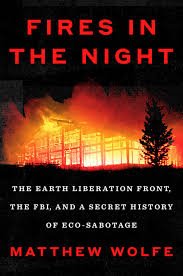 In his new book, Fires in the Night: The Earth Liberation Front, the FBI, and a Secret History of Eco-Sabotage, the journalist Matthew Wolfe narrates the history of a group of people in the 1990s and early 2000s who gave a bold answer to that question: the only kind of action that can meet the moment is eco-sabotage. Arson was their favorite method. The protection of animals was one of their major interests, so in addition to burning, say, car dealerships that sold gas-guzzling SUVs, they also targeted slaughterhouses, lumber companies, a large ski resort that was planning to expand into an old-growth forest, the university office of a biologist who was thought to be researching genetic engineering, and even Forest Ranger stations that were seen as complicit in timber sales. The FBI branded these people the country’s foremost domestic terrorism threat, and by 2007 most of them were in prison.
Wolfe’s book is of interest not only because it is based on incredibly meticulous research that makes it possible for Wolfe to tell the personal stories and motives of the core of activists who constituted the Earth Liberation Front (ELF)—or rather its most active cell, in Eugene, Oregon—as well as the stories of some of the federal officials and police officers whom they eluded for years. It’s a gripping and suspenseful tale, told without bias. But equally importantly, the book raises the same questions that, in a different way, Andreas Malm’s How to Blow Up a Pipeline raised in 2021: is economic sabotage in defense of the environment justified, and if so, what forms of sabotage and under what circumstances? Wolfe doesn’t answer these questions, but the history he relates demands they be taken seriously. It isn’t hard to argue that the ELF’s actions were misguided and accomplished little or nothing, but neither is it hard to argue that some kinds of eco-sabotage are defensible or even imperative.
Most readers, in any event, could probably empathize with the ELF activists (“Elves”) and even respect them for putting their lives on the line and for strictly adhering to their principles. They were always very careful to ensure that no animals or humans would be harmed by their property destruction—although it’s true that risks and uncertainty are inevitable in cases of arson. The Elves were young and idealistic, mere teenagers and twenty-somethings who met each other through the anarchist and radical environmentalist circles in Eugene. They had heard of something called the Earth Liberation Front in the UK and Europe, a decentralized, leaderless network of “cells” of anonymous eco-saboteurs, and in 1996 a few of them decided to start a new cell in the U.S. For the next five years, a dozen or so people would be behind most of the ELF incidents that the government and mass media dubbed “ecoterrorism”—despite the fact that not a single person was ever killed or injured.
Given their youth and relative inexperience, the Elves’ achievements were impressive. Always acting at night, deploying rather sophisticated incendiary devices they had built themselves, they caused over $100 million in property damage. In 1998, a single young man—known to his comrades only as “Avalon”—was able to burn down an entire ski resort at the summit of a mountain in Vail, Colorado. This act, the most expensive act of environmental sabotage in U.S. history, is what really raised the ELF’s profile nationwide. A half dozen law enforcement agencies, including the FBI, the Bureau of Alcohol, Tobacco, and Firearms, and the Eugene Police Department, set out to crush the ELF—and made very little progress until 2004. The Elves were just too good at covering up their tracks, too good at never making mistakes. They used fake IDs, never discussed previous actions even with each other, lived double lives, and used code words when talking about proposed arsons. They were also able to release statements to the press anonymously, by mailing them to a sympathetic intermediary who had no idea of the Elves’ identities.
In fact, it wasn’t law enforcement that brought about the demise of the Eugene cell; it was disillusionment. By 2001 (even before 9/11), the Oregon Elves were floundering: they had judged several recent actions to be misguided failures; interpersonal tensions were flaring; they were increasingly worried that sooner or later the police would catch them; and they were profoundly discouraged by their failure to ignite a movement or even to interfere with the System’s functioning at all. Some of them wanted to choose their targets more intelligently and carefully; others thought it was necessary to become more militant and start assassinating people. But this path horrified most of them and was decisively rejected. In the end, the cell disintegrated in the months after 9/11.
One must agree with the Elves’ harsh retrospective self-judgment. Looking back at the many thousands of extra-legal actions of groups like the Animal Liberation Front and the Earth Liberation Front between the 1970s and 2010—most of them fairly trivial, such as spraying graffiti, smashing windows, slashing tires, gluing locks, and releasing captive minks into the wild—Andreas Malm concludes that the acts “achieved little if anything and had no lasting gains to show for them. They were not performed in a dynamic relation to a mass movement, but largely in a void.” This tends to be true of anarchist tactics in the tradition of “propaganda of the deed.” Sometimes they’re counterproductive, provoking authorities to crack down violently; often they’re merely useless, indicative of an immature politics of self-expression rather than strategy. Sabotage and violence are unlikely to be politically effective unless their perpetrators first think carefully and realistically about their probable consequences in the given social and political environment.
Violence can certainly be useful sometimes. Modern history has seen many governments give concessions to the masses in order to forestall public disorder and property destruction. Malm gives the examples of the Civil Rights Acts of 1964 and 1968, which were passed in part because of the threat of spiraling Black violence in cities. He quotes the Australian scholar Verity Burgmann: “the history of social movement activity suggests that reforms are more likely to be achieved when activists behave in extremist, even confrontational ways.” The scholarship of Frances Fox Piven and Richard A. Cloward, likewise, has shown the great political utility to mass movements of disruptive tactics. The disruption need not be violent, but it can be.
If sabotage of oil and gas pipelines or of data centers or coal mines or other types of industrial infrastructure occurred on a large scale and in the context of a social movement, it could potentially affect the economic and political calculus of the ruling class. One way is simply by disincentivizing investment in carbon-emitting technology; another is by motivating policymakers to give concessions to the movement in the interest of maintaining public order. On the other hand, depending on the political complexion of the government—if it’s far-right, for instance—violent actions might only motivate a harsh crackdown that harms even the movement’s more moderate and peaceful wing. And there is always the possibility that violence will alienate the public to such an extent that it shifts its support to conservative politicians.
Politics is inherently unpredictable, and there is no point in making a priori judgments about the efficacy of particular types of tactics. Too much depends on contingency. All one can say is that it’s necessary to dramatically raise the cost for the ruling class, or certain segments of it, of continuing on its present course.1 This is what the ELF attempted—especially with regard to animal rights, arguably its highest priority. Its actions were too few, too unintelligently chosen, and too politically “in a void” (lacking a supportive movement) to succeed.
The denouement of the ELF story is tragic. The FBI had come to think Jacob Ferguson, one of the two founders of the Eugene cell, was somehow involved in the actions, though it didn’t know any specifics and hadn’t a clue of how involved he was. In 2004, its officials made their move: they managed to convince Ferguson (mostly by bluffing) that if he didn’t cooperate, he might go to prison for five years or even longer. This might mean his young son would grow up without a father. So, after much agonized reflection, Ferguson decided to cooperate and sell out his comrades. He told investigators everything, and he agreed to contact some of the Elves—they had all gone their separate ways—and spend the next year talking to them about their past exploits while wearing a wire. In late 2005, Ferguson’s former comrades were arrested. They received sentences varying from three to thirteen years.
The Earth Liberation Front, which had cells in many countries, was abortive in its revolutionary anti-capitalist aspirations, but it certainly wasn’t abortive in the courage its members displayed or the commitment they showed to worthy principles. Fires in the Night is a brilliant and timely, if not uncritical, homage to the sort of idealism and courage the world could use more of in these dark days.
Endnote:
1 I say “certain segments” because one can raise the cost for complicit politicians by voting them out of office. Or one can raise the cost for fossil fuel companies by sabotaging energy infrastructure. Etc.