
Most people in Victoria don’t realize we’re on treaty land.
— John Lutz, a University of Victoria historian and scholar on indigenous and colonial histories, Time Colonist, 19 February 2017
Throughout Canada, the spillover effects of colonialism continue to be experienced. In the west coast city colonially designated as Victoria,1mətúliyeʔ in Lək̓wəŋən, the the traditional language of the Songhees; METULIYE in SENĆOŦEN, the traditional language of the W̱SÁNEĆ. named after an imperialist queen who never set foot in the city, a political reckoning is underway to return pockets of land to the Songhees.
The return is being opposed by a certain section that might best be regarded as guardians of colonialism.
Geoff Russ, editor-at-large of the conservative substack Without Diminishment, is featured at the top of page A10 in a Times-Colonist commentary entitled “The Songhees land transfer should be an election issue.” (18 August 2026)
Many conservative types are opposed to Te’mexw, a current treaty process, in which the British Columbia government, supported by the City of Victoria municipal government, is proposing the return of a parking lot and another lot to the Songhees Nation.
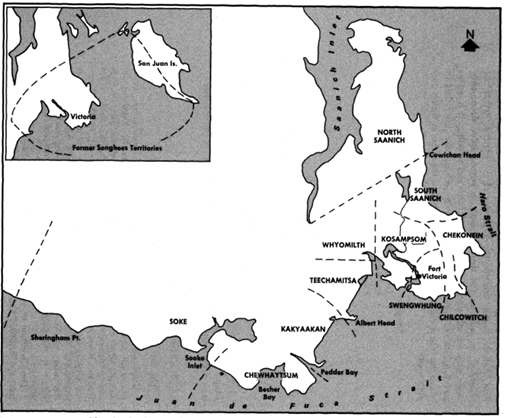 First Nation Territories of Southern Vancouver Island. Inset: Songhees Territories
Does White Man speak with forked tongue?
Russ contends that the lands were “surrendered” by the Douglas/Vancouver Island Treaties. Some of the First Nations members contend otherwise.
We make a distinction between the oral agreements that the colonial officials made with the different Vancouver Island First Nations which are the real Vancouver Island Treaties, and the record that was made by James Douglas which we believe differed significantly from the First Nations understanding of the oral agreement. What was written by Douglas — the Douglas Treaties – we call the Douglas Forms because, a full nine months after the first oral treaties were made, Douglas received a standard form from his superiors at the Hudson’s Bay Company in London. He slightly adapted the template and then inserted below it the names of the Indigenous people who participated in the earlier oral agreement, as if they had signed it. None of the First Nations saw this written version until decades later, and none could have read it as it was written in English, a foreign language to them.
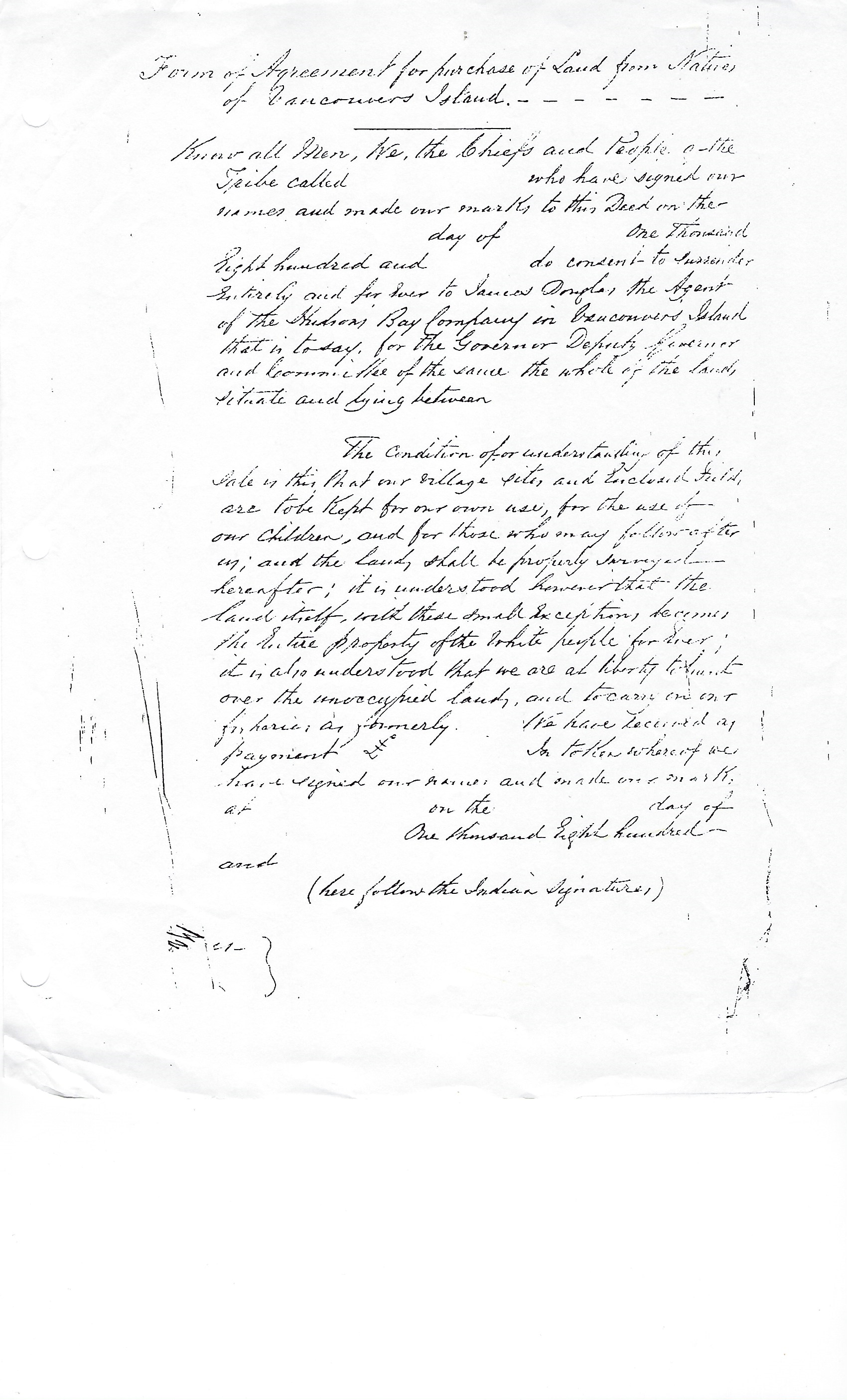
W̱SÁNEĆ Chief David Latasse who was present at the treaty negotiations in Victoria in 1850 said it was a rental agreement.
Many First Nation members find that what is in the written treaties is at odds with what was discussed orally. The pithy, two-paragraph written treaties were produced many months after negotiations with names of First Nations members added and an X to represent a signature. Colonial courts have accepted these as legal treaties. First Nations have published their version.
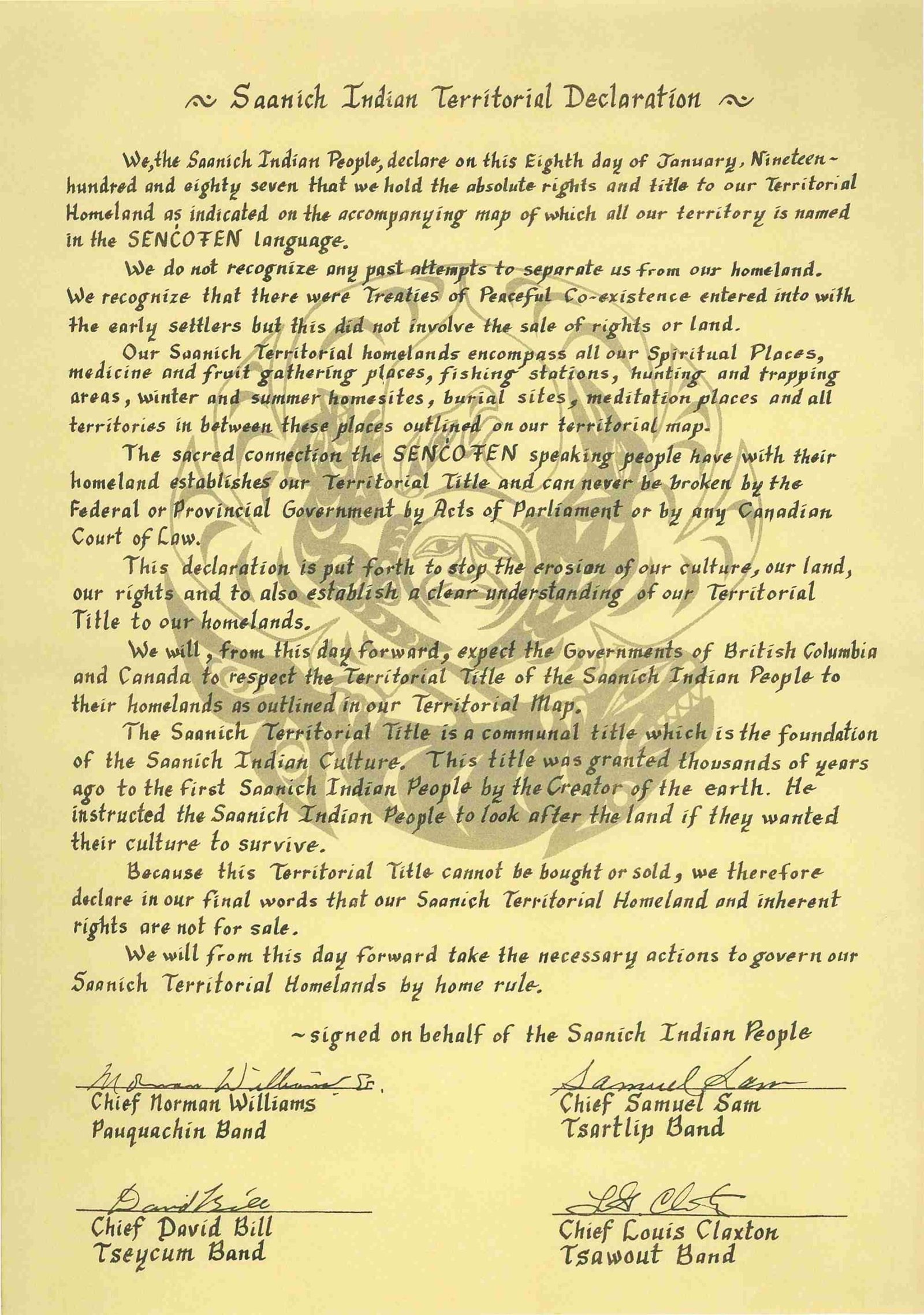
On 8 January 1987 the Chiefs of Pauquachin, Tsartlip, Tseycum and Tsawout came together to sign the Saanich Indian Territorial Declaration.
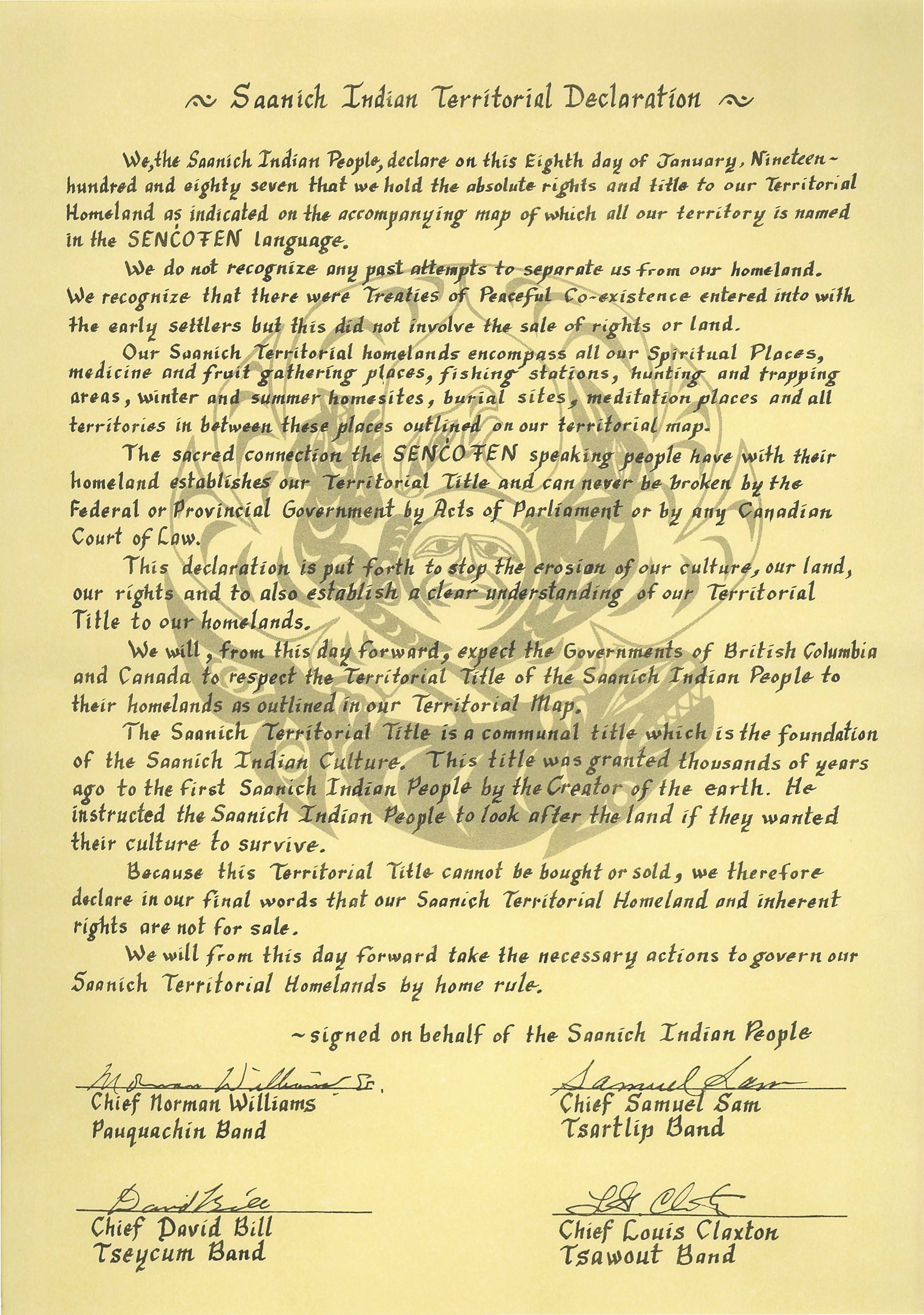
The declaration explicitly asserts the people’s absolute rights and title to the W̱SÁNEĆ Territorial Homeland. Despite the attempts of the Provincial and Federal governments to impose dominion over these lands for the past 170 years, our Chiefs declared that these rights are irrevocable. The declaration also makes clear the expectations for all levels of government and establishes a path forward for how they need to honour W̱SÁNEĆ rights and title.
The Saanich [the Anglicization of W̱SÁNEĆ] Indian Territorial Declaration was signed after over a hundred years of W̱SÁNEĆ people enduring a failed relationship with the Crown. This Crown, in this relationship, not only failed to fully recognize W̱SÁNEĆ rights and title, but consistently sought to undermine the Treaty relationship—at times denying its validity. Further, the Crown’s relationship with W̱SÁNEĆ people, which at the time of the signing of the Douglas Treaties was based in mutual respect, became increasingly paternalistic without any consideration for W̱SÁNEĆ self-determination.
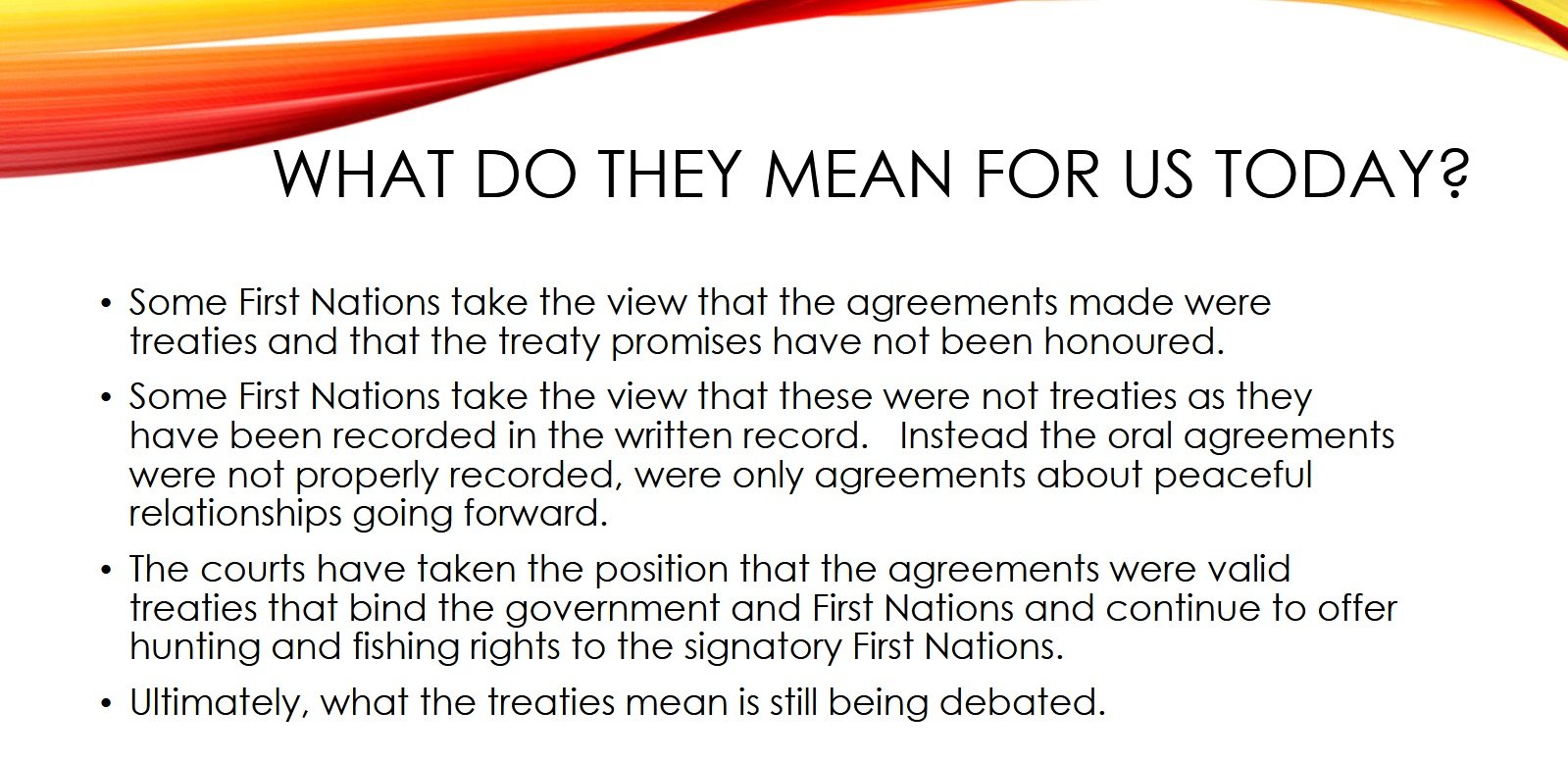
Professor Lutz summarized the question of the treaties today:
Russ calls for a referendum. In effect, what Russ is calling for is a vote whereby the invaders who intentionally brought smallpox that wiped out large swaths of Indigenous nations facilitating their dispossession. The genocide is laid bare by Tom Swanky’s recording the oral history of First Nation knowledge keepers.2Tom Swanky, The Smallpox War against the Haida (Lulu.com, 2022). See “Was Smallpox Weaponized against First Nations?”
First Nations were driven by the Douglas government out of Victoria and back to their home communities. The result was a catastrophic decline of over 50% of the Indigenous population along the BC coastline.3Robert T. Boyd, Chapter 7: A Final Disaster in The Coming of the Spirit of Pestilence: Introduced Infectious Diseases and Population Decline among Northwest Coast Indians, 1774-1874 (Seattle: University of Washington Press, 1999): 172-201. Available online at Archive.org.
In effect, what Russ propounds, wittingly or not, is democracy being used as a tool to entrench the intended outcome of a historical genocide.
Endnotes: