




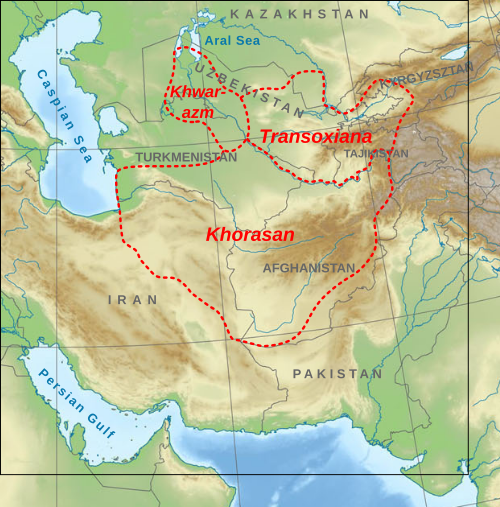
 Transoxania, the ancient Greek name for today’s Uzbekistan, has hosted many of the great turnings of history. The name signifies the lands beyond the Oxus River, which we now call the Amu Darya, the river which for millennia has given life to the oases of this desert region and made it a central node of the Silk Road. It was in Transoxania that Alexander the Great fought some of his hardest campaigns, against the Eastern Persian people known as the Sogdians.
The battles ended when Alexander took his Sogdian bride, Roxana — “Little Star” in the old Iranian tongue — and thereby drew the Sogdians to his side. Our local driver, a cheerful man, is also named Iskander (Alexander). The same name has been carried with pride across twenty-three centuries in the land the Macedonians wooed to their side.
The Sogdians were here well before Alexander, before Rome, and more than two millennia before the Western-dominated world of recent centuries. The Polo brothers passed this way some 750 years ago. And into this ancient and enchanting region our small caravan of electric cars rolled in today.
We have arrived to the center of the world as the ancient and medieval world knew it. This is the hinge between China and Persia, India and the steppe, the place where silk, paper, faiths, and the numerals we count with all changed hands. It is now becoming a 21st century destination for tourism, trade, and culture along the new “middle corridor” once again connecting Europe and China.
America marked its 250th birthday while we were on this road. Two hundred and fifty years is a blink of the eye in Transoxania. I feel a great sorrow at how the toddler U.S. empire has been behaving — lashing out at ancient civilizations, the Iranians above all, a people whose statecraft and poetry and science reach back some ten times longer than America’s own short national life. As we know, America’s war of whim against Iran this year did not go well.
There is a wisdom in the old city walls and ancient madrassahs of Khiva that Washington would do well to relearn: that great and ancient nations are not to be bullied into submission but should be met in trade as equals. Peace, the first aim in our Marco Polo journey, starts with humility before the dignity of other peoples.
The walled inner city of Khiva — the Itchan Kala — is a wondrously preserved medieval town, its mud-brick ramparts glowing amber at dusk, its minarets and madrassahs and the stout turquoise stump of the unfinished Kalta Minor rising within. I am spellbound. Yet this walled city is no mere museum piece. Some two thousand people still live inside the ancient walls, sending their children to school along lanes worn smooth by a thousand years of tradesmen and artisans. Layer upon layer of civilization is stacked here — Khwarezmian, Persian, Turkic, Mongol, Timurid, Uzbek, Russian — and the whole of it is still a living, working part of the city today. That is a marvel: a place that carries its whole past forward without ceasing to be a home.
This region, Transoxania to the ancient Greeks and Uzbekistan for us, remains a crossroads of many great civilizations, all inter-mixed rather than replaced. The Persian world gave the land its poetry and its administrative genius. The Greek world left its Iskanders and cities today such as Khujand, Tajikistan (once known as Alexandria Eschate, or Alexandria the Furthest). The Turkic peoples gave the Uzbek language and part of the population that fills these streets today. Christianity was here too, especially in the form of the Nestorian churches that once dotted the Silk Road as far as China. In Bukhara, where we go today, there survives the remnants of an ancient Jewish community, the Bukhara Jews, who have prayed and traded and sung here for millennia. All of these civilizational threads are still visible in the weave of this remarkable region.
After Bukhara — city of pilgrims, scholars and saints — we will reach Samarkand, the jewel at the center of Transoxania. Samarkand was the capital of the vast empire of Timur, whom Europe came to know as Tamerlane: a conqueror as brutal as any in history, and yet also the founder of a dynasty that made this city a beacon of art and learning. It is his grandson I most long to honor there. Ulugh Beg — prince, sultan, and, most gloriously, astronomer — built on the hill of Samarkand one of the great observatories of the pre-modern world, with a sextant so vast its arc was sunk deep into the bedrock. There, over seventeen years, he and his team of mathematicians measured the heavens with a precision Europe could not then match.
Their great star catalogue, the Zīj-i Sultānī of 1437, fixed the positions of more than a thousand stars anew — the first such catalogue built on fresh observation since Ptolemy, thirteen centuries before — and it was not surpassed in accuracy until Tycho Brahe, a century and a half later. Ulugh Beg’s measurement of the length of the year, and of the tilt of the Earth’s axis, were finer than the values Copernicus himself would use. And the knowledge traveled: his tables reached Europe, were printed at Oxford by Thomas Hyde in 1665, and were studied by astronomers such as Hevelius, feeding the very stream of observation from which the Copernican revolution and modern astronomy would rise. That a Timurid prince on this Silk Road hill helped light the way for Kepler and Newton is the kind of connection our Marco Polo drive was made to celebrate — the long, patient, borderless collaboration of human minds across every frontier of nations, faiths, and languages.
From the heart of the Silk Road, with the dust of Khiva on our sandals and Samarkand’s blue domes still ahead — warmest greetings, and our fondest yearnings for peace among the old and young nations alike.
Jeffrey and Sonia Sachs
- Image credit: Wikipedia.