







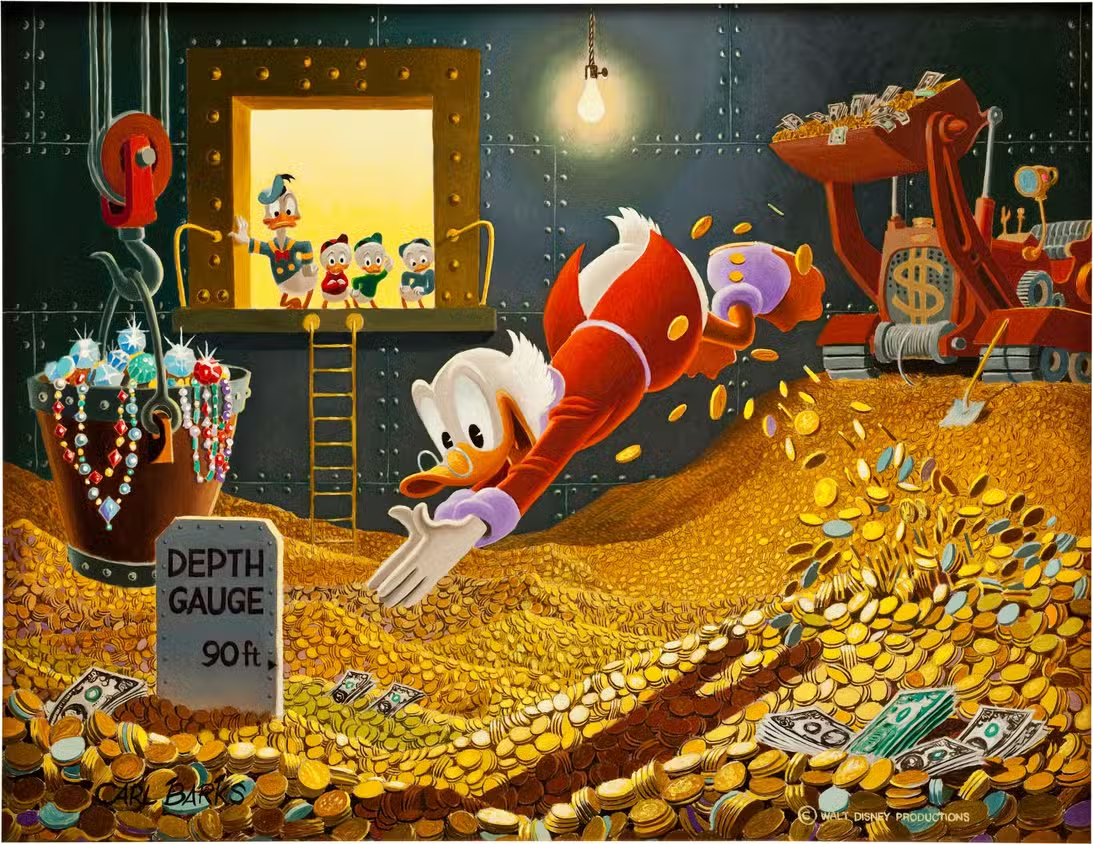
 The fourth estate has taken leave of its senses again, not that much is left for the exercise of those frail faculties. But commentary on Elon Musk’s transformation from multibillionaire tech prat into a trillionaire tosser because of magical accounting and the bubble of company valuation was reverenced rather than critiqued. Starry-eyed commentary from financial analysts swooned over the prospect of further investments after SpaceX made its public offering on June 12; the rhetoric of intergalactic travel and extra-terrestrial based data centres was lapped up. (Easy to revel in what is yet to be created.)
Publications such as Forbes “declared” – as if they have such priestly authority to do so – the change of financial status of the cocksure mogul. Better reporting would at least have pointed out that these assessments lie in the world of the fictive, a trillionaire status tied up in stockholdings in Tesla and the monster that is now SpaceX. The stock in SpaceX will be unsellable for at least a year. But let us see how that supposed scrutineer of wealth described it: “Forbes estimates that the IPO has boosted Musk’s fortune to $1.1 trillion, as of Friday morning. His net worth rose by $188 billion to an estimated $982 billion on Thursday evening, when SpaceX priced the IPO at $135 per share.” Matt Durott, Deputy Editor of the Wealth section of Forbes valiantly bored readers with the observation that Musk’s “ascent to a $1 trillion fortune represents a milestone once considered unimaginable, highlighting how rapidly wealth can be created in an increasingly interconnected and technology-driven world.”
Renaissance Capital’s Matthew Kennedy was appropriately banal to observe that such public offerings do tend to involve fluff, bluster and show. “No question that there is a ton of hype about it. Nothing captures the imagination like space”. Such expansive imagination becomes borderless with the realisation that SpaceX is a loss-making exercise, a warning that is being beaten back by the financial tribes. In 2025 and 2026, it lost $9 billion, according to the company’s own financial filings. Much of that bleeding has taken place in the artificial intelligence portfolio, where artificial means what it says. Nancy Tengler of Laffer Tengler Investments, a firm that has put in an order to net SpaceX shares, had to admit that the AI arm of the company was proving to be a “cash incinerator”. Proving to be a gambler, as many in this bubble industry are proving to be, Tengler is focusing on an “investment horizon” lasting anywhere from three to ten years.
Unless you subscribe to Cult Musk, another facet of this monstrous growth of counterfeit wealth lies in its origins, which are very much of a government and administrative making. The tech brat complex has tended to draw a generous share of public monies through government subsidies and research propped by the public sector. Government contracts have sought to fill the coffers of SpaceX, dispelling notions of rugged, self-sufficient innovation. Even as Musk went about his vigilante task of trimming US federal spending through his DOGE (Department for Government Efficiency) team, it was hard to ignore the looming shadow that his business empire had received, according to an estimate arrived at by the Washington Post, $38 billion in government padding and stretching, be it through contracts, loans, subsidies and tax credits. “Nearly a tenth of government money that has benefited Musk’s companies comes from agencies in eight states, including California. Since 2007, state and local governments have given Musk companies at least $1.5 billion in tax credits, grants and reimbursements, while various government agencies at multiple levels contributed another $2.1 billion, much of it to drive the development of Tesla and the batteries it relies upon”.
Those sufficiently alert can at least make the obvious point that a risibly generous tax system, which should be described as a system that negates tax for the wealthy, has turned the clownishly well-heeled into caricatures of gilded wealth, a bird species ornamented beyond conscience and saved from any hunting season. Igor Volsky, director of the Tax the Greedy Billionaires Campaign, offered few surprises in expressing the view that Musk had become this unfortunate planet’s first trillionaire due to a tax system that offered a shield for the ultra-wealthy while requiring the toiling workers to “pay taxes on every paycheck.” Volsky then mourns the horse long bolted from the stable. “Unless we plan to cede control and agency over our future to a handful of ultra-wealthy individuals, lawmakers must pursue bold tax policies that actually meet this moment – not just slowing the accumulation of extreme wealth, but reversing it.”
Social responsibility tended to be hard to find in the cultic coverage of Musk’s attainments. Here was indulgence and market distortion aplenty, which should bother anyone whose fund managers wish to ride the wave. Musk is not just a threat to such simple notions as civic duty but an arid, unforgivable bore who tries so hard to be, well, liked. Were a novelist to ever try to do justice to his repulsive case, not much would present itself. At least Evelyn Waugh, when trying to elevate the nobs he worshipped in Brideshead Revisited, proved lush in his representation of a dying era he should have left to the tombs. No amount of cash, or space, will do it for Musk on that score.