










Giant Mine is a Monster that has loomed over many generations of Yellowknives Dene. It is constantly changing shape… but its legacy is always destruction and death.
– Johanne Black, director of Treaty, Rights, & Governance, Yellowknives Dene First Nation
What is colonially designated as the Northwest Territories (NWT) of Canada, but is referred to as Denedeh (the land of the Dene)1It should be noted that the Inuit comprise a substantial Indigenous population in the more northern regions. About 10% of NWT’s population. by the Dene, is enormous — about 1,127,712 square kilometres (435,412 sq mi); yet, its is sparsely populated with 45,803 people (2026 Q1 statistics), approximately half identified as Indigenous.
Given the large land mass and low human population, one might surmise that Mother Nature would be grand and pristine. Denedeh is indeed grand, and for the most part it appears to be pristine.
Within Yellowknife, the capital city of the NWT, is a lake that appears deceptively pristine. It is most commonly known by its colonial designation, Frame Lake, after an early miner and businessman, Bill Frame.2Out of respect for the primacy of designations by the Indigenous peoples, I will give prominence to Indigenous designations. It is important to note a distinction regarding nomenclature. For the Dene, nomenclature regarding a place encodes information about the location. It is almost always descriptive, not a person’s name. However, usage of Dene place names poses a difficulty because colonization rendered many Indigenous peoples unaware of the Indigenous designations. This is conveyed in an excerpt from Stolen Words by Melanie Florence, (Cree/Scottish); Gabrielle Grimard (Illustrator) (Second Story Press, 2017):
when we used our words, [Grandpa] answered.
They took our words and locked them away,
punished us until we forgot them,
until we sounded like them.
As was noted on “The Importance of Names” Dëneze Nakehk’o; the colonists “beat the language out of us [the Dene].” The changing of place names and “taking our [personal] names away from us” was rued. (Living Well Together: Module 6: Toward Reconciliation [NWT, 2021]).
The Yellowknives Dene (T’astsą T’ı̨nę) called the lake Łıwegǫ̀atì (Lake where small fish are found). Another term used by the T’astsą T’ı̨nę is Enaàtì (Narrows Lake), which refers to a specific bottleneck in the lake, but it is commonly used to refer to the entire lake.
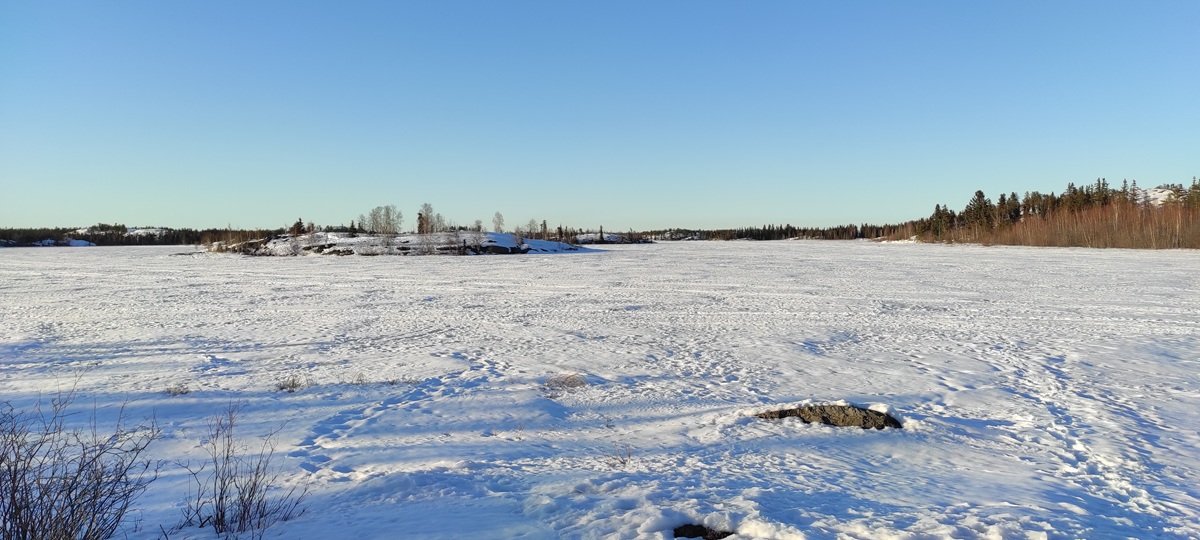
Looking northeast of Enaàtì (Frame Lake), Sǫǫ̀mbak’è (Yellowknife) on 28 April 2026. The winters are long in Denedeh (Northwest Territories).3All photos, copyleft, are by the writer except where otherwise noted.
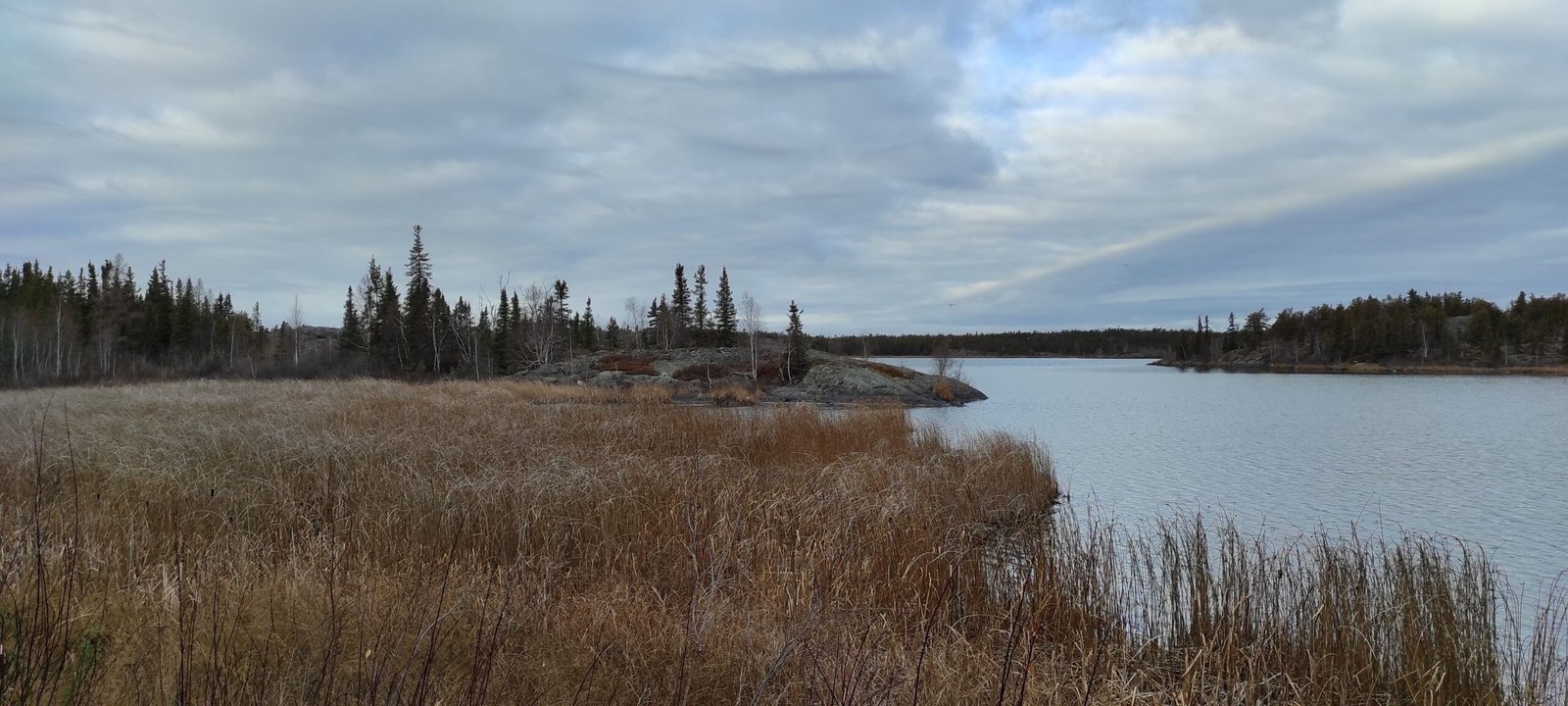
Looking southwest of Enaàtì (Frame Lake).
In The Truth About Stories (U of Minnesota Press, 2008), Cherokee writer Thomas King wrote scathingly of the capitalist system:
So if it’s not racism per se, maybe you don’t like us because we control large tracts of land and valuable resources, or maybe it’s because we get government subsidies and ‘special’ privileges. But none of these should present a serious problem. Corporations own land. They own resources. They get government grants and subsidies. It’s one of the benefits of a free-market economy, where the facade of capitalism is supported by public largesse. Matter of fact, if it weren’t for the infusion of free public money into the private sector, capitalism would have a very difficult time maintaining itself. Just ask Air Canada or Bombardier and any of the major players in the Alberta oil industry.
Of course, we don’t call it ‘free money.’ We refer to these public generosities as tax incentives, without mentioning that the incentive is not to create a better society but to make a profit.
The settler-colonial state of Canada is resource rich. Too often this has been to the detriment of Indigenous peoples. In Denedeh, oil disrupted the Indigenous ways of life in Tłegǫ́hłı̨ (Norman Wells),4See We Remember the Coming of the White Man, edited by Sarah Stewart and Raymond Yakeleya, (Durville, 2021) diamond mines are claimed to negatively impact the migratory routes of caribou herds in the Barren Grounds, and gold mining has been no environmental boon for the lakes around Sǫǫ̀mbak’è (Yellowknife).
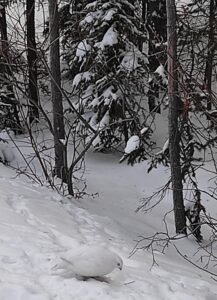 Whenever I am in Yellowknife, I can’t help but appreciate Enaàtì for its scenic beauty. A 7 km trail loops around Enaàtì in the heart of Yellowknife, with views of nature framed by Stanton Hospital in the south to Yellowknife City Hall in the North and westward to a museum, the Prince of Wales Northern Heritage Center. [Ptarmigan with winter plumage viewed from trail, left]
However, the natural vista belies what is a dead lake. Enaàtì – with its previous populations of whitefish and pike – used to house a fishing camp for the Yellowknife Dene First Nations. Later it would serve as a public swimming beach.
The museum informs visitors of what would be a transformative event in 1935. While berry picking, the elder Lisa Crookhand had picked up a gleaming stone which a white man traded a new stove pipe for. Thereafter, Wiìliìcheè (Yellowknife Bay) was rife with gold exploration and mining. Giant Mine would release enormous amounts of arsenic into the heretofore pristine environment. It was not until 1951, when a little boy died after eating arsenic-contaminated snow, that Giant Mine would install equipment to prevent the release of arsenic.
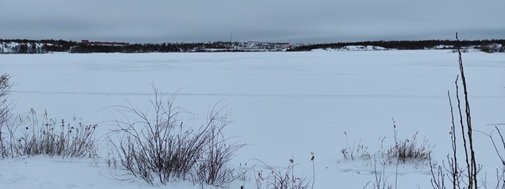
Enaàtì in winter
Gold mining had laced the lakes around Yellowknife with arsenic.5Using Enaàtì as a dump during industrial and urban development of the area has also been cited as a polluting factor. Enaàtì which had once been a favorite swimming and fishing spot was dead by the 1970s. Remediation was called for.
In 2015, the Yellowknives Dene First Nation, Alternatives North, Yellowknife City, North Slave Metis Alliance, the Government of Canada, and the NWT Government signed an ongoing oversight of the remediation project at Giant Mine.
With increased urbanization, nutrient build-up compounded the beleaguered state of Enaàtì. The lake hosted leeches as well as microflora that deoxygenated the lake in the warm, sunny months.
Proposals were put forth to aerate the lake or dredge the arsenic-laden sediment. But it wasn’t until 2024 that an aerator was installed, an installation which hasn’t been without its own hitches.
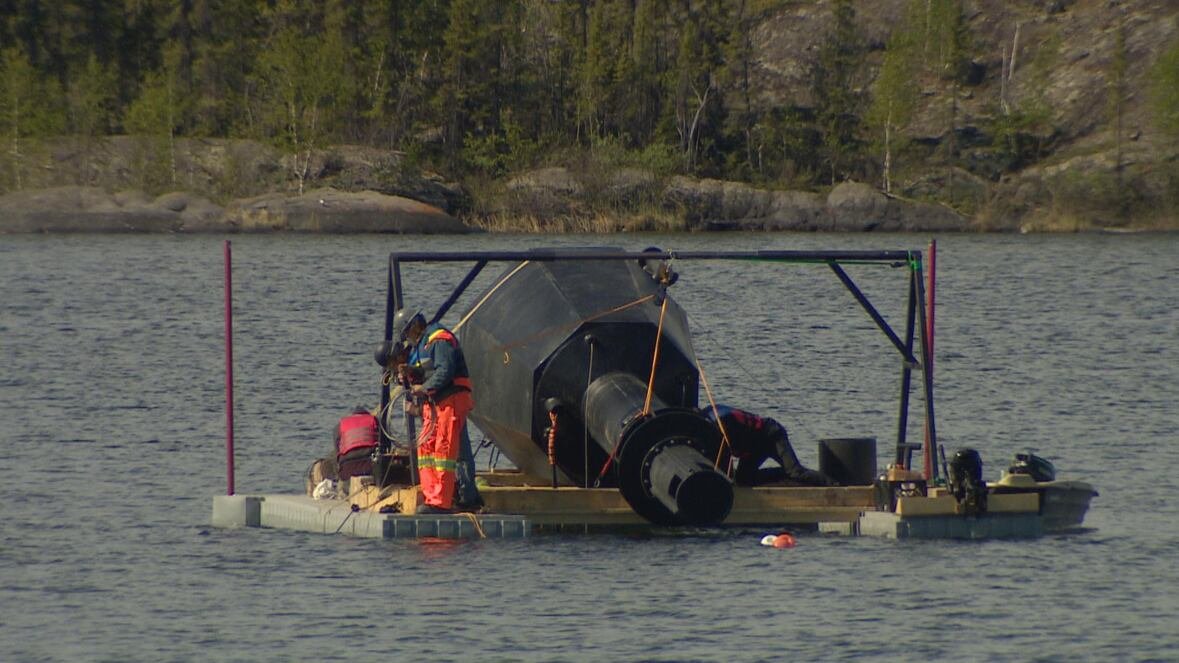
Workers installed the aerator in Enaàtì on June 5. (Robert Holden / CBC)
Enaàtì is still without fish, and no swimmers frolic in the water. Those people who look forward to fish thriving again in Enaàtì will have to wait, as the reintroduction of fish originally planned for the summer of 2026, has been delayed until data from the aerator is reviewed.
ENDNOTE: