


May Day, the international day of working class unity and struggle, finds its origins in the historic strike of U.S. workers for the eight-hour workday.
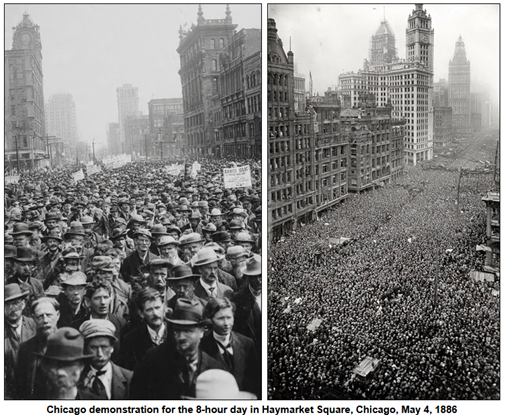
The strike started on May 1, 1886. In Chicago, workers’ defence organizations organized a general strike and tens of thousands of workers walked off the job. Some 80,000 people marched down Michigan Avenue with the cry, “Eight-hour day with no cut in pay.” Police and private security forces from Pinkerton were on hand to suppress the workers, but there was no incident that day. Over the next few days, Chicago workers were joined nationwide by 350,000 workers who went on strike at 1,200 factories, including 45,000 in New York, 32,000 in Cincinnati and thousands more in other cities.
On May 3 in Chicago, striking workers at the McCormick Reaper Works rushed the factory during a shift change and began fighting with non-union workers sent in to break the strike. Police arrived and attacked the striking workers with their clubs and revolvers, wounding several and killing two.
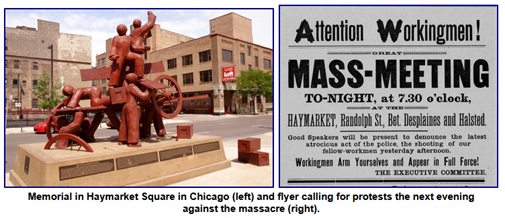
Workers immediately mobilized to condemn and oppose the police violence with an action called for the following day at Chicago’s Haymarket Square. The brutal suppression of workers at Haymarket Square that followed on May 4 has gone down in history as the Haymarket Massacre. It began when an unknown provocateur threw a dynamite bomb at the police. The police then unleashed a hail of bullets at the protestors, killing at least four and wounding hundreds. The bourgeois press launched a full-scale fearmongering campaign against the workers’ movement and immigrants.
In November 1886, a kangaroo court sentenced eight labour leaders to death for conspiracy related to the bomb thrown at the police and the subsequent “riot” despite the fact that witnesses testified that none of the eight men charged threw the bomb. Nonetheless, four were hanged, one committed suicide and three were later pardoned. No evidence of conspiracy by the accused was produced, and the perpetrator of the bombing was never brought to trial. This year marks the 140th anniversary of these events.
One of the labour leaders murdered by the U.S. state following the Haymarket Massacre was August Spies. In his statement to the court, he declared: “You pronounce upon us the sentence of an appointed vigilance committee, acting as jury, I say, you, the alleged representatives and high priests of ‘Law and Order,’ are the real and only law breakers, and in this case to the extent of murder. It is well that the people know this. And when I speak of the people I don’t mean the few co-conspirators of Grinnell, the noble patricians who thrive upon the misery of the multitudes. These drones may constitute the State, they may control the State, they may have their Grinnells, their Bonfields and other hirelings! No, when I speak of the people I speak of the great mass of human bees, the working people, who unfortunately are not yet conscious of the rascalities that are perpetrated in the ‘name of the people,’ – in their name.” Julius Grinnell was the state’s prosecutor and John Bonfield was the police inspector who oversaw the police forces at the Haymarket Massacre.
On November 11, 1887, George Engel, Adolph Fischer, Albert Parsons and August Spies sang the Marseillaise as they stood upon the gallows. In the moment before they were hanged, Spies shouted: “The time will come when our silence will be more powerful than the voices you strangle today.”
In 1889, during the founding congress of the Second International in Paris, a resolution was passed on the initiative of a U.S. delegate to commemorate the strike of hundreds of thousands of U.S. workers fighting for the eight-hour workday by establishing May 1 as an international day on which to pay tribute to the working class and affirm workers’ rights and demands, bringing into being May Day as it is known today.
 The eight-hour workday was won through the blood shed by U.S. workers. It inspired workers all across the world to fight for suitable wages and working conditions as a matter of right. With their blood and sacrifice it was the workers who provided rights with a modern definition, just as they are doing today — that they belong to people by virtue of their being human. By the end of the 1920s, U.S. workers had established political parties and trade unions that had members in the millions, and the Congress of Industrial Organizations came into being. They forced the ruling elite and their state, led by President Franklin D. Roosevelt, to implement major concessions that favoured the workers during the Great Depression.
But right after these concessions were won, the ruling elite with their state started chipping away and attacking them. One of the aims of these attacks was to erase the memory and history of May Day which, after World War II, motivated by anti-communism, was designated “Flag Day,” the day to pledge allegiance to the U.S. state, and the first Monday in September was designated Labour Day, whose main aim is to depoliticize the workers. In Canada also, communists were barred from joining unions whose mission became fundamentally anti-communist, while Labour Day became a day to hold family picnics, not a day to express the fighting unity of the working class the world over.
While the struggle of U.S. workers was inspiring people globally, the ruling elite and its ideologues started spreading the lie that there is no working class in the U.S., everybody is middle class, and if you are a worker you are uneducated and a failure. They also created a labour aristocracy, a privileged strata amongst trade union leaders which became part of the apparatus tying the workers to a political system whose main aim is to disempower the working people so that decision-making remains in the hands of a privileged few who do not have the same living and working conditions as the mass of workers.
In the ’60s and ’70s the significance of May Day emerged again during the movements against war, for civil rights, women’s rights and workers’ rights. In 2004, a memorial was erected in Haymarket Square in Chicago to mark the struggles of the working people in the USA. In the last few decades more and more working people in the U.S. have organized protest rallies, teach-ins, concerts and manifestations on May Day. In 2006, it was decisively revived as “Day Without an Immigrant,” with militant actions affirming the rights of immigrants and migrant workers and that they are integral to the U.S. working class.
 This year across the U.S., on May 1 a national day of action themed “Workers Over Billionaires” is scheduled, featuring rallies, marches and a call for “No Work, No School, No Shopping” to protest economic inequality, corporate influence and anti-immigrant policies. Coordinated by groups like May Day Strong, actions include worker strikes and student walkouts.
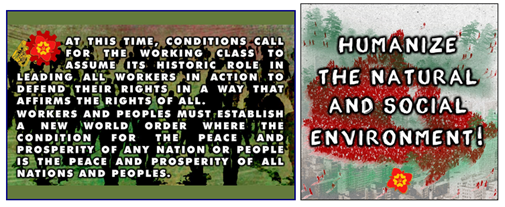
May Day in 2026 finds workers and toilers across the globe engaged in a life and death struggle to bring into being a new world which serves them. The people face worsening living standards, genocidal wars, out-of-control climate change, and the threat of nuclear catastrophe. New depths of cultural devastation are depriving people of the ability to think things through and discuss the unfolding reality as it presents itself. Ruling elites across the globe are more concerned about maximizing profits than the lives of billions. They are committing countless crimes against humanity and the earth, in the name of “we the people.” It is up to the working class to show what is meant by “the people.” History demands that the working class in all countries constitute the nation and vest sovereign decision-making power in the people. The working class must become the makers of history in their own image, with their own aims, which are those of humankind. This is the aim to humanize the natural and social environment, to break with the Old and usher in the New.