“Engaging communication has the power to transform the lives you influence.”
– Darius Wallace
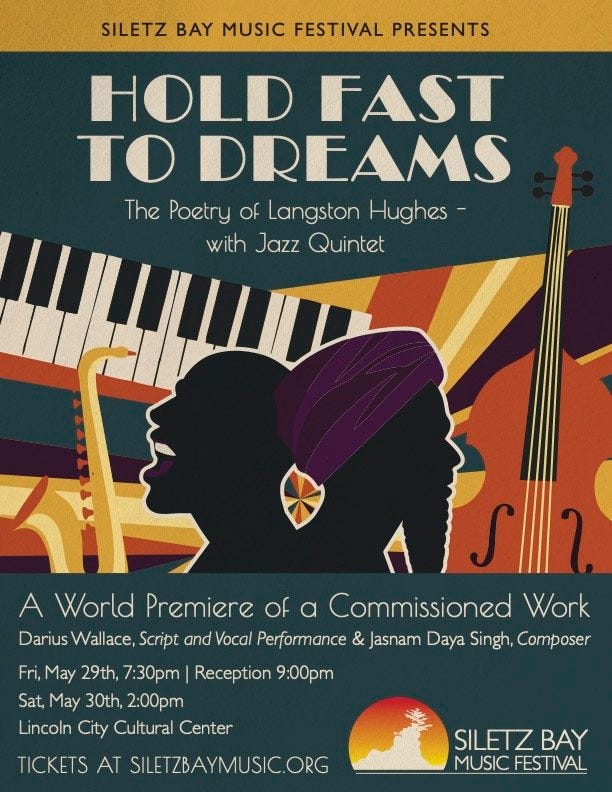
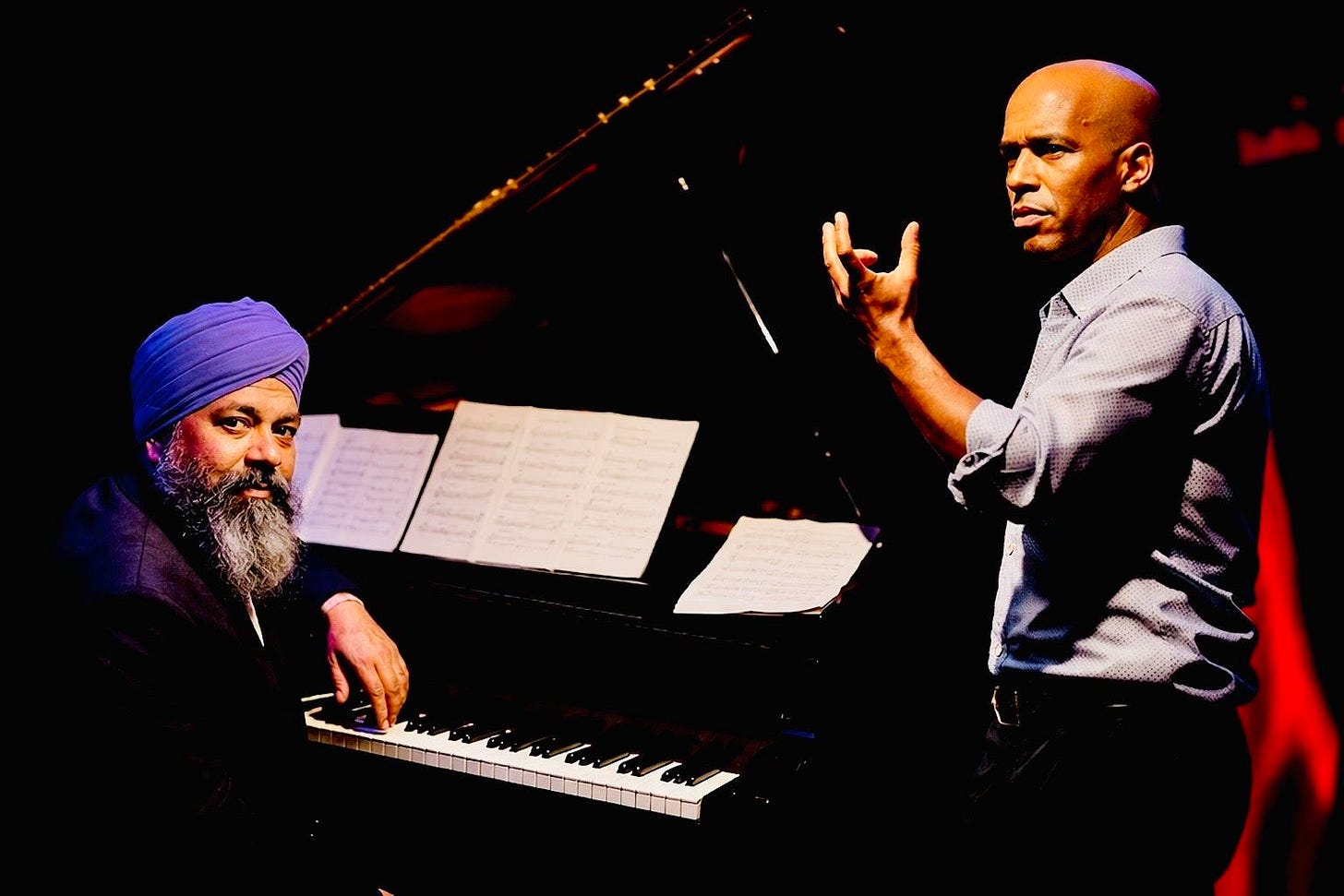
It’s more than a rendering of poetry, more than a jazz quintet riffing and gracing the performance of Darius Wallace.
It’s a night (May 29) and afternoon (May 30) of benediction, a Chautauqua-like lesson on Black history, and a love performance honoring the first African American to make a living as a writer. Wallace brings with him a deep regard for voice, past lives, spirituality, and his own life lived from the school of hard knocks in Flint, Michigan, and Brooklyn, New York.
The Dream Keeper by Langston Hughes
“Bring me all of your dreams,
You dreamers,
Bring me all of your
Heart melodies
That I may wrap them
In a blue cloud-cloth
Away from the too-rough fingers
Of the world.”
I talked with Darius on my KYAQ radio show. His previous appearance on the coast was a couple of years ago with his one-man show, My Words Are My Sword.
Ironically, I worked with homeless youth and adults in the Portland area, and I brought to the table one of Darius’ TED talks, an inspiring and engaging master class on his coming from a dying city, Flint, with all the drug dealing, violence and unemployment (the auto industry abandoned the Detroit-Flint area), his own falling down on hard luck a few times, and then rejoicing in self-renewal.
“I carried num-chuks, but I never used violence.” He was in a gang at age 13, and many of those kiddos had guns and knives.
It was a vice principal who saw in Darius potential, and so he enrolled in an arts and theater program. Interlochen Center for the Arts is a room-and-board arts camp in Michigan, with inspiring teachers on 1,200 acres of rolling hills.
Maybe the dreams of a kid, captured in the Hughes’ poem above, spurred the young Darius into Shakespeare’s “The Tempest” and dramatic and film acting.
He did hit rock bottom more than 28 years ago, when his mother died of breast cancer. He had a breakdown and ended up homeless in Brooklyn, N.Y. But the substance abuse turned into an addiction to reading, as he snuck into bookstores and absorbed old and new wisdom from books.
Wallace’s performance of Starry Road to Freedom: The Life of Frederick Douglass has been called stellar by none other than Douglass’ great-great-great-grandson, Keith Morris.
In fact, early in Wallace’s career he did performances of Malcolm X’s and Martin Luther King’s lives, their words and philosophies.
Music drama? Collage? Spoken-word piece? One-man show? Multi-media jazz collaboration? Syncopation of a powerful voice for Black America and the rhythms of a Latin musician, Jasnam Daya Singh? Brazilian-born Singh calls himself a “melting pot of cultures.”
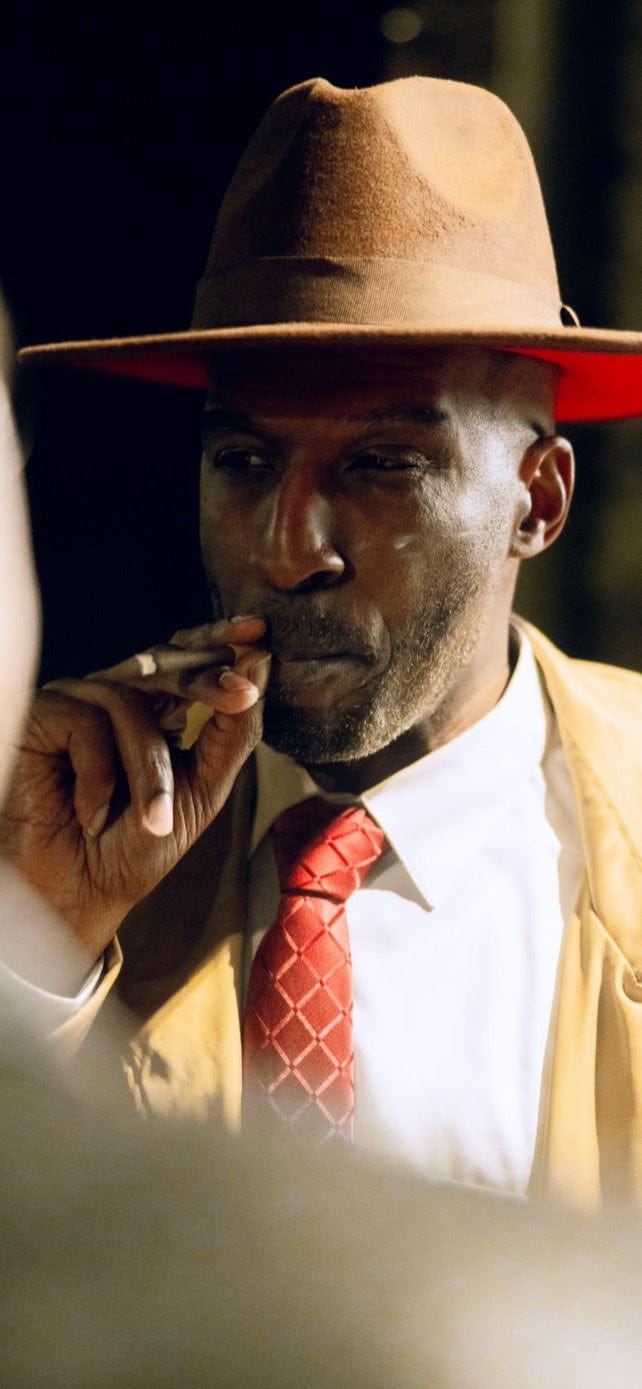
Transformative is one key word Wallace and Sing deploy in their own walkabout on planet earth, and the audiences will have their own transformative moments engaged in this Siletz Bay Music Festival melting pot of craft.
Weber Ribeiro Drummond was born in Rio de Janeiro, but 30 years later, he adopted the stage name Weber Iago as a homage to the Roma people. Further transformation occurred 15 years ago when Weber started his initiation into the Sikh religion. In 2013, this Brazilian took on the name of Jasnam Daya Singh.
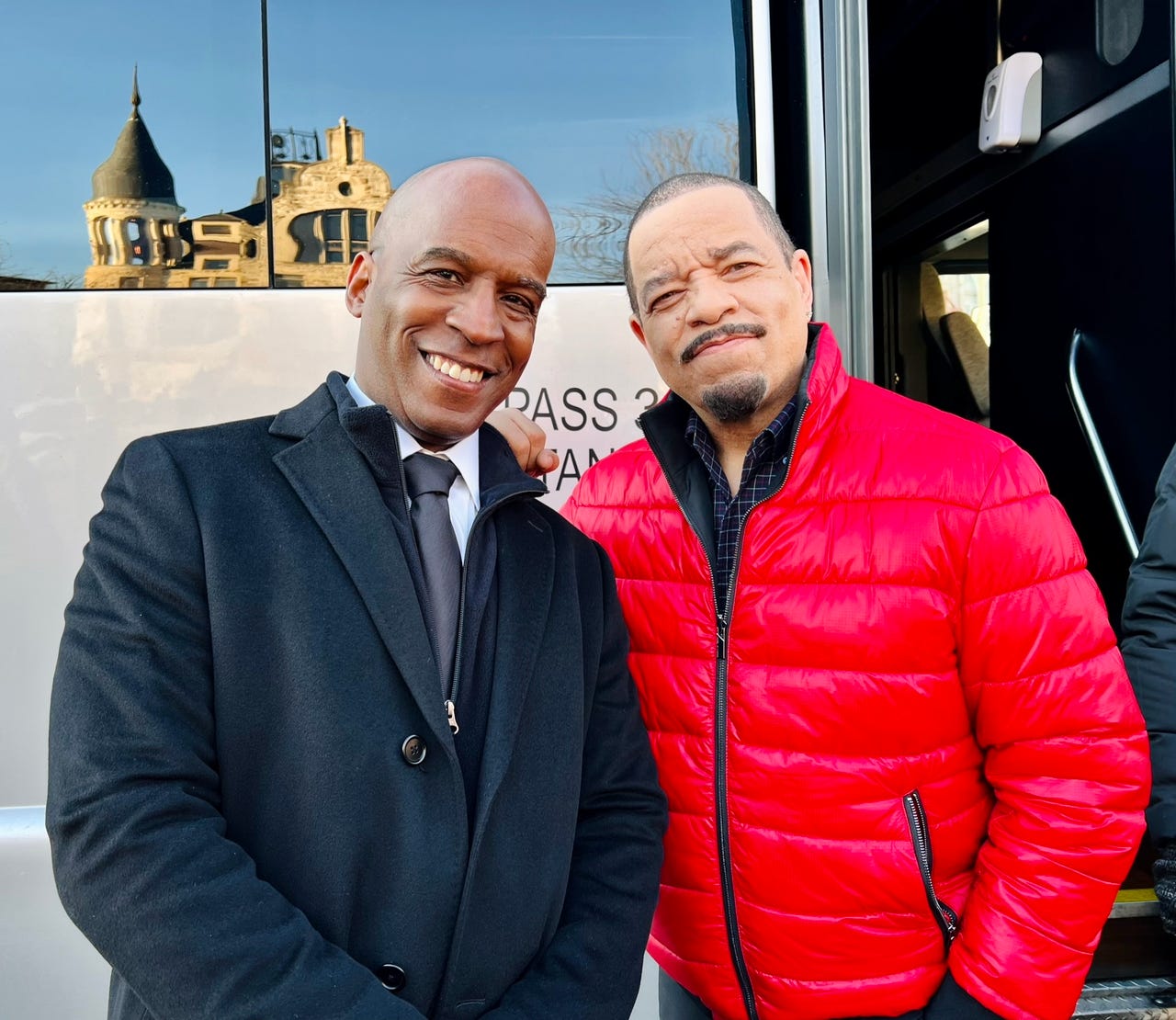
While acting and performance poetry are some of his avocations, Wallace grounds himself in various practices such as Tai Chi, meditation, and prayer. He and I talked much about the current tsunami of anti-Black history and anti-Black legacies by the Trump regime.
“I have lived that Black experience of overt racism.” People are awakening to the selfish and racist administration, and Darius sees artists in the lead.
Dr. King called it “a sickness.” It’s the product of a broken, heavily propagandized and indoctrinated culture. Militarism can only create new enemies, never peace. Its cost is everything.
Darius talked about the ills of the world as seen through King’s and Malcolm X’s eyes. On August 31st, 1967, Reverend Martin Luther King delivered The Three Evils of Society speech at the National Conference on New Politics, which is the most prophetic and revolutionary address to date on the questions of militarism, poverty, and racism. “We are now experiencing the coming to the surface of a triple-prong sickness” was how MLK framed the problem that “has been lurking within our body politic from its very beginning.” He identified “the sickness of racism, excessive materialism, and militarism” and considered the three problems as the “plague of western civilization.”
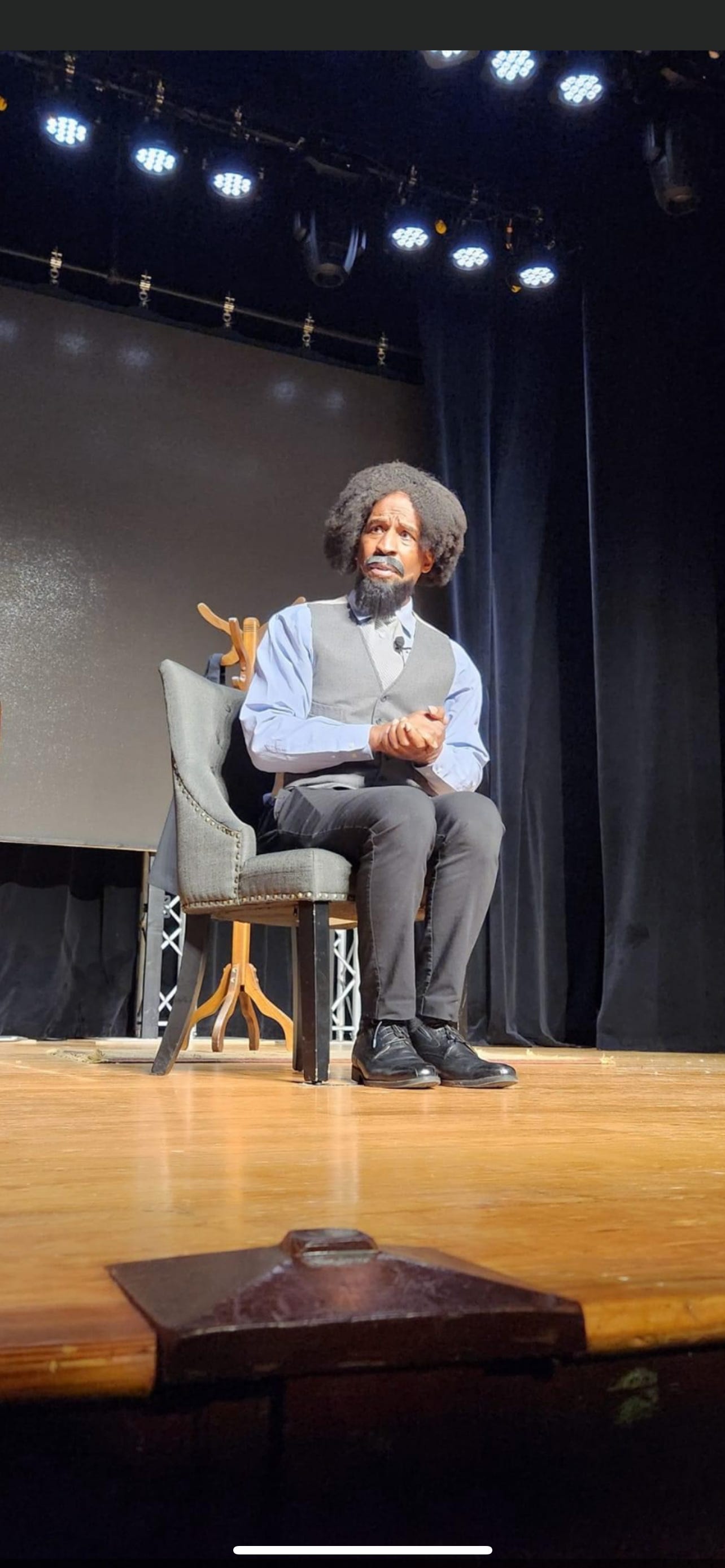
Wallace, like all great scholars, sees race as a construct invented around 250 years ago. “We see America’s schizophrenic personality on the question of race,” King said.
Darius will be conjuring up poems by and various characters in Hughes’ life. He will not be in costume playing Langston, but he will be the prophetic voice of the Black writer who traveled the world and was part of the Black Harlem Renaissance.
Big shoes to fill, but Wallace is fully capable of fulfilling the task. Langston wrote poetry, short stories, literature, plays, and essays, many of which were about civil rights. He wrote an honest portrayal of the lives of the Black working class, and he wrote in everyday language to reach as many people as possible.
Hughes incorporated many aspects of Black culture into his work, writing poetry with characteristics from music like the blues, jazz, and spirituals. He wrote about their lives, their joys and sorrows, seeking to portray his community as genuinely as he could.
This will be revived on stage, May 29 and 30 as part of the Siletz Bay Music Festival at the Lincoln Cultural Arts center. Singh will deliver the vibes via his quintet. As Darius said, “As long as we bury the truth, we will be enslaved to lies.” Truth shall be delivered by Wallace.
Hughes:
“What happens to a dream deferred?
Does it dry up
Like a raisin in the sun?
Or fester like a sore—
And then run?
Does it stink like rotten meat
Or crust and sugar over—
Like a syrupy sweet?Maybe it just sags
Like a heavy load.Or does it explode?”
Primarily, we hear about Langston Hughes when learning about the Harlem Renaissance, which was a cultural and social movement to celebrate many aspects of Black culture. Music, fashion, art, literature, and other forms of self-expression were centralized in the Harlem neighborhood within New York City.
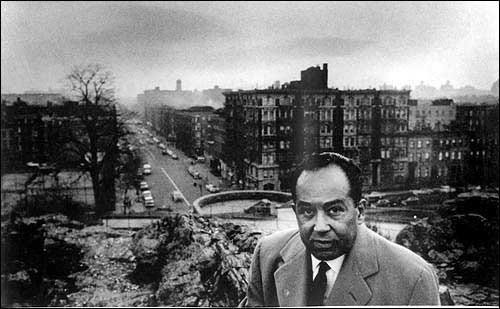
It was a very important movement for the U.S. as a whole, as it amplified African Americans‘ voices to show that their culture was just as worthy and just as important as all other cultures in the U.S.
It gave them a chance to portray themselves as something other than the caricatures assigned to them, and it expanded cultural communities.
Langston Hughes was an especially big part of that, because not only did he hold a big position in the writing field at the time, but he was also involved in the civil rights movement as a whole.
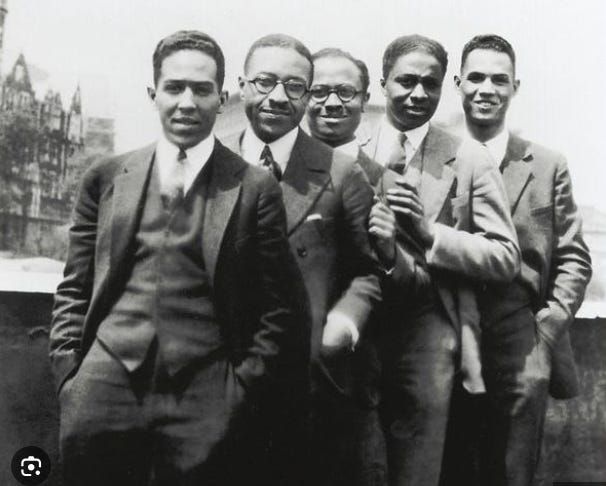
It’s important to study him because it’s important to remember the people who came before us, who laid the foundation for the rights and privileges we have today. It’s a chance to read and learn about cultures you aren’t familiar with, and to gain new appreciation for other people.
Though not to the extent that it was in Hughes’ time, America still sees its fair share of inequality today, and it’s important to reflect on both how far we’ve come and how far we still have to go.
Many of Hughes’ poems could be argued to be the “best” or the “most powerful,” or “most impactful,” but I believe you should find those poems for yourself.
10. Life is Fine
“I went down to the river,
I sat down on the bank.
I tried to think but couldn’t,
So I jumped in and sank.
I came up once and hollared!
I came up twice and cried!
If that water hadn’t a-been so cold,
I might’ve sunk and died….”
9. The Weary Blues
“Droning a drowsy syncopated tune,
Rocking back and forth to a mellow croon,
I heard a Negro play.
Down on Lenox Avenue the other night
By the pale dull pallor of an old gas light
He did a lazy sway. . . .
He did a lazy sway. . . .”
Hughes won first prize in a contest hosted by Opportunity magazine with this poem in 1925, and was awarded the title of the best poem of that year. It was also one of the first times he experimented with using motifs from music into his poetry, which later became a defining point in all his work.
This poem was later included in, and became the title of, his very first poetry collection that he published with Alfred A. Knopf in 1926.
8. The Dream Keeper
“Bring me all of your dreams,
You dreamers,
Bring me all of your
Heart melodies
That I may wrap them
In a blue cloud-cloth
Away from the too-rough fingers
Of the world.”
7. Still Here
“I been scared and battered.
My hopes the wind done scattered.
Snow has friz me, sun has baked me.
Looks like between ’em
They done tried to make me
Stop laughin’, stop loving’, stop livin’ —-
But I don’t care!
I’m still here!”
6. The Negro Speaks of Rivers
“I’ve known rivers:
I’ve known rivers ancient as the world and older than the
flow of human blood in human veins.
My soul has grown deep like the rivers. . . .”
5. Mother to Son
“Well, son, I’ll tell you:
Life for me ain’t been no crystal stair.
It’s had tacks in it,
And splinters,
And boards torn up,
And places with no carpet on the floor—. . .”
4. Let America Be America Again
“Let American be America again.
Let it be the dream it used to be.
Let it be the pioneer on the plain
Seeking a home where he himself is free.
(America never was America to me.) . . .”
3. Dreams
“Hold fast to dreams
For if dreams die
Life is a broken-winged bird
That cannot fly.
Hold fast to dreams
For when dreams go
Life is a barren field
Frozen with snow.”
2. I, Too
“I, too, sing America.
I am the darker brother.
They send me to eat in the kitchen
When company comes,
But I laugh,
And eat well,
And grow strong.
Tomorrow,
I’ll be at the table
When company comes…
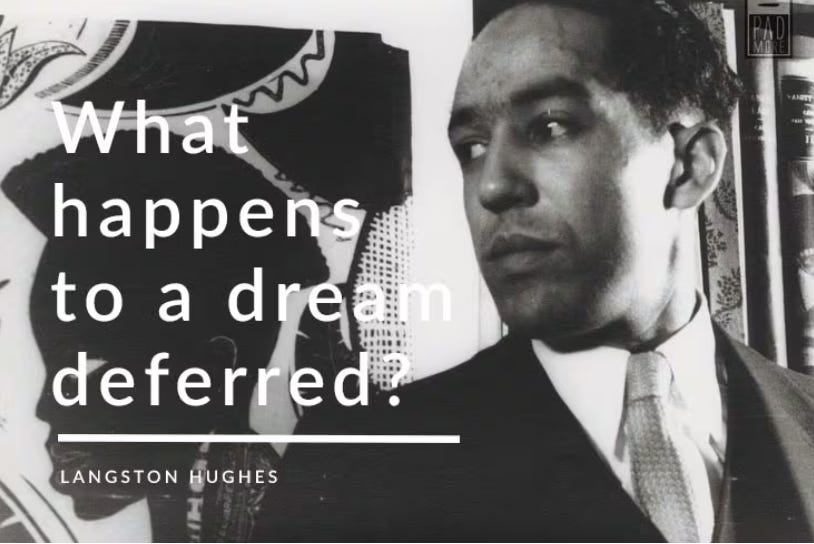
1. Harlem
“What happens to a dream deferred?
Does it dry up
Like a raisin in the sun?
Or fester like a sore—
And then run?
Does it stink like rotten meat
Or crust and sugar over—
Like a syrupy sweet?
Maybe it just sags
Like a heavy load.
Or does it explode?”