







UPDATED on 14 August 2026.
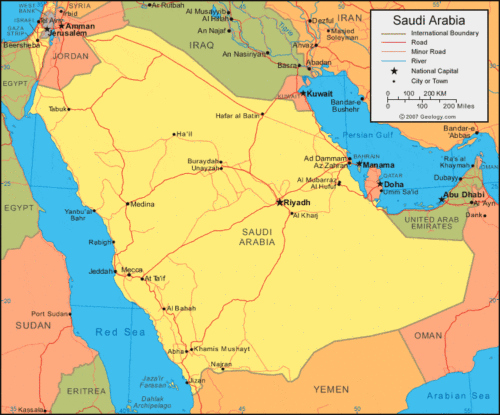
Why is Saudi Arabia, a Sunni absolute monarchy, enthusiastically supported by the West, considered a global promoter of ‘democracy’? This question is rarely asked. The apparent mismatch between liberal democracy and religious fundamentalism is hastily airbrushed when the matter is about oil trade and arms deals. This attitude is not an expression of mere hypocrisy on the part of the West; it is deeply rooted in a historical process whereby Saudi Arabia was propped up by major powers as an outpost of imperialist interests and a bulwark against revolutionary ideologies.
Muhammad ibn Abd al-Wahhab (1703–1792), whose teachings later became associated with Wahhabism, emerged in eighteenth-century Najd amid disputes over religious practice. He advocated a return to what he regarded as the uncompromised monotheism of the earliest Muslim community and rejected devotional practices centered on shrines and sacred sites. His program also endorsed severe corporal punishments for offenses such as theft. Local religious and political authorities resisted his campaign, and the ruler of Uyayna eventually compelled him to leave.
Creating the Kingdom
In 1744, Ibn Abd al-Wahhab moved to Diriyah and entered into an alliance with Muhammad ibn Saud, the political leader whose descendants would eventually establish the Saudi monarchy. The partnership connected religious legitimation with territorial expansion. Ibn Saud acquired a religious framework through which followers could be mobilized, while Ibn Abd al-Wahhab gained a political patron capable of extending his teachings beyond Najd. Their alliance also challenged the authority exercised by the Ottoman political and religious order.Ibn Abd al-Wahhab presented his project as a purification of Islamic practice. He condemned bid’ah, meaning religious innovations that he regarded as departures from early Islam, and appealed to the Sunnah and Hadith as authorities for restoring what he understood as authentic belief. His critique also targeted practices associated with the Ottoman religious establishment and forms of popular devotion that he considered illegitimate.
The early Saudi state expanded through campaigns that brought it into conflict with Ottoman authority and with communities whose religious practices differed from Wahhabi doctrine. In 1801, Saudi forces attacked Karbala and destroyed important Shi’a religious sites. Wahhabi authorities also targeted shrines in the Hijaz, treating forms of sacred architecture as manifestations of idolatry. Ottoman forces eventually defeated the first Saudi state. A later Saudi expansion resumed under Abd al-Aziz ibn Saud, whose forces and the Ikhwan captured Mecca and Medina during the consolidation of the modern kingdom in the 1920s.
The later Saudi advance again involved coercion and violence, while Abd al-Aziz simultaneously cultivated ties with Britain. The 1915 Treaty of Darin established a formal British relationship with his emerging polity and strengthened British support against rival forces. British officials viewed him as a useful counterweight to Ottoman influence during the First World War. After the Ottoman collapse, this relationship continued as Britain sought to shape the political settlement of Arabia and manage the rivalry between Ibn Saud and Sharif Hussein of the Hijaz.Sharif Hussein of Mecca had helped in the defeat of the Ottomans after joining the Arab Revolt in 1916; this had come about due to his negotiations with Henry McMahon, Britain’s representative in Egypt. Hussein understood the correspondence as providing grounds for an independent Arab polity after the Ottoman defeat, while British policy subsequently moved toward a different regional settlement. The Sykes-Picot arrangement divided areas of Arab territory into British and French spheres, while the Balfour Declaration supported a Jewish national home in Palestine. Hussein rejected the Anglo-Hijaz Treaty that sought to formalize the postwar relationship. His conflict with Britain eventually coincided with Ibn Saud’s expansion into the Hijaz, making British policy toward Ibn Saud an important factor in Hussein’s defeat.
Meanwhile, Ikhwan eventually became dissatisfied with the direction taken by Abd al-Aziz. Its leaders objected to his growing accommodation with Britain, the court’s adoption of practices associated with Western modernity, and his willingness to impose limits on their campaigns against neighboring communities. Some members also rejected technologies such as the telegraph on religious grounds. Tensions became an open revolt in 1927, after Abd al-Aziz had further consolidated his political relationship with Britain and sought greater control over the movement’s independent military activity.
The Ikhwan’s campaigns eventually crossed borders into territories that Britain and France sought to control, bringing the movement into conflict with the imperial order established after the First World War. Abd al-Aziz suppressed the revolt with British assistance and executed several of its leaders. In 1932, he proclaimed the Kingdom of Saudi Arabia, formalizing the territorial consolidation achieved under his rule. The defeat of the Ikhwan reduced its autonomous military power while leaving its religious outlook deeply embedded within state institutions. The resulting monarchy therefore joined dynastic authority to a religious establishment that helped legitimate the political order.
Cozying Up to the USA
The Great Depression weakened revenues associated with the Hajj pilgrimage and left Abd al-Aziz searching for new sources of income. In 1933, he granted Standard Oil of California an oil concession in return for financial payments and access to future petroleum revenues. The agreement gave the monarchy resources with which to strengthen its administration and extend its control over recently incorporated territories. American commercial involvement consequently became intertwined with the financial consolidation of the Saudi state.
The California company eventually became part of the consortium that operated as the Arabian American Oil Company, or ARAMCO. Commercial production began in 1938 after major discoveries in eastern Saudi Arabia. Oil then reshaped the country’s political economy as the company developed facilities required for extraction and export, including transport links and worker settlements. American corporate capital and government support reinforced the monarchy’s growing dependence on petroleum revenue.The Second World War accelerated the strategic relationship between Washington and Riyadh. In 1943, the US administration declared that “the defense of Saudi Arabia is vital to the defense of the United States”. American personnel helped train Saudi forces, while the United States developed an air installation at Dhahran close to the country’s principal oil-producing region. The base gave Washington a strategically valuable position in the Gulf independent of its established British facilities. American military access later declined before the Gulf War created conditions for a large-scale return of US forces to Saudi territory.
The relationship between the US and Saudi Kingdom was ratified in a 1945 meeting on the Suez Canal between President Franklin D. Roosevelt and Abdul-Aziz. The two leaders agreed that the kingdom would supply the US with oil, and the US government would provide the kingdom with security and military assistance. Over the years, US presidents reiterated their commitments to Saudi Arabia’s security. The 1947 Truman Doctrine, which stated that the United States would send military aid to countries threatened by Soviet communism, was used to strengthen US – Saudi military ties. In 1950, President Harry S. Truman told Abdul-Aziz, “No threat to your Kingdom could occur which would not be a matter of immediate concern to the United States.” This assurance was repeated in the 1957 Eisenhower Doctrine.
American regional strategy became increasingly explicit during the Cold War. The Nixon Doctrine treated Iran and Saudi Arabia as major Gulf partners, while the Carter Doctrine declared that Washington would resist outside attempts to control the Persian Gulf. After the Iranian Revolution and the Soviet intervention in Afghanistan, these commitments acquired greater strategic significance. The Reagan administration subsequently strengthened military cooperation with Riyadh and made clear that Washington would use force when Saudi security was judged to be at stake.Spreading Counter-Revolution
The expansion of petroleum revenues transformed Saudi Arabia’s international role during the 1960s and 1970s. Oil income supplied the monarchy with resources that could be directed toward religious institutions, educational programs, charitable organizations and overseas networks. Through these channels, Saudi authorities promoted Wahhabi interpretations beyond the kingdom and sought greater influence over debates about the meaning of Islam. Religious patronage consequently became an instrument of Saudi foreign policy and a means of projecting the monarchy as a major representative of Sunni political interests.Saudi religious diplomacy also complemented the kingdom’s Cold War partnership with Washington. The monarchy regarded secular Arab nationalism, Ba’athism and later revolutionary Shi’a politics as threats to its political model.
The Muslim World League, founded in 1962, became one vehicle through which Saudi religious influence was projected abroad. Its activities helped advance a conception of Islam that emphasized religious unity while portraying republican and socialist currents as hostile to the political order favored by Riyadh.Saudi Arabia also played an important role in the Organization of Islamic Cooperation, established in 1969. The organization provided the monarchy with another diplomatic arena in which it could promote its preferred interpretation of Muslim political solidarity. Riyadh also used Islamic multilateral institutions to contest the regional influence of Nasser’s Egypt and other currents associated with Arab republicanism.
The Iranian Revolution radically altered the strategic environment confronting Riyadh and Washington. The fall of Mohammad Reza Shah Pahlavi removed a major American partner and replaced the monarchy with an Islamic republic whose leadership openly challenged hereditary rule in the Gulf. Ayatollah Ruhollah Khomeini criticized the Saudi monarchy and its relationship with the United States, while Saudi rulers viewed the revolutionary model as a direct ideological threat. The conflict therefore involved competing interpretations of Islam alongside rival conceptions of political authority.
Iraq under Saddam Hussein became the principal Arab state willing to confront Tehran militarily. The resulting Iran-Iraq War lasted from 1980 to 1988 and inflicted enormous costs on both societies. Iraq emerged from the conflict heavily indebted and increasingly frustrated with the Gulf monarchies that had supported it. Saddam’s subsequent invasion of Kuwait in 1990 created a direct threat to Saudi security and prompted Washington to deploy a massive military force to the Gulf. Operation Desert Storm then demonstrated the extent to which American power had become integrated into the security architecture of the Saudi monarchy.
Once the history of Saudi Arabia is understood, it can be easily concluded that the monarchs of the kingdom willingly entered into a relationship of geo-political servitude to the West. The kingdom would have had marginal or limited importance in the world if it was not supported wholeheartedly by the British and American empires. Thanks to the significant backing it received by them, Saudi Arabia became an international political player. With the help of their enormous oil wealth, the decadent kings and princes of Saudi Arabia have been perpetrating massacres and wars in various countries, such as the bombing of Yemen, the indirect attacks in Syria and Libya. All this has been allowed to happen by the West, which provides both tacit and explicit support to the House of Saud in its myriad crimes. As Che Guevara said, “The bestiality of imperialism knows no limits, has no national frontiers.”