










UPDATED on 14 August 2026.
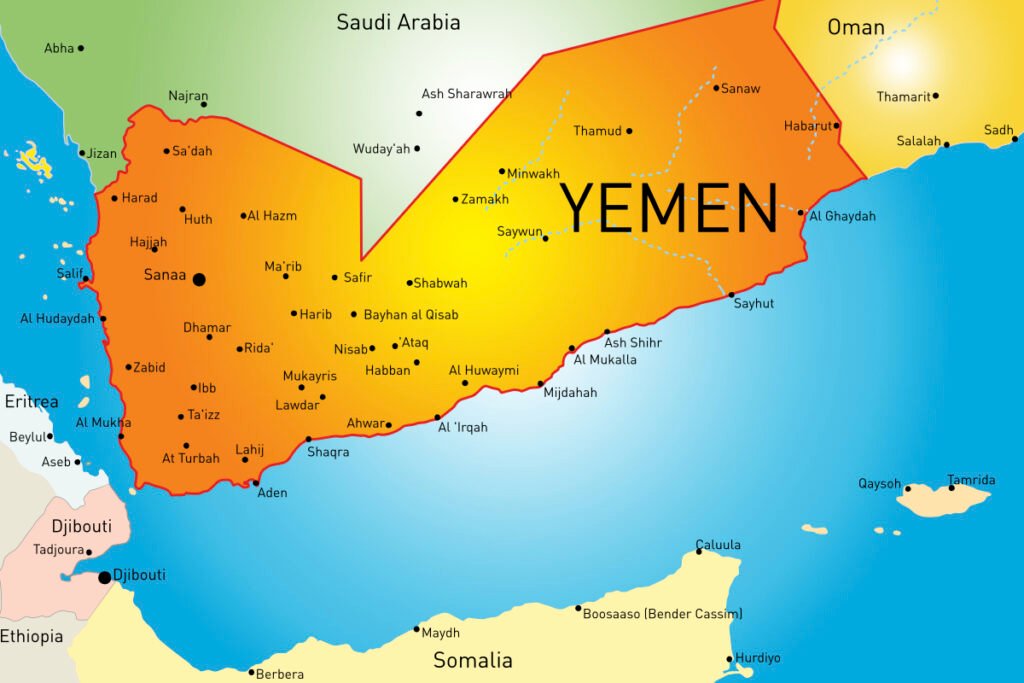
The fighting around Marib has become one of the central military confrontations in Yemen. The governorate, located northeast of Sana’a, possesses particular strategic importance because of its oil and gas infrastructure. Government forces retain control of the area while Houthi forces have intensified their offensive. A Houthi advance could therefore alter the military balance and strengthen the movement’s position in any subsequent negotiations.
Origins of War
Hadi administration’s territorial weakness reflects the failure of the 6-year long Saudi-UAE war against Yemen. The origins of the war can be traced back to 2011 when Arab Spring protests erupted in Yemen. Authoritarian president Ali Abdullah Saleh, who had survived in power since 1978, was forced to resign. He stepped aside in favor of Hadi, who was his vice president from 1994 to 2011. Hadi’s interim government was legitimized by way of a February 21, 2012, referendum in which his was the only name on the ballot.
Hadi’s transitional government also pursued an economic program centred on market liberalization. Yemen’s accession to the WTO was accompanied by pressure for changes to trade policy, privatization and the reduction of state protections. These measures exposed domestic producers to intensified international competition at a time when the country’s economy was already under severe strain. The government’s economic agenda consequently became part of the wider political conflict surrounding the post-Saleh transition.
The Hadi government combined a neoliberal orientation with the undemocratic imposition of a new politico-legal structure. The government recrafted many of Yemen’s laws, starting a process of federalization that would debilitate regions with anti-Saudi and anti-Qatari interests. As a result, millions of Yemenis supported the Houthis.
Houthis represent a religious revivalist movement within the Zaydi branch of Shi‘i Islam led by the sons of Badr al-Din al-Huthi, a Zaydi scholar, in the Sa‘ada province on the Saudi border. During the 1990s and 2000s, the movement developed from a localized Zaydi revivalist current into an armed challenge to Saleh’s government. Its organization expanded considerably during the successive conflicts with the Yemeni state, eventually giving Ansar Allah a much larger military and political presence in northern Yemen.
International actors involved in Yemen’s political transition treated Ansar Allah primarily as an armed political actor, a characterization that contributed to its marginalization within the transitional process. The movement’s position in the National Dialogue Conference consequently became contested.
The outright persecution of Houthis proved to be counterproductive, resulting in the formation of a temporary and unstable alliance between the Saleh and AnsarAllah. Even after resigning from the presidency, Saleh retained a lot of support within the security services. In September 2014, Houthi militias, in alliance with Saleh, took over government buildings in the capital while the army stood by.
When Ansar Allah’s forces entered Sana’a, the movement initially presented its intervention as a response to the failures of the transitional government. Its committees called for a timetable for elections and sought to reverse economic and legislative measures adopted during Hadi’s tenure. These demands became part of the movement’s broader claim that the transitional process had failed to address Yemen’s political and economic grievances.
The relationship between Saleh and Ansar Allah eventually collapsed in December 2017. Saleh publicly broke with the movement and sought cooperation with the Saudi-backed camp. Fighting between his supporters and Houthi forces followed in Sana’a, where the Houthis defeated the pro-Saleh forces. Saleh was killed shortly afterward.
Genocide
Hadi fled to Aden and appealed to Riyadh and Abu Dhabi for military assistance. Saudis and Emiratis proceeded to assemble an alliance of Middle Eastern and African states – Bahrain, Egypt, Jordan, Kuwait, Qatar, Eritrea, Morocco, Senegal, Somalia and Sudan – acting in the name of Hadi’s government – exiled in Riyadh. The first Saudi air strikes were launched on 26 March, 2015 to prevent Aden falling to Saleh’s Republican Guards. This was the beginning of genocide.
The Saudi intervention in Yemen was propelled by the monarchy’s domestic concerns. Mohammed bin Salman, as defense minister, became closely associated with the military operation in Yemen. This subsequently formed an important part of his emerging political profile within the Saudi leadership.
Within days of starting the war, Saudi Arabia imposed a total land, air and sea blockade, along with targeting agriculture and food supply infrastructure that support life for the Yemenis – all of which constitute war crimes under international law. Yemen’s dependence on imported food made restrictions on maritime access particularly consequential for civilians. The Saudi-led coalition’s control over the country’s ports and surrounding waters disrupted the movement of commercial and humanitarian supplies. Such restrictions placed additional pressure on food markets and contributed to the worsening humanitarian conditions created by the war.
The conflict severely damaged Yemen’s health infrastructure and restricted access to medical care. Attacks affecting health workers and facilities contributed to the closure or reduced operation of medical institutions. Physicians for Human Rights reported that 92 to 95 percent of medical equipment in Yemeni hospitals and health facilities was expired or no longer functioning
The consequences of the war have extended far beyond deaths directly attributable to combat. The destruction of infrastructure, disruption of food supplies and deterioration of health services have produced extensive indirect mortality and severe food insecurity. Humanitarian assessments consequently describe the crisis through both direct casualties and the wider effects of deprivation, disease and the breakdown of essential services.
Saudi Arabia has justified the saturation bombing of Yemen by claiming that the Houthis are an Iranian proxy. Given that the Saudis and local allies control the Gulf of Aden, Iranian ships with weapons cannot travel all the way to northern Yemen and Sana’a. The same applies to the airspace, which is entirely controlled by the Saudis. While Iran may have managed to send some support and advisors, it is stupid to describe the Houthis as Iranian-backed. Moreover, the Saudi usage of the Iranian threat stokes the sectarian flames of the Shite-Sunni narrative and elides a deeper analysis of the problems plaguing Yemen after the 1990 unification.
With the onset of the COVID-19 pandemic in Yemen, the genocidal impact of the war has combined with an epidemiological crisis to generate a perfect storm for Yemenis. However, Yemeni lives don’t matter for the rulers sitting at the helm of our brutal system. War profiteers are least concerned about what happens in Yemen as long as they are able to sell a full range of arms that kill human beings and destroy nations. Without concerted action, the genocide in Yemen will continue, with the profits accruing to the arms industries.