







Does a single Canadian MP seek peace, or do they all want Ukraine wrecked?
On Saturday, the Financial Times reported on a 2023 proposal to end the devastating war by exchanging land for neutrality. Vladimir Putin endorsed a plan to withdraw troops from most of the four oblasts Russia declared “annexed” — to positions held before the February 2022 invasion — in exchange for Kyiv dropping its bid for NATO membership. As per the discussion, Ukraine could still receive security guarantees from NATO members and seek to join the European Union. In exchange, Ukraine would recognize that Russia controlled (not its right to) Crimea, portions of the Donbas, and allow a land bridge connecting Russia to Crimea.
While Putin accepted the proposal, Ukrainian President Volodymyr Zelensky and Joe Biden’s administration rejected it.
After the report was published, Ukrainian MP Oleksiy Goncharenko confirmed the Financial Times’ revelations and added details about an effort he backs.
A year earlier, the US and UK scuttled Ukraine-Russia peace talks. David Arakhamia, who was parliamentary leader of Zelenskyy’s Servant of the People party, said Russia was prepared to end the war a month after its 2022 invasion if Ukraine agreed to neutrality, but UK Prime Minister Boris Johnson told Zelensky not to sign the peace deal. Former Israeli Prime Minister Naftali Bennett, Turkish foreign minister Mevlut Cavusoglu, Vladimir Putin and others have echoed this account of the initial peace negotiations.
No Canadian politician will comment on Russia’s relative flexibility on these proposals, let alone publicly endorse the terms, which indirectly rebuke Canada’s push to NATOize Ukraine. Everyone in official Canadian politics is also offside with Ukrainians’ desire to end the horrible war. A Rating Group poll this month found that “83% of Ukrainians support negotiations, while 56% are open to territorial concessions in exchange for guarantees from the West.” Additionally, only 21% of Ukrainians supported fighting until the Donbas was returned, while a large majority favored a national referendum on peace (instead of allowing the president or parliament to decide).
An August Gallup headline noted “Ukrainian Support for War Effort Collapses”. Gallup’s poll found that 66% of Ukrainians favored an immediate negotiated cessation of hostilities and 57% supported an immediate negotiated peace with Russia and territorial concessions.
Polls also consistently show that the closer Ukrainians live to the territories in question, the more sympathetic they are to negotiations and territorial concessions.
Instead of promoting a negotiated end to the war, Mark Carney recently labeled a US plan to purchase Russian diesel a threat to “peace”. As Canada’s prime minister supports or ignores Donald Trump’s violence in Iran, Somalia and elsewhere, Carney criticizes an energy deal tied to de-escalating an ever-widening four-and-a-half-year-old war.
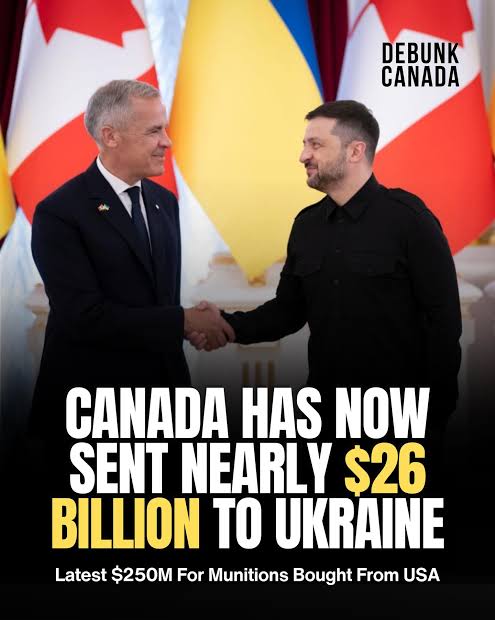
Instead of promoting negotiations, Carney announced $355 million to support Ukrainian air defenses two weeks ago. As part of the NATO-led Prioritized Ukraine Requirements List, Canada has put up $900 million recently to purchase US arms for Ukraine. (Interestingly, about a month ago government releases on the subject began describing nearly $20 billion in non-military assistance Canada has provided as “over $750 million for Ukraine’s recovery and reconstruction”. The downplaying of the $27 billion in total assistance may be a response to observers noting Ottawa has spent more on the NATO proxy war in four years than during 13 years of Canadian occupation of Afghanistan.)
Canada has also steadily increased the number of troops it has stationed on Russia’s border in Latvia. Recently, Ottawa announced it would boost the total from 2,200 to 2,600 by 2031 (Canada may have more troops per capita in Latvia than at home!) Canada also has a regular naval presence in the region and 150 troops in Poland.
Yet no Member of Parliament or major party leader promotes diplomacy or peace negotiations.
They all want to fight until the last Ukrainian. (Ukraine’s population has dropped from about 52 million at independence in 1991 to 27 million today. Over the past four years, about 6 million have fled or been killed, and millions more have been lost to Russian territorial conquest.)
A month ago, Zelensky’s former spokesperson, Yulia Mendel, warned that her former boss was committing national suicide. Mendel said the President’s war policy made him an “instrument of the suicide of the Ukrainian nation”.
Fighting an ever-widening war of attrition with a nation five times your size is unlikely to succeed, and by bombing civilian infrastructure across Russia, Kyiv has made it easier for Moscow to justify its blockade of Ukrainian Black Sea grain shipments. This year Ukrainian farmers have had a successful harvest, but a large proportion of it is expected to rot since they can’t access the country’s main shipping route. Ukraine is currently losing around CDN $90 million a day in export revenue from the sea blockade and faces a significant budget gap this year and a whopping $100 billion next year, which the European Union and Canada will struggle to cover.
If Canadian politicians concerned themselves with Ukrainian well-being as much as NATO and Western domination, they would be promoting détente and diplomacy.