











Global Affairs Canada has announced that the Canada-EU Summit will take place in Montréal on October 29-30, 2026. Canadian Prime Minister Mark Carney will host European Commission President Ursula von der Leyen and European Council President António Costa.
Global Affairs informs that Carney and EU leaders will meet to advance the Canada-EU Strategic Partnership, trade and economic security, defence and security cooperation, critical minerals, technology and the digital sphere. The meeting also intends to launch or define their strategic partnership framework called “The Canada-EU Alliance for the Future.”
None of this serves the burning issue of democracy today which is the peoples’ striving for independence, sovereignty and a new world order serving their interests. This is not what Mark Carney is proposing or the EU is offering.
The list of things to be negotiated comes under Collective Resilience, the second of three “core pillars” which comprise the doctrine Carney put forward when he addressed the European Parliament in Strasbourg on September 17. In his address to the European Parliament, referring to Collective Resilience, Mark Carney used the phrase “elective affinities” to characterize what he calls the profound, values-driven partnership between Canada and the European Union. He invoked the term to contrast the Canada-EU relationship with traditional alliances born purely out of geographical proximity. Carney argued that as trade integration is increasingly weaponized and tariffs are used as leverage and multilateral norms face pressure, Canada and Europe are bound together not by accident or maps, but by a conscious, shared choice. They are drawn to one another through an inherent alignment of values — including democracy, the rule of law and human dignity — making their relationship “stronger for being so.”
The concept of elective affinities, Wahlverwandtschaften in the original German, originated in 18th-century chemistry and physics. It described how certain chemical elements have a natural, inherent tendency to selectively bond with or attract specific other elements over others when combined in a mixture.
The term was famously popularized in the humanities by German polymath Johann Wolfgang von Goethe in his 1809 novel, Die Wahlverwandtschaften (Elective Affinities). Goethe used the chemical metaphor to explore human relationships, marriage and emotional chemistry. He illustrated how people, much like chemical compounds, are drawn together by powerful, seemingly involuntary yet deep-seated affinities that transcend conventional rules.
Goethe’s usage carried a vital romantic connotation: that relationships are driven by an internal, compelling resonance rather than external coercion or mere coincidence.
By employing the term in his speech to the EU Parliament on September 17, Carney bridged its historic trajectory by framing the Canada-EU bond not as a cold bureaucratic treaty, but as a deep, scientifically and philosophically resonant “chemical” attraction between two like-minded democratic spaces. It is shallow boilerplate gibberish promoted by Carney and his ilk, the thin veil of 18th century science and philosophy taken out of context and “transported” into 21st century use in order to cover up the big lie that the Carney Doctrine concerns any arrangement other than the “cold bureaucratic” and military one. It is no different but with changed phrases, therefore part of the big lie that something new is being created which the peoples can rely on to serve their interests. The “attraction” of “like-minded democratic spaces” is the delusion of so-called democratic peace among like-minded democracies which don’t fight each other in a world bristling with war preparations and rhetoric.
The fact that Carney’s speech to the European Parliament is replete with boilerplate vapid nonsense serves to underscore that, despite and because of his attempt to associate himself with the outstanding polymath Goethe, behind all his banker savvy he is utterly devoid of character and depth.
Carney seems to have grand illusions of being a polymath himself — “a person of great and varied learning whose knowledge and deep proficiency span multiple, distinct subjects or disciplines.” He poses as having the ability to synthesize and apply insights from one field, such as art, literature and values, to solve problems in another, such as matters related to science, technology and nation-building today.
His phony doctrine has received a euphoric reception by desperate leaders of several European countries, bankers and financial oligarchs who are facing the wrath of their own peoples against their pay-the-rich schemes and dangerous preparations for war. They are awed by what superficially appears to be the ability of a polymath to master diverse areas, balancing intellectual, creative and technical pursuits.
But Carney is no Renaissance Titan. While he seems to suffer from a grand illusion that he can be considered a polymath of some kind, the fact remains that the needs of the world at the end of the 1700s and the personalities which emerged at that time to address those needs on behalf of the rulers of the age are not the needs of the world in the 21st century. This period of historic transition must complete the democratic revolution which began in Europe in the late 1600s, at which time the territorial nation-state was founded in the image of a ruling class which took over power based on a juridical outlook and system to protect its commercial and landed interests. It was a system designed to keep the working class and people out of power which served its purpose under those conditions but no longer serves the purpose and raison d’etat originally intended.
 Today, Carney’s illusions of grandeur notwithstanding, history is not calling forth Titans such as the Renaissance gave rise to. It is calling forth the kind of modern democratic personality which expresses the collective action and striving of individuals, their collectives and entire societies for modern mass democratic arrangements which meet their needs.
Since the early 1990s, the working class and people of this country have opposed the Europe of the Monopolies — today oligopolies — and their brutal neo-liberal nation-wrecking agenda. They have opposed participation in wars of aggression and destruction such as the criminal NATO bombing of Yugoslavia and its subsequent dismemberment and that against Afghanistan. They reject the resuscitation and encouragement of neo-Nazi organizations to commit crimes against the peoples. None of this showed a united Europe but, on the contrary, the sharp inter-imperialist contradictions between Germany, France, Britain and the United States in their striving to control Europe so as to dominate Asia.
Their aggression and nation-wrecking have given rise to tremendous crimes against humanity with destruction of Yugoslavia, Libya, in Iraq, Afghanistan and within other countries. The failing U.S./NATO proxy war in Ukraine to annihilate Russia is another example. All of this while the peoples of Palestine, Lebanon, Yemen and Iran, as well as Cuba and other blockaded countries subject to U.S. state terror courageously fight for their right to be. The Europe of the Oligopolies and Canada posture self-righteously about upholding rights and values which the entire world knows is not true.
Their “Alliance for the Future” is a pitiful declaration that they will constitute a new hegemon to counter the U.S. hegemon to which they are still bound hand and foot. The peoples of Europe and the world have been forced to suffer the consequences of the anti-social offensive and restructuring of the states in Europe and Canada to give rise to altered raisons d’etat which cement the rule of the oligopolies as is also the case of the Trump counter-revolution in the U.S. It is the peoples who have to reckon with the forced migrations, climate disasters, famines, immiseration of all kinds and genocide.
The rulers in Canada are wrong if they think the working class and people of this country have short memories despite having fought against the effects of the Canada-Europe Free Trade Agreement (CETA) since it went into force in 2017.
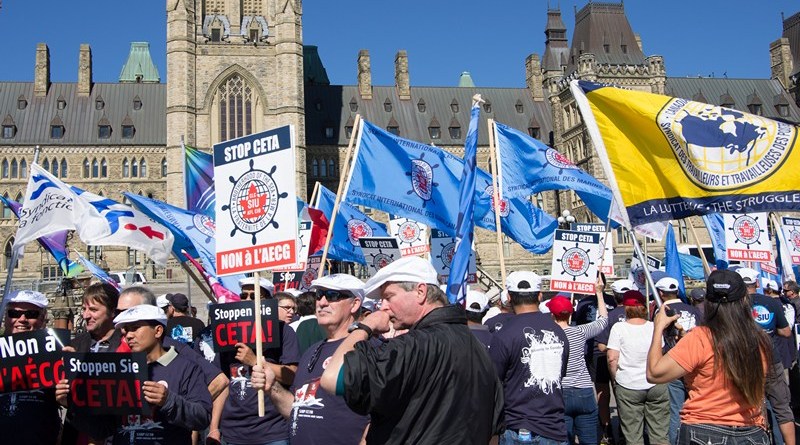


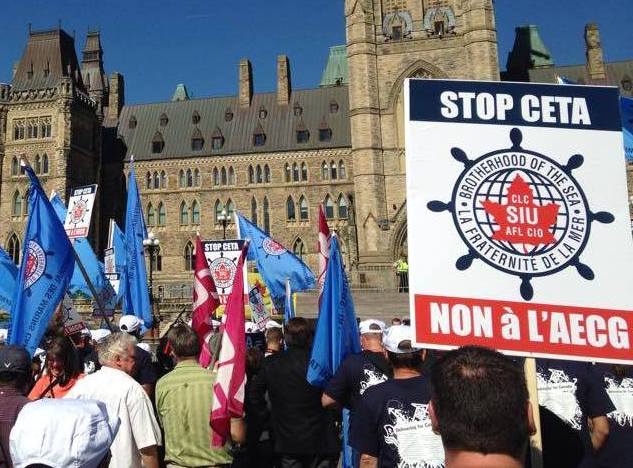

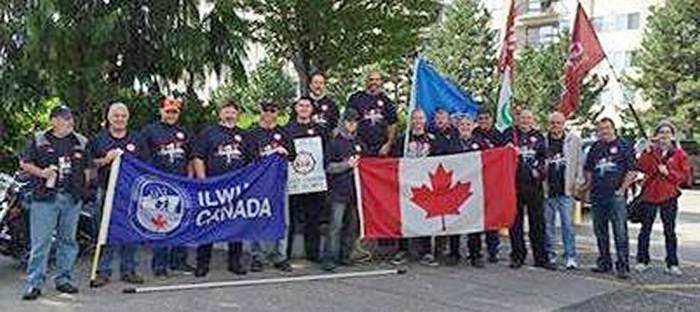
Demonstration on Parliament Hill against the Canada-Europe Free Trade Agreement (CETA),
September 27, 2014.
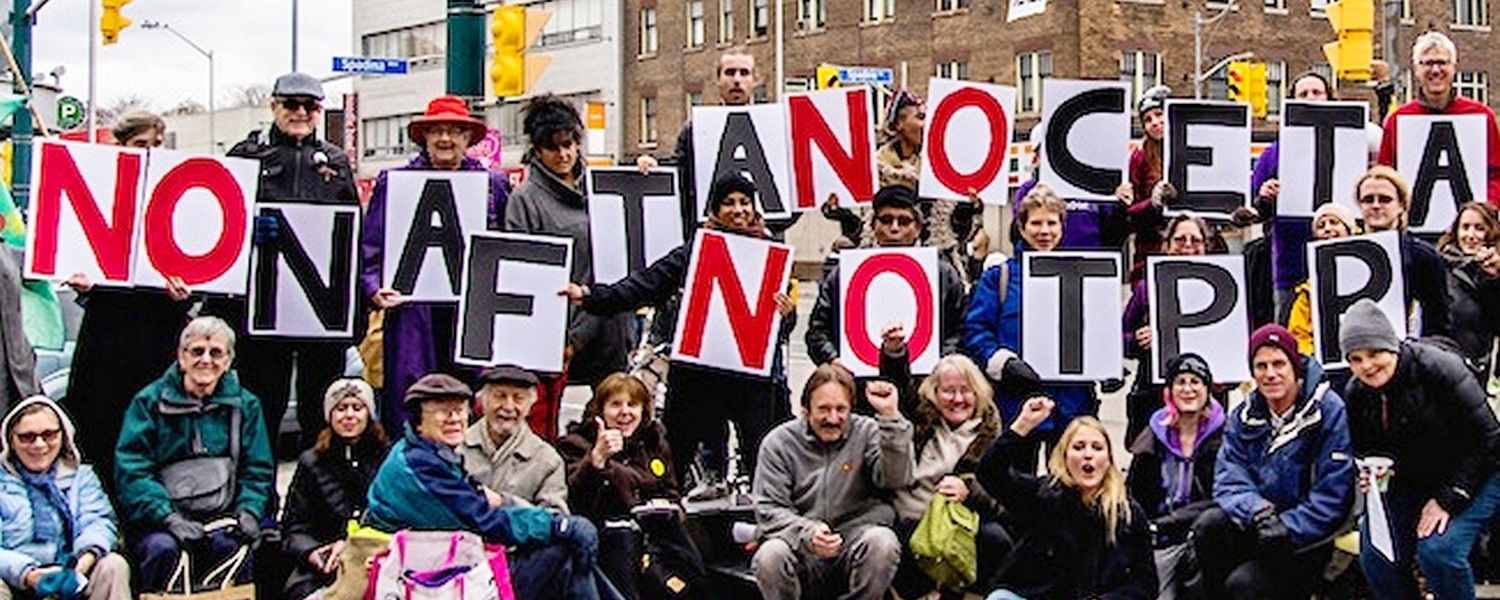
Toronto protest against neo-liberal free trade agreements, November 26, 2016.
Carney’s Canada-EU “Alliance for the Future” is an attempt to boost war preparations by overwhelming the demands of the people for peace, justice and a modern democracy which empowers the people. It may well cause more havoc as anarchy and violence are increasingly raised to positions of authority but it will not go unopposed. The peoples from east to west, north and south are getting tempered by speaking out in their own names. By formulating their own claims on society they will become proficient in how to create the kind of political organizations they require, along with those of a social and trade union character, to unite the people politically beyond the purview of the cartel parties and their cartel party governments in the hands of the oligopolies and their coalitions and cartels.
No to Joint Canada-Europe Militarization,
Anti-People Cooperation and War Preparations!
- First published at The Marxist-Leninist.