

 The monopoly media predominantly covers warring through the lens of political power. Of course, the politicians do not directly take part in the physical violence; that would require a physicality and courage that most politicians do not possess. But politicians are the ones who make the decisions to send humans to fight wars. The service personnel are, therefore, culpable in the violence. In the American case, the fighters chose to take part in wars and not declare conscientious objector status.
However, there are other cogs complicit in the death and destruction wrought by warring. Wars of self-defense aside, there is a process before choosing to go to war. Surveillance is carried out, intelligence is gathered, data is generated, and these are all assessed for factuality and accuracy by the human cogs in the war machine. Then military officers will deliberate on a strategy to identify the mission and its goals, what number of fighters and what armaments are required, what supply lines need to be set up, what are the initial targets, etc. War is complex — as Prussian military theorist Carl von Clausewitz put it, “a kind of business competition on a grand scale.”1Carl von Clausewitz, On War (Wordsworth Classics, 1997): 103. Not to diminish the revulsion of war by likening it to commerce, von Clausewitz wrote of blood-filled war where “the horror of its elements excites repugnance.”2von Clausewitz, p 189.
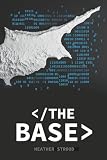
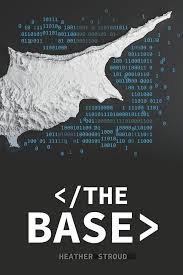
Heather Stroud has written a novel, </The Base>, that makes us question more deeply the morality of the role that cogs play in preparation for the carrying out of violence.
Stroud’s main protagonist is an 18-year-old woman, Zoe, who visits her father, Rowan, at the RAF Akrotiri base in Cyprus, a British Overseas Territory. Rowan works at the Akrotiri base, separated from his wife who does not accept his line of work.
Akrotiri is described by the Royal Airforce as “a forward mounting base for overseas operations in the Middle East” purposed “to protect the UK’s strategic interests.”
Notably, the storyline in </The Base> reads very much like how one might imagine such circumstances would play out in reality.
Cyprus is a Mediterranean island still affected by colonialism and imperialism. The island is divided into Greek and Turkish sides. Its location makes it geopolitically important in the Middle East. Stroud explores this and the ramifications for the Israeli occupation of and war crimes against Palestine.
Zoe’s father Rowan enters data into computers and deals with the patterns. The question is to what ends is the data information applied? Zoe wonders if her father even knows this. For Zoe, this presents her with a dilemma between loyalty and conscience.
Rowan refuses to consider the consequences of his job. Were other people such as Palestinians harmed as a result of the information generated from Rowan’s data crunching? The father-daughter reunion is challenged by the geopolitical climate. The reader is kept wondering what would be the outcome, but sensing an inevitable conclusion. However, Stroud comes up with an eloquent, contrary-to predicted ending that this reviewer did not see coming.
</The Base> is a fascinating read, emphatically so because of its relevance to the death and devastation being wreaked in the Middle East today by various geopolitical actors. Stroud challenges the reader to consider not only how the man sitting behind a computer screen analyzing data streams but how the assemblage of co-workers, the cook on base, the cleaners, the maintenance workers, the auto mechanics, the pilots, etc might be complicit in great harm to other human beings elsewhere.
Endnotes: