




The essay begins in Peter’s experience and widens into a shared reflection.
Let me start by saying that, up to a point, I am such a person. I live in Cambodia, where I am a stranger. My life’s work has made that a semi-permanent condition. I have resided and worked in many more strange lands, and for longer periods, than I have in those places that you could, if pressed, say I was “from”.
But there are strangers and strangers.
Some strangers are much stranger than others. And some seem much less aware than they should be of the fact that they are guests in someone else’s home. Or, worse, they just don’t care.
One of the last things we ever learn about ourselves is our effect on others.
That may be especially difficult to learn when we travel from rich countries to much poorer ones. Wealth changes when it crosses a border. So does status. A perfectly ordinary income at home may confer considerable privilege elsewhere; a passport may make the world traversable in ways unimaginable to most of the people among whom we are travelling; and a person accustomed to being merely one citizen among millions can suddenly become a customer whose approval matters.
The danger is that being welcomed gradually comes to feel like being entitled.
Siem Reap, where we live, offers a particularly good vantage point from which to observe this transformation. Angkor brings people here from all over the world, many of them from societies incomparably richer than Cambodia. Tourism provides livelihoods and opportunities for enormous numbers of Cambodians. Visitors are therefore welcomed, encouraged and, sometimes, endured.
The distinction may not always be obvious to the visitor.
And so, from our front-row seat, an ethnographic stiletto occasionally seems irresistible.
-
-
Taking Up Space
-
The most obvious form of intrusion is simply the amount of space some visitors assume they are entitled to occupy.
Not necessarily physical space, although there is plenty of that. More often it is acoustic space.
Ethnically, we are both of mostly English extraction and one of us went to a British public — that is, private — school, so when it comes to audio we are both afflicted with a more or less innate conversational reserve: a preference, you might say, for oral and aural minimalism. One should generally err on the side of saying too little, and never too loudly. Be ironic and cutting by all means, but — de rigueur — do so politely and quietly.
This puts us at something of a disadvantage when confronted by the full conversational resources of certain travelling groups.
Loud, voluble and bombastic visitors will sometimes invade the cafés where we like to read in air-conditioned comfort for a couple of hours. Their arrival immediately alters the room. Conversations taking place at half their volume become impossible. Whatever music is playing disappears beneath them. Everybody present becomes, involuntarily, part of their party.
They may be having a perfectly pleasant time. That is not really the point.
The point is that freedom to speak does not necessarily include freedom to make everyone else listen.
The long struggle over second-hand cigarette smoke provides an instructive analogy. For decades the smoker’s freedom was assumed to include everybody else’s involuntary participation. Eventually we recognised that the exercise of one person’s preference could materially diminish somebody else’s use of the same space.
Cultural intrusion is obviously not lung cancer. But the principle of reciprocal consideration is not entirely different.
What is striking is the apparent absence, sometimes, of the question: What effect am I having on the people around me?
This is not uniquely American, Australian, British, French, Chinese, Korean or anything else. Every country exports its quota of the oblivious. But wealth and tourism can amplify obliviousness because the visitor is usually insulated from its consequences. People smile. The waiter continues serving. The guide continues guiding. Nobody tells you to shut up.
It is easy to mistake this for approval.
-
-
Over-Exposed
-
The same problem becomes more sensitive when it involves dress.
Freedom of expression does not carry the automatic assumption that other people will like what they see or hear as a result. Nor does the fact that something is permissible in one cultural setting make it culturally neutral in another.
At Angkor Wat recently we watched several visitors who had evidently acquired shawls in order to meet the temple’s dress requirements. Once inside, however, the shawls migrated from shoulders to hands.
The requirement seemed to have been understood not as an expression of respect for the place, but as an irritating obstacle to admission.
Their Cambodian guides said nothing.
Perhaps the guides saw no problem. Perhaps they had already said something. Or perhaps correcting the people who pay you is one of the luxuries tourism does not always permit.
The incident was trivial, but it illustrates something less trivial.
A visitor can obey a rule while missing entirely the reason for it.
At temples, where dress expectations are rarely enforced, the question becomes still more revealing.
Respect begins where enforceable rules end.
The issue is not prudery and certainly not the attractiveness or otherwise of anybody’s body. Nor should women carry a burden here that men somehow escape. The question is whether entering a sacred or culturally important place generates any obligation to notice what that place means to the people whose inheritance it is.
The same question arises, less sharply, in town. Siem Reap is not a beach resort, although at times one might reasonably conclude that an invisible coastline had materialised somewhere behind Pub Street. Much of Cambodian social life remains considerably more conservative than the visitor might assume. Foreigners are legally entitled to dress in ways that attract attention or disapproval. But legality is a remarkably low threshold for deciding how a guest should behave.
There is a peculiar contradiction here. Much Western discussion correctly insists that people should have the right to make choices about their own bodies and dress. Yet the same discussion can become remarkably universalist when encountering cultures in which different ideas of modesty prevail. Revealing the body becomes emancipation; covering it becomes repression.
Why should either interpretation be automatic?
One of the lessons of cultural relativism is surely that emancipation cannot be defined simply by counting square centimetres of visible skin.
The more useful question for a traveller is less grand:
Where am I, and what does consideration look like here?
-
-
Reinvention
-
There is another form of asymmetry among foreigners in Cambodia that is more intimate and more difficult to discuss.
Anyone who has lived here for long has seen older foreigners forming relationships with much younger Cambodians.
The most conspicuous examples are probably older Western men with younger Cambodian women, but they are not the only ones. There are older men with younger Cambodian men, and no doubt older foreign women who discover comparable opportunities for reinvention. The pattern is neither exclusively male nor exclusively heterosexual, although some forms are plainly more conspicuous than others.
These relationships should not simply be caricatured as predatory. That would reproduce the very condescension we are trying to examine.
A Cambodian partner has agency. A relationship may involve affection, companionship, loyalty and love. It may also provide financial security not merely for an individual but for parents, siblings and children. Economic calculation and genuine tenderness are not mutually exclusive human states.
But neither should the asymmetry be romanticised away.
None of these calculations is peculiar to Cambodia, to expatriates, or even to men. Age, money, status, attractiveness, security and need enter relationships everywhere. Our narrower concern is what happens when crossing a border dramatically recalibrates them.
Cambodia, and countries like it, can produce an extraordinary change in how an otherwise quite ordinary foreigner experiences his or her own status.
A man who felt old, lonely, sexually invisible, unsuccessful in relationships or simply ordinary in London, Melbourne or Manchester may arrive in Cambodia and discover that he is suddenly important. His pension becomes significant. His passport represents mobility. His capacity to pay for dinner, rent, medicine, school fees or a family emergency can make him useful in ways he may never before have experienced.
He may feel wanted.
Perhaps he is wanted.
The more uncomfortable question is: wanted for what, and under what conditions?
That question does not invalidate the relationship. It merely refuses to pretend that money, nationality and mobility disappear when two people fall in love.
The foreign partner usually retains much greater freedom to leave. The Cambodian partner may have considerably more at stake.
At its worst, something older lurks beneath this arrangement: a residue of colonial entitlement, the assumption that relative wealth confers greater access not merely to restaurants and houses and services but to other people.
Yet even that statement needs qualification. There is a danger in portraying the Cambodian partner as passive material upon which foreign power operates. People make choices within the circumstances available to them. The fact that those circumstances are unequal does not mean the choices are unreal.
What matters is whether the wealthier stranger is sufficiently interested in the imbalance to see it.
Cambodia allows certain foreigners to reinvent themselves.
The moral question is what obligations accompany the reinvention.
-
-
Hospitality Is Not Invitation
-
Perhaps much of what we are describing arises from one persistent misunderstanding:
Cambodian openness can be mistaken for invitation.
Politeness can be mistaken for approval.
Reluctance to confront can be mistaken for consent.
Service can be mistaken for deference.
Economic necessity can be mistaken for gratitude.
Hospitality can be mistaken for submission.
And silence can be mistaken for enthusiasm.
For visitors from cultures in which displeasure is often expressed directly, the reluctance to embarrass or publicly confront others that we have often encountered here may be particularly easy to misread.
Nobody complained.
Nobody stopped me.
Everyone smiled.
Therefore everyone must have been happy.
Perhaps.
But perhaps not.
The tourist industry complicates the matter further. Once an encounter becomes commercial, the visitor acquires the power of the customer. The guide needs a tip. The hotel needs a favourable review. The restaurant needs the table. The tuk-tuk driver needs tomorrow’s fare.
One consequence is what might be called the purchaser’s fallacy:
I am bringing money into your country, therefore my presence is a benefit, therefore my behaviour should be accommodated.
That logic can turn a guest into a consumer of place.
The temple becomes something bought with an entrance ticket. The guide becomes an employee rather than a cultural intermediary. The city becomes an entertainment district. Local tolerance becomes part of the service package.
And because Cambodia genuinely does need the economic benefits of tourism, the distinction between hospitality and compelled accommodation can become almost impossible for the visitor to detect.
Unless the visitor makes an effort to detect it.
-
-
What We Bring with Us
-
This is where the apparently trivial examples begin to connect with something larger.
Foreigners do not arrive empty-handed.
We bring money, certainly. We bring cameras, luggage, expectations and appetites. But we also bring assumptions about normality.
We carry ideas about how loudly one may speak, how one should dress, what constitutes freedom, what money purchases, what service means, what relationships look like and how much of ourselves the surrounding world should be required to tolerate.
Rich-country travellers possess the additional luxury of imagining these assumptions are merely individual choices.
They are not always experienced that way by the host.
This is where capitalism enters the argument, although perhaps less dramatically than it might.
Mass tourism converts places into commodities. The temples, streets, villages, restaurants and even interactions with human beings become experiences purchased by people with sufficient disposable income to travel.
Poorer countries face an unattractive bargain. The visitor brings money that is genuinely needed, while also bringing cultural externalities that cannot readily be priced: noise, pressure, altered expectations, commodification, rising land values, sexual markets, visual and social intrusion.
The visitor can then go home.
The consequences remain.
None of this means tourism is intrinsically destructive. Nor does it mean cultures should be preserved in aspic for the aesthetic satisfaction of foreigners who arrived twenty years earlier and now object to everybody who came after them.
We should be particularly suspicious of that temptation.
And neither of us stands outside this argument.
We live here because Cambodia permits us to. We enjoy economic privileges arising from many of the same inequalities we are criticising. Our familiarity with the country can itself become dangerous if it persuades us that longevity has somehow converted guesthood into ownership.
The expatriate who says “Cambodia is being ruined by foreigners” should occasionally glance in a mirror.
We do.
Not always comfortably.
-
-
A Ger in the Mongolian Steppe
-
Peter remembers an encounter years ago while travelling through Mongolia on a consulting assignment for UNDP. His co-consultant was a Dominican UNDP staff member of African ancestry; with their Mongolian driver, the three of them must have made an improbable party appearing out of the steppe.
They had crossed the Gobi travelling from one small soum to another and had reached the steppe. For hours they had seen almost nobody — horses, cattle, sheep, emptiness.
Eventually they stopped for a breather near a solitary ger.
The herder was home with his wife and children.
From their perspective, an improbable machine had appeared from the steppe and disgorged three strangers.
Peter remembers waiting, perhaps, for the moment of surprise.
It never came.
There was no alarm, no suspicion, hardly even curiosity of the sort one might reasonably have expected. What remained instead was something approaching a deep-seated assumption of hospitality.
They had arrived.
Therefore they should be fed and watered.
So they were.
The head of the household and Peter discovered that they shared an interest in horses. Peter had bred horses himself in Australia — rather different animals, but the differences mattered less than the recognition.
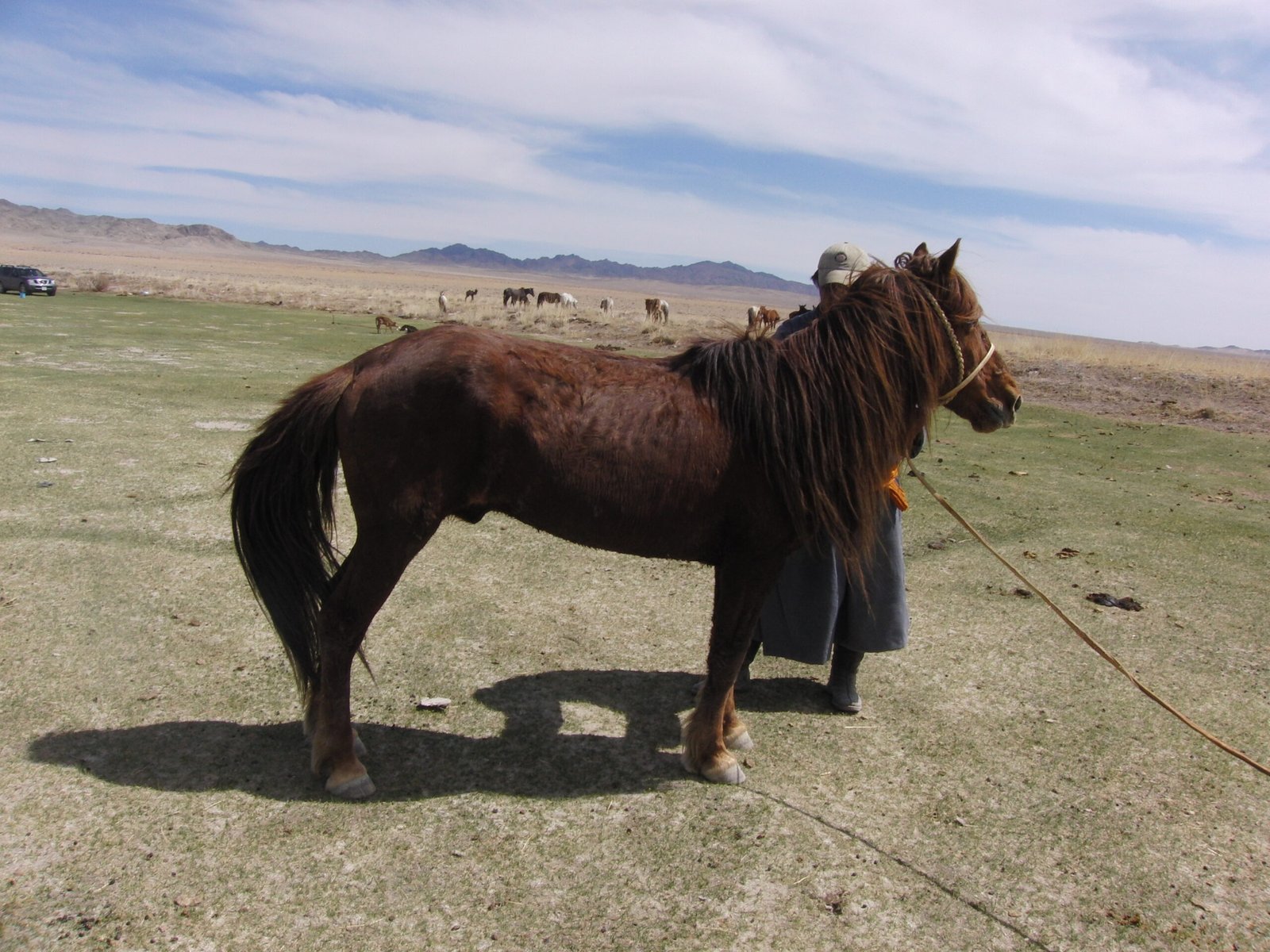
They talked horses and admired the herder’s pride and joy, his stallion.
Then they continued across the steppe.
It is an encounter that has stayed with Peter ever since, but the question it leaves belongs to both of us now.
The story does not prove anything. Hospitality is not a uniquely Mongolian virtue, nor are people living traditional lives morally superior to tourists with wheeled luggage.
But the encounter suggests another way of thinking about the relationship between stranger and host.
There was no obvious material advantage in welcoming us.
They welcomed us anyway.
What, then, might reciprocal hospitality require from the stranger?
Perhaps the obligation of the guest is not merely gratitude after being welcomed, but restraint while being welcomed.
To lower one’s volume occasionally.
To notice where one is.
To understand that paying does not confer possession.
To recognise that another person’s politeness may conceal an opinion they cannot comfortably express.
To wonder whether sudden desirability has anything to do with one’s passport or bank account.
To remember that freedom exercised without attention can feel remarkably like domination to the person required to accommodate it.
None of this requires the traveller to disappear into the host culture or imitate it.
A stranger remains a stranger.
Perhaps that is not a condition to be overcome.
Perhaps the important thing is to remember it.
-
-
Strangers Still
-
Those of us who spend years living outside the societies from which we came can acquire an odd sense of belonging.
We know the roads. We have favourite cafés. We complain about newcomers. We recognise changes and mourn things that have disappeared. Eventually we begin speaking about “our” neighbourhood, “our” temple, “our” Cambodia.
Some of that is affection.
Some of it may be another form of possession.
The test of belonging may therefore be almost the opposite of what we imagine.
Perhaps living somewhere well does not mean finally ceasing to be a stranger.
Perhaps it means becoming increasingly conscious of what being a stranger requires.
There are strangers and strangers.
Perhaps the better ones never quite forget that they are guests.