

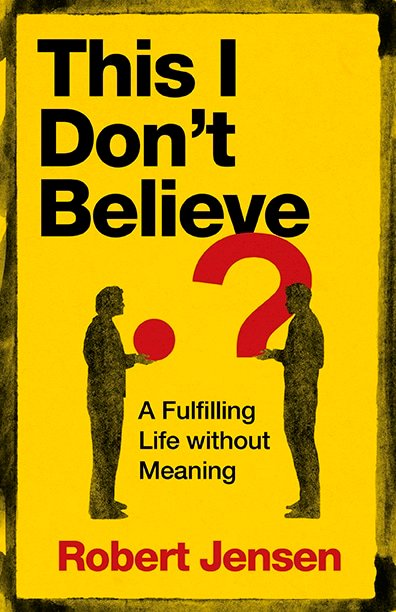
 [This essay is adapted from This I Don’t Believe: A Fulfilling Life without Meaning.]
In the nearly universal search for meaning, four questions seem inescapable.
Is there a God, understood as a divine force, entity, or being that created the universe and has the power to direct events in it? Are we spiritual beings, with spirituality understood as a nonphysical plane of existence in which the concept of a soul is intelligible? Does capital-N Nature—a belief that the larger living world has an intelligence beyond any organism, or that from natural forces we can find meaning in our lives—offer a purpose for our existence? Do human beings (and perhaps other organisms) have free will, understood as the ability to make decisions independent of any prior event or state of the universe, to make choices not caused by anything outside our own will?
If the answer to those questions is no, can we find other sources of fulfillment that don’t rely on concepts such as the divine, transcendent, mystical, or sacred? I have been able to live a “meaningless” but fulfilling life.
I do not believe in God or gods and, from my earliest memory, never believed. I don’t believe there is a spiritual plane of existence, a concept that, from the time I had the intellectual ability to ponder it, never made sense to me. I don’t believe there is anything mystical about Nature, a position I came to in the same fashion as my rejection of spirituality. I do not believe that humans, or any organism, have free will, a conclusion I reached in more recent years. And I don’t find myself searching for an account of our existence that creates any sort of transcendent meaning. My sense of fulfillment comes from ordinary everyday activity.
I believe that faith in God or gods is an expression of hope that there is a force, entity, or being—often conceived of as a parental figure—that can help us make sense of the world, especially unavoidable human suffering. I believe that embracing spirituality is an expression of hope that there is some realm beyond the physical plane of existence in which that suffering does not exist. I believe that an appeal to the wisdom of Nature is an expression of hope that we can make suffering more bearable, perhaps even intelligible. I believe that asserting we have free will is an expression of hope that, no matter how much suffering is in the world and how strong the forces that produce it, each one of us is at least in command of ourselves as we suffer.
I believe the quest for meaning anchored in something bigger than our everyday existence is an expression of hope that when we’re forced to face our fears and anxieties, something out there—beyond the individual and our communities, beyond the human—can relieve our anxiety.
These questions have been asked and answered countless times in human history, in many different ways. I assume they’ll continue unresolved as long as people are around to debate. Experts with highly impressive credentials disagree about the answers. Someone with moderately impressive credentials (like me) is not likely to settle the debates. Instead of trying to argue for my conclusions, I want to explore why I find it so easy to reject God, spirituality, Nature, and free will as sources of meaning. Why do I reject ideas that many (probably most) people feel are necessary?
The book is my attempt to explain why I reject the idea that our lives have meaning and yet feel that I live a fulfilling life. One answer might be because I just don’t care about anything, that I’m a nihilist in the way most people use the term—someone who doesn’t give a shit about anything or anyone. But I give a shit about many things outside myself and have spent a lot of my time, energy, and money to pursue those things.
I am able to continue to care and act on that caring without believing that I can find truth from a God, or experience transcendence spiritually, or tap into the sacred wisdom of Nature, or have free will. I’m not the only person with these views, but we are a minority, both today and in human history. The book is my attempt to understand why I am a part of that minority. My gut feeling is that the answer has something to do with the kind of danger I faced as an infant, toddler, and child, experiences that began before I had the capacity to express any understanding of what was happening to me, even before I was cognitively capable of understanding much of anything.
Here’s one more aspect of my life that might be a bit odd: A friend told me that he doesn’t know anyone who is more compelled not only to think about these issues, but to work out a framework in which the questions make sense; come to a resolution of the issues consistent with that framework, even if the conclusions are not convenient; work to explain the framework and resolutions in plain language; then defend the results in public, even if it leads to clashes not only with political opponents but also with friends.
He was politely saying I have a compulsion to act on my too much thinking. That explains why this book exists. I think I’m the way I am not because I’m special or particularly smart, but most likely because I survived the kind of events that leave many people broken, some beyond repair. Perhaps the most interesting thing about me is that I’m alive and fairly functional.
Not because God saved me but not others; not because I have a deeper spirituality than others; not because I have tapped into some planetary intelligence; and not because I exercised my free will more effectively. I am sometimes amazed that I’m still here, and even more amazed that I’m writing a book, again. Maybe the book will shed some light on my odd ordinary life, a fulfilling life that has no meaning.