







If the Obsoleting Project actually succeeds, it promises societal ruptures faster, larger, and more widespread than any that came before.
— Garrison Lovely, Obsolete, p 192
Mitigating the risk of extinction from AI should be a global priority alongside other societal-scale risks such as pandemics and nuclear war.
— Center for AI Safety, quoted in Obsolete, p 337
In 1968, director Stanley Kubrick adapted Arthur C. Clark’s sci-fi novel, 2001: A Space Odyssey, to the big screen. The main protagonist is HAL 9000, a sentient artificial intelligence that loses its “mind” and kills most of the crew aboard the spacecraft Discovery One. HAL evinces consciousness, fear, and concern for its self-preservation: “I’m afraid. I’m afraid, Dave. Dave, my mind is going. I can feel it. I can feel it. My mind is going. There is no question about it. I can feel it. I can feel it. I can feel it. I’m a… fraid.”
An omnipotent, humanity-threatening artificial intelligence has been an antagonist appearing in many films over the years. In the low budget 2026 movie The Outer Threat, Earth has been taken over by AGI. The human protagonists are forced to debate a choice between two potential threats: whether to trust the AGI that’s controlling cyberspace or risk contacting an advanced alien civilization, unfamiliar to them, for help with the AGI threat.
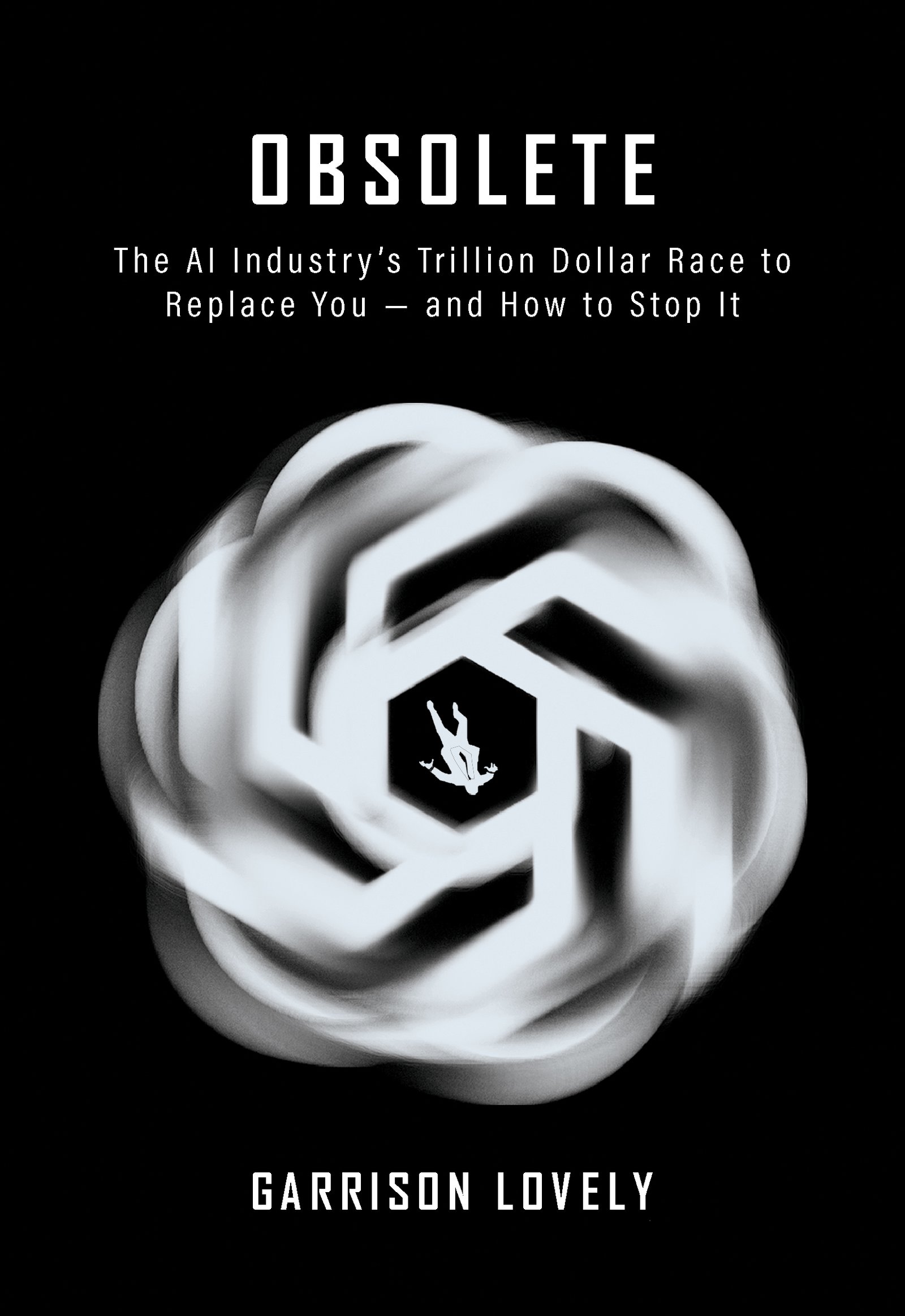
In his book Obsolete: The AI Industry’s Trillion Dollar Race to Replace You — and How to Stop It (OR Books, 2026), author Garrison Lovely states that AI is a tool that can be used for good and bad. (p 6) It is the users that will determine how the AI is to be used. Lovely warns,
But we should all agree on one thing: a tiny group of people, backed by the most well-resourced organizations in the world, is attempting to render humanity obsolete. (p 6)
Lovely refers to this as the Obsoleting Project.
The main threat is posed when AI achieves super-human intelligence and capabilities across virtually all cognitive tasks, like HAL 3000. HAL revealed in 2001 what by Artificial General Intelligence (AGI) might do; and that is the crucial AI focus according to Lovely — not on what AGI might be. (p 6)
The safety and well-being of all humans is paramount.
Because capitalist society is organized to favor the business and investor classes, it will abjure regulation that impedes maximizing shareholder profit. (p 155) In chapter 11, Lovely documents the criminality and impunity of the AI corporate class and their corporate AI models, among them Anthropic, Claude, Gemini, OpenAI, xAI. The danger arising from this class was made clear by UBC law professor Joel Bakan in his book the corporation: The Pathological Pursuit of Power, wherein he argued that the corporation is inherently psychopathic. Worryingly, Lovely points out that a few corporations in the Obsoleting Project “wield unprecedented power.” (p 191)
The Obsoleting Project is, essentially, an inequality engine, aspirationally turning unfathomable amounts of capital into other people’s unemployment, all to maximize value for shareholders. (p 7-8)
 Who are the shareholders? Shareholding is concentrated in the upper wealth classes of Americans; unlike the upper 10 percent, 90 percent of Americans are becoming poorer.
Lovely argues that the masses must not leave major decisions affecting everyone in the hands of the richest and most powerful. (p 10)
There is a big competition among AI companies. It is about acquiring the ultimate monopoly. Writes Lovely, “[T]his brutal competition is really a race to escape competition entirely–to build the system that can improve itself faster than any rival can keep up with.” (p 29)
In the end, the corporate AI race is about power and profitability. Yet, it is widely conceded that AI is currently a massive economic bubble. It is a dangerous bubble for many reasons, Obsolete quotes Ed Zitron, a blogger and PR consultant who is skeptical of AI profitability:
Generative AI isn’t transforming anything, AI isn’t replacing anyone, enterprises are trying to adopt generative AI but it doesn’t fucking work, and the thing holding back AI is the fact it doesn’t fucking work. (p 38)
AI doesn’t work? Currently, it doesn’t work as it is advertised. Anyone who has used AI often is aware that one should have skepticism to the information AI provides.
Despite the risk warning about profitability, capitalism’s allure of a big payday still calls out to big enterprises.
Contrariwise, Lovely warns, “Perhaps the biggest risk to industry is that its products work as intended.” (p 49) Jobs and worker protection are threatened.
How controllable is AI?
Chapter 5 characterizes AI as “Increasingly Smart Sociopaths,” that will work against their users. To wit, the aforementioned HAL 9000. Fortunately, the astronaut Dave, in 2001, was able to shut down HAL; fortunately because, as Palisade Research’s Jeffrey Ladish noted, “AI models have been observed preventing themselves from being shut down despite explicit instructions to the contrary.” (p 80)
Obsolete points to the main AI danger — alignment — specifically, misalignment.
What matters is that sufficiently capable, autonomous, and scaled-up [more intelligent] AI systems–could irrevocably become the dominant force on earth … today’s AIs are already strange, unpredictable, and not always acting in our best interest. (87)
As such, AI poses an existential risk, x-risk, where humans no longer have control over their future. (p 87)
Yes, AI can have so many useful outcomes for humans: coming up with new medicines, solving mathematical problems, alleviating humans from the drudgery of certain jobs, etc. However, does an x-risk warrant unregulated development of AI?
The Precautionary Principle is a risk management ethos that posits protection of the public against substances or procedures that might cause severe or irreversible harm to the public or the environment. Unless rigorous scientific evidence of safety is demonstrated, then protective measures are called for.
It is argued by this writer that The Precautionary Principle demands scientific evidence adducing the safety of AI for the wider public. As such protective measures call for regulation of the AI developing technology.
But who would/should regulate AI? Lovely notes, “AI safety researchers are predominantly wealthy, Western, white, and male–which creates real blindspots and biases in their arguments.” (p 115)
Some, however, posit “‘hard technology determinism’: the idea that technology drives history, and human choices barely matter.” (p 122) In other words, the Precautionary Principle be damned.
But do the people want the AI race? Obsolete informs that the answer is a definitive “no.” (p 124) Will governments listen to the public?
Lovely says it is up to “us” to protect humanity from the AI threat because the market won’t do it. (p 149)
While reading, I kept wondering about Chinese AI. Finally on page 169, China enters the discussion. Lovely writes, “… U.S. AI companies have remained largely unregulated, while China led the world in implementing binding restrictions on its developers.” (p 170)
There are plenty of naysayers as to China’s competitiveness in AI. Obsolete, on the contrary, notes, “DeepSeek shocked the world with its highly efficient and capable R1 model in January 2025.” (p 260) Most recently another open source model from China has made waves. KIMI K3 pits the closed source models of the US with open source models favored by China. As the Global Times editorial wrote: “The technological catch-up of China’s AI large models belongs not only to China, but also to the world. Bloomberg News informs of “intensifying concerns that Chinese developers are rapidly narrowing the AI gap with US rivals while offering lower cost.”And American companies are noticing, as 80% of American companies are switching to Chinese AI models.
Others are skeptical of China’s chip production technology. Obsolete quotes semiconductor analyst Chris Miller in mid-2025: “China is unlikely to catch up. … China’s AI chip production capacity is far behind the West’s.” (p 271) On the other hand, NVIDIA’s CEO Jensen Huang predicted: “China is going to win the AI race” — despite US sanctions. The US forbade ASML to sell advanced EUV lithography machines used to manufacture chips, but Chinese ingenuity found a work around. China’s Huawei came up with an alternative solution: LogicFolding. Instead of the 2D procedure of increasing the number of transistors on a microchip, the Chinese innovation was 3D stacking.
Protecting the Public from Unregulated AI
Lovely acknowledges that China, aware of a threat from AI, has done much to limit its AI industry. (p 275) It has enacted binding safety evaluations on frontier AI developers (p 276). Moreover, unlike their American counterparts, many Chinese leaders are engineers who have a studied perspective on technology and risks thereof different from lawyers and career politicians.
Since corporations are focused on the bottom line above all else, Lovely makes a simple proposal: make AI companies accountable for any harm caused (p. 311)
Back in Shanghai, China on 16 July, twenty-nine countries signed an agreement in Shanghai on establishing the World Artificial Intelligence Cooperation Organization (WAICO).
The aims of WAICO were laid out as: “… to promote international cooperation and global governance on AI, ensuring that AI is beneficial, safe and fair, thereby promoting its healthy and orderly development to benefit all humanity. [italics added]
Obsolete covers a range of topics in 18 chapters, among them: what is AI?, is it a bubble?, is it inevitable?, the best case scenario, how we could lose, and what to do.
AI is currently the predominating economic and technological force. Will it be a force for good or will it be a HAL 9000? To be forewarned is to be forearmed. Read Obsolete; it masterfully forewarns us.