





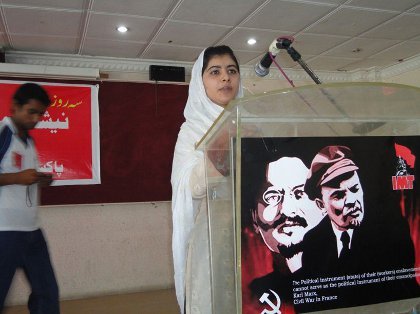
Malala at the Marxist school in Swat Valley
A girl locked out of school by force and a girl pushed out by neglect lose the same future.
When Malala Yousafzai stood before the United Nations in 2013 and declared that “one child, one teacher, one book and one pen can change the world,” much of the world imagined Afghanistan. The image seemed to fit easily. Afghanistan had already become a global symbol of women barred from schools and public life under militant rule. Yet Malala was Pakistani, from Swat Valley in Khyber Pakhtunkhwa, a region where the Pakistani Taliban once burned girls’ schools and threatened families who educated their daughters. In October 2012, she was shot on her school bus for speaking publicly about girls’ education. The confusion surrounding her identity revealed something larger than geography. The world notices the exclusion of women when it is dramatic, when armed men close classrooms or governments openly ban girls from learning. It pays far less attention to the quieter exclusion created by poverty, neglect, weak institutions, and social customs, even when millions of girls disappear from education in silence.
In Afghanistan, exclusion is direct and unmistakable. Since the Taliban returned to power in August 2021, Afghanistan has become the only country in the world where girls are banned from secondary schools and universities. Girls above sixth grade were removed from classrooms in September 2021. Universities were closed to women in December 2022. According to UNESCO, nearly three quarters of school age Afghan girls are now out of school, and more than 2.2 million are unable to study beyond primary level. The restrictions go beyond education. New “Vice and Virtue” regulations introduced in 2024 further erased women from public life. Female journalists lost their jobs. Radio stations faced tighter controls. Even appearing in public became difficult. Human Rights Watch has documented growing depression, despair, and isolation among Afghan women who once hoped to become teachers, doctors, and journalists. The economic cost is enormous, but the human cost is worse. A generation is being taught that its ambitions do not matter. Yet surveys by UN Women continue to show broad public support for girls’ education across both urban and rural Afghanistan. The ban survives not because society demands it, but because the state imposes it.
Pakistan presents a different reality, though not a comforting one. No law bars girls from attending school. Education is guaranteed under the Constitution, and women study openly in universities across cities such as Lahore, Karachi, and Islamabad. In some urban districts, girls now outnumber boys in higher secondary education. Pakistan also produced Malala herself, the youngest Nobel Peace Prize winner and one of the world’s best known advocates for education. Yet behind these visible successes lies another crisis. The Pakistan Economic Survey 2024 and 2025 estimates that roughly 22 million Pakistani children remain out of school, nearly 12 million of them girls. Female literacy rates continue to lag far behind those of men, particularly in rural areas. Pakistan also ranks near the bottom of global gender equality indexes in education. Unlike Afghanistan, the exclusion here does not arrive through official decrees. It grows quietly through state failure and social inequality. That silence makes it easier to ignore.
The barriers facing Pakistani girls are often ordinary, but no less destructive. Poverty forces families to decide which child deserves an education. In many households, sons are treated as investments while daughters are expected to remain at home. In parts of Balochistan, female literacy remains below twenty percent. Many girls leave school after primary education because the nearest secondary school is too far away or because no female teachers are available. Thousands study in buildings without electricity, toilets, transport, or even proper walls. Early marriage cuts short the education of countless girls every year. In conservative districts, some parents refuse to send daughters to schools staffed by men, yet the state continues to underhire female teachers. The shadow of militancy also remains. In parts of Khyber Pakhtunkhwa once targeted by the Taliban, memories of attacks on girls’ schools still shape public fear. The result is a form of exclusion without headlines. A girl disappears from school quietly. No emergency debate follows. No global outrage erupts. Her absence becomes normal.
Malala’s life stands between these two realities. She came from a region where militant ideology briefly captured public space, yet her survival also showed the difference between Pakistan and Afghanistan. The Pakistani state, despite its failures, condemned the attack against her and eventually pushed militants out of Swat. Malala received treatment abroad and became an international advocate. In Afghanistan today, girls denied education have no institution inside the country capable of reversing state policy. That difference matters. Still, Pakistan should not use Afghanistan’s tragedy to avoid confronting its own failures. A country does not need an official ban to deny education to millions of girls. Neglect can be as powerful as prohibition.
Pakistan’s uneasy relationship with its own achievers also exposes deeper social contradictions. Abdus Salam, the country’s first Nobel laureate and one of the twentieth century’s leading physicists, was pushed aside because of his Ahmadi faith. Even the word “Muslim” was removed from his tombstone by state order. Malala faced a different kind of hostility. Many Pakistanis celebrated her courage, while others accused her of seeking Western approval or questioned her motives altogether. Such reactions reveal discomfort with people who challenge social norms, especially women who speak publicly and succeed internationally. Even educated women who overcome barriers to schooling often encounter invisible ceilings later in life. In universities, hospitals, civil service institutions, and professional workplaces, many discover unwritten limits on authority, promotion, and leadership. Exclusion does not always arrive through violence. Sometimes it survives through custom, suspicion, and silence.
The burden falls hardest on poor and minority women. Across Pakistan, women work in brick kilns, rice fields, textile factories, domestic labor, and sanitation work while remaining largely invisible in national conversations. Hindu and Christian girls in rural Sindh continue to face cases of forced conversion and coerced marriage. Afghan refugee girls remain vulnerable to exploitation because of poverty and weak legal protection. In these conditions, remaining in school becomes more than an educational struggle. It becomes resistance against a system designed to narrow a girl’s future from the beginning. Malala once said, “We realize the importance of our voices only when we are silenced.” For millions of girls across South Asia, silence is produced not only by militants and laws, but also by poverty, fear, distance, and neglect.
Afghanistan’s exclusion is open and ideological. Pakistan’s exclusion is gradual and structural. One uses decrees. The other relies on decay. Yet both produce the same outcome, millions of girls denied the power to shape their own lives. Governments in Pakistan regularly promise reform and speak proudly about education at international conferences, yet public spending on education remains among the lowest in the region. The gap between rhetoric and reality continues to widen. Malala insisted at the United Nations that she spoke “not for myself, but for all girls and boys.” More than a decade later, her words still expose the false divide between girls openly banned from school and girls quietly forgotten by the system around them. The methods differ. The loss does not.