







It is easier go back home than to have constantly to be building a new one. This potential god does away with anything familiar with anything cherished. The gate opening on all possible combinations is far more powerful determinant of life’s destiny than the desperate nostalgia for the loss of oneness in the womb.
Reality is a seedless phenomenon engaged in the task of creating the seed. Once the seed is created, realty will be able to repeat itself in all the singular variations peculiar to the individuals involved in that repetition. While the tree can find itself by seeking itself according to its own genetic matrix, the cosmos has nothing like that to turn to. The cosmos is seedless, fatherless. It has to invent and create its own matrix.
— Paolo Soleri, The Omega Seed
Orientation
The connection between this article and previously related articles
This article is a follow-up on two earlier articles. The first was my last article, Engels Was Right: There is a Dialectic in Cosmic Evolution. In that article, based on the small book Crisis By Nature by Karl Seldon, I contended that humanity has a place in nature, that is to create a supernature. This departs from both the Christian depiction of humanity as separate from nature and the Neopagan contention that humanity is identical with nature with nothing new to offer. In that same article I also attempted to show that far from being a curse on nature, humanity saved the biosphere.
The other article was based on a Russian Cosmist which I quote: According to George M. Young, “Russian cosmism is a blend of political activist speculation, futuristic religious science and utopian outer space colonization. It includes the following assumptions and motives: Active evolution: the present humanity is not the end point;
- The exploration of the cosmos;
- A belief in the existence of astral forces;
- Inclusion of premodern bodies of knowledge like astrology, alchemy and the Kabbalah as valuable sources of knowledge;
- A belief that leading scientists should be involved in the human future;
- Belief in unlimited extension of human physical longevity;
- Humanity bears the responsibility for our future development on this planet and
- The existence of a planetary envelope, the noosphere on top of Vernadsky’s biosphere and lithosphere.”
Marxist intellectuals and future Soviet officials including Bogdanov, Anatoly Lunacharsky and Maxim Gorky wanted to redirect the religious character and spiritual energy to the Russian Revolution. Gorky writes that mysticism and science are not incompatible. They wanted to create a new Adam for a new Eden. In Turgenev’s Fathers and Sons, the character Bazarov contended that nature was not a temple but a laboratory. These “God Builders” wanted to combine non-Euclidean mathematics, subatomic particles and depth psychology. In the arts, they wanted to follow Wagner to unite all the arts into a single grand pageant.
In the last third of the article, I turned to a communist theory of how the earth is becoming a new layer of evolution called the “noosphere”. I closed the article with a visionary description of how communist theory of the noosphere on earth can be extended into the spreading of noospheres to other planets.
What I want to do in this new article is introduce you to the work of Paolo Soleri, specifically his book The Omega seed to see how his work can expand, compliment and contradict the previous two articles.
Who was Paolo Soleri?
Paolo Soleri (1919–2013) was trained as an architect and city planner. He was a futurist influenced by Teilhard de Chardin books about the nature of cosmic evolution including humanity’s place in nature, the evolution of consciousness and how this played out in ecology, architecture and city planning. He developed a visionary project Arcosanti, a model city, and developed a following that was committed to realizing and building up this city in real life. In fact, Soleri designed a cloister dedicated to Chardin that challenged traditional spatial configurations used in Catholic churches. For Soleri, architecture can be sacred not because it is built or used by an established church, but because it teaches its inhabitants ways to understand the relationship between human technology and the noosphere.
Soleri was a wonderfully poetic writer who painted images through his words. This article is his visualization of our cosmic past as well as our cosmic future. Metaphorically he tried to make sense of cosmic evolution by linking cosmic evolution to the reign of different kinds of gods at the heart of the different levels of nature and to the different kinds of rays including alpha rays at the bottom to beta, gamma and culmination in omega rays on more complex levels.
Where are we going?
In the first part of my article I will contrast the story of Soleri’s version of God the Father and its connection metaphorically to the alpha ray of primitive matter. In the next section I will compare this to the God of Becoming or the Omega god. Then there is a summary table which compares the two types of gods across 19 categories. In the brief second part of my piece I discuss how Soleri connected humanity to cosmic evolution. The third part of the article is an overview of the levels of nature from the inorganic to the realm of life to the superorganic or social realm of the noosphere. Table 2 summarizes the movement from different types of gods to different types of rays across cosmic evolution. The last part of my article is about the place of visionary cities, both on planet earth and in an extraterrestrial civilization. Soleri criticizes the entropy produced by capitalist cities, specifically cars and gigantism.
Creation vs creativity; seeds of potential vs emergent possibility
What does the first quotation at the beginning of this article mean? It is a criticism of the infantile desire of humanity to depict our future world as a nostalgic calling to go back to the womb and being taken care of by God the Father. Our divinity rather consists of our continuous creativity with nature without any promises or yearning for going back to the womb. The second quote makes a distinction between potential and possibility. Seeing cosmogenesis as a seed means that the cosmos has potential which naturally unfolds. Soleri seems to be saying that is too easy a way out. Soleri challenges this zoomorphic projection of the cosmos as a seed created by God which folds overtime. Soleri says one of the greatest mysteries of the cosmos is the process of a seedless inanimate world producing a seed which then reproduces. It is the inorganic, inanimate world through its creative processes that produces a world with seeds. Cosmogenesis is not an unfolding because movements in nature can go wrong with the result that natural events get fragmented and turn to entropy. Secondly, in order to complexify nature must create seeds in the beginning. Through cosmic creativity the possibility of seeds might be created. Here is a small summary:
| Creation | Creativity |
| Potential | Possibility |
| Like seeds of the biosphere | Inanimate world creates seeds |
The Story of God the Father: Looking Backward
The Omega Seed of Paolo Soleri is, among many other aspects, an attack on the theological concept of God the Father. As the Christian story goes, in the beginning there was nothing. Then out of nothing God creates the world. This world is perfect until Adam and Eve mess things up, for it is curious humanity that killed the cat. The goal for humanity is to get back to the Garden. For Soleri this makes any human striving into the future nothing more than an imperfect striving. God is like the Platonist otherworldly eternal forms, all good and already perfect. Humanity is like Plato’s real world of change, infinitely striving but never catching up.
God the Father expects humanity to look backward towards a unified experience of the earlier time which Soleri mockingly calls “the nirvana syndrome”. God the Father counts on humanity to experience progressive identification with this God, in the hopes of reentering as a flock of sheep into the divine corral. For fallen humanity the best future is in the discovery of a primordial time.
For God the Father faith is crucial. The world is an immense reform school where a mimicking of a Father is filled with competitive striving of children. The Garden of Eden is an unsoiled paradise with God happily tending our life as sheep. For God the Father of Catholics, building images are fine. But for the God of the Protestants, Jews and Muslims image making shows God in a creaturely form. For the God Becoming of process philosophy there are better reasons for not building images as we shall see.
The God of Becoming: Looking Forward
Soleri takes the opposite position of God the Father. For Soleri what is novel co-creative and in the future is what is divine. This means no more wishing to climb back into the womb, no more nostalgia. He reverses the relationship between being and becoming. Instead of being coming first and becoming following he says, “only that which can become can be.” This means that a being is not something self-sufficient which than reaches out to the changing world in some kind of a noble gesture. Instead, it is what is changing, what is eternally moving is where it is at. In the early cosmos, matter and anti-matter create and destroy each other. Only as a secondary phenomenon does matter emerge from radiation, congealing into stable forms which are way-stations with unpredictable movement. This is just like the Darwinian picture of life form as stabilizing if they can adapt though natural and sexual selection.
For the god of becoming, faith is not required, it is hope that is crucial. Planet Earth is no reform school. Rather it is an infinite source for co-creation. For the God of Becoming the Garden of Eden was a static backwater and being told to remain idle was next to a curse worse than death, a promenading passivity which is the real blasphemy. For the God of Becoming, God is attempting to persuade us to help him grow into a more complex being. For the God of Becoming making images of God is unacceptable, not because God is perfect. It is because this infant God is embarrassingly imperfect compared to what it could be. In process philosophy, God is not like a noun or a substance as with God the Father. Instead, God is a like a verb, a substance. What matters is movement. What congeals as objects is secondary. The God of becoming is radical process philosophy in action. The Omega God in Soleri’s Christian terminology is God the Son, Chardin’s Christ consciousness at the end of time and the most complex form of matter.
The Alpha God
Soleri creates a metaphor between the levels of nature and four types of rays: alpha, beta, gamma and omega. He makes a nice distinction between an “Alpha” god and “Omega” god. This alpha god is somewhat confusing, because it is a mixture of God the Father and the most primitive form of matter. God the Father is a strict authoritarian, whereas primitive matter is governed by probability. In any event, Soleri says the Alpha god is connected to the most primitive state of matter. The Alpha god is like the sun, conservative, always there and preserving what was initially created. It is brute, mass-energy. For the alpha God, destiny is either salvation or damnation. The Alpha God can also be characterized as pure externality, simplification, decentralization, and fragmentation. The physical sun is the true Alpha God of dawn. This original alpha state is characterized by utter elementariness and insularity.
The Omega God
For the process God of Omega destiny is a voyage, a quest where the outcome is in suspense, not a show-down with being saved or damned. For the Omega God, God is not a being to be emulated, but a rough draft, a scaffold for what is possible. So far, humanity’s draft of a God is infantile, a mere father, a projection of human life. This is a first, but very bad first draft. The overall movement in time of the Omega God is an irreversible journey toward miniaturization (doing more with less) not growing larger; a gradual interiorization through complexity, not externalizations. The entire process is no longer “man cometh God willing”, but God cometh, humanity willing. It is the centrapedilizing and convergence of matter, not centrifugalizing, spreading out of simplicity. For the Omega God, there is no ought to be of God the Father but only what could be.
Beyond Satan, rewards and punishments
For the Omega God evil exists not in Satan but in the measure in which God is incomplete. According to Soleri, Evil gradually withers away by an ever more mature presence of the self-creating God. As original sin in reverse, sin is not having been guilty of having bitten of the fruit of knowledge but lacking the courage after the tasting to accept the knowledge and what it would give to humanity. The sin is in glossing over man’s responsibility for becoming the prime mover of consciousness and understanding in the known cosmos. The piousness and hypocrisy of the devotee under the God the Father Alpha God is challenged by the nature of the Omega God. It is no longer a matter of either reward or punishment. Instead, there is the suspense of a voyage. In the beginning of cosmic evolution there was an atomist beast of probability. Forward into the future is the co-creative plan of complex beings. As Soleri says:
We are the acrobats at the tip-top of the living pyramid and the apple we reach for is the apple we can create while resisting the call of the immense sea of nirvana.
The most riveting characteristics of Western civilization will be in operation: self-reliance, drive, pioneering perseverance and the underlying Faustian restlessness.
Omega seed and collective resurrection
Individuality will then be not preserved as in the Alpha God’s afterlife. Instead, the individual will be bathed in the transparent identification with all levels of nature, meeting at the Omega point. As Soleri muses, “One will have the experience of being an atom, virus, flower, dinosaur, a forest a galaxy, a Giotto painting, a Lincoln or a Christ”. This performance will not entail simply the astonishing brilliance of each life by each life one-by-one but in reveling with utter ecstasy each life and all the other lives at once. Rituals should be made offerings to the Supreme God Almighty of the Old Testament but fragmentary and helpless Omega God. The durational process which we will eventually participate in is a movement from mass-energy space-time into massless, energy-less, timeless spaceless convocation of Omega, the resurrection condition of Omega in the making.
Soleri foretells that we will be struck by the following implications:
- There is no longer a just and loving power to turn to when things are out of hand
(we only have each other). - There are no longer two responsibilities – God’s and humanity.
- There is only humanity’s responsibility to each other.
- There is no longer access, vicarious or direct to past perfection, free of pain and sorrow (there is only joy, pain, suffering and recovery)
- There is no longer access to salvation and the end of the personal experience of life, nor is there the threat of personal damnation (there is only the success or failure at contributing to the building of the noosphere)
- There are no longer the words spoken by God or by his spokesman.
There are words of humans, good and bad humanity and their deeds. Chilling and exhilarating wouldn’t you say? Please see Table 1 for a summary.
Table 1 Alpha God Vs Omega God
| Alpha God | Category of Comparison | Omega God
|
| God the Father | Type of Christian God | God the Son |
| Looking backward | Time | Looking forward |
| Return to the Garden | Aspirations | Build visionary cities – Colonize space |
| Faith is essential | What is essential? | No Faith Necessary Collective creativity |
| God is all powerful | Omnipotence | God is an infant hoping for humanity to help it grow up |
| God is a noun Substance |
Metaphorical figure of speech | God is a verb Process |
| Simplicity: primitive state of matter Subject to statistical laws |
Kind of matter | Maximum complexity Subject to the laws of love |
| Conservative: preserving what was created | Preservation or Experimental? | Experimental what is new |
| Salvation or Damnation | End result | Quest, voyage |
| Maximum exteriorization | Outer vs Inner | Maximum internalization |
| Fragmentation centrifugalizing |
Organization | Convergence centrapedilizing |
Levels in Nature
Inorganic-physical
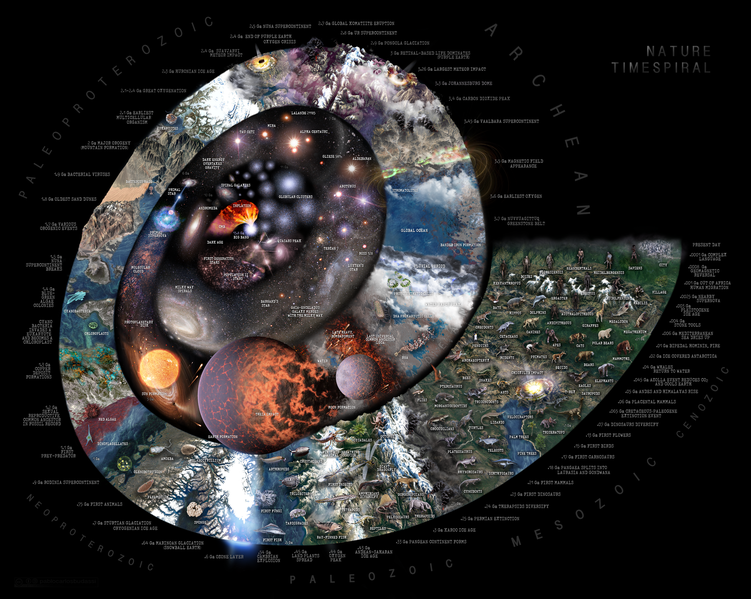
From between 15 billion and 4 billion years ago the world of cosmogenesis was characterized by a combination of dynamics governed by chance. This is the non-teleological way of the mass-energy universe of the Alpha God. It is a world of indifference where the conservation of energy is the rule in an isolated, granular world of entropy. For this mineral world, the past and future are one. Its existence is given, unchangeable, a priori and things work out according to the law of conservation of energy. This is the preliminary quivering of matter.
Organic-biological
In the life world, matter begins to interact in ways that combine chance and determined structures. They interact in ways that are first interdependent and eventually instinctive. Four billion years ago on this planet the biological universe appeared to be driven by the concentration of energy in which a Beta God operation through genes. There is both cooperation and competition in the biological world which operates unconsciously, instinctively and where time becomes irreversible. For the vegetative and animal worlds the present is all that matters and life is a process of the concentration of energy. Soleri writes that consciousness is like a membrane that stands at the interface between internal life and external life. It solves problems from without while regulating processes from within.
In the case of the social animals, technology begins to successfully make the universe into a working machine nested in the middle of the physical universe and the Omega God. It is an interiorization of the cosmos which starts with the partial interiorization of organic nature. It is life seen as the eye of the storm making matter into both society on one hand and mental life on the other.
Superorganic, socio-cultural, mental self-consciousness
Roughly two million years ago, we began to move into the hominid world of Homo habilis. This Gamma God’s cultural way is the human world. The past is the launching pad for practice performances according to humanity’s planning following the laws of incrementalism of energy. Here as in the biosphere world there are also the twins of cooperation and competition operating. But late in the Homo sapiens line there also emerges the realm of compassion. Humanity is the home of both unconscious and conscious effort, mental self-consciousness and what Soleri calls the “urban effect” (more on this soon). This city is at the center of the cyclone, the link between the super-organic local societies and the noosphere of planet earth.
Super consciousness, the Omega God
Finally, the Omega god involves what Chardin called the totalization of energy which involves a collective resurrection of energy filled with love, an asymptotic thrust ever moving closer to centripetal force as the universe keeps opening into an undetermined future. The bridge between the Alpha God of the sun and the Omega God of Christ consciousness is the slow struggle of matter transfiguring itself into fragments of God under the pressures of complexification, intensification, understanding, sensitization and miniaturization. This Omega God will not touch upon the total radiance of the divine through revelation but through creational genesis. Revelation does not give us a completed God, only a blueprint for his creation. Religion is not a revelation but a powerfully inspirited invention.
Continuing with his heretical Christian musings, cosmogenesis is the movement from the sun to the Son of God in Christ as the subject matter of evolution, the transformation of the raw and savage power of the sun first to the biosphere and the sociosphere. In the process more and more is packed into less and less, until the miniaturization process reaches its greatest level of what Chardin called complexification in the compactness of the human brain. From here social life first spreads around the globe and then onward to the colonization of space. See the table below for a summary of cosmogenesis from Alpha God to Omega God and everything in between.
Table 2 Levels in Nature According to the Omega Seed
| Time Frame | Type of way Type of God |
Type of universe Type of energy | Type of genesis | Characteristics | Involvement |
| Superconscious Noosphere Urban effectColonization of space |
Sacramental way Omega God |
Divine universe The totalization of energy |
Theo-genesis | Resurrectional Totalizing Loving Asymptotic |
Transcendent |
| 2 million years ago Superorganic |
Sociocultural way
Gamma God |
Human universe The integration of energy |
Homo-genesis | Social Cooperative Compassionate Mental Urban effect |
Self-conscious Planning Irreversibility in time |
| 4 billion Life? Organic |
Genetic way
Beta God |
The biological universe
(the concentration of energy) |
Bio-genesis | Social Cooperative Sensitive Selective Unconscious Instinctive |
Innocence Chance Determinism Irreversibility in time |
| 15 billion years ago
Physical Inorganic |
The random deterministic way
Alpha god |
Mass-energy universe (conservation of energy) |
Cosmo-genesis | Deterministic Insensitive Structural Predicable Chance? Entropic Segrative |
Indifference
Reversibility in time |
Urban Effect
One problem with the work of Teilhard de Chardin is that he has no spatial site or arena in which the noosphere or self-reflective consciousness complexifies and is grounded on planet Earth. The noosphere for him seems like it is an individual, spiritual experience which then seems to spread around the earth like dominoes. For Soleri it is the hot house of an ideal city in which the noosphere grows. It is in city architecture that is specifically where the setting for this superconscious emerges. Our Omega God could be reinvented the likeness of the city. After all, superconscious is super-social. There could be proto-conscious cities, where the dependence on matter because less and less measured by the bulk of physical material and more and more by arrangement and discrimination of moving information instead of moving mass. Architectural design of cities are the alternations made upon nature through the interaction of the organic, the sociological and mental. The surface of an arcology, a city would be a membrane, not a wall. The flat grid of our cities and the urban effect are irreconcilable.
Arcology as an ideal city is not an instrument for survival but an organism fertile with creations other than its original one. Sacred cities are not a house of God but a God-maker. Soleri writes we could be dealing with the new Jerusalem in a process of emergence. This is the urban human striving, what he calls “the urban effect”. The city is an extension of the human brain, into what is most complex in the known universe. It is intended, small (miniaturization) centripetal, expansive, conscious, and filled with love.
What Soleri’s urban effect is and isn’t
Arcosanti (what he calls the experimental city) is Soleri’s model at the epicenter on planet earth between super-organic local societies and the noosphere. Soleri insists that the city is not a commune or utopia. It is a design in process, interacting with real cities. It does not take as its model hippie communes that propose that individuals can break away from society. It attempts to experiment within the existing world to create seeds of a new society. This is a long-term journey into the infinite of the yet to be created. Soleri has no intention of trying to create paradise on earth because humanity has bigger fish to fry in outer space. It is not a place where enlightenment and happiness are achieved as if truth were something defined apriority and available for discovery. Arcosanti is using it as simply a launching pad for coordinating events in a novel way. Neither does Soleri want to position his project as the fringe as an ashram of salvation among the wreckage of humanity. It seeks to be a working model that might be influential in transforming the character of the present. It has no aspirations to “return to nature” nor advocate for a new tribalism. It supports breaking away from kinship to loving strangers as Christ is said to advocate in highly developed cities. Here are just a couple of the differences between Arcosanti and capitalist cities.
Enemies of the urban effect
Humanity can contribute to the Omega God on earth through the construction of ideal cities. What stands in the way are automobiles and gigantism.
Automobiles as the enemy of urban effect
Soleri argues that the automobile as it is now used is the single most destructive invention for the deterioration of urban life. It is a force of pollution and an expander of entropy. The car is the fulcrum of a whole series of divisive, brutalizing, wasteful energy-burning, noisy, segregating objects from -ridden city and the experience of it as enormous logistical breakdown of the super-loop freeways to the gas stations on a crossroad from the endless parking lots to the countless ribbon of semi-parked cars on the traffic-jammed highway. Soleri asks us to consider a car our technology and information. All this is crippling the physical structure of the cities themselves. Not only is an individual isolated within his pollution machine, but the automobile is a killer. It kills the city as a radiant information-learning milieu.
The monster of gigantism as the enemy of the urban effect
For many of the activities humanity performs there is a distinctive relationship between the objective of the activity and the size of objects. Hand tools are very much sized-defined. There are two kinds of size pathologies: gigantism and dwarfism. Soleri points out that the size of the hand shovel should be measured by the muscular capacity of humanity. The steam-shovel is geared to the per hour tonnage capacity. Gigantisms is mindless process driven by capitalist illogic of the making of objects which destroy the morphological congruence of an organism.
Gigantism does not refer to the absolute size of an object but to the relationship between size and performances. Soleri points out an ant 2 inches long would suffer from gigantism. The tall building is often a structure that got too tall by thoughtlessly add-ons, oblivious to the human activities it was once meant to house. There is a functional-morphological break between the organ – the tall building – and the organism. Here is an example. One of the benefits (however unconscious) of single or double storied houses on city streets is that people living in the house can look out or watch for suspicious activity on the street. Police were less needed because potential thieves or robbers knew they were being watched by house residents. But the building of high-rise apartments undermined that. Landlords may have made a fortune but the crime rates went up because people hundreds of feet above the ground are going to stop watching the street life below. The high-rise becomes not just an incomprehensible chaos of strangers who don’t know or care about each other but the building of indefensibility against robberies, especially planned ones.
A tree-limb cannot be designed apart from the trunk. The tree loses its life when divided. Now, huge megalopolitan buildings are like beasts sprawling all over the earth. In terms of thermodynamics they are spreading their energy equitably through space, approaching the heat-death of entropy. This fascination and fear with size plays out movies through monstrous insects or gigantic robot-insects with overpowering legs, terrorizing humanity. Remember the movie “Them” made in 1954? Gigantic instruments are exactly what life has successfully avoided through its own evolution up until the 20th century
Noosphere
Meanwhile as human societies slowly spread around the earth the urban effect of Arcosanti might create the beginning of a noosphere that Vernadsky and Chardin talked about into new envelopes of radiance around planet Earth. Our existence can be described as the reality of a membrane of consciousness interposed between two universes equally unknowable, the Alpha God and the Omega God. The outer universe is spatiotemporal and expanding. The inner world is complex, durational and imploding. Complexity moves from physical, atoms to galaxies; biological from viruses to hominids; social, from cell association to cities to the noosphere.
Colonization of Space
The urban effect is not tied to the Earth. In cultivating the virtue of hope we are making a process-oriented God in the making. We then release Arcosanti from the gravitation pull of the earth, by opening the cosmos to urbanization. It would be as if the earth were to be peeled off in successive skins, each containing an interiorized landscape (city-scape) of minimum physical bulk while spirally moving to the exhortation “do unto matter what you do unto yourself.” It is the space-city, as Isaac Asimov might say, which is to be sought as the next step. Life could not ever even conceive of leaving Earth before the appearance of self-reflective human consciousness. 150 thousands of years ago the first step towards leaving expressed itself in metaphorical religious form of an afterlife or spiritual worlds. But for Soleri, there is no access to full divinity without the concrete realization of noosphere to all corners of the universe. Soleri closes with an analogy between a rocket ship and a cathedral:
We could look upon the Apollo capsule as the seed of a cathedral. The seed around which life has consciously begun its journey into the extra-biological technology of complexification after a long journey of analysis-simplification. Even if involuntarily and only to put down roots outside itself indeed go outside the world and into a miniatured hardware of the capsule.
Taking Stock
One of my disappointments with the Omega Seed is that it lacks the explanatory power of Crisis by Nature which identifies the dynamic processes by which one level of nature is transformed by another. There is no description of resource depletion, population expansion and the accumulation of toxics as processes leading to emergent levels. Secondly, there is no analysis of how capitalism is responsible for both the expansion of cars and the growth of gigantisms in cities. Also, The Omega Seed is the work of one person. The article on the Russian cosmists was about a movement within Russian history that was 100 years in the making both before, during and after the Russian revolution. During its Marxist-Leninist phase the Russian cosmists had very detailed plans about how humanity was to intervene in outer space. There is not any detail like this in Soleri’s work.
So what does The Omega Seed have to offer that the other two books lack? Both Crisis by Nature and the Russian Slavophile (at least in its Marxist-Leninist phase) lack any kind of appeal to spirituality. This is a big gap given how important spirituality is to at least 90% of the population of humanity. However, the spirituality Soleri offers is not the kind most people in the world would identify with. He criticizes God the Father, the Alpha god. What he offers is a process theory of becoming. This might appeal to graduate students training to be ministers in liberal churches but it would never have mass appeal. However, liberation theology is a process theology based on Marxist work that once had a significant following in South America. It certainly would have appeal there.