




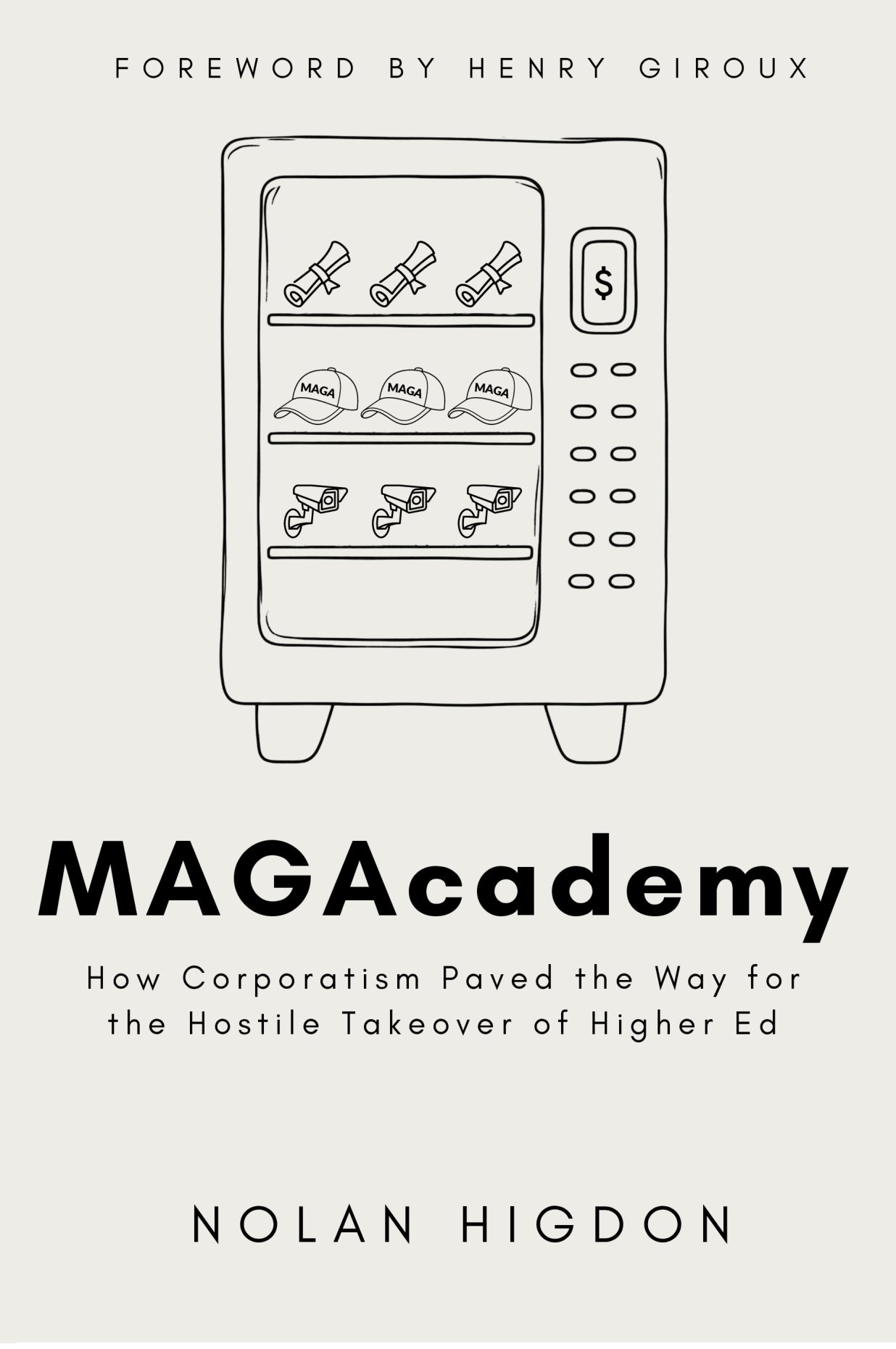
 Note: The following is an excerpt from the book MAGAcademy. By purchasing the book through Project Censored, proceeds go to support their work as a non-profit education and media literacy organization. Click Here to Purchase
“People can have a difference of opinion.” Farley, a gray-faced bureaucrat from the university’s labor relations office, repeated the phrase for what felt like the tenth time in a twenty-minute meeting. He looked like an archetype of “the administrator” that modern universities fetishize: an overweight white man in a wrinkled white button-down shirt, glasses slipping down his nose, exuding the confidence of someone whose most radical undergraduate reading was probably scribbled in Sharpie on a bathroom stall.
What gnawed at me wasn’t just the repetition, it was the categorical error. Farley was conflating opinion and argument, pretending they were interchangeable. Yes, people can have different opinions. But not every position is grounded in evidence, and not every perspective deserves equal weight. Not everyone has a compelling argument, as demonstrated by Farley.
What bothered me even more was that my training in a doctoral program for education managers had taught me the script that he was following: show up to “stakeholder” meetings, make faculty feel heard, but never actually listen, because faculty had little formal power. Farley was following the manual to the letter.
And here we were, the faculty labor representatives, meeting because the university had rolled out a new set of policies in response to student protests and encampments that were critical of U.S. support for Israeli attacks on civilians in Gaza after October 7, 2023. The policies were conveniently drawn up while faculty were on summer break, and the new draconian rules effectively outlawed protest on campus. Practiced by generations of graduate and undergraduate students and constitutionally protected, student expression is as varied as departmental majors.
Whether they are marches, sit-ins, vigils, or boycotts—celebratory or confrontational—their core purpose is to highlight glaring injustices and demand change. In the United States, the First Amendment explicitly protects the rights of students to protest by guaranteeing their freedoms of speech, assembly, and petition. Although governments, and by extension administrators, can regulate the time, place, and manner of protests in order to allow the expression of even unpopular views, restrictions on them are legally mandated to be content-neutral. Courts consistently uphold such protests as central to democratic self-governance, and banning or dispersing them is permitted only under conditions defined as “clear and present danger.” There are independent requirements that constitute such danger: one is the threat of serious harm that the government can prevent, and the other is a real and immediate danger.
To justify the new policies, campus administrators cited unsubstantiated claims about how faculty and students felt “discomfort” with the activism. Dense layers of new restrictions on timing, where events could take place, and how loud they could be, sadly had the predictable effect—meaningful protest would be nearly impossible. It was a classic administrative tactic: weaponize social-justice language about caring, and the campus community, to mask a bureaucratic process built to restrict rights and silence dissent.
It was the fall term of 2024, and the protests of the previous spring had shaken the nation. Footage of police in riot gear confronting students on college campuses was broadcast across major news channels and widely circulated across social media platforms. Establishment media and political pundits conflated student protests against the Israeli government with antisemitism, providing a rhetorical weapon for the incoming Trump administration. But that administration was still months away. The assaults on constitutional rights on college campuses were happening under the leadership of the president and political party most people in higher education seemed to support: Joe Biden and the Democratic Party.
Many of my colleagues accepted the prevailing propaganda about the activists and welcomed the crackdown on student and faculty rights. Their instinct to side with the Democratic Party and legacy news media’s narratives—no matter the cost to collective bargaining power or faculty freedoms—was already a well-established pathology.
The meeting with Farley unfolded over Zoom, now the standard videoconferencing platform for labor disputes. Faculty union members occupied one side of the screen, while the administrators, including Farley, sat on the other. I was tasked with pleading our case to defend the rights of our labor union, students, and faculty. There I was, reduced to begging an administrator to respect rights that should never be negotiable in a university setting. The absurdity of having to plead for free expression spoke volumes about how bureaucrats, administrators, faculty, students, and everyday citizens had collectively allowed the crisis in higher education to metastasize.
My arguments were straightforward: protect constitutional rights rather than police political debate. But nothing landed. Farley wasn’t there to consider policy; he was there to perform. I recognized the routine: nod gravely, feign thoughtful engagement, then walk away claiming, “We consulted with stakeholders and made the hard decision…” which always meant ignoring us.
And that’s exactly what happened. Across the country, campuses were tightening the screws: debates were censored, speech was restricted, peaceful assembly was banned, and even email communication about protests was prohibited under the auspices of fighting hate. Faculty and students alike were being steamrolled by increasingly authoritarian administrations. It is a bitter irony: the very administrators who championed social justice as a bulwark against Trumpism were developing the infrastructure he would eventually use to transform the university into the MAGAcademy.
The Gaza protests revealed just how far the system had deteriorated: students and faculty were punished for engaging in the very forms of activism universities once claimed to champion. Administrators leaned on narrow interpretations of laws and campus policies and manufactured public fear to silence dissent, while too many faculty chose career preservation over principle.
The U.S. support for Israeli operations in Gaza and the clampdown on campus protest were not the root causes of the crisis. They merely exposed it as an increasingly transparent political agenda. Decades of neoliberal restructuring had already hollowed out the public mission of higher education, weakened collective bargaining power, eroded shared governance, undermined academic freedom, and transformed students into customers, all while deprofessionalizing faculty. Yes, flashpoint moments like Gaza, Trump’s first election, and the Covid-19 pandemic accelerated these trends, but the decline had been underway for decades. All of this rot beneath the surface meant that when the real assault finally arrived, the system was too weak to withstand it. And the MAGAcademy was born.
Donald Trump’s second term brought a coordinated, systematic campaign to transform higher education into what I call the MAGAcademy. The “MAGAcademy” is more than a play on words—it is a description of a new reality. It captures how Trump’s “Make America Great Again” (MAGA) political movement reached beyond rhetoric to physically occupy the university, utilizing the infrastructure of neoliberal corporatism to install a new, authoritarian brand of campus life. Within weeks of returning to office in 2025, he issued sweeping executive orders banning diversity, equity, and inclusion (DEI) policies across all federal agencies, reversing Title IX protections for transgender students, and redefining sex strictly as male or female. Campuses were stripped of their “sensitive location” status, clearing the way for immigration raids and arrests. Federal agencies froze, canceled, or withdrew billions in grants and research contracts, most notably nearly $900 million from the Institute of Education Sciences, while the Office for Civil Rights was gutted and seven of its twelve regional branches eliminated. By October 2025, the White House had sent ultimatums to nine major universities demanding that they implement a list of ideological conditions in exchange for continued access to federal funds. It was an unprecedented attempt to force political conformity onto higher education.
When Trump took the reins again, he did not have to build a new apparatus of control; he simply weaponized the one the neoliberals left behind. Just as previous administrations used federal funding as a carrot to enforce identity policies, Trump used it as a stick to dismantle them. The neoliberal era normalized a culture of surveillance where people reported one another for bias; Trump merely incentivized reporting “anti-patriotism.” Neoliberals’ fetishization of corporate tech became Trump’s fetishization of AI, and the long-standing bureaucratic war on faculty unions provided the perfect infrastructure for mass funding cuts.
My goal in writing MAGAcademy is to hold up a mirror to the processes that proud anti-MAGA liberals engaged in that made this MAGAcademy possible. We cannot continue making the same mistakes and expect different results. The critiques within this book have been whispered in faculty lounges for decades; my aim is to place them in a broader context to show exactly how we built the MAGAcademy. Only by acknowledging the failures of the past can we hope to build a future for higher education that is worth defending.