

UPDATED on 12 August 2026.
The House Foreign Affairs Subcommittee on the Middle East, North Africa and Global Counterterrorism held a hearing on April 15, 2021, on “10 Years of War: Examining the Ongoing Conflict in Syria.” As is customary of American exceptionalism, the feasibility of regime change in Damascus was not left undiscussed.
Rep. Joe Wilson of South Carolina, who is the top Republican on the subcommittee, explicitly called for President Bashar al-Assad’s ouster. “The Assad regime is illegitimate and should be replaced,” said Wilson. Omar Alshogre, Director for Detainee Affairs at the Syrian Emergency Task Force, also remained uncompromising in his insistence on the overthrow of the government, saying the 2011 uprising in Syria was inspired by USA’s “democratic” tradition.
Fantasies of Regime Change
Continued talk about regime change in Syria is unmoored from reality. Those begging the US to overthrow the Assad regime with guns and bombs fail to see how the involvement of external powers has led to sheer devastation. Far from being “democratic”, USA has been fuelling a viciously sectarian war in Syria.
While initial periods of the 2011 uprising expressed the discontent of the Syrian people against Assad’s neoliberal authoritarianism, Euro-American interventionism soon gave a sectarian character to the rebellion. The Syrian Muslim Brotherhood played a significant role in the opposition’s political organization, including within the Syrian National Council (SNC), established in October 2011. Western governments subsequently treated the SNC as a principal representative of the opposition. Contemporary reporting described the council as an important channel through which outside governments sought to organize political opposition to Assad. These developments helped produce a movement whose political composition was far more complicated than the image of a unified democratic opposition suggested.
The relationship between the SNC and the Free Syrian Army (FSA) likewise linked political opposition to an armed insurgency. Aref Hammoud, a Turkey-based FSA commander, described the arrangement to the Wall Street Journal as a political wing represented by the SNC alongside a military wing represented by the FSA. The formulation itself belongs to Hammoud and is retained here as a direct quotation in the original sourcing. The wider point is that the opposition developed through overlapping political and military structures rather than through a single coherent organization.
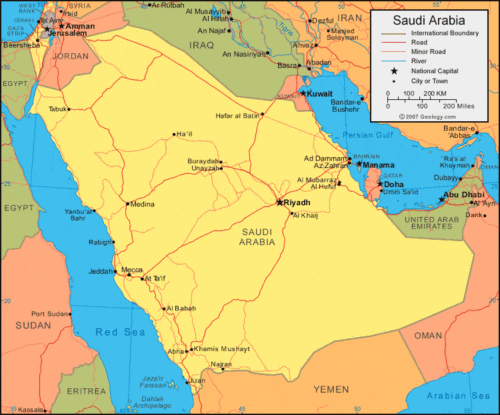
Funding from Gulf states became an important part of this opposition infrastructure. Molham al-Drobi, a senior SNC member associated with the Muslim Brotherhood, told the Wall Street Journal that Saudi Arabia, Qatar, Kuwait and the United Arab Emirates were providing substantial financial support to the council. Contemporary reporting placed the figure at approximately $40 million per month. The involvement of these monarchies created an obvious tension in the Western presentation of the Syrian opposition as a straightforward democratic project, given the political systems of the states supplying much of its external support.
The FSA was consequently a heterogeneous armed coalition whose political character varied across units. Contemporary reporting documented the presence of Islamist organizations and religious rhetoric within parts of the force, while other units presented themselves in more secular or nationalist terms. This composition made the Western label of “moderate rebels” analytically unstable. The available evidence points toward a fragmented insurgency containing groups with divergent ideological commitments, including factions influenced by the Muslim Brotherhood and groups with more explicitly Salafist orientations.
One example was the Tawheed Division, a major rebel formation active in Aleppo that maintained an Islamist orientation. Contemporary reporting also recorded religious language among some FSA commanders and recruits. Such evidence complicates attempts to describe the armed opposition as uniformly secular, even though individual units and commanders differed substantially.
As the conflict developed, the armed opposition became increasingly fragmented. ISIS, Jabhat al-Nusra and the Islamic Front emerged as major forces, while the factions initially presented in Western discourse as “moderate” struggled to establish an independent political and military strategy. Western governments subsequently attempted to distinguish selected rebel formations from jihadist organizations, often by changing the groups receiving external assistance or by presenting particular commanders as acceptable interlocutors. The result was a shifting landscape in which the category of “moderate opposition” frequently depended upon geopolitical alignment as much as upon the groups’ own ideological positions.
Reviving Jihadis
In February 2021, the US government media organization Public Broadcasting Service (PBS) conducted an interview with Abu Mohammad-al-Jolani, the head of Hayat Tahrir al-Sham (HTS), the latest among the name-changing jihadis the mainstream press still refers to as Syria’s “moderate opposition.” Martin Smith’s exchange with Jolani is a piece of a documentary on Jolani that PBS’ Frontline program plans to air in the future.
The HTS was formed in 2017 out of the remaining jihadi groups that had gathered in Idlib in 2015. The main pillar of the HTS is the al-Qaeda branch in Syria, the Jabhat Fateh al-Sham, and before that the Jabhat al-Nusra. The other groups that joined the Jabhat Fateh al-Sham to create the HTS include the four main omnibus jihadi groups: the Jabhat Ansar al-Din, the Jaysh al-Sunna, the Liwa al-Haq and the Haraka Nour al-Din al-Zenki. These are hardened groups of fighters, many of them coming in and out of each other’s platforms and even fighting each other viciously.
For the past several years, the HTS has tried to rebrand itself as “moderate”. In 2015, after it became the dominant force in Idlib, the outfit took on its new name and withdrew its pledge of allegiance to al-Qaeda. It claimed to be a Syrian nationalist force with an Islamic ideology. But this is merely a superficial change. It continues to propagate the view that the Syrian state must be based on Sharia law and the general orientation of the 100,000 to 200,000 “radical” fighters inside Idlib is towards al-Qaeda. This is something that is accepted even by the US government, which has otherwise used these fighters in its geopolitical games against the government in Damascus.
Jolani was once an Islamic State commander who went on to found Jabhat al-Nusra. The State Department declared Jolani a “specially designated global terrorist” in 2013. This designation still stands. Jolani now runs what he calls a “salvation government” in Idlib, the remaining retreat of Islamist extremists in northwestern Syria. He remains an Islamist theocrat determined to impose Sharia law on secular Syria, but he is committed to fighting Assad and so shares “common interests with the United States and the West,” as PBS puts it.
PBS’s attempt to legitimate Jolani was not a one-off. This was made clear on April 7, 2021, with the publication by the New York Times of an article by its Middle East correspondent Ben Hubbard based on an HTS-sponsored visit last month to Idlib. Comparing Jolani’s Islamist front favorably to the Islamic ISIS, Hubbard writes: “H.T.S. is not pushing for the immediate creation of an Islamic state and does not field morality police officers to enforce strict social codes.” He failed to mention the numerous cases of torture, violence, sexual abuse, arbitrary arrests, disappearances and the rest of the inexcusable stuff these groups get up to.
Efforts to portray the Jolani and the HTS as the new representative of “moderate rebels” in Syria are another PR ploy on the part of USA to continue its war in Syria. In an interview on March 8, 2021, James Jeffrey, who served as US ambassador under both Republican and Democrat administrations and most recently as special representative for Syria during the presidency of Donald Trump, has been quoted as saying that HTS has been an “an asset” to America’s strategy in Idlib. To quote Jeffery, “They [HTS] are the least bad option of the various options on Idlib, and Idlib is one of the most important places in Syria, which is one of the most important places right now in the Middle East.” USA will continue to revive jihadis as long as the Assad government remains in power.