





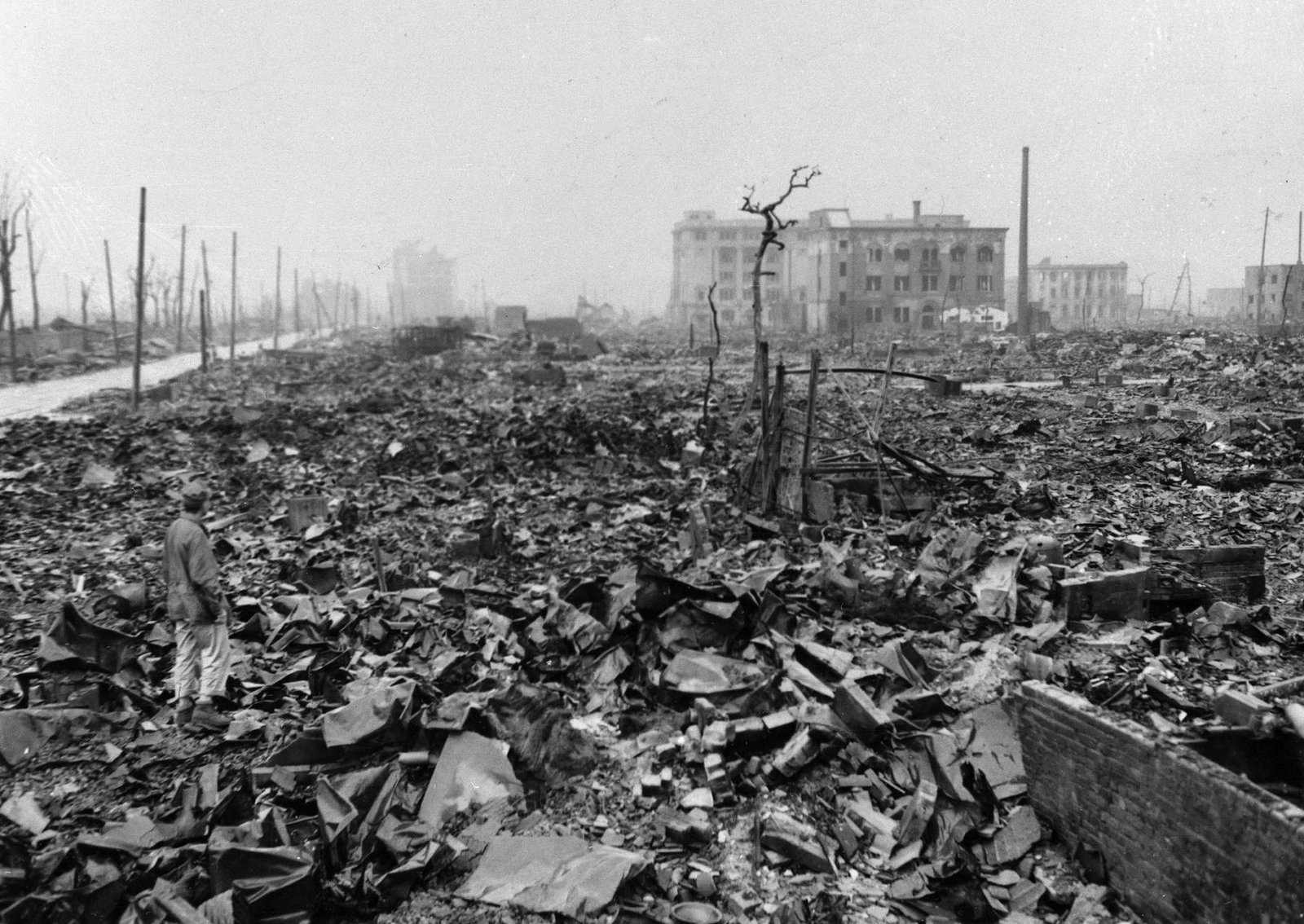
 The bombing of Hiroshima [image left] captured my imagination at a young age. I must have been around 11 or 12 when my mom (who was born in Japan) told me that the first time an atomic bomb was dropped was on my birthday. When I asked her why the US (my birth country) did so, she said that it was to end World War II. And when I asked her how World War II started, she said because of Japan’s attack of Pearl Harbor on December 7, 1942. I realized that our birthdays bookended the beginning and end of the war. I couldn’t believe it! What a coincidence!
As a school kid in the Netherlands, I always thought that Nazi Germany was the main enemy and the Holocaust of Jewish people was the most tragic event that ever happened. But as I learned more about what happened in Hiroshima, I wondered why the media and people around me didn’t talk more about the horrific destruction of this Japanese city. Wasn’t the atomic bomb the most powerful weapon of war ever invented? Didn’t it have the radioactive fire power to destroy the whole world? Then why didn’t Hiroshima (and Nagasaki) get the attention it deserved?
Unfortunately, my childhood curiosity about these questions waned when I went to a Dutch high school and later to a US university, where teachers decided what I should study. So, I was excited when Rusty and the Spokane Veterans for Peace invited me to speak here this evening, giving me a chance to learn more about what Hiroshima means in our world. Veterans for Peace is, in my view, one of the few local organizations that has continuously paid attention to nuclear energy and weapons since 1985. I also appreciate that veterans, who have personally experienced war, know best why ending war and building peace are vital for the world’s future. Yes, war is a racket!
I want to explore 3 major questions:
1) Why did most Americans justify dropping atomic bombs on Japan?
2) Why did they fail to empathize with Japanese victims and survivors?
3) How has the “hell of Hiroshima” led to today’s “genocide in Gaza”?
All these questions address how we see and pay attention to some things or events in the world, and not to others.
Q1: Why did most Americans justify dropping atomic bombs on Japan?
On August 6, 1945, after announcing that a bomb had been dropped on a Japanese Army base in Hiroshima, President Truman explained his decision:
The Japanese began the war from the air at Pearl Harbor. They have been repaid many times. And the end is not yet. With this bomb we have now added a new and revolutionary increase in destruction to supplement the growing power of our armed forces. In their present form these bombs are now in production, and even more powerful forms are in development.
It is an atomic bomb. It is a harnessing of the basic power of the universe. The force from which the sun draws its power has been loosed against those who brought war to the Far East.
In this statement, Truman indicates several key aspects of the US government’s official narrative: First, it emphasizes that the Japanese started the war and that the US has punished them with overwhelming force. Second, it is a revolutionary atomic bomb with unprecedented power to destroy, enhancing US supremacy in the world. And third, the US empire will keep improving and expanding the atomic bomb’s devastating force. Later in his announcement, Truman gives credit to the scientists that worked on the Manhattan Project and pressures Japan to accept unconditional surrender. He concludes by claiming to want to “spare the Japanese people from utter destruction” and to control the production and use of atomic bomb in the name of preserving world peace.
On August 7, Truman administration officials released statements and reports that called the bomb dropped on Hiroshima a “fabulous achievement,” a symbol of freedom, and a way to “save thousands of American lives,” who would have otherwise had to invade Japan and fight many more months. The US media relied completely on information provided by the US military, which rigorously controlled speakers, messages, and public opinion. Critical scientists and intellectuals tried to create a counter-narrative emphasizing the moral and political implications of the bomb for Americans, Japanese people, and the world’s future. But over time, the official narrative re-established itself by censoring unwelcome documents and hiding the full picture of how the atom bomb’s blast and radiation affected the hibakusha (survivors exposed to the bomb). The Truman administration also limited the impact of critical scientists by emphasizing the danger of atomic war to human life and publishing a letter by the US Secretary of War, stating the facts of decision-making and declaring that the number of lives saved was over 1 million. Again, the US media jumped on the bandwagon and stifled all significant dissent.
During the weeks after August 6, 1945, 85% of the US public favored the atomic bombing of Hiroshima and Nagasaki. In the following decades, as coverage of these apocalyptic events dwindled, US public support stabilized at a little over 50%. So why did most US authorities and citizens justify the bombing of Hiroshima and Nagasaki? One historical reason was racist propaganda to prepare the US public for war against Japan. US government and corporate media after the Pearl Harbor attack constantly portrayed the Japanese as animals and subhuman species in films, radio programs, and cartoons. They manufactured popular consent by stirring up old fears of the “Yellow Peril” and wartime hostility toward possible spies. This created a xenophobic environment producing much more anti-Japanese than anti-German hatred, leading to violent treatment of Japanese Americans and forced incarceration of 120,000 civilians in heavily guarded concentration camps. (If my mom had been born in the US before 1942, she could have been detained.). In short, US society had been primed to accept massive deaths in Japan, legitimating the atomic bomb as a weapon for ending World War II and saving American lives.
Another historical reason was (and still is) a widespread belief in the US empire’s exceptionalism, especially among white Americans. They shared an optimistic view of their country as fundamentally decent, freedom-loving, and progressive. They also believed that the US nation had a divine mission and manifest destiny to settle on American land from coast to coast, and to spread peace, democracy, and capitalism across the world. So, when advisors told President Truman that the best scientists in the nation were building a bomb “great enough to destroy the whole world,” he realized he could use it to force Japan to accept unconditional surrender. Although fully aware that the bomb was “the most terrible weapon ever known in human history,” he took for granted that only the US could wield it for a good cause. He recognized that Germany’s defeat in May 1945 meant that Japan would be defeated sooner or later. But he also appreciated the strategic benefits of using the atomic bomb to pressure Russia to meet American political demands after the war, ensuring the US empire’s global domination in the future. While the American people did not know the details of the US government’s decision-making process, they overwhelmingly supported the dropping of atomic bombs on Hiroshima and Nagasaki. For them, it meant that soldiers in Asia would come home as heroes, and that young people would not have to confront an early death by being drafted. Even the people’s historian Howard Zinn remembered being happy when he read the NYT headline on August 7: “First atomic bomb dropped on Japan.”
Q2: Why did they fail to empathize with Japanese victims and survivors?
While US government officials, scientists, and journalists debated the political and military implications of dropping nuclear bombs, they rarely paid attention to what would happen to Japanese civilians, consisting mostly of women and children. These opinion leaders clearly displayed selective empathy, which refers to the political and psychological biases causing people and societies to show compassion to some groups exposed to brutal violence while ignoring or denying compassion to others. Members of the Truman administration, for example, were empathetic to the suffering of Americans and their allies. But they withdrew all compassion for the humanity of the Japanese and (to a lesser extent) the Germans. Similar forms of selective empathy prevailed among most American people, although some African Americans empathized with the Japanese.
According to psychiatrist Robert Jay Lifton, selective empathy is a result of psychic numbing: a human mental process for blocking overwhelming emotions in the face of extreme catastrophe and future threats. He first discovered psychic numbing among Hiroshima hibakusha, who were forced to confront the unimaginable destruction and fall out caused by the atomic blast and radiation. While these survivors could feel strong empathy for friends and family, their capacity to care dropped in encounters with large groups of victims. Lifton later realized that perpetrators of immense evil—including those involved with the atomic bomb—could also experience psychic numbing to avoid experiencing or taking responsibility for the immorality of their actions. And even bystander audiences constantly exposed to news of atrocities, disasters, and threats often need to shut down their emotions to avoid feeling depressed or burnt out.
For example, Paul Tibbets, the B-52 pilot who dropped “Little Boy” (the name soldiers gave to the bomb) on Hiroshima, proudly displayed his psychic numbing in public, stating: “If you gave me the same circumstance, I would not hesitate. And I have never lost a night’s sleep.” And Director of the Manhattan Project, J. Robert Oppenheimer, was aware of his tragic role in developing the atomic bombs when he quoted the Bhagavad Gita: “Now, I am become Death, the destroyer of worlds.” But despite being conscious of his role in building the bomb that could extinguish humanity, he didn’t express remorse until after the B-52 dropped it. American resistance to psychic numbing in response to Hiroshima and Nagasaki did not begin to grow until Robert Hersey’s 1946 publication of Hiroshima in The New Yorker, which carefully narrated the stories and experiences of six survivors: Miss Toshiko Sasaki, pastor Kiyoshi Tanimoto, German priest Wilhelm Kleinsorge, Mrs. Hatsuyo Nakamura, and two Japanese doctors: Masakazu Fujii and Terufumi Sasaki.
It wasn’t until Hersey’s book that growing numbers of Americans began to address their psychic numbing and pay closer attention to the appalling human impact of the bomb’s blast and radiation. Let me share one of the stories that focuses on Dr. Sasaki, who devoted himself to caring for victims despite being the only uninjured doctor in his hospital:
After the explosion…, he went out into the corridor and began patching up the wounded patients and the doctors and nurses there. The people in the suffocating crowd inside the hospital wept and cried for Dr. Sasaki … and the less seriously wounded came and pulled at his sleeve and begged him to go to the aid of the worse wounded. Tugged here and there in his stockinged feet, bewildered by the numbers, staggered by so much raw flesh, Dr. Sasaki lost all sense of the profession and stopped working as a skillful surgeon and a sympathetic man; he became an automaton, mechanically wiping, daubing, winding, wiping, daubing, winding.
These scenes paint a picture of the incredible suffering of victims and incredible courage of Dr. Sasaki in the hospital. For him, psychic numbing was temporarily necessary to prevent as many patients as possible from dying. In the first ten days, the atomic blast caused most of the injuries and deaths, especially within a 2-mile radius of the hypocenter. After a few weeks, however, various radiation diseases began to appear. The fall out due to atomic radiation lasted for decades, causing cancer and other dreadful illnesses. Hersey writes:
The second stage set in ten or fifteen days after the bombing. Its first symptom was falling hair. Diarrhea and fever, which in some cases went as high as 106, came next. Twenty-five to thirty days after the explosion, blood disorders appeared: gums bled, the white-blood-cell count dropped sharply, and eruptions appeared on the skin and mucous membranes… The two key symptoms, on which the doctors came to base their prognosis, were fever and the lowered white-corpuscle count… Toward the end of the second stage, if the patient survived, anemia, or a drop in the red blood count, also set in.
The third stage was the reaction that came when the body struggled to compensate for its ills–when, for instance, the white count not only returned to normal but increased to much higher than normal levels. In this stage, many patients died of complications, such as infections in the chest cavity. Most burns healed with deep layers of pink, rubbery scar tissue, known as keloid tumors. The duration of the disease varied, depending on the patient’s constitution and the amount of radiation he had received. Some victims recovered in a week; with others the disease dragged on for months.
These brief glimpses of human suffering among Hiroshima hibakusha push us to attach to the humanity of Japanese people rather than detach from the pain in their eyes by allowing psychic numbing to take over. We can counter our psychic numbing by awakening our compassion and acting constructively, often after being shocked out of our complacency. We can try to heal from our moral blindness by refusing to “see no evil, hear no evil, speak no evil,” as portrayed by the 3 monkeys on the Tosho-gu shrine in Nikko, Japan.
How has the “hell of Hiroshima” led to today’s “genocide in Gaza”?
For us to fully pay attention to the historical conditions in our society that justified making and using humanity’s most destructive weapon, we need to face the brutal violence and mass murder that the US government—mostly with popular support—has committed in the world. If we don’t learn to see other people, other cultures, and other environments as part of one diverse humanity, then how can we truly say, “never again!” to dropping weapons of mass extinction. How can we say, “never again!” to nuclear energy disasters, to genocide of cities and countries, and to ecocide of living systems around the world? If we can’t learn from the “hell of Hiroshima,” how can we learn to stop and prevent another “genocide of Gaza”?
Robert Lifton argues that the US government’s decision-making on nuclear weapons before, during, and since Hiroshima has displayed a similar genocidal mentality as the Nazi regime. I propose that this genocidal mentality has also infected Israel’s government and population for the past 80 years. The latter systematically demonstrate selective empathy and psychic numbing toward Palestinians in Gaza and other occupied territories. They generally refuse to acknowledge Israel’s genocidal violence or show any compassion for Palestinian victims and survivors—who are predominantly women, children, and civilians. But what should concern us most urgently and directly is how the US empire’s genocidal mentality perpetuates and promotes Israel’s genocidal mentality—in the name of democracy, self-defense, and the right to exist. Both the US and Israel are producing dying social and ecological systems. Instead, we need to regenerate and nurture living systems!
Distant observers rely on abstract data and legal criteria to decide whether mass violence constitutes genocide. On-the-ground witnesses, in contrast, can see the total destruction of lifeworlds with their own eyes and hear the hibakusha testimonies with their own ears. Looking at photos taken by witnesses, we can immediately see that both Hiroshima and Gaza are reduced to rubble, making both places unlivable. Photos of injured and killed children represent the barbaric crimes against humanity in both cities. And photos of surviving parents show the suffering and desperation in their faces. Genocide is an experiential and existential matter, not an academic matter.
But genocide in Hiroshima/Nagasaki and Palestine involves more than destruction of populations, infrastructures, and human bodies. It also involves colonial systems of nationalism, capitalism, racism, and sexism that destroy ecosystems, cultures, and human well-being. Hiroshima was a portal for the world that emerged after 1945. Gaza is now a portal for the world in the future—a world that confronts human extinction more directly than ever. In the face of overwhelming planetary challenges, what choices can we make? What can we do to make small changes that consolidate into global healing and justice? How can we turn endless war into emerging peace?
Each of us must decide how to respond to these burning questions. I will conclude with several ways that we can make a difference, individually as well as communally.
1) Question authorities and popular opinion on catastrophes in the making
2) Expose cover-ups of governments justifying crimes against humanity
3) Learn from people on the frontlines: bombers, doctors, journalists
4) Study the people’s history of war and peace, oppression and liberation
5) Organize collective capacities to build alternatives and fight oppression
6) Turn psychic numbing of nationalism into compassion for all humans
Let’s walk out of dying systems of division and walk on to living systems of connection! Systems thinker Margaret Wheatley says it best:
Change always involves a dark night when everything falls apart. Yet if this period of dissolution is used to create new meaning, then chaos ends and new order emerges.