


A city councillor in Brantford, Ontario is at the center of a kerfuffle over his stance on land acknowledgments. In most jurisdictions in Canada it is common to begin many functions by acknowledging that the location is or historically was a territory of a First People or Peoples. This acknowledgment addresses the historic wrong of dispossession, an admission that the land, to the extent that land can be rightfully owned, belonged to the inhabitants that the ocean-crossing Europeans encountered.
Following several years of colonialism, a state called Canada was established usurping multiple Indigenous nations.
The colonialists and their progeny entrenched European-derived government structures and legal institutions. This meant that the official languages of Canada are English and French — not any of the Indigenous languages. While Canada is secular, early on the Christian Church had much sway over the populace and played a role in “civilizing” the Indigenous peoples by bringing them to the Christian God. Under government auspices, churches ran Indian Residential Schools that did much to extinguish Indigenous languages and culture. There is a Canadian anthem — the original 1880 lyrics were “O Canada! Land of our ancestors, Your brow is wreathed with a glorious crown,’ and is now replaced by “O Canada!, Our home and native land!” –, there is a coat-of-arms that celebrates the two founding nations (the English and the French), although educated people are aware that the European nations were founded on Indigenous nations.
As recently as 2009, a Canadian prime minister, Stephen Harper, denied that Canada had a history of colonialism. The land acknowledgment makes it known to Canadians that they reside on land that had already been occupied by peoples before Europeans and subsequent nationalities and ethnicities arrived in Canada.
*****
Brantford councillor Greg Martin had chaired the committee of the whole meeting on 2 June and was set to get to business when councillor Richard Carpenter spoke: “Point of order. I think you missed the land acknowledgment as part of the opening. Thank you.”
Martin said he had intentionally skipped the land acknowledgment, and the meeting proceeded.
It wasn’t unusual for the councillor. Martin had on 15 April stated, “I don’t believe in land acknowledgments. I think it’s virtue signalling. I don’t think it really means much of anything.”
Isn’t the question of whether a land acknowledgment “means much of anything” best decided by the people dispossessed rather than by the more recent comers to a territory?
Said Martin, “There’s no reciprocal acknowledgment. What about my treaty rights? They do nothing to acknowledge that some of the land was sold, some of the land was traded for services — they just say everything’s under claim. It has to be a two-way street and I don’t see that that’s happening right now.” [italics added] Martin had framed the land acknowledgment as a “they” versus him.
Colonialism is not a two-way street. Martin’s understanding of history and his logic is querulous. Is Martin saying the dispossessed must acknowledge the dispossessors? What are Martin’s claimed treaty rights that he feels are not adhered to? After all, the White Man has access to and control of the land and its resources.
*****
There is no one-size-fits-all land acknowledgment.
For instance, in the The Deh Cho First Nations Framework Agreement of May 2001, it is stated:
the Deh Cho First Nations of the Dene Nation assert that the Deh Cho territory has been their traditional territory since time immemorial; [italics added]
The usage of the word “traditional” could be taken to imply that at one time the land was the land of the Deh Cho First Nations but that present-day circumstances have altered the sovereignty over the land. The language can be construed to imply that sovereignty is historical and ongoing, but legally contested. Why not remove the wording “traditional” because it conveys an interpretation that something once was and might currently no longer be — that land theft can be grandfathered in by outsiders and that such theft and dispossession can be considered legal and even respectable. “Deh Cho territory has been their territory since time immemorial.”
Deh Cho First Nations indicate that their territory covers approximately 250,000 square kilometres across the Northwest Territories and portions of Yukon and British Columbia.
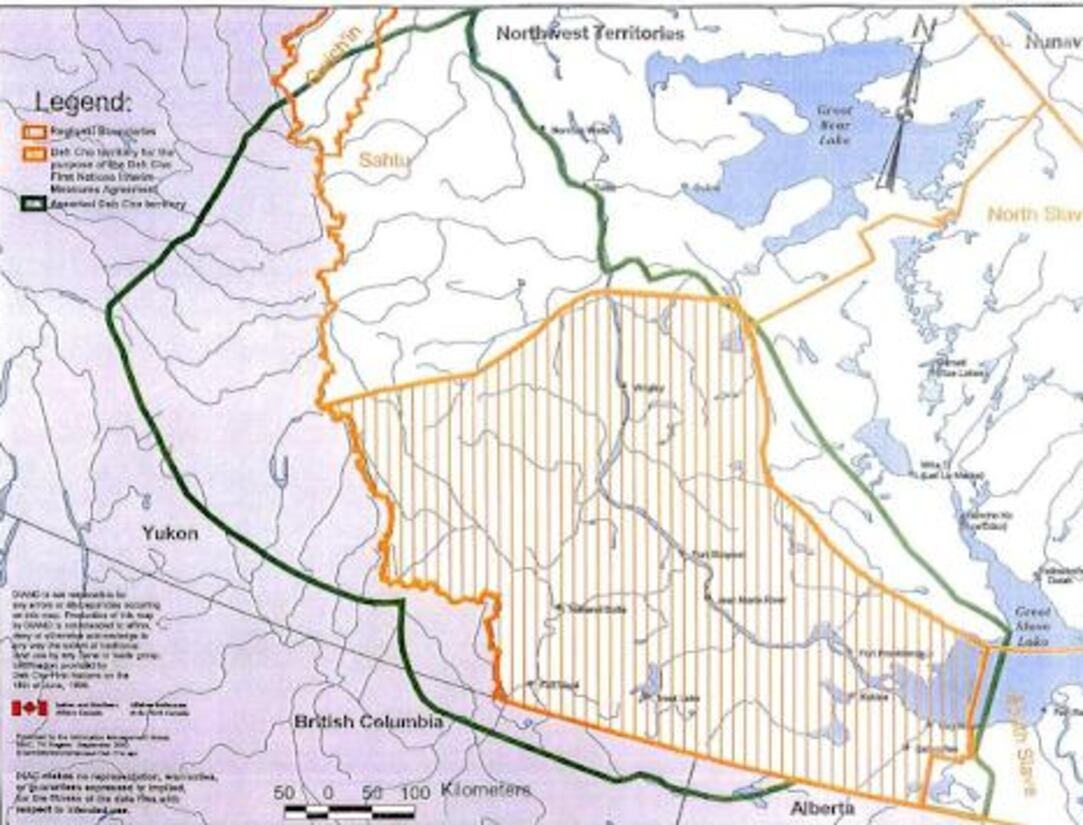 The Dehcho territory, outlined in green, spans approximately 250,000 square kilometres across the N.W.T. and extends into Yukon and British Columbia. The Dehcho have been in land negotiations with the federal government for more than 20 years. (Deh Cho First Nations)
Deh Cho First Nations sovereignty applies to the vast ancestral territory they have used since time immemorial. Nonetheless, this large area is currently under Canadian Crown sovereignty, divided into provinces, municipalities, and fee-simple private property; in other words, today, the Deh Cho First Nations do not have exclusive legal jurisdiction over all the claimed traditional territory.
CBC News posted an article on 17 December 2021 that captured the frustration of Deh Cho First Nations in the dragged-out negotiations:
Dehcho First Nations says it’s tired of waiting for the federal and territorial governments to recognize the Dehcho people’s authority over their land and resources — so it’s creating its own rules laying out how they can be used.
Once the code is implemented, “DFN will request that Canada and the [government of the Northwest Territories] acknowledge their jurisdiction over the lands and resources of their Territory and acknowledge that the Dehcho Land Code is paramount over any federal or territorial legislation,” read a Dec. 6 news release from DFN.
A “land acknowledgment” often seems so indistinct. It causes one to ask: is it not acknowledgement of control or stewardship (if not ownership) of the land? Do the people who speak the “land acknowledgements,” state it is the ancestral land of whichever First Nation, and that the land remains whichever First Nation’s land, and that First Nation law and governance rules the land? Have the Indigenous peoples been acknowledged as stewards/owners of the land (since Canada is a capitalist society and imposes the notion that land can belong to individuals, be sold, developed, fenced off, etc). When riot-gear clad RCMP toting rifles invade the unceded territory of the Wet’suwet’en and arrest elders to force a corporate pipeline through the land, what would a land acknowledgment mean? In the Wet’suwet’en case, there is certainly no virtue being signalled.
Deh Cho First Nations Declaration of Rights & Treaty 11 affirm,
We the Dene of the Dehcho have lived on our homeland according to our own laws and system of government since time immemorial.
Our homeland is comprised of the ancestral territories and waters of the Dehcho Dene. We were put here by the Creator as keepers of our waters and lands.
The Peace Treaties of 1899 and 1921 with the non-Dene recognize the inherent political rights and powers of the Dehcho First Nation. Only sovereign peoples can make treaties with each other. Therefore our aboriginal rights and titles and oral treaties cannot be extinguished by any Euro-Canadian government.
Our laws from the Creator do not allow us to cede, release, surrender or extinguish our inherent rights. The leadership of the Dehcho upholds the teachings of the Elders as the guiding principles of Dene government now and in the future.
Today we reaffirm, assert and exercise our inherent rights and powers to govern ourselves as a nation.
We the Dene of the Dehcho stand firm behind our First Nation government.
*****
As a moral principle, First Peoples should have the right to determine if a land acknowledgment is required, what wording is appropriate, and whether the land acknowledgment is respected in both word and deed.
- Acknowledgment: This article was inspired by Marco Katz Montiel’s poem “Land Acknowledgment.”